Solar Panel Savings & Payback UK 2026: What You'll Actually Get Back

Written and reviewed by Sepehr. See our editorial policy.
Solar panels in the UK have never been cheaper to install, and the ongoing savings have rarely been more compelling. If you just want the price tag, see our solar panel cost breakdown for 2026. This guide answers the question that actually decides whether solar is worth it: once you’ve paid £6,000–£10,000 for a typical 4–6 kWp system, what do you get back? We work through real self-consumption savings, Smart Export Guarantee income, battery economics and payback timelines, so you can judge the return honestly rather than just the sticker price. Solar is also one of the most powerful ways to cut electricity bills in the UK — this guide focuses on what it actually earns and saves you over time.
What a solar system costs by size
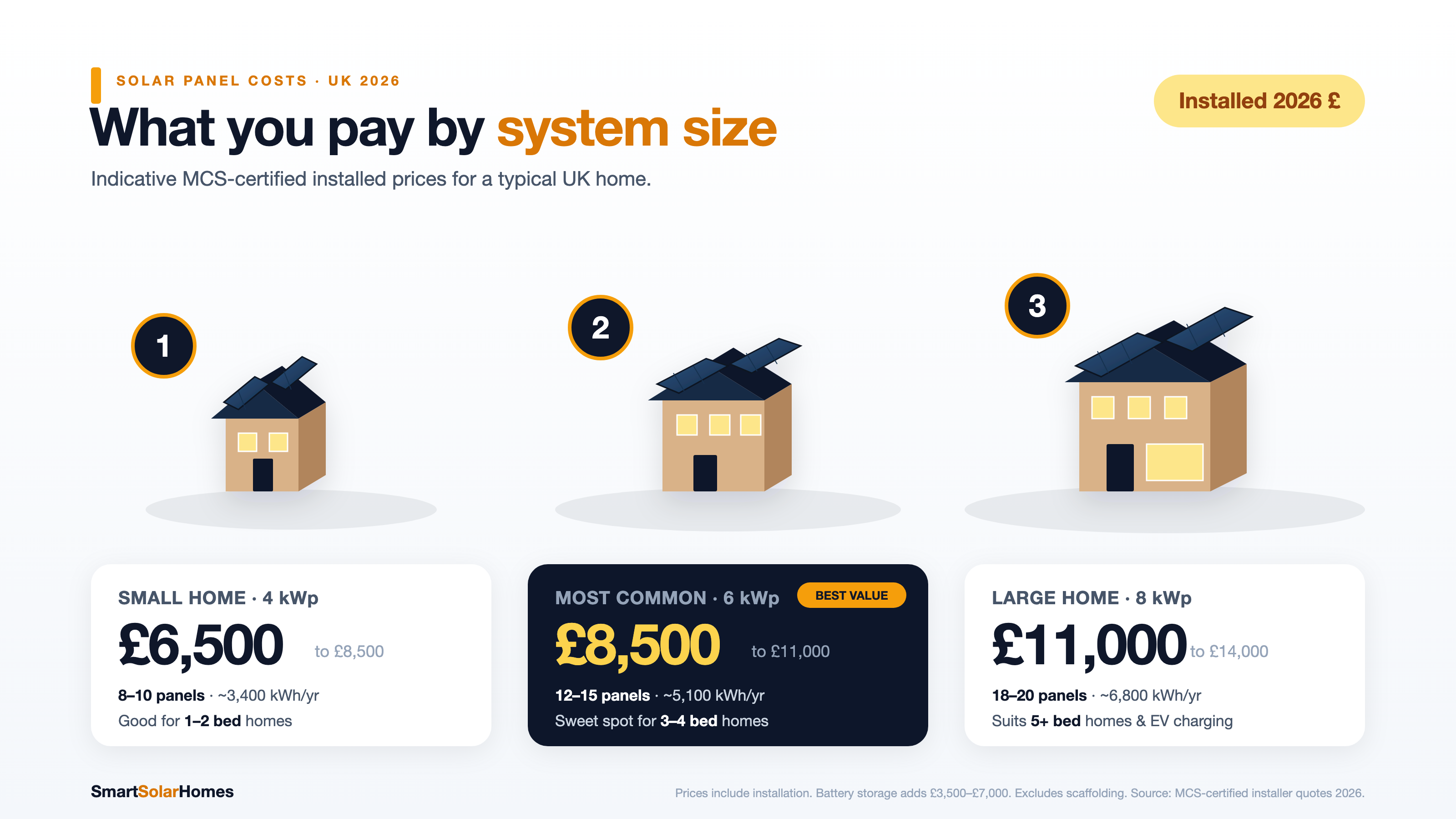
The most useful way to think about price is cost per kilowatt-peak (kWp) of capacity. Typical UK installers charge £1,500–£2,200 per kWp for a standard residential job. A quote below £1,400 /kWp warrants scrutiny — it may indicate cut-price panels, a rushed survey, or an installer cutting corners on mounting hardware. A quote above £2,500 /kWp needs clear justification, such as a complex slate roof or a listed building requiring specialist fixings.
- 4 kWp (10–12 panels, around 18m²): £6,000–£8,000. Suits a south-facing roof on a 3-bed house with moderate daytime use. Generates around 3,400–3,800 kWh per year in central England. See a full breakdown at solar panel cost by system size.
- 6 kWp (15–16 panels): £8,000–£12,000. Better match for a larger home, a household with an EV or a heat pump, or anyone wanting meaningful export income. Generates around 5,100–5,700 kWh per year.
- 8 kWp: Around £10,000–£15,000. Often requires a larger roof and sometimes a 3-phase supply check with your DNO. Generates roughly 6,800–7,600 kWh per year. Well suited to high-consumption households — particularly those running an EV and a heat pump simultaneously.
For a more detailed cost-per-size comparison including who each size suits, the full solar panel cost guide for 2026 covers additional variables including roof orientation and shading penalties. If you're unsure which size to specify, working out how many solar panels you actually need before requesting quotes gives you a much stronger negotiating position.
What drives the price up or down
Scaffolding adds £400–£800 to most jobs. It's not optional — Working at Height regulations require it for residential roofs — so treat it as a fixed cost. Quotes that omit scaffolding and add it later are a yellow flag.
Microinverters and power optimisers add £200–£600 to the total. They're worth considering if any part of your roof is shaded by a chimney, dormer, or neighbouring tree. On a fully unshaded south-facing roof they offer diminishing returns over a conventional string inverter.
Roof type matters more than most installers will volunteer. A concrete tile roof is the cheapest to work on. Slate roofs require more care and more labour time. Flat roofs need ballasted mounting frames rather than rail-and-clamp kits. Each adds £300–£800 in real terms. A flat roof is different again: panels sit on a ballasted frame and you pick the orientation yourself, which is its own decision — see flat roof solar panels.
Panel quality spans a wide range. Budget Tier 2 panels from less-established brands may underperform their rated output within a few years; Tier 1 panels from manufacturers with long track records tend to degrade more slowly and carry more credible 25-year performance warranties — our roundup of the best solar panels in the UK for 2026 picks out the models worth paying for. You can compare panel specifications at our solar panel product guide.
VAT and the zero-rate scheme
Since April 2022, installing solar panels has been zero-rated for VAT in Great Britain — that's 0% rather than the 5% reduced rate that applied to energy-saving materials before then (and well below the 20% standard rate). Crucially, this is not permanent: the 0% rate runs until 31 March 2027, after which it reverts to 5% from 1 April 2027 (HMRC guidance). On a £8,000 system, the 0% rate saves around £400 against the 5% rate it replaced (5% of £8,000); installing before April 2027 locks in that saving. Note Northern Ireland has different rules. The zero VAT scheme page explains which components qualify and what documentation your installer should provide.
What you actually save: self-consumption
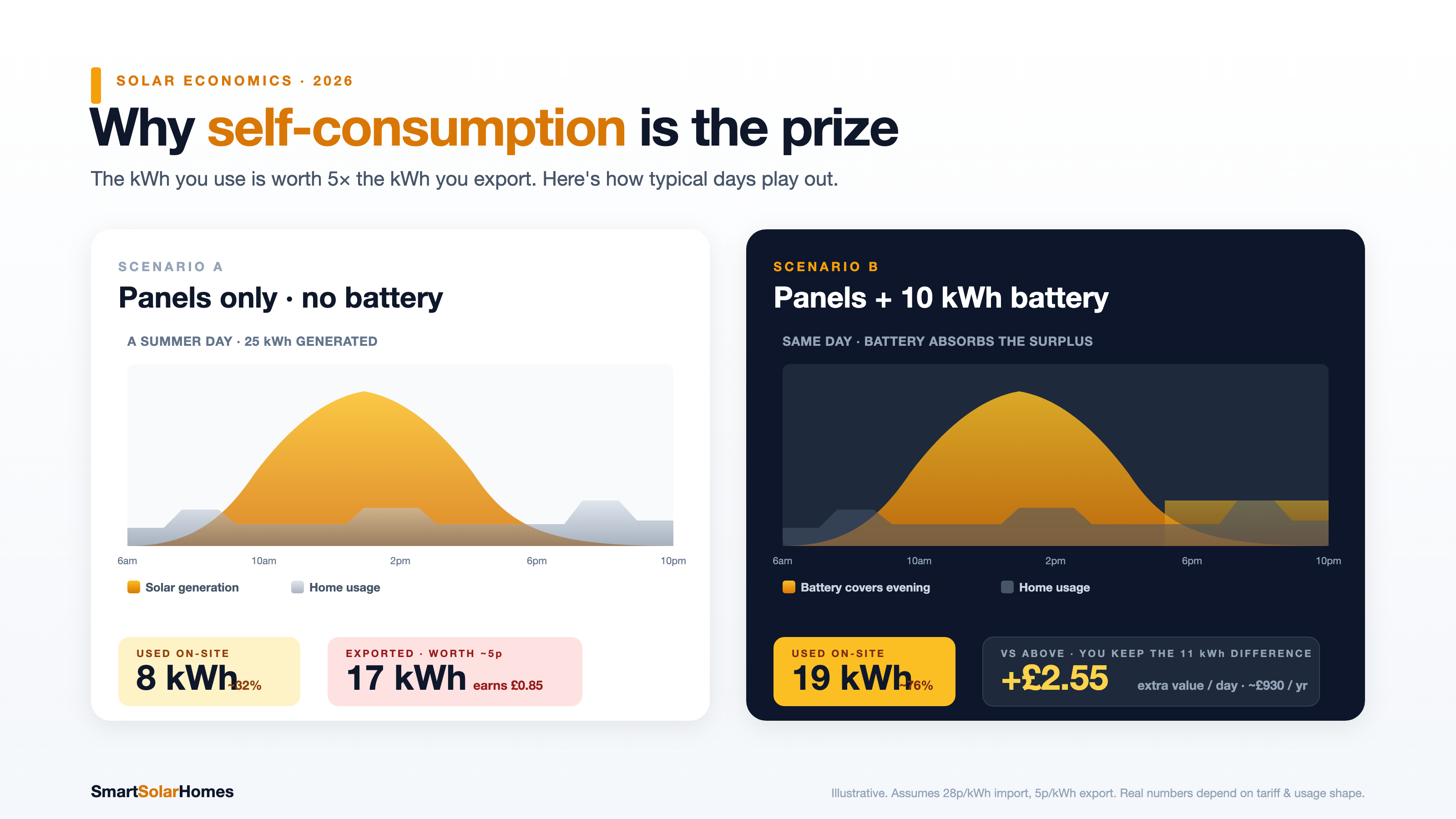
The key metric is not what your panels generate — it's how much of that generation you actually use yourself, avoiding grid import at around 24.7p per kWh under the current Ofgem energy price cap (Ofgem, cap for 1 Apr–30 Jun 2026). With UK energy bills among the highest in Europe, solar payback periods are shortening. Generation costs around 5–7p per kWh once amortised over a 25-year system life, so every kilowatt-hour you self-consume saves you roughly 18–20p compared to buying it from the grid.
Without a battery, households that are home during the day (retirees, home workers, families with young children) can self-consume 30–45% of their generation. Households that are out all day may manage only 20–30% without storage or smart controls — a solar-only home self-consumes around 30% of generation on average, rising to roughly 65% with a battery (Energy Saving Trust). With a battery, self-consumption typically rises to 55–70%, and can approach 80% on well-optimised systems. The home battery storage guide covers the economics in detail.
Understanding whether solar panels generate enough on overcast winter days is a common concern. The short answer is yes, but at reduced output — the full explanation is in do solar panels work in winter?. Scotland generates around 15–20% less per kWp per year than central England; the south coast generates slightly more.
The Smart Export Guarantee: your export income
Any electricity you don't use goes to the grid. Under the Smart Export Guarantee (SEG), your energy supplier must pay you for it. SEG rates are set by each supplier rather than regulated, so they vary widely — roughly 3–15p per kWh, with the best widely-available fixed tariffs around 12–15p and a representative figure of about 13p (Energy Saving Trust). A 4 kWp system without a battery, exporting perhaps 55–70% of its generation, earns roughly £200–£350 per year from SEG at that rate.
That export income still looks modest next to self-consumption, which is why self-consumption matters more than raw generation. Selling a kilowatt-hour at 13p is worth roughly half of not buying one at the ~24.7p import rate, and a lower-paying SEG tariff widens that gap further. Choosing the best-paying SEG tariff helps, but optimising self-consumption — through a battery, smart EV charging, or timed appliances — will almost always deliver a better return than chasing export rates.
Batteries: what they add to the maths
A 10 kWh battery adds roughly £4,500–£6,500 to a solar installation. The case for one rests on the gap between what you'd otherwise export (around 13p/kWh under a typical SEG tariff) and what you'd otherwise import from the grid (around 24.7p/kWh). By storing daytime surplus and discharging it in the evening, a battery captures that gap repeatedly. An EV further strengthens the case: an EV adds 2,000–3,500 kWh of annual consumption, creating more opportunity to use stored solar rather than grid power. The EV charging with solar guide covers how to size both together.
Adding a battery does not necessarily shorten your overall payback period — it depends entirely on your import/export pattern. It does, however, increase total lifetime savings on most households that are away during the day. Run the numbers specific to your situation using the what could you save calculator.
Payback and long-term return
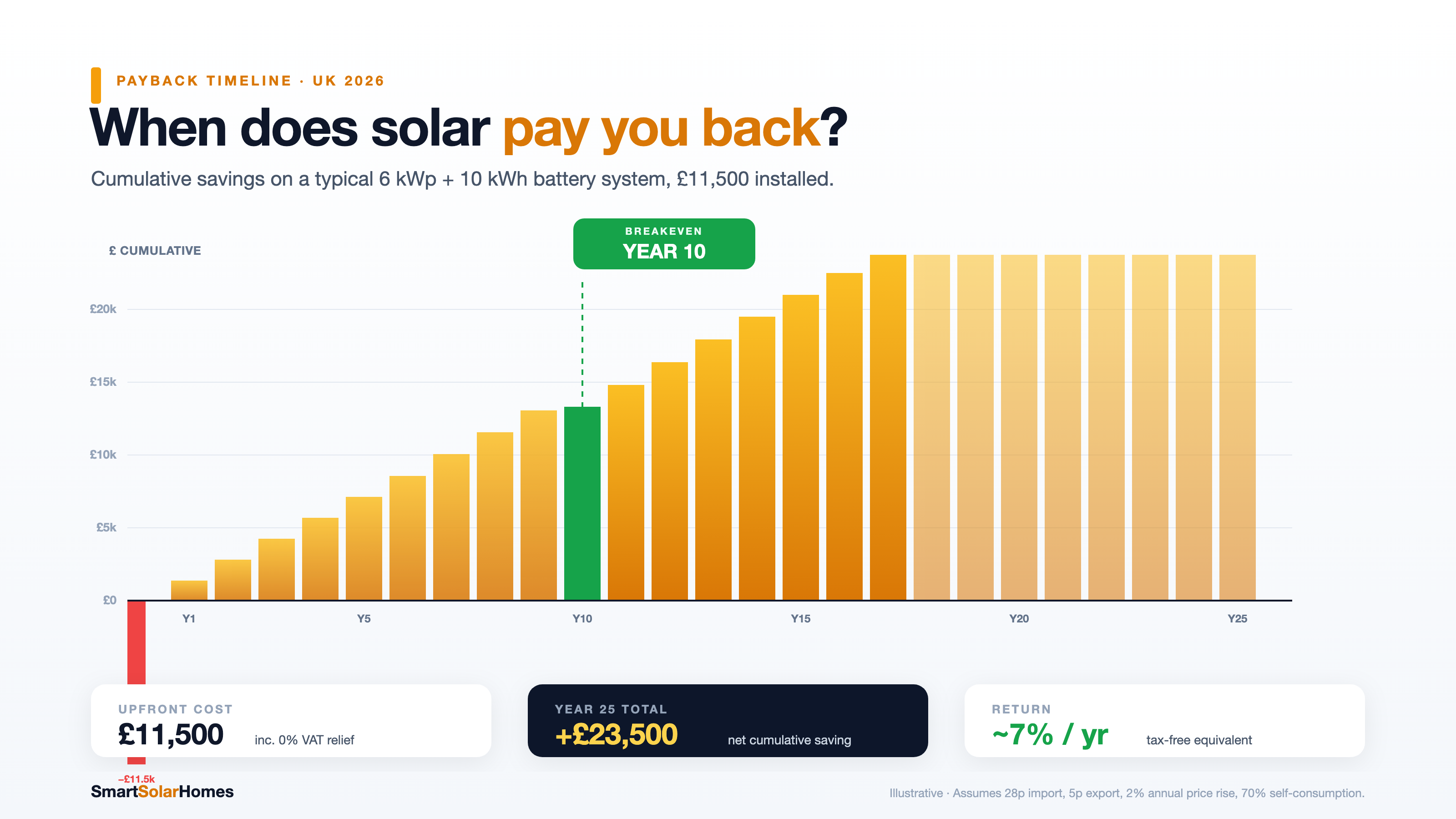
Payback for a solar-only system (no battery) typically falls in the 8–12 year range for UK households, depending on system size, self-consumption rate, local electricity tariffs, and SEG income. Adding a battery extends upfront cost and adds its own payback calculation, though the two systems interact — the battery makes the panels more valuable by raising self-consumption. A full worked example is in our payback period guide.
After payback, the panels continue generating for another 10–15 years or more (most reputable panels carry 25-year performance guarantees). The ongoing return at that point is essentially pure saving on bills, plus whatever SEG income accrues. The honest long-term picture is in are solar panels worth it in the UK? — including the circumstances where the case is weaker.
Red flags in installer quotes
A few patterns in quotes that consistently signal problems:
- Price below £1,400 per kWp with no explanation. Competitive pricing is real, but below this level it usually means Tier 3 panels, an underspecified inverter, or a very thin margin that may not survive a warranty call.
- Generation projections significantly above 950 kWh per kWp per year in the Midlands or North. 850–950 kWh/kWp is the realistic central England range; claims above this should be substantiated with shading analysis.
- Scaffolding presented as optional. It isn't. If an installer suggests otherwise, ask them to put their health and safety method statement in writing.
- No MCS certificate included in the quote. MCS certification is required for SEG eligibility. Non-MCS installations cannot register for export payments.
How self-consumption actually works day to day
A common misconception is that solar panels directly power your appliances. What actually happens is more indirect, as our explainer on how solar panels work sets out: your panels generate electricity which feeds into your home's main supply. When your home is using electricity, that solar generation is consumed first before the grid makes up any shortfall. When you're generating more than you need at that moment, the surplus flows out to the grid.
This means consumption timing matters enormously. A washing machine running at noon on a sunny day draws from your panels. The same machine running at 11pm draws entirely from the grid at full import price. Shifting high-draw appliances — dishwashers, washing machines, tumble dryers — to run during generation hours is the simplest and cheapest way to raise self-consumption without adding a battery. Some households manage an extra 5–10 percentage points of self-consumption simply by adjusting appliance schedules. Smart plugs with time schedules make this effortless.
For EV owners, the opportunity is even larger. An EV charger set to start at 10am on solar generation rather than 10pm on grid power captures the full ~24.7p-per-kWh import cost it avoids on each unit charged, rather than receiving around 13p for exporting it. A 7kW EV charger running for two hours at midday from solar surplus is worth significantly more than the same generation exported. The EV charging with solar guide explains the practical setup in detail, including smart charger compatibility.
Worked example: annual savings for a typical household
This illustration uses realistic mid-range assumptions rather than optimistic sales projections.
- System: 4 kWp, south-facing, central England. Annual generation around 3,600 kWh.
- Self-consumption: 40% (household home part of the day). Self-consumed: 1,440 kWh.
- Import saving: 1,440 kWh × 24.7p/kWh = £356/yr
- SEG export: 2,160 kWh × 13p/kWh = £281/yr
- Total annual benefit: around £637
- System cost: £7,000. Indicative payback: around 11 years.
Add a 10 kWh battery and self-consumption rises to perhaps 65%, changing the picture:
- Import saving: 2,340 kWh × 24.7p/kWh = £578/yr
- SEG export: 1,260 kWh × 13p/kWh = £164/yr
- Total annual benefit: around £742
- Combined cost: £7,000 + £5,500 battery = £12,500. Indicative payback: around 17 years.
The battery delivers more annual savings but spreads those savings across a larger investment. Whether it makes sense depends heavily on how much surplus the panels generate during the day and how much the household draws in the evenings. The what could you save calculator lets you run your own figures. The 24.7p/kWh import rate used above reflects the Ofgem price cap — see What Is the UK Energy Price Cap? How It Affects Your Solar Savings for how the cap is set and how changes to it flow through to your solar returns.
Available grants and schemes
The zero-rate VAT is the most universally available financial benefit — it applies to all domestic installations. Beyond that, the landscape of grants varies by region and household circumstance. The solar grants UK guide covers ECO4, the Great British Insulation Scheme, and local authority schemes that may further reduce the upfront cost for eligible households.
Where to go next
If you rent, live in a flat, or simply lack a suitable roof, plug-in balcony solar is a lower-cost entry point: 400–800W kits now have a clear UK regulatory framework following BS 7671 Amendment 4 (April 2026). For everyone else, if you're building up a complete picture before requesting quotes, the most useful next stops are the payback period guide for a worked financial example, cost by system size for a closer look at 4kW, 6kW and 8kW options, and home battery storage if you're weighing up whether to add storage. When you're ready to compare installers, get quotes from vetted MCS-certified installers in your area.
If you run a business from commercial premises, the economics can be even more compelling. Businesses with daytime electricity loads can self-consume 70–90% of generation, and the Annual Investment Allowance lets you write off the full installation cost against taxable profits in year one. Read our guide to commercial solar panels in the UK for a full breakdown of costs, payback periods and finance options for SMEs.
If you own rental property, the investment case has its own wrinkles: incoming EPC minimum standards, split-incentive issues between landlord and tenant, and upcoming legislative deadlines all shape whether the numbers work. Our solar panels for landlords UK: EPC rules and why the maths work guide walks through the full picture. Solar also has a concrete impact on your property’s EPC rating — typically adding 6–10 SAP points and often lifting a Band D home into Band C.
For homeowners prioritising reducing energy dependence rather than just cutting bills, see our guide to reducing energy dependence with solar.
Beyond bills, it's worth understanding the carbon footprint of solar panels — embodied carbon payback typically takes 1–4 years.
Installation costs vary by up to £1,200 depending on where you live — see our guide to how much solar costs in your region.
If installation isn't possible or affordable, community solar schemes let you invest in shared capacity and receive a proportional return.
For larger homes and small commercial installs, our guide covers 10kW solar system costs including battery pairing and G99 DNO requirements.
The most common UK system size is covered in our guide to 4kW solar system costs and output — the UK standard for a 3-bedroom home.
For homes with above-average consumption, see our dedicated guide to 5kW solar system costs and output.
For high-consumption homes or those adding an EV, our guide to the 6kW solar system covers costs, output, and who it suits.
For landowners and farmers, there are specific economic models to consider — read about solar for farms and agricultural use.
For larger industrial roofs, the economics differ substantially from residential — see our guide to commercial solar for industrial buildings.
For businesses and larger residential installs, solar asset finance options can make large systems cash-flow neutral from day one.
The economics of solar differ by region — see our dedicated guide to solar savings in Scotland.
JA Solar is one of the more affordable Tier 1 options — see our guide to JA Solar panel pricing in the context of a full system quote.
The UK solar market has grown rapidly — our UK solar installation statistics put the numbers in perspective.
The cost-benefit picture has two sides — our pros and cons guide gives an honest view of both.
For large homes and properties with high consumption, see our guide to 8kW solar system costs.
For smaller homes or those with limited roof space, see our guide to 3kW solar system costs and output.
Costs have fallen dramatically since the earliest solar cells — see our history of solar energy for how a technology that once cost thousands of dollars a watt became affordable enough for an ordinary UK roof.
You may see solar generation costs quoted as LCOE in industry and government reports — a grid-scale comparison metric, not the number to judge your own system by. Our LCOE explained guide unpacks what it means and why the figures above (installed cost and payback) are the ones that actually apply to a residential purchase.
FAQs
Does the size of my roof determine how many panels I can fit?
Broadly, yes. Each 400W panel requires around 1.8m². A 4 kWp system needs roughly 18m² of usable, unshaded roof space. Dormers, skylights, soil stacks and chimneys all reduce the available area. An on-site survey is the only reliable way to determine maximum capacity for your specific roof.
Can I add a battery later?
In most cases, yes — a hybrid inverter installed at the time of the solar array makes a later battery addition straightforward. A standard string inverter can sometimes be upgraded but may require an additional AC-coupled battery inverter. If you think you might want a battery within five years, it's worth specifying a battery-ready inverter from the start.
Is the payback really 8–12 years?
For a 4–6 kWp system on a south-facing roof for a household with reasonable daytime self-consumption, yes. Very high electricity users (EV plus heat pump), high self-consumption households, and those in the south of England may see payback closer to 8 years. Households with significant shading, a north-facing roof, or very low daytime occupancy may be closer to 12–14 years.
Sources — verified 5 June 2026
- Ofgem, “Changes to energy price cap between 1 April and 30 June 2026” — www.ofgem.gov.uk
- Energy Saving Trust, “Solar panels” — energysavingtrust.org.uk
- HMRC / GOV.UK, “VAT on energy-saving materials and heating equipment (Notice 708/6)” — www.gov.uk
- MCS, “Smart Export Guarantee — consumer eligibility” — mcscertified.com
- GOV.UK / DESNZ, “Warm Homes Plan” — www.gov.uk
- GOV.UK, “Energy Company Obligation (ECO4)” — www.gov.uk

About the author
Sepehr
Solar specialist & co-founder, Smart Solar Homes
Solar specialist and co-founder of Smart Solar Homes, which works with MCS-certified UK installer partners. I write all the guides and reviews here; the aim is straight-talking education the industry rarely provides.
Citing this page? Please use a dofollow link back to the original article — it helps us keep the data on this page accurate and up to date.
Browse Solar Panels on Smart Solar Homes


Want to compare these side by side? Use the compare tool →
Or browse all Solar Panels on Smart Solar Homes.
Related reading
More on solar panels from the editorial team.
Find installers near you
MCS-certified solar installers covering these areas.