3kW Solar System UK: Cost, Output and Is It Enough?

Written and reviewed by Sepehr. See our editorial policy.
A 3kW solar panel system is the smallest grid-tied array commonly installed on UK homes — compact enough for a terraced house with limited roof space, yet capable of covering a meaningful share of a small household's electricity needs. If you use under 2,500 kWh per year and have a south-facing (or near-south) roof clear of serious shading, a 3kW array may be all you need. This guide covers what you actually get: panel count, annual output by region, realistic installed cost in 2026, payback, and how it stacks up against the next size up.
How many panels does a 3kW system need?
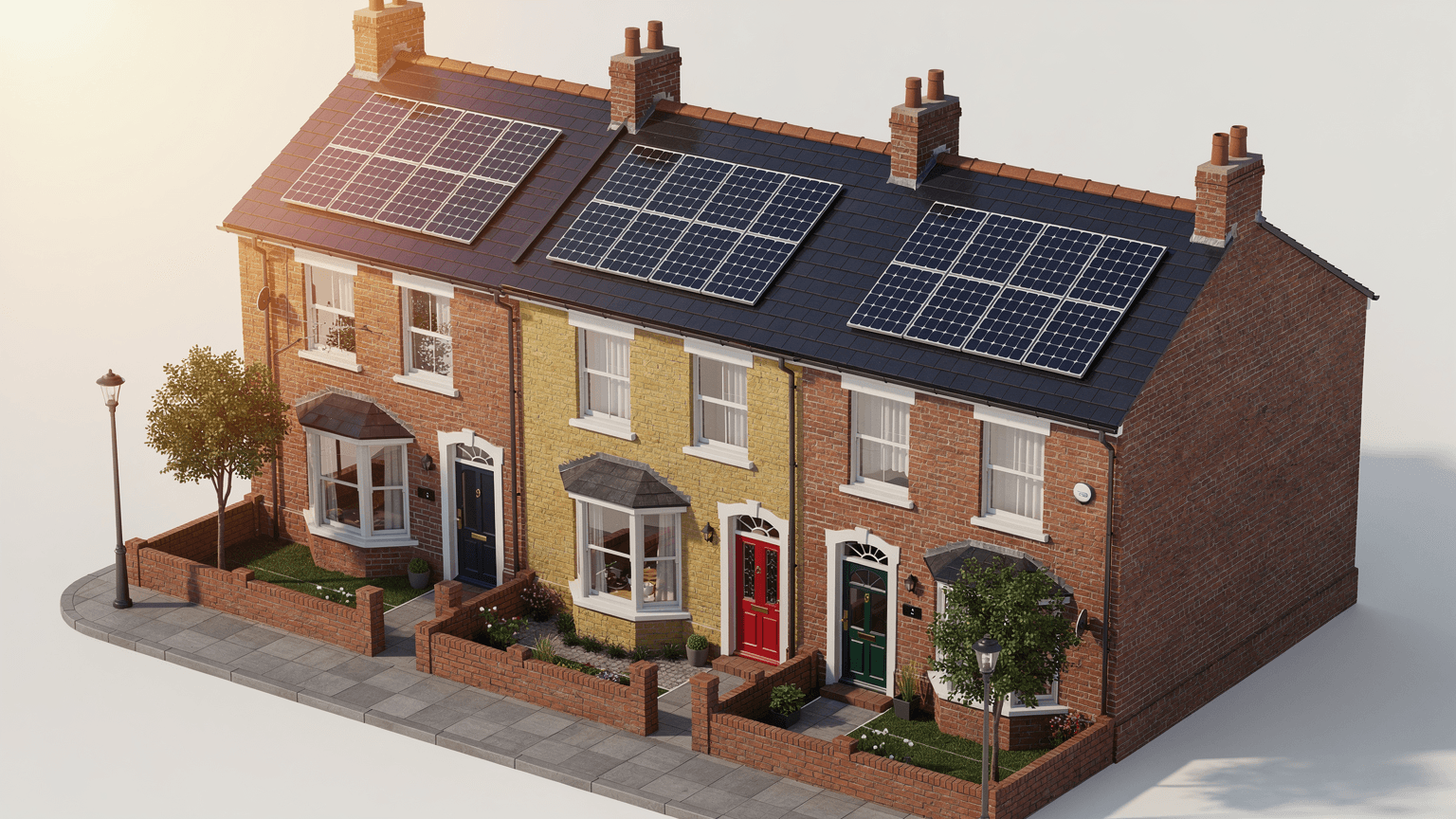
Typically 7–8 panels. Modern monocrystalline panels are rated at 375–425 W each, so a 3 kW (3,000 W) system works out to seven panels at 430 W or eight panels at 375 W. That footprint — roughly 12–15 m² of clear roof — is achievable on the back roof of most semi-detached and terraced houses. The exact count depends on the specific panels your installer specifies; always confirm roof measurements with an MCS-certified surveyor before signing a contract.
Annual output: what to expect across the UK
Output varies significantly by location. A 3 kW array in the south of England (London, Bristol, the South East) generates around 2,500–2,700 kWh per year under typical irradiance. The same system in the north of England or central Scotland can produce closer to 2,100–2,300 kWh annually, because the UK receives noticeably less solar irradiance at higher latitudes. These figures assume a south-facing roof at a tilt of around 35°, unshaded between 9 am and 3 pm.
Daily generation follows a strong seasonal pattern. In June and July a 3 kW system can produce 10–14 kWh on a clear day; in December it may generate only 1–2 kWh. For planning purposes, the annual average of around 2,400–2,600 kWh is a more useful figure than any single-day estimate. You can check site-specific estimates for free using the EU's PVGIS tool, which draws on satellite irradiance data for any UK postcode.
Who does a 3kW system suit?
Small households with modest consumption. Ofgem's current typical domestic consumption values put the average UK home at around 2,700 kWh of electricity per year, but smaller households — a single person or a couple without electric heating or an EV — often use 1,800–2,500 kWh annually. A 3 kW array generating 2,400–2,700 kWh can in theory cover 100% of such a household's demand on an annual basis, though the timing mismatch between solar generation (daytime) and domestic use (morning and evening) means you will still import some grid electricity.
A 3 kW system is not well suited to:
- Homes with an EV that charges at home regularly — the additional 1,500–3,000+ kWh a year for an average EV driver quickly outstrips what a 3 kW array can supply.
- Homes with an air source heat pump, which adds roughly 2,000–4,000 kWh per year to electricity demand.
- Three-bedroom-plus family homes with typical consumption above 3,000 kWh annually.
If you fall into any of those categories, a 4–6 kW system is likely to offer a better financial return. See our guide on how many solar panels you need for a fuller breakdown by household size.
3kW solar system cost in 2026
Typical installed price: £4,000–£6,500 including VAT. VAT on solar panel installations was cut to 0% in April 2022 and remains at 0% in 2026, so there is no additional VAT to pay on a domestic installation. The wide range reflects real variation in scaffolding requirements, panel brand and efficiency, inverter choice, and labour rates by region. London and the South East tend to sit at the top of the range; Northern England and Scotland often come in closer to the floor.
The government's solar PV cost data, published annually by DESNZ, confirms that residential system costs have continued to fall in real terms since 2010, though the rate of decline has slowed as the market matures. Getting three quotes from MCS-certified installers remains the most reliable way to establish fair market price for your specific property.
Payback period and savings
Payback of 7–11 years is typical, depending on your electricity tariff, self-consumption rate, and the export rate you receive under the Smart Export Guarantee (SEG). Here is how the sums broadly work for a 3 kW system generating 2,500 kWh per year:
- Self-consumed electricity saved: if you use roughly half the solar generation directly (1,250 kWh), and your unit rate is 24–26 p/kWh, that saves around £300–£325 per year.
- SEG export income: the remaining 1,250 kWh exported earns income at your SEG tariff. Ofgem's Year 5 SEG Annual Report (covering April 2024–March 2025) shows combined average tariffs of around 10.80 p/kWh; tied tariffs offered by some suppliers reached 15 p/kWh or above. At 10 p/kWh that is a further £125/year.
- Total annual benefit: roughly £425–£450 per year in this illustrative scenario.
Against an installed cost of say £5,000, that gives a simple payback of around 11 years. Higher self-consumption (achieved with a home battery or a solar diverter heating your hot water) shortens payback materially. Solar panels typically carry a 25-year output warranty, so there is a long tail of benefit once the system has paid back.
3kW vs 4kW: which should you choose?
Size up if your budget and roof allow. A 4 kW system adds roughly one panel (and around £500–£1,000 to the installation cost) but boosts annual generation by approximately 800–1,000 kWh. If your consumption is close to or above 2,700 kWh, the larger system usually offers better value per pound invested. The 3 kW size makes most sense when roof space is genuinely constrained — for example, a north-south split roof where only one slope can take panels, or a terraced property with a small south-facing section — or when your consumption is demonstrably low. If your roof is smaller still, see our 2kW solar system guide for when going even smaller makes sense.
Key questions to check before you buy
- Installer certification: always use an MCS-certified installer; it is required to claim SEG payments and is a condition of most manufacturer warranties.
- DNO notification: systems up to 3.68 kW (16 A per phase) can usually be notified to your Distribution Network Operator under G98 rather than requiring full approval — your installer handles this, but it is worth confirming.
- Planning permission: most residential solar installations are permitted development; a listed building or conservation area requires consent.
- Battery storage: adding a battery costs an extra £2,500–£5,000 but can increase self-consumption from around 30–40% to 60–80% of generation, improving payback speed.
FAQs
How many panels are in a 3kW solar system?
How much does a 3kW solar system cost in the UK?
How much electricity does a 3kW solar system produce per year?
Is a 3kW solar system enough for my home?
What is the payback period for a 3kW solar system?
Sources — verified 8 June 2026
- Ofgem — Average gas and electricity use explained (typical domestic consumption values) — www.ofgem.gov.uk
- Ofgem — Smart Export Guarantee Annual Report Year 5 (April 2024–March 2025) — www.ofgem.gov.uk
- DESNZ / GOV.UK — Solar photovoltaic (PV) cost data — www.gov.uk
- Energy Saving Trust — Solar panels: costs, savings and benefits explained — energysavingtrust.org.uk
- GOV.UK — Smart Export Guarantee: earn money for exporting renewable electricity — www.gov.uk

About the author
Sepehr
Solar specialist & co-founder, Smart Solar Homes
Solar specialist and co-founder of Smart Solar Homes, which works with MCS-certified UK installer partners. I write all the guides and reviews here; the aim is straight-talking education the industry rarely provides.
Citing this page? Please use a dofollow link back to the original article — it helps us keep the data on this page accurate and up to date.
Browse Solar Panels on Smart Solar Homes


Want to compare these side by side? Use the compare tool →
Or browse all Solar Panels on Smart Solar Homes.
Related reading
More on solar panels from the editorial team.
Find installers near you
MCS-certified solar installers covering these areas.