How Do Solar Panels Work? A Plain-English UK Guide

Written and reviewed by Sepehr. See our editorial policy.
If you are weighing up solar for your roof, it helps to understand the basics before you look at price lists or quotes. So how do solar panels work? In short, they turn daylight into electricity using a physical effect inside the panel, with no moving parts and no fuel. There is nothing burning, nothing spinning, and almost nothing to maintain. This guide explains the whole chain in plain English, from a single silicon cell up to the power feeding your kettle, and it sets honest expectations for how the technology behaves through a real British year.
How do solar panels work? The photovoltaic effect in plain English
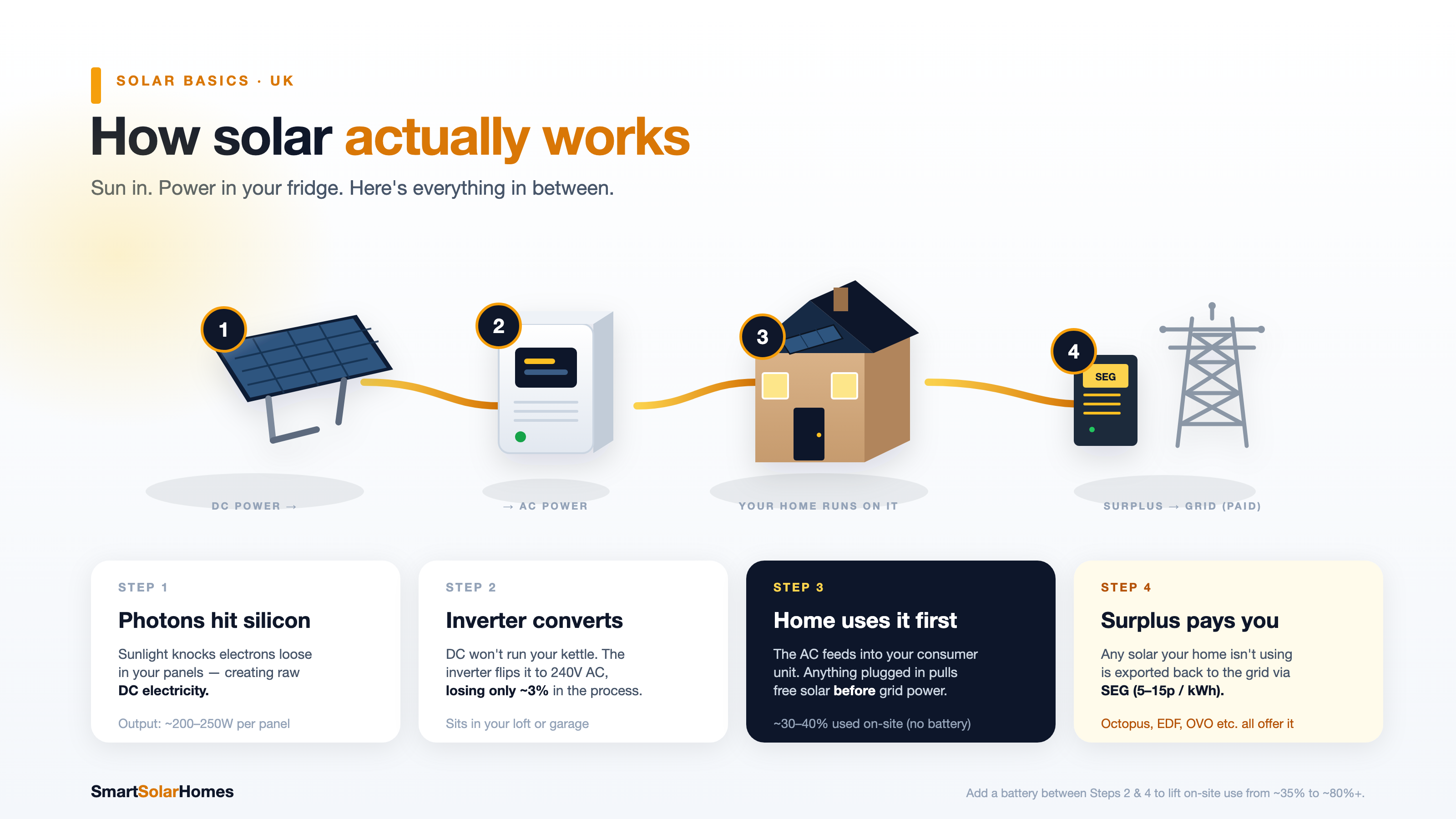
Solar panels work by converting daylight into electricity using the photovoltaic effect. Inside each panel, silicon cells absorb light, freeing electrons that flow as direct current (DC). An inverter then converts that DC into alternating current (AC) for your home. There are no moving parts, no fuel, and almost nothing to maintain.
The heart of every panel is the photovoltaic effect, which is a slightly grand name for a fairly simple idea. A solar cell is a thin wafer of silicon that has been treated so that one side is slightly positively charged and the other slightly negative. When daylight hits the cell, packets of light energy knock electrons loose inside the silicon. Because of the way the cell is built, those freed electrons all want to flow in the same direction, and that flow of electrons is an electric current.
No sunshine is being stored. The cell only produces power while light is actually landing on it. Brighter light means more electrons are freed and more current flows, which is why output rises and falls through the day as the sun moves and clouds pass over. It is direct, instant and undramatic, which is exactly what you want from something bolted to your roof for the next 25 years.
From cells to panels to an array
A single cell only produces a small voltage, so cells are wired together in series and sealed behind glass to make a panel (sometimes called a module). A typical residential panel today contains 54 to 72 cells and produces a few hundred watts in full sun. The cells themselves come in different grades, and the type you get affects how much power you squeeze out of each square metre of roof. If you want to go deeper on that, our explainer on solar panel cell types breaks down the trade-offs. For a focused comparison of the two silicon crystal structures that shaped the whole industry, see monocrystalline vs polycrystalline solar panels.
Several panels wired together form an array, which is just the full set on your roof working as one system. The number of panels you fit depends on your roof space, your electricity use and your budget. How efficiently each panel converts light into power matters here too, because a more efficient panel generates more from the same area; we cover that in solar panel efficiency explained. If you are trying to size a system, how many solar panels do I need in the UK walks through the sums, and you can browse current options on our solar panels page.
Turning DC into AC: the inverter
Here is the catch. Solar panels produce direct current (DC), the same kind of steady, one-direction electricity you get from a battery. But your home and the grid run on alternating current (AC), which rapidly switches direction many times a second. The two are not interchangeable, so you need a device to translate between them.
That device is the inverter, and it is the unsung workhorse of any system. It takes the DC coming off your array and converts it into clean AC at the right voltage and frequency for your sockets and the grid. There are a few different designs, from a single central inverter to small ones fitted under each panel, and each suits different roofs and shading situations. Our guide to solar inverter types explains which is which. The inverter is also typically the first component you might expect to replace during the life of the system, since it works hard every daylight hour.
Where the electricity actually goes
Once the inverter has produced usable AC, the power follows a simple order of priority, and understanding it is the key to understanding why solar saves money.
Self-consumption comes first. Any electricity your home needs at that moment is taken straight from the panels. If the kettle, fridge and router are drawing power while the sun is out, they use solar first. This is the most valuable kind of solar power, because every unit you use yourself is a unit you did not have to buy from your supplier.
Then the battery, if you have one. When your panels are producing more than the house is using, the surplus can charge a home battery. That stored energy is then available later, typically in the evening when the panels have stopped but you are cooking, watching television and putting the lights on. A battery is optional, but it raises how much of your own generation you actually use rather than exporting.
Finally, export. Any surplus left after the house and battery are satisfied flows back out to the grid through your meter. Under the Smart Export Guarantee, your supplier pays you a small amount per unit exported. A modern smart or export meter records this automatically, which is why a meter is part of a complete system even though it generates nothing itself. Self-used power is worth far more than exported power, so the goal is usually to use as much as you can on site.
Do solar panels work at night, on cloudy days, and in winter?
This is where honest expectations matter, so let us take the awkward questions head on.
Do solar panels work at night? No. There is no daylight, so there is no generation at all after dark. Panels do not store energy themselves. Anything you use overnight comes from a battery (if fitted and charged) or from the grid. Any product or salesperson suggesting otherwise is overselling.
Do solar panels work on cloudy days? Yes, just at reduced output. Panels respond to daylight, not only direct sunshine, so on an overcast day they still generate, often somewhere in the region of 10 to 25 percent of their bright-sky output depending on how thick the cloud is. You will notice the dip, but the system keeps ticking over rather than switching off.
What about winter? Output drops in winter because the days are shorter and the sun sits lower, so a UK system typically produces far less in December than in June. It does not stop, though, and cold weather itself is actually fine for panel performance. We go into the seasonal pattern in do solar panels work in winter in the UK.
How do solar panels work in the UK well enough to be worth it?
People often ask how do solar panels work in the UK, or simply search how do solar panels work UK, given our reputation for grey skies. It is a fair question. We do get less sunshine than Spain or California, so a UK array generates less over a year than the same kit would further south. But two things keep it firmly worthwhile. First, panels run on daylight rather than heat or blue sky, and the UK gets plenty of daylight across the year even if a lot of it is diffuse. Second, our electricity is expensive, so every unit you generate and use yourself offsets a relatively high price. The economics are driven as much by what you avoid buying as by raw sunshine hours.
The result is that a typical British home with a reasonably unshaded roof can cover a meaningful share of its annual electricity from solar, with the rest topped up from the grid. For a realistic look at the numbers behind that, see solar panel cost and savings.
What a typical home system is made of
Pulling it together, a standard UK home solar setup has just a handful of parts. The panels on the roof do the generating. The inverter converts their DC output into AC your home can use. An optional battery stores surplus for later instead of exporting it. And a smart meter measures what you import and export so you are billed and paid correctly. There is also the mounting and wiring that holds it all together, but those are the four components that decide how the system behaves day to day.
That is the whole story: light in at the panel, DC to AC at the inverter, then power used, stored or exported in that order. It is mature, low-maintenance technology, and the main decisions are about sizing and component choice rather than anything exotic. The same photovoltaic technology that powers your roof also underpins large-scale solar farms that feed electricity directly into the National Grid. When you are ready to see what your own roof could do, you can get quotes tailored to your home.
For a full carbon payback calculation, read our detailed look at the environmental impact of solar panels.
For context on the scale of solar adoption in the UK, see our UK solar adoption statistics.
Once you understand how solar works, it's worth weighing the solar panel advantages and disadvantages honestly.
Curious where the photovoltaic effect itself came from? Read our history of solar energy, from an 1839 laboratory discovery to today's UK rooftop boom.
FAQs
How do solar panels actually generate electricity?
Do solar panels work on cloudy days in the UK?
Do solar panels work at night?
Why do I need an inverter with solar panels?
What happens to solar electricity I do not use?
Sources — verified 8 June 2026
- Energy Saving Trust, "Solar panels" — energysavingtrust.org.uk
- MCS, "Consumer guide to solar panels" — mcscertified.com

About the author
Sepehr
Solar specialist & co-founder, Smart Solar Homes
Solar specialist and co-founder of Smart Solar Homes, which works with MCS-certified UK installer partners. I write all the guides and reviews here; the aim is straight-talking education the industry rarely provides.
Citing this page? Please use a dofollow link back to the original article — it helps us keep the data on this page accurate and up to date.
Browse Solar Panels on Smart Solar Homes


Want to compare these side by side? Use the compare tool →
Or browse all Solar Panels on Smart Solar Homes.
Related reading
More on solar panels from the editorial team.
Find installers near you
MCS-certified solar installers covering these areas.