Solar Panel Grants & Funding UK (2026): Every Scheme Explained

Written and reviewed by Sepehr. See our editorial policy.
Most people searching for a “solar panel grant” in 2026 are looking for something that no longer exists in the way they imagine. The old Feed-in Tariff, which paid a generation rate to every household that installed solar, closed to new applicants in April 2019. What replaced it is a patchwork of different support mechanisms — some are automatic, some are means-tested, and some are only available in certain parts of the UK. Understanding the difference matters, because it affects whether you end up with a realistic return on a solar investment or whether you've been misled by a company vague about what “government funding” actually means. This guide maps every form of support currently available, what each one is worth, and who genuinely qualifies.
The honest picture: what support looks like in 2026
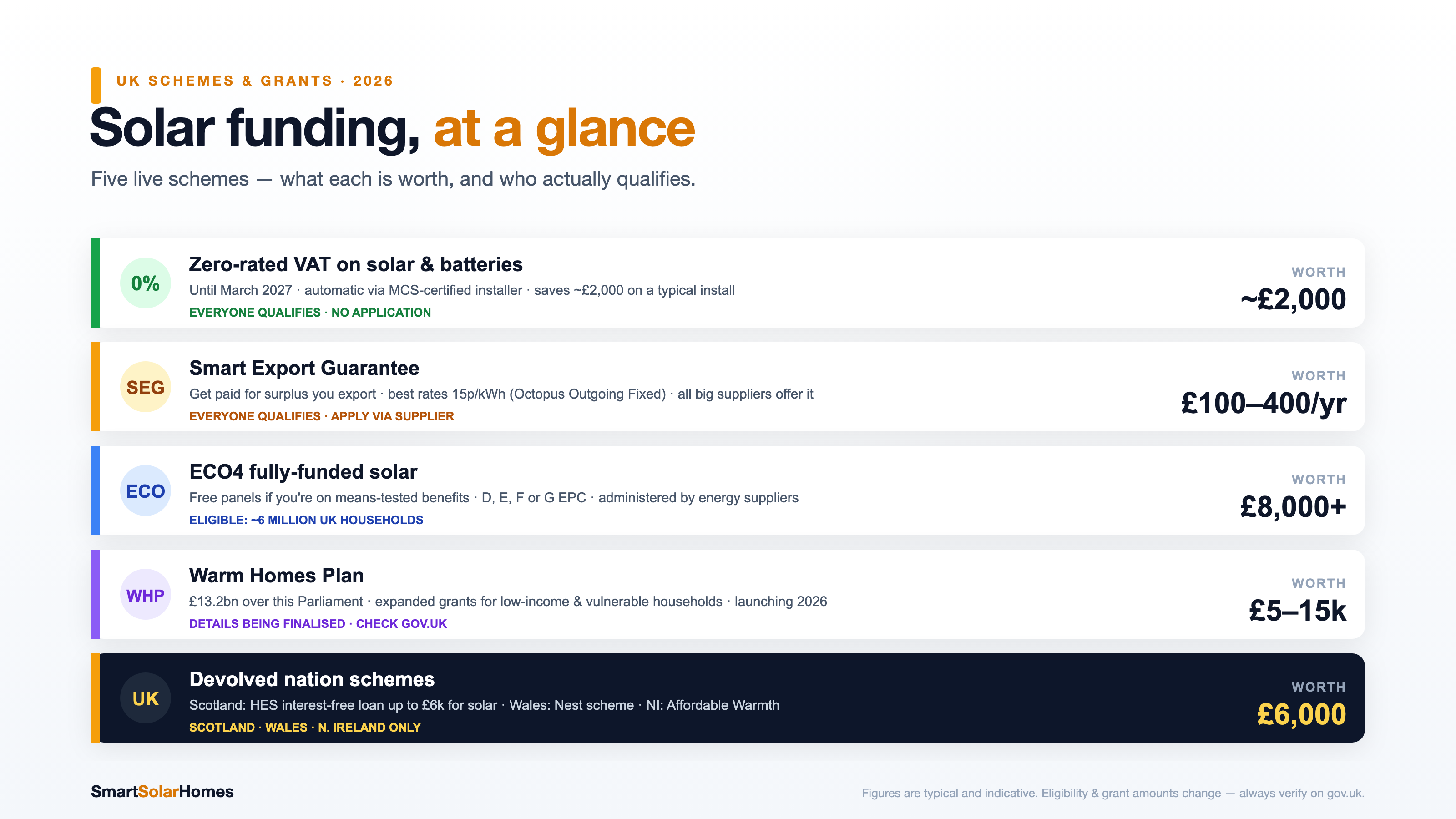
For most UK households, solar support in 2026 takes two forms: a VAT relief that reduces the upfront cost at the point of purchase, and an export tariff that pays you for surplus electricity you send to the grid. Neither of these is a grant in the traditional sense. There is no universal cash payment, no voucher scheme, and no middle-income solar grant scheme currently open. The households who can access something closer to a free install are those who meet the eligibility criteria of energy company funding programmes — which are genuinely valuable but not available to everyone.
For a complete list of every live UK scheme in one place, visit the schemes overview. The sections below explain each one in plain terms.
Zero-rated VAT: the most widely available benefit
The most straightforward form of support for most households is the 0% VAT rate on solar panels, battery storage, and solar thermal panels. Solar thermal systems — which heat water rather than generate electricity — are also zero-rated under the same relief. Before April 2022 these products attracted 5% VAT; a temporary zero-rate was introduced in Great Britain that year, and standalone batteries (storing electricity from the grid) were added from 1 February 2024. Crucially, this relief is temporary, not permanent: the 0% rate applies in Great Britain until 31 March 2027, after which it reverts to 5% VAT (source). You do not apply for it — any reputable installer will price their quote at 0% VAT as a matter of course.
The saving is the 5% VAT you would otherwise pay. On a typical 4kWp system costing roughly £6,000–£9,000 installed, that works out at around £300–£450 — useful, but modest. It is not a grant — you are still paying for the system — but it reduces the upfront outlay. If an installer quotes you with VAT included at a rate above 0%, ask them to clarify.
For a fuller explanation of what qualifies and the exact wording of the relief, see the zero-rated VAT scheme page. There is also a detailed breakdown in our guide to VAT relief for solar in 2026.
Smart Export Guarantee: earning from your surplus
The Smart Export Guarantee (SEG) replaced the export element of the old Feed-in Tariff. Under it, licensed electricity suppliers with at least 150,000 domestic customers are legally required to offer a tariff that pays above 0p/kWh for electricity you export to the grid (source). Ofgem sets no minimum rate beyond that — which means rates are supplier-set and vary considerably, typically in the range of around 3–15p/kWh, with the best widely-available tariffs around 12–15p/kWh, depending on the tariff you choose and when you apply.
To qualify you need an MCS-certified solar installation and a smart meter requirements for SEG. If you already have solar panels installed by an MCS-certified installer, you can apply for an SEG tariff with a supplier of your choice — you are not locked to your electricity supplier.
Because rates vary, comparing offers before you sign up makes a material difference to your long-run income. Our guide to the best SEG rates in 2026 covers the current tariff landscape in detail, and the full eligibility rules are on the Smart Export Guarantee scheme page.
ECO4: free or heavily subsidised solar for eligible households
The Energy Company Obligation (ECO4) is the scheme that generates most of the “free solar panels” headlines you will see. It is a government-mandated programme under which large energy suppliers fund energy-efficiency and low-carbon improvements in low-income and low-EPC-rated homes (source). Importantly, under ECO4 solar PV is funded only as a heating-related measure — for example alongside a heat pump, electric storage heaters or other electric heating — rather than as a standalone install, and homes on mains gas are generally not eligible for funded solar. The majority of ECO4 funding goes to insulation and heating system upgrades rather than solar specifically, so availability of solar under ECO4 is not guaranteed. ECO4 is currently due to close to new measures on 31 December 2026, with the Warm Homes Plan taking over thereafter.
Who is eligible depends on a combination of household income (typically linked to qualifying means-tested benefits), the property's EPC rating, and what a surveyor recommends as the most cost-effective measures for your home. If you meet the criteria, the installer's costs are covered by the energy company, and you pay little or nothing.
We do not publish a hard figure for ECO4 support here because the amount varies by property, measure and supplier — full details are on the ECO4 scheme page and in our ECO4 scheme explained: who qualifies and what you can get. If you think you may qualify, our article on free solar panel grants for low-income households explains the application process in plain terms. Octopus Energy participates in ECO4 as an obligated supplier — for a full picture of what they offer for solar, including their Trusted Partners installer network and export tariffs, see our Octopus Energy solar panels review.
Warm Homes Plan: the government's newer programme
The Warm Homes Plan is the current government's successor funding programme, covering a broader range of energy-efficiency and low-carbon measures for eligible homes. It is designed to sit alongside and eventually supersede the ECO framework from 2027, backed by around £15bn of government investment to upgrade up to 5 million homes (source). Details of eligibility thresholds, qualifying measures and how to apply are evolving — defer to the Warm Homes Plan scheme page for the most current information rather than relying on figures in any article, including this one. For a full breakdown of every delivery route, grant amounts and eligibility criteria, see our Warm Homes Plan complete guide.
“Free solar panels”: what that phrase actually means
Adverts for “free solar panels” are not a scam in themselves, but the phrase is often misleading. In practice, “free solar panels” almost always means an ECO4-funded or similarly eligibility-gated installation — not a universal offer available to any household that asks.
There is no scheme in 2026 under which a homeowner with a reasonable income and a well-insulated home can receive solar panels at no cost from the government. If a company tells you otherwise without naming a specific scheme, treat it as a red flag. Ask them to name the scheme, confirm your eligibility, and explain who pays the installer. A legitimate ECO4 referral company will give you clear answers to all three questions.
For a sober explanation of who actually qualifies and how the process works, read the free solar panels scheme page.
Scam warnings and red flags
The solar sector in the UK has attracted mis-selling, particularly around vague claims of government grants. The following are reliable warning signs that a company may not be operating honestly:
- Vague “government grant” language: If a company advertises a government grant for solar without specifying the scheme by name, ask them to name it. If they cannot, walk away. The legitimate schemes are ECO4, the Warm Homes Plan, and the devolved nation schemes described below. There is no unnamed universal grant.
- Pressure to act immediately: Any claim that a grant window is “closing this week” or that you need to book a survey today to secure funding is a high-pressure sales tactic. Legitimate schemes have published eligibility criteria and are not closed by individual companies booking calendars.
- No mention of eligibility conditions: Any genuine scheme has eligibility criteria. If a company tells you everyone qualifies, they are either wrong or misleading you.
- Upfront fees to “apply” for a grant: You should never pay an upfront fee to apply for ECO4 or any government-backed energy scheme. Referral and assessment are free.
Devolved nations: Scotland, Wales and Northern Ireland
Energy policy is partially devolved, and Scotland, Wales and Northern Ireland run their own funding programmes alongside the UK-wide ones. Scotland in particular has historically offered interest-free or low-interest loans for energy improvements through Home Energy Scotland — our guide to solar panel grants in Scotland covers these in full. Wales runs its own support through the Warm Homes Nest scheme, set out in our guide to solar panel grants in Wales. Northern Ireland operates within the Single Electricity Market and has its own distinct programmes — including NISEP and the Affordable Warmth scheme — detailed in our guide to solar panel grants Northern Ireland. These schemes have different eligibility criteria, funding levels and application processes from their English counterparts.
If you are in Scotland, Wales or Northern Ireland, check the devolved nation schemes page before assuming that the England-focused information elsewhere on this site applies to you in full.
The Boiler Upgrade Scheme: adjacent context
The Boiler Upgrade Scheme (BUS) is not a solar scheme, but it is often considered alongside solar because many households look at heat pumps and solar at the same time. The BUS currently offers £7,500 off an air-source heat pump installation (source). It is a separate application from any solar scheme and has its own eligibility and installer requirements. Mentioning it here because it can make a combined solar-and-heat-pump project look different financially from solar alone.
What is NOT available in 2026
It is worth being direct about what has gone. The Feed-in Tariff paid a guaranteed per-unit rate for all electricity generated, not just surplus exported. It closed to new applicants on 1 April 2019 (source). There is no equivalent universal generation payment for new solar installers today. The SEG pays only for electricity you export, and at a rate set by the market rather than a government guarantee.
There is also no universal middle-income solar grant. The VAT relief is available to everyone buying solar, but beyond that, direct financial support is means-tested or EPC-gated. Most households installing solar in 2026 fund it through savings, finance, or a mix of both, and recover the cost through reduced bills and SEG income rather than through any grant. It is also worth clearing up a common mix-up: Great British Energy (GB Energy), the publicly owned investment company, has funded rooftop solar for schools and the NHS and backed a UK solar-thermal manufacturer, but it does not offer a homeowner grant — see our GB Energy and solar panels explainer for what it actually funds.
How the maths really works without a grant
For a household that does not qualify for ECO4 or similar, the financial case for solar rests on bill savings and export income rather than upfront grants. A typical 4kWp system costs in the range of around £6,000–£9,000 after the zero-VAT saving. The payback period depends heavily on how much of your generation you self-consume, your daytime electricity use, and the SEG rate you secure.
Battery storage adds to the upfront cost but increases self-consumption — and battery hardware is also zero-rated for VAT. Running the numbers carefully before committing matters. Our guide to solar panel costs and savings covers typical payback periods, the impact of batteries, and how to estimate your own return.
If you want to understand your eligibility for any of the schemes above before getting installation quotes, the schemes overview is the right starting point. When you are ready to move forward, get quotes from MCS-certified installers to compare costs and see what the numbers look like for your property specifically.
Where to go next
The landscape of solar funding is patchwork rather than straightforward — VAT relief for most, export income through the SEG for anyone with MCS certification and a smart meter, and means-tested or EPC-based support for lower-income and less efficient homes. If you think you may qualify for ECO4 or the Warm Homes Plan, read our low-income grants guide first. If you are a typical homeowner weighing up whether to pay for solar outright, the cost and savings guide is the more relevant starting point. And when you're ready, you can compare quotes from vetted installers.
For households who don't qualify for grants, interest-free solar finance options can spread the cost without adding to the total.
If you are a business owner rather than a homeowner, the grants landscape is different again — UKSPF-backed local council grants, capital allowances, Salix Finance for the public sector, and devolved nation schemes are all in play. Our dedicated guide to business solar grants UK maps every route currently open in 2026.
If you own a rental property, the picture is different: EPC rules are tightening, and solar can improve a rating while cutting bills for tenants. Our guide to solar panels for landlords UK covers the EPC rules and why the maths work in detail.
FAQs
Can I still get a solar panel grant in the UK in 2026?
How much does the 0% VAT on solar panels save you?
Are 'free solar panels' offers a scam?
Do I need a smart meter and MCS certification to get paid for exported solar?
Is there any solar grant for middle-income households?
Sources — verified 5 June 2026
- HMRC / GOV.UK, “VAT on energy-saving materials and heating equipment (VAT Notice 708/6)” — www.gov.uk
- Ofgem, “Smart Export Guarantee (SEG)” — www.ofgem.gov.uk
- GOV.UK, “Energy Company Obligation (ECO)” — www.gov.uk
- GOV.UK / DESNZ, “Warm Homes Plan” — www.gov.uk
- GOV.UK, “Apply for the Boiler Upgrade Scheme: what you can get” — www.gov.uk
- Ofgem, “Feed-in Tariffs (FIT)” — www.ofgem.gov.uk
- Home Energy Scotland, “Home Energy Scotland Grant and Loan” — www.homeenergyscotland.org
- GOV.WALES, “Get free home energy efficiency improvements (Nest)” — www.gov.wales
- Energy Saving Trust, “Solar panels” — energysavingtrust.org.uk

About the author
Sepehr
Solar specialist & co-founder, Smart Solar Homes
Solar specialist and co-founder of Smart Solar Homes, which works with MCS-certified UK installer partners. I write all the guides and reviews here; the aim is straight-talking education the industry rarely provides.
Citing this page? Please use a dofollow link back to the original article — it helps us keep the data on this page accurate and up to date.
Browse Solar Panels on Smart Solar Homes


Want to compare these side by side? Use the compare tool →
Or browse all Solar Panels on Smart Solar Homes.
Related reading
More on solar panels from the editorial team.
Find installers near you
MCS-certified solar installers covering these areas.