What Is the UK Energy Price Cap? How It Affects Your Solar Savings

Written and reviewed by Sepehr. See our editorial policy.
Most households in Great Britain buy electricity and gas on a standard variable tariff — a deal that can move up or down whenever their supplier chooses. To stop suppliers profiteering during volatile wholesale markets, Ofgem introduced the energy price cap in January 2019. It does not cap your total bill; it caps the maximum unit rate and standing charge a supplier may levy on standard variable and default tariffs. Use more energy and you still pay more — but never at a rate higher than the cap allows.
How Ofgem Calculates the Cap
The cap is built from eight cost components. Ofgem models the full cost stack a “efficient supplier” would face and sets the cap to allow a reasonable but not excessive margin. The eight components are:
- Wholesale energy costs — what suppliers pay on commodity markets for gas and electricity. This is the single largest element, typically around 40% of a bill at the current cap level.
- Network costs — charges for using the transmission and distribution infrastructure that delivers energy to your home.
- Policy costs — levies that fund government schemes such as the Warm Homes Discount and the Contracts for Difference (CfD) scheme supporting renewable generation.
- Operating costs — metering, customer service, debt management, and the cost of running a retail energy business.
- Supplier earnings (EBIT) — a modest profit allowance to keep the market competitive.
- Headroom — a buffer for unexpected costs and market risks.
- Levelisation allowance — ensures consistent charges across different payment methods (Direct Debit, prepayment, standard credit).
- VAT — 5% applied to the final tariff.
Ofgem reviews these components and resets the cap every three months, publishing the new rates roughly six weeks before each quarter starts. Wholesale gas and electricity prices are the dominant driver: when spot and forward markets rise, the cap follows; when they fall, so does the cap.
You will sometimes see the phrase “LEBA adjustment” in Ofgem's technical documents. LEBA (the London Energy Broker's Association) provides the reference index for the forward-curve prices Ofgem uses when setting the wholesale cost element. It is essentially the data source, not a separate calculation method — the underlying logic remains the eight-component model described above.
Current Cap Rates: Q2 and Q3 2026
For Q2 2026 (1 April – 30 June), Ofgem set the cap at a typical annual bill of £1,641 for a household paying by Direct Debit. The average unit rates across Great Britain were:
- Electricity: 24.67p per kWh
- Gas: 5.74p per kWh
- Electricity standing charge: 57.2p per day
- Gas standing charge: 29.1p per day
On 27 May 2026, Ofgem confirmed that from 1 July 2026 (Q3) the cap rises by 13%, driven by higher wholesale gas prices linked to ongoing Middle East supply disruption. The updated Q3 2026 rates are:
- Electricity: 26.11p per kWh
- Gas: 7.33p per kWh
- Electricity standing charge: 57.19p per day
- Gas standing charge: 29.04p per day
Under updated Typical Domestic Consumption Values (TDCVs) — revised to reflect that households now use around 7% less electricity and 17% less gas than the previous baseline — the recalculated Q3 typical bill is £1,663 per year. Rates vary by region across the 14 distribution network areas in Great Britain, and also differ by payment method.
Ofgem confirmed the next reset on 26 August 2026: from 1 October to 31 December 2026 the cap rises a further 3.6% (rounded to 4%) to £1,723 a year, with electricity at 26.32p per kWh and gas at 7.97p per kWh. See our breakdown of what the October 2026 price cap rise means for solar households for the full unit-rate figures and how they interact with the concurrent electricity VAT cut.
Price Cap vs Fixed Tariff: What’s the Difference?
The cap protects standard variable tariff customers only. If you sign a fixed-rate deal with your supplier, that deal sits outside the cap — you lock in rates that could be above or below the prevailing cap, and your supplier is not obliged to reduce them if the cap falls mid-contract. Fixed tariffs suit customers who value certainty; the variable tariff under the cap suits those who want to benefit automatically when wholesale prices drop.
A common misconception is that the cap sets your maximum annual bill. It does not. Ofgem publishes a “typical household” figure purely as a benchmark, based on a household consuming 2,700 kWh of electricity and 11,500 kWh of gas per year (the 2026 TDCV). Large families or poorly insulated homes easily spend more; smaller households or those with heat pumps and solar panels can spend far less.
Business energy and heat-network customers are also outside the cap. If your flat is heated via a communal heat network, you are not protected by Ofgem's domestic cap — a separate framework applies.
How Solar Panels Reduce Your Exposure to the Cap
Every kilowatt-hour your solar array generates and your household consumes directly is a kilowatt-hour you do not buy from the grid at the capped rate. At Q3 2026's electricity rate of 26.11p per kWh, a 4 kWp system generating roughly 3,400 kWh per year and achieving 60% self-consumption saves approximately £530 per year in avoided grid purchases — a figure that climbs every time the cap rises.
This is the fundamental asymmetry solar owners enjoy: your cost of self-generated electricity stays close to zero (after payback) regardless of what the cap does. When wholesale gas prices spike and Ofgem lifts the cap, grid electricity customers absorb the full increase; solar households absorb only the fraction they still draw from the grid.
To understand the full economics — upfront system costs, payback periods, and long-run savings at different cap scenarios — read our detailed guide to solar panel costs and savings in the UK.
Battery Storage and Time-of-Use Tariffs
A battery system extends the solar advantage into evening and overnight hours. Solar panels generate most of their output between roughly 9 am and 5 pm, which does not always align with peak household consumption. A home battery stores surplus generation that would otherwise be exported to the grid at a far lower rate, letting you draw on your own cheap electrons during the costly early-evening peak.
Combining a battery with a time-of-use (TOU) tariff adds a further dimension. TOU tariffs, such as Octopus Agile, price electricity dynamically — rates change every 30 minutes and can drop to near zero (or even go negative on very windy or sunny days) overnight and at midday. A smart battery controller charges at cheap grid rates and discharges at peak rates, stacking savings on top of solar self-consumption. On a 5 kWp solar plus 16 kWh battery setup under an Agile-style tariff, estimated annual combined savings run to £1,800–£2,500 versus staying on a flat-rate plan with no solar or storage.
Crucially, TOU tariffs work alongside the price cap framework: the standard capped unit rate is still the “reference price” underpinning supplier pricing, but TOU tariffs can price individual half-hour slots below the cap when wholesale conditions allow. You benefit both from the cap's consumer protection floor and from the potential to buy cheap when renewables are abundant.
For a deeper look at battery sizing, payback, and the top units available in the UK, see our guide to home battery storage.
The Smart Export Guarantee and the Cap
Solar energy you don’t use yourself is exported to the grid. Under the Smart Export Guarantee (SEG), licensed suppliers with more than 150,000 customers must offer at least one export tariff, though the rate is set commercially rather than by Ofgem. Export rates in mid-2026 typically range from 4p to 15p per kWh depending on supplier and tariff type, well below the import rate of 26.11p under the Q3 cap.
This gap — between what you pay to import and what you receive to export — is precisely why maximising self-consumption (and storing surplus in a battery rather than exporting it cheaply) delivers the greatest financial return. Every unit exported earns you at best 15p; the same unit consumed directly avoids spending 26p. The maths firmly favours self-use first, storage second, export last.
For the latest SEG rates from every major supplier and how to switch to the best deal, read our guide to the best Smart Export Guarantee rates for 2026.
What to Watch: Future Cap Movements
Energy price forecasting is inherently uncertain, and Ofgem does not publish forward guidance on cap levels. Independent analysts such as Cornwall Insight and Octopus Energy publish quarterly predictions based on wholesale market forward curves, but these shift week to week with geopolitical events, storage levels, and weather.
What is more predictable is the structural direction: the UK government's 2030 clean power target requires a major build-out of wind, solar, and long-duration storage. As the grid's dependence on imported fossil gas falls, wholesale electricity prices should become less volatile and less correlated with gas. Solar owners are already positioned on the right side of that transition — their marginal cost of self-generated electricity is effectively zero, whatever the cap does.
For now, the Q3 2026 cap of 26.11p per kWh for electricity makes rooftop solar one of the most straightforward investments available to UK homeowners. The cap is the benchmark your solar system is beating every time the sun shines.
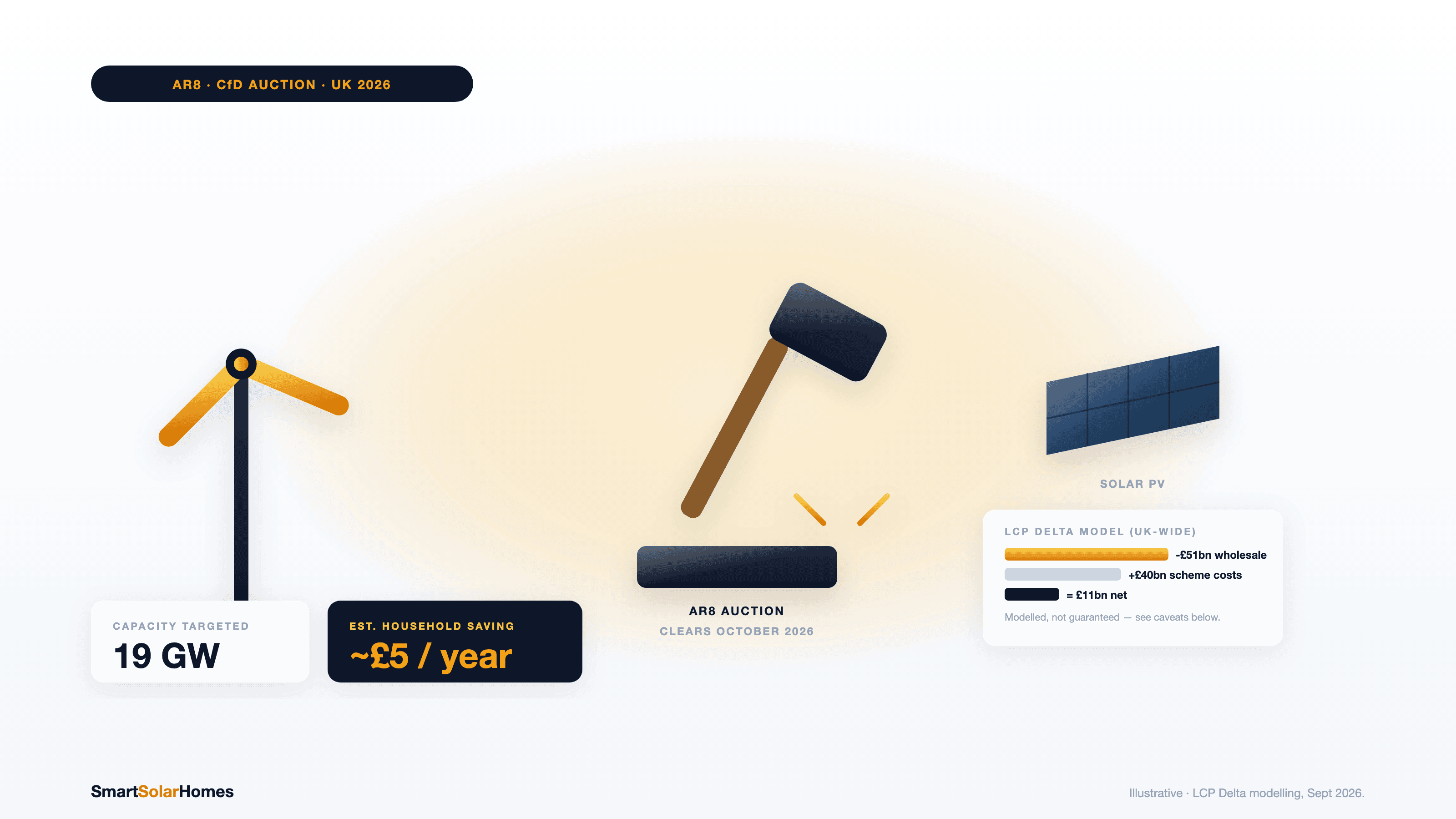
One upcoming auction could nudge that structural direction along: see our explainer on what the AR8 renewables auction means for your bill.
That case is landing with more households every quarter — government data shows installations climbing in every UK region, not just the sunniest ones.
One near-term shift worth knowing: VAT on domestic electricity is temporarily dropping from 5% to 0% between 1 October 2026 and 31 March 2027. See our breakdown of what the VAT cut on electricity bills actually means — including whether it changes solar payback.
To understand the deeper structural causes behind the numbers the cap tracks, see our guide on why UK energy bills are so high in the first place.
The most direct way to understand your bill exposure is by tracking your energy consumption at the appliance and circuit level.
The price cap affects specific line items on your bill — our guide walks through how to read your energy bill and what each line means.
FAQs
Does the energy price cap limit my total annual bill?
How often does the energy price cap change?
What is the Q3 2026 energy price cap rate?
Are fixed-rate tariffs covered by the price cap?
How much can solar panels save against the price cap?
Sources — verified 7 June 2026
- Ofgem — Energy price cap and standing charges explained — www.ofgem.gov.uk
- Ofgem — Energy price cap will rise by 13% from July (27 May 2026) — www.ofgem.gov.uk
- Ofgem — Changes to energy price cap between 1 July and 30 September 2026 — www.ofgem.gov.uk
- Ofgem — Changes to energy price cap Q1 2026 (historical Q2 baseline) — www.ofgem.gov.uk
- Ofgem — Energy price cap regulation page — www.ofgem.gov.uk

About the author
Sepehr
Solar specialist & co-founder, Smart Solar Homes
Solar specialist and co-founder of Smart Solar Homes, which works with MCS-certified UK installer partners. I write all the guides and reviews here; the aim is straight-talking education the industry rarely provides.
Citing this page? Please use a dofollow link back to the original article — it helps us keep the data on this page accurate and up to date.
Related reading
More from the Smart Solar Homes editorial team.
Find installers near you
MCS-certified solar installers covering these areas.