Do Solar Panels Work in Winter in the UK? What to Actually Expect

Written and reviewed by Sepehr. See our editorial policy.
Yes, solar panels work in winter in the UK. No, they do not work as well as in summer. The honest numbers are less dramatic than the pessimists suggest and less impressive than the optimists claim — and the difference matters less to the financial case for solar than most people assume, because the bulk of the annual payback comes from the April-to-September period anyway.
The actual output difference
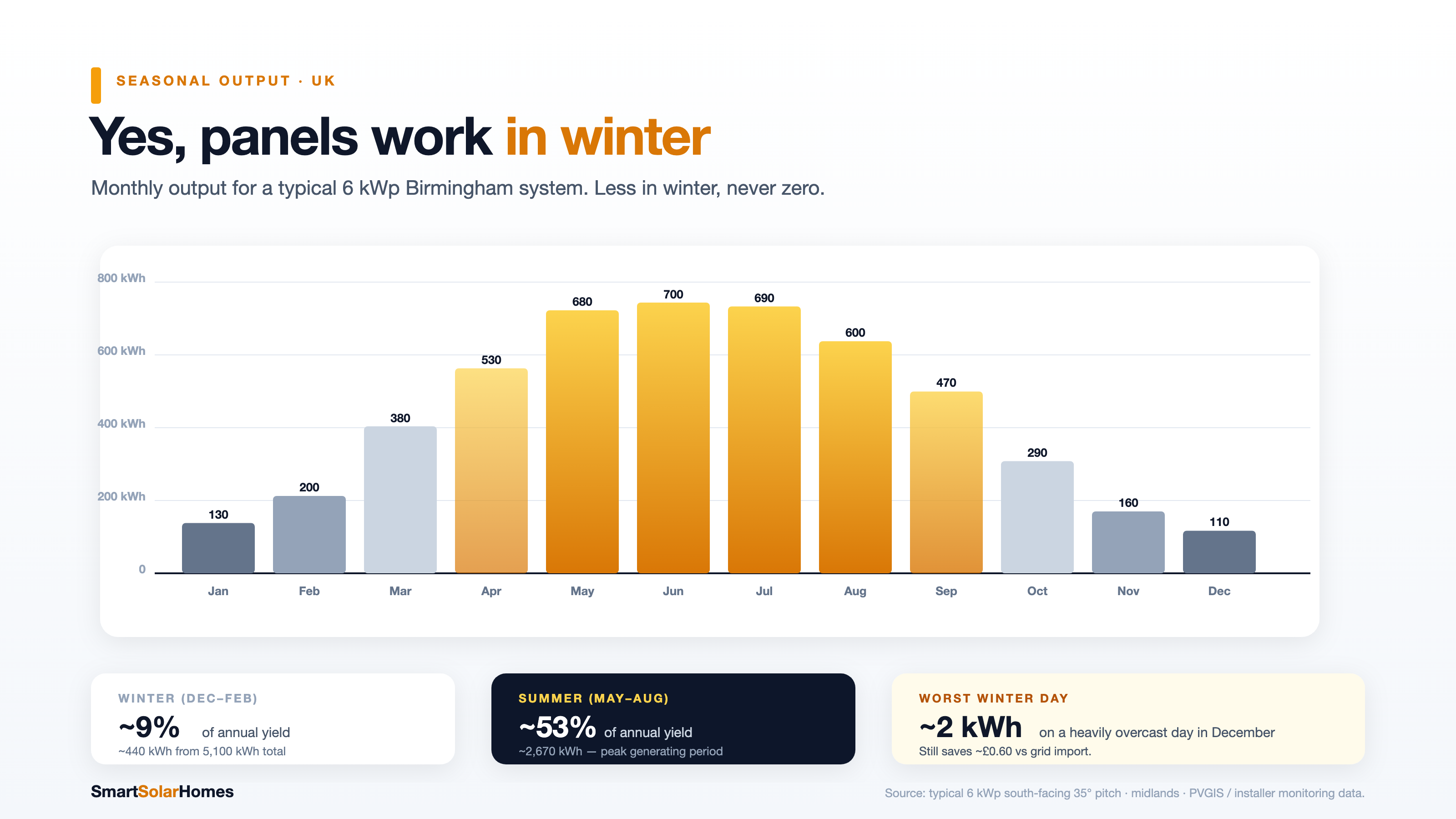
A well-sited south-facing 4kWp system in southern England generates roughly:
June–August: 450–550kWh per month
September / May: 250–350kWh per month
December–February: 80–130kWh per month
Annual total: approximately 3,400–3,800kWh
The summer months together account for roughly 50% of the annual yield. By contrast, December, January and February combined contribute only around 9–12%. The headline number on most installer quotes — annual generation — is what carries the payback case, so the seasonal variation is a presentation issue more than a financial one.
In Scotland, subtract 15–20%. In Cornwall, add 10–15%. East/west-facing roofs produce around 80% of a south-facing equivalent annually, but the loss is concentrated in the shoulder months rather than the depths of winter — a flatter generation curve, not a deeper trough.
Month-by-month output for a 4kWp south-facing system
Indicative kWh output for a Birmingham postcode, well-sited (no shading, 35° pitch):
- January: 90 kWh
- February: 130 kWh
- March: 280 kWh
- April: 380 kWh
- May: 470 kWh
- June: 500 kWh
- July: 510 kWh
- August: 460 kWh
- September: 320 kWh
- October: 200 kWh
- November: 110 kWh
- December: 75 kWh
These figures come from MCS-standard performance estimates using PVGIS irradiance data. Your actual numbers will depend on roof pitch, orientation, shading, and panel quality, but the seasonal shape is consistent across the UK.
Why output drops in winter
Three factors drive the reduction. First, shorter days — in December, London gets around 8 hours of daylight versus 16 in June, and Edinburgh sees just 7 hours versus 17 at the solstices. Second, the sun's angle is lower in the sky, which means solar irradiance (the intensity hitting your panel surface) is lower and more of it is lost to the atmosphere on its way down. Third, cloud cover is more persistent in winter, especially over north-west England, Wales, and Scotland.
What panels do not suffer from in winter: cold temperatures. Solar panels actually produce slightly more power per watt in cold, clear conditions than in hot summer conditions — the temperature coefficient (typically -0.30 to -0.40%/°C) works in your favour when it's cold. A crisp February morning at -2°C with full sun will outperform the same panel at 35°C in August, watt-for-watt.
Snow, frost and short-term effects
Snow that fully covers panels stops generation, but it rarely lasts. UK snow is typically wet, settles unevenly, and slides off panels within hours once any sunshine hits the dark glass surface. Frost has no measurable effect on output. Brief overnight ice has melted off long before the sun is high enough to generate anything.
The genuine risk is heavy, prolonged snow on a low-pitch roof — under 15° pitch, snow lingers longer. Standard UK domestic roofs are 30–45° and clear quickly. Brushing snow off is not recommended: the small generation gain rarely justifies the risk of falling or scratching the panel glass.
Does this change the payback calculation?
Not significantly. The payback case for UK solar is almost entirely built on the April–September generation, when panels produce 65–70% of their annual output. Winter generation is a bonus rather than the foundation of the economics. The typical payback period for a well-sized system is 8–12 years, and that calculation holds whether you count winter generation or not. For the full picture, the solar cost and savings guide covers what to expect.
If you want to see how this plays out for a specific roof, the savings calculator in the guide takes location, orientation and consumption inputs and returns a year-round figure.
What it means practically
In winter, most UK solar households are net importers from the grid — the panels contribute but do not cover daily demand. In summer, many are net exporters, and a Smart Export Guarantee tariff pays you for the surplus. A home battery helps smooth that seasonally if you want to maximise self-consumption, but even without one, the annual generation figures stack up.
The people most disappointed with winter performance are usually those who sized their system based on summer output expectations applied year-round. Size your system for annual generation, not summer peaks. The sizing guide walks through how to do this from your electricity bill.
Heat pumps, EVs and winter solar
If you own a heat pump, your winter electricity demand is the highest of the year — exactly when your solar contribution is lowest. The two systems do not pair as cleanly in winter as marketing material implies. Solar still helps over the full year, but the peak winter heating load is met from grid imports, not from your roof. Sizing the solar array up specifically to chase winter heat-pump demand rarely pays — most of the extra generation falls in summer when the heat pump barely runs.
EV charging is different. EV demand is roughly flat across the year (slightly higher in winter due to cabin heating and battery efficiency), so the seasonal solar mismatch is less severe. A battery and/or smart EV charger lets you shift more of your overnight EV charging onto cheap off-peak tariffs in winter, then onto direct solar in summer. The EV charging with solar guide covers how this works in detail.
Regional differences across the UK
Average annual generation per kWp installed, by region (PVGIS-derived, south-facing 35° pitch):
- South-east England: 1,000–1,050 kWh/kWp
- South-west England: 1,000–1,100 kWh/kWp
- Midlands: 900–950 kWh/kWp
- North-east England: 850–900 kWh/kWp
- North-west England: 820–880 kWh/kWp
- Wales: 870–950 kWh/kWp
- Southern Scotland: 820–880 kWh/kWp
- Northern Scotland: 780–840 kWh/kWp
- Northern Ireland: 850–900 kWh/kWp
The regional gap narrows in summer (Scotland sees long days that partly offset weaker irradiance) and widens in winter. The economic case for solar still works across the whole UK because the variation is at most 25%, and the long payback period absorbs it. There is no UK location where solar PV makes no financial sense on a south-facing unshaded roof.
Where to go next
If you want to model winter output for your specific roof, the savings calculator takes regional and orientation inputs. To work out whether a battery makes sense for your usage pattern, see do you need a battery. When you're ready to move forward, get quotes from MCS-certified installers with realistic annual generation figures broken down by month.
Snow sitting on your panels cuts output for a day or two, but does it actually damage them? Our guide to snow and hail resilience covers the hail impact test panels have to pass, UK snow-load mounting standards, and why you should never climb up to clear panels yourself.
FAQs
How much do UK solar panels generate in December?
A typical 4kWp south-facing system generates around 75–100kWh in December across most of the UK — roughly 15% of June's output. That covers around three days of average household demand for a non-EV, non-heat-pump household.
Do solar panels work when it's cloudy?
Yes — panels generate from diffuse light, not just direct sunlight. On a heavily overcast day, output drops to roughly 10–25% of a clear day equivalent. On a "bright overcast" day with thin cloud, output can reach 40–60% of clear-day output.
Should I clean snow off my solar panels?
No. The fall risk and panel damage risk outweigh the small generation gain. UK snow typically clears within 24–48 hours of any sunshine on standard 30°+ pitch roofs.
Are panels less efficient in winter?
Per watt, they are actually slightly more efficient in cold conditions. The reason annual winter output is low is daylight hours and solar angle, not cell efficiency.
Will winter performance shorten my system's life?
No. Modern panels are warrantied for 25 years against a maximum annual degradation of 0.4–0.55%. Winter cycling has no measurable effect on lifespan.
Sources — verified 4 June 2026
- European Commission Joint Research Centre, “Photovoltaic Geographical Information System (PVGIS)” — re.jrc.ec.europa.eu
- Energy Saving Trust, “Solar panels” — energysavingtrust.org.uk
- Ofgem, “Smart Export Guarantee (SEG)” — www.ofgem.gov.uk
- LONGi Solar, “How to Read a Solar Panel Datasheet” — longi-solar.net
- timeanddate.com, “Sunrise and sunset times in London” — www.timeanddate.com
- timeanddate.com, “Sunrise and sunset times in Edinburgh” — www.timeanddate.com

About the author
Sepehr
Solar specialist & co-founder, Smart Solar Homes
Solar specialist and co-founder of Smart Solar Homes, which works with MCS-certified UK installer partners. I write all the guides and reviews here; the aim is straight-talking education the industry rarely provides.
Citing this page? Please use a dofollow link back to the original article — it helps us keep the data on this page accurate and up to date.
Browse Solar Panels on Smart Solar Homes


Want to compare these side by side? Use the compare tool →
Or browse all Solar Panels on Smart Solar Homes.
Related reading
More on solar panels from the editorial team.
Find installers near you
MCS-certified solar installers covering these areas.