4kW Solar System UK: Cost, Output and Is It Right for You?

Written and reviewed by Sepehr. See our editorial policy.
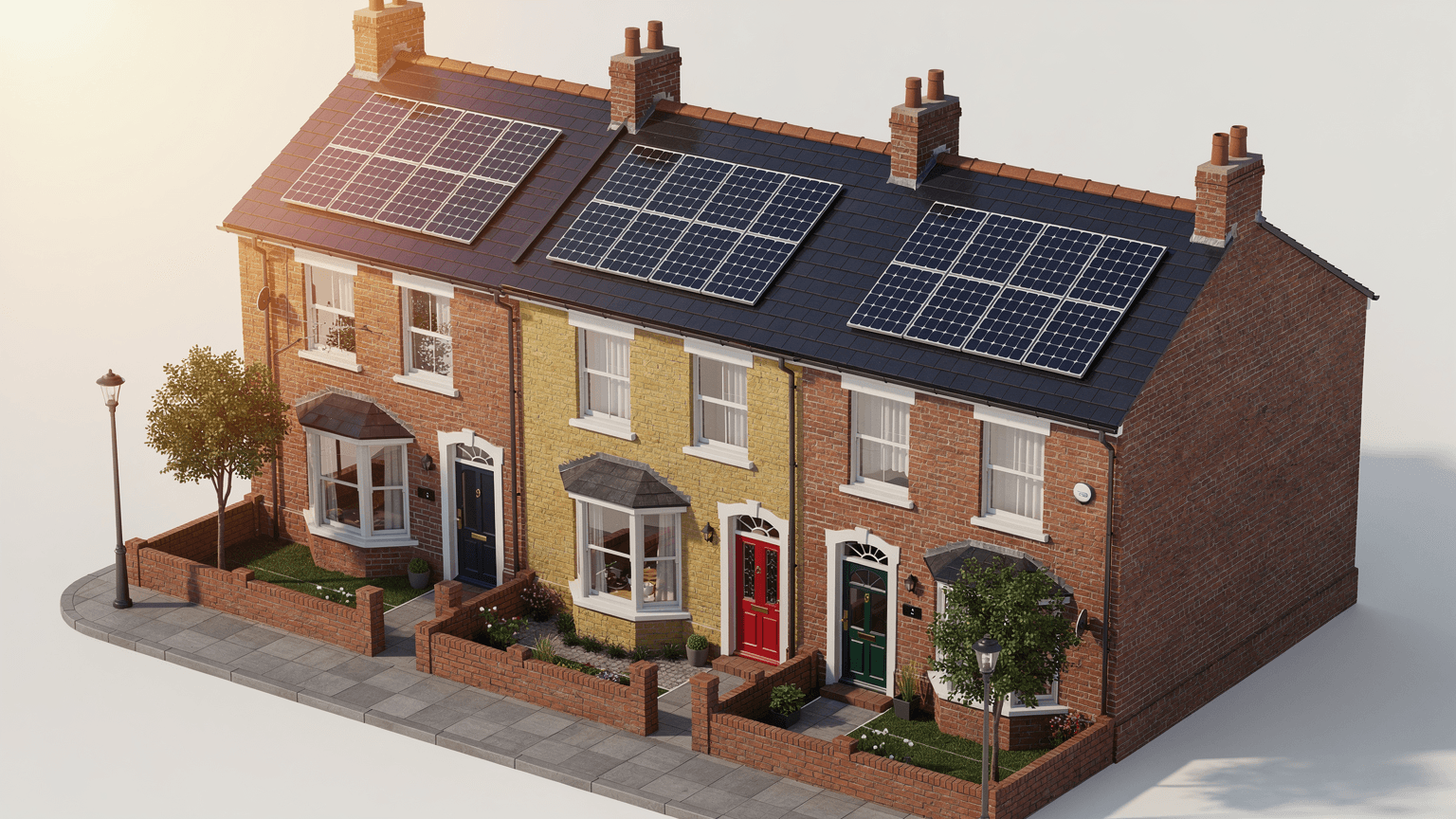
A 4kW solar panel system is the most commonly installed size in the UK — and for good reason. It fits neatly on the roof of a typical two-bedroom or three-bedroom semi-detached or terraced home, generates enough electricity to cover a large share of an average household's annual use, and sits at a price point that makes the numbers stack up without requiring a very large south-facing roof. This guide explains exactly what you get: how many panels, how much electricity, what it costs in 2026, and how long before it pays for itself.
What is a 4kW solar system?
System size refers to peak output, not continuous generation. A 4kW (or 4kWp) system produces up to 4 kilowatts of electricity under ideal laboratory conditions. In a real UK installation you will never see that figure on your inverter display — but you will see a steady trickle of generation from early morning to late evening throughout the year.
In practice, a 4kWp array usually means 9–11 monocrystalline panels each rated at roughly 375–440W. Modern high-efficiency panels (400W+) mean you can now achieve 4kW in as few as 9 panels, which matters if roof space is limited. The panels connect via a string inverter or microinverters to your household consumer unit, turning DC power into the AC your appliances use.
How much electricity does a 4kW system generate?
Annual output depends mainly on your location and roof orientation. On a south-facing roof pitched at 30–45°, a 4kWp system in the south of England generates roughly 3,600–3,800 kWh per year. In the Midlands or Wales, expect 3,200–3,600 kWh; in Scotland, 3,000–3,400 kWh. East- or west-facing roofs typically produce 15–20% less than a south-facing equivalent.
To put that in context, the average UK household uses around 3,500 kWh of electricity per year, according to Ofgem. A well-sited 4kW system in southern England can therefore generate close to — or slightly above — your total annual demand, although you will still import from the grid at night and in deep winter and export surplus on sunny summer days.
What does a 4kW solar system cost in 2026?
Installed costs for a 4kWp system currently sit at £5,500–£8,000, including panels, inverter, mounting hardware, cabling, and installation labour. The Energy Saving Trust estimates that an average home solar panel system costs around £6,100 to install. Larger or more complex installations — awkward roof access, multiple roof pitches, or upgrading an older consumer unit — will push costs toward the top of that range.
Crucially, solar panel installation in Great Britain currently attracts 0% VAT — the zero rate applies until 31 March 2027, after which it reverts to a reduced rate of 5%. That means a £6,500 quote today carries no VAT uplift. From April 2027, the same job would cost around £325 more. If you are on the fence about timing, the VAT window is a genuine financial reason to act before that date.
To understand how 4kW compares with smaller and larger arrays, see our solar panel cost by system size breakdown.
Who is a 4kW system right for?
The 4kW system suits households with annual electricity demand of roughly 3,000–4,500 kWh. That typically means a two- or three-bedroom semi-detached or terraced home with two to four occupants who are at home during the day for at least part of the week. If you work from home, run an electric car, or heat water with an immersion, you will use more electricity during daylight hours and extract more value from self-generated power.
You need at least 20–25 m² of usable, unshaded south-facing (or broadly south-east/south-west) roof to fit 9–11 panels. A standard semi-detached has roughly 30–40 m² of total rear roof area, so a 4kW array is almost always achievable. Heavily shaded roofs — dense tree coverage or adjacent tall buildings — reduce output substantially and may make a smaller system a better fit.
Bill savings and self-consumption
The more solar electricity you use directly, the larger your saving. Every unit you generate and consume yourself saves you the import price — currently around 24–25p/kWh on a standard variable tariff. If you export the surplus to the grid via the Smart Export Guarantee (SEG), you earn a smaller rate, typically 4–12p/kWh depending on your supplier and tariff.
A household that uses roughly 30–40% of its solar generation directly (the typical figure for a family that is partly at home during the day) and exports the rest can expect to save £400–£600 per year on bills, with an additional £100–£250 from SEG export income. Running dishwashers, washing machines, and EV charging during daylight hours — a practice known as demand-shifting — can raise self-consumption above 50%, meaningfully improving returns. For a full look at whether the economics work for your household, our are solar panels worth it UK guide runs through the detailed sums.
Smart Export Guarantee: getting paid for what you export
Every new solar installation in Great Britain is entitled to SEG payments. The scheme, regulated by Ofgem, requires licensed electricity suppliers to offer export tariffs to eligible generators — including any system under 5MW peak capacity. Rates vary by supplier: as of mid-2026 they range from around 4p/kWh for basic tariffs to over 12p/kWh for premium time-of-use export offers. You choose your SEG supplier independently of your import supplier, so it pays to compare offers before signing up.
For a 4kWp system in southern England exporting roughly 1,500–1,800 kWh per year, a 10p/kWh tariff would generate approximately £150–£180 annually. Combined with bill savings, total annual benefit typically reaches £550–£800 in year one, improving slightly as grid electricity prices rise over time.
Pairing a 4kW system with a battery
A home battery storage unit stores surplus daytime generation for use in the evening. For a 4kWp system, a 5–10 kWh battery is usually the right size — enough to capture most of a typical summer day's surplus and carry it through to the evening peak. A 5 kWh battery currently costs £1,500–£2,500 installed on top of the solar array; a 10 kWh unit adds £2,500–£4,000.
Adding a battery raises self-consumption from 30–40% to 60–70% in many households, substantially reducing the volume of cheap export income but replacing it with higher-value avoided import. Whether the premium makes financial sense depends on your tariff structure and daily usage pattern. Our home battery storage guide covers sizing, brands, and payback in full.
Payback period
At current energy prices and system costs, a 4kW system alone typically pays back in 8–12 years. A £6,500 system saving £650 per year (combined bill reduction and SEG income) breaks even in 10 years — well within the 25-year performance warranty most quality panels carry. Adding a battery extends the payback period of the combined investment by 3–5 years but raises overall lifetime savings.
Solar panels require almost no maintenance and the only scheduled cost is an inverter replacement (typically £500–£1,000) after 10–15 years. After payback, every unit generated is effectively free electricity for the remaining life of the system.
Getting the installation right
Use an MCS-certified installer. MCS (Microgeneration Certification Scheme) certification is the UK industry standard for domestic solar installations and a requirement for SEG eligibility. Always obtain at least two or three quotes, check whether the installer will handle the DNO notification (required for systems above 3.68kW under G98/G99 rules), and confirm the warranty terms on both panels and inverter.
FAQs
How many panels are in a 4kW solar system?
How much electricity does a 4kW solar system generate per year in the UK?
How much does a 4kW solar system cost in 2026?
How long does a 4kW solar system take to pay for itself?
Is a 4kW solar system big enough for my home?
Should I add a battery to a 4kW solar system?
Sources — verified 8 June 2026
- Energy Saving Trust — Solar panels: costs, savings and benefits explained — energysavingtrust.org.uk
- Ofgem — Smart Export Guarantee (SEG) — www.ofgem.gov.uk
- Ofgem — Smart Export Guarantee: guidance for generators — www.ofgem.gov.uk
- GOV.UK — VAT on energy-saving products — www.gov.uk
- GOV.UK — VAT on energy-saving materials and heating equipment (Notice 708/6) — www.gov.uk
- GOV.UK / DESNZ — Solar photovoltaic (PV) cost data — www.gov.uk

About the author
Sepehr
Solar specialist & co-founder, Smart Solar Homes
Solar specialist and co-founder of Smart Solar Homes, which works with MCS-certified UK installer partners. I write all the guides and reviews here; the aim is straight-talking education the industry rarely provides.
Citing this page? Please use a dofollow link back to the original article — it helps us keep the data on this page accurate and up to date.
Browse Solar Panels on Smart Solar Homes


Want to compare these side by side? Use the compare tool →
Or browse all Solar Panels on Smart Solar Homes.
Related reading
More on solar panels from the editorial team.
Find installers near you
MCS-certified solar installers covering these areas.