Solar Panel Payback Period UK

Written and reviewed by Sepehr. See our editorial policy.
For a UK household, the honest payback range is 8–12 years for a solar-only system — though with a battery the combined investment may take longer to repay, depending on how you use it. Payback is the single most important number to understand before investing in solar panels, and also the one most frequently misrepresented in sales conversations. This guide walks through exactly how payback is calculated, works through a realistic example with ranges, and explains what shortens or lengthens it.
How payback is calculated
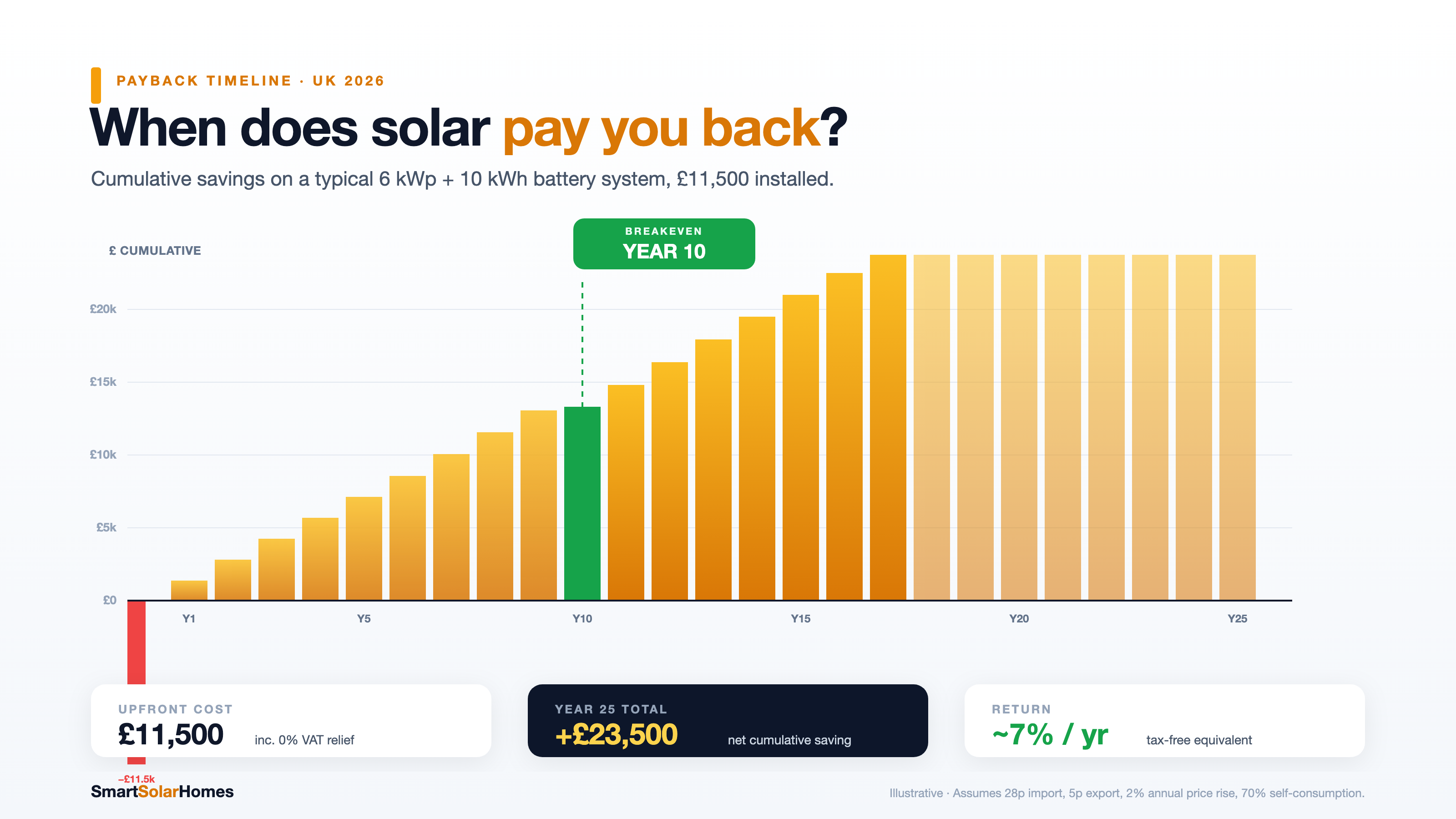
Payback period is simply your total system cost divided by your total annual benefit. The annual benefit has two components: savings on grid imports (the bigger part) and export income under the Smart Export Guarantee. Both depend on how you use the system, not just how much it generates.
Savings on imports: Every kilowatt-hour you generate and use yourself avoids buying one from the grid. At around 24.67p/kWh import price (the Ofgem default-tariff price cap for 1 April–30 June 2026) versus around 5–7p/kWh amortised generation cost, each self-consumed unit saves you roughly 18–20p.
Export income: Every unit you don't use goes to the grid. Under the Smart Export Guarantee, your supplier pays you for it — but at a lower, supplier-set rate. SEG rates are not regulated and run roughly 3–15p/kWh, with around 13p/kWh a representative midpoint among the better widely-available tariffs. Even so, selling a unit at 13p is worth far less than not buying one at around 25p. This asymmetry is why self-consumption dominates the payback calculation.
The solar panel cost and savings guide covers the cost side in detail, including what drives prices up and down and how to assess whether a quote is reasonable.
Worked example: 4 kWp system, central England
This is a realistic scenario, not an optimistic sales projection.
- System cost: £7,000 installed, zero-rated VAT (saving around £1,400 vs pre-2022 pricing — see the zero VAT scheme)
- Annual generation: around 3,600 kWh (mid-range for central England)
- Self-consumption rate: 35% (household out during the day, no battery) → 1,260 kWh self-consumed
- Import savings: 1,260 kWh × 26p = £328/yr
- Export: 2,340 kWh × 13p = £304/yr
- Total annual benefit: £632/yr
- Payback: £7,000 ÷ £632 = around 11 years
Now the same system for a household that's home during the day:
- Self-consumption rate: 45% → 1,620 kWh self-consumed
- Import savings: 1,620 kWh × 26p = £421/yr
- Export: 1,980 kWh × 13p = £257/yr
- Total annual benefit: £678/yr
- Payback: £7,000 ÷ £678 = around 10 years
These examples illustrate why “8–12 year payback” is achievable but not guaranteed. The 8-year end requires a combination of high self-consumption, a competitive system cost, and grid tariffs at or above current levels. The 12-year end — or beyond — is where many households land. For context on system sizing and how costs vary, see solar panel cost by system size and the broader verdict at are solar panels worth it in the UK?
Payback by system size: at-a-glance table
The table below summarises typical payback ranges across the three most common residential system sizes in the UK. Figures assume a south-facing roof in central England, mid-range self-consumption (40%), and current grid prices. All costs include zero-rated VAT, which applies until 31 March 2027 under current HMRC rules. Battery figures assume a 10 kWh unit at around £5,000 installed.
| System size | Typical installed cost | Annual generation | Solar-only payback | Solar + battery payback |
|---|---|---|---|---|
| 3 kWp | £5,000–£6,000 | ~2,700 kWh | 9–12 years | 13–17 years |
| 4 kWp | £6,500–£8,000 | ~3,600 kWh | 9–12 years | 12–16 years |
| 6 kWp | £8,500–£11,000 | ~5,400 kWh | 9–13 years | 12–16 years |
The solar-only payback range is similar across sizes because cost-per-kWp tends to fall as systems get larger, roughly offsetting the proportional increase in generation. The battery payback is notably wider for smaller systems: a 3 kWp array may not generate enough surplus in winter months to keep a 10 kWh battery meaningfully cycled, reducing its value. If you have a 3 kWp roof, a 5 kWh battery is usually a better match than a 10 kWh one.
What shortens payback
Higher electricity tariffs. Every 1p increase in import price makes your self-consumed generation more valuable. At 30p/kWh, the same 1,260 kWh saves £378 rather than £328 — a meaningful difference over years of operation.
Higher daytime consumption. Running dishwashers, washing machines, and other high-draw appliances during generation hours directly improves your self-consumption rate. Timed appliances cost nothing extra to set up.
South-facing roof, no shading. A clean south-facing roof in the south of England can comfortably exceed 950 kWh per kWp per year. A shaded or off-south roof in Scotland may be 30% below the central England figure.
Competitive quote. A system at £1,500 per kWp rather than £2,000 per kWp reduces upfront cost by a third, directly compressing payback. It's worth getting at least three quotes and understanding what differentiates them.
What lengthens payback
Low self-consumption. Households out all day, every day, may realistically self-consume only 20–25% without a battery or smart controls. At those rates, payback can stretch to 15 years or beyond.
Falling electricity prices. If grid electricity becomes cheaper in real terms — possible but historically uncommon over 25-year horizons — the import-saving value of each self-consumed unit falls.
Shading or orientation. A southwest-facing roof with some chimney shading might generate 20% less than the optimum. This directly reduces annual benefit while leaving upfront cost unchanged.
Low SEG rates. Currently around 3–15p/kWh depending on tariff, with around 13p typical among the better deals. Households exporting large proportions of their generation are heavily exposed to rate changes. The best SEG rates guide for 2026 covers which suppliers currently pay the most.
How batteries affect payback
A 10 kWh battery adds roughly £4,500–£6,500 to the investment. It raises self-consumption from around 35–45% to 55–70%, which substantially increases annual savings — but the additional upfront cost means the combined system's payback does not automatically shorten. The battery pays for itself separately through the gap it captures between cheap storage and expensive imports. In many cases the solar-plus-battery system has a longer combined payback than solar alone, but a higher total lifetime saving because it continues capturing that gap for 10–15 years.
The maths depends heavily on whether you're home in the evening (when the battery discharges), your import tariff, and whether you use a time-of-use tariff that charges cheap overnight rates. See the detailed treatment in the cost and savings guide.
How to calculate your own payback estimate
You do not need specialist software. A simple spreadsheet built around four inputs will give you a reliable first estimate:
- Annual generation (kWh): Your installer should provide this as part of their quote. Alternatively, use the European Commission's free PVGIS tool, which models UK roof performance by location, tilt, and orientation using satellite irradiance data. Enter your postcode, set your system size, and read off the annual yield.
- Self-consumption rate (%): If you're mostly out during the day and have no battery, start at 30–35%. If you work from home or can schedule appliances, use 40–50%. With a battery, 60–70% is realistic. The Energy Saving Trust notes that typical UK households without a battery self-consume around 30–50% of what they generate.
- Import price (p/kWh): Check your current unit rate on your energy bill, or use the Ofgem price cap rate as a conservative baseline. Multiply your self-consumed kWh by this figure for your annual import saving.
- Export rate (p/kWh) and exported kWh: Your exported units are total generation minus self-consumed. Multiply by your chosen SEG rate. To find current rates, check supplier websites directly — Ofgem publishes a register of licensed suppliers but does not set export prices.
Once you have import savings and export income, add them together to get your total annual benefit. Divide your total system cost (including any battery) by that annual benefit figure. The result is your payback period in years. Run the calculation twice — once with conservative assumptions and once with optimistic ones — and treat the midpoint as your working estimate.
The years after payback: effectively free electricity
Payback period gets all the attention, but what comes after it matters just as much. Solar panels carry manufacturer performance warranties of typically 25 years, and many systems continue generating meaningfully beyond that. Once you pass the payback date, the economics shift entirely: every unit you generate and use yourself is electricity you do not buy. At current prices, a 4 kWp system that has repaid its cost in year 10 will generate roughly £4,500–£6,000 of further value between years 10 and 25 in import savings alone — before export income. The panels may degrade slightly (around 0.5% per year is a typical figure cited by manufacturers), but this is a slow decline: a panel in year 25 is still operating at around 87% of its original output.
This long tail is why payback period alone is an incomplete metric. A system with an 11-year payback and a 25-year life has 14 years of largely free generation ahead of it. Framed this way, the question is less “when does it pay back?” and more “how much free electricity will I generate over the system's lifetime?”
VAT and the payback calculation
Zero-rated VAT has been in place since April 2022, but it is a time-limited relief that ends on 31 March 2027, after which VAT on installing solar PV and battery storage in Great Britain reverts to 5% (Northern Ireland differs). This reduces the upfront cost by around £1,400–£3,000 on a typical installation compared to what the same system would have cost before April 2022. Because payback period is driven by upfront cost, the zero-rate directly shortens payback — it's not just an accounting benefit, and it is worth installing before the relief expires. The zero VAT scheme page explains eligibility and what your installer should confirm in writing.
Getting quotes with payback in mind
When reviewing quotes, ask each installer to show their generation estimate as an annual kWh figure (not just peak capacity), their assumed self-consumption rate, and the SEG rate they've used in their savings calculation. Generation estimates above 950 kWh per kWp in central England should be backed by a shading analysis; sales projections based on 100% self-consumption are not realistic for most households. Once you have consistent assumptions across installers, comparing payback periods becomes a fair exercise. When you're ready, get quotes from vetted MCS-certified installers in your area. Our guide to choosing a solar installer in the UK explains why MCS accreditation is only the starting point — and what to check before you commit.
The export tariff you choose has a material effect on payback. Good Energy currently offers among the highest rates — see our Good Energy export tariff review for the numbers.
If you are planning to sell in the next few years, payback is only part of the story — solar panels can also lift your asking price. Our guide on whether solar panels add value to your home covers the UK evidence and what sellers and buyers need to check.
You may also see solar quoted in terms of LCOE (Levelised Cost of Energy) — a generation-industry metric, not a homeowner one. Our LCOE explained guide covers what it actually measures and why payback period, not LCOE, is the number that applies to your own roof.
Related: a new GreenSketch study puts the average UK home's solar-and-battery saving at £946 a year — see our Sunlight Salary report explainer.
FAQs
How long do solar panels take to pay for themselves in the UK?
The honest range is 8–12 years for a solar-only system. The 8-year end requires high self-consumption, a competitive system cost, and grid tariffs at or above current levels; the 12-year end — or beyond — is where many households actually land. Adding a battery raises your total saving over time but typically lengthens the combined payback, since it adds upfront cost.
What is a good solar panel payback period?
Anywhere within the 8–12 year range is a reasonable outcome for a solar-only system in the UK. Reaching the shorter end depends on using a high proportion of your generation yourself, securing a competitive quote, and current or higher grid prices holding. Treat any sales projection promising a much faster payback — especially one assuming 100% self-consumption — with caution, as that isn't realistic for most homes.
How quickly can you pay back a solar panel installation?
Around 10–11 years is realistic for a typical 4 kWp system. A worked example of a £7,000 system generating about 3,600 kWh a year pays back in roughly 11 years if the household is out during the day (35% self-consumption), or about 10 years if someone is home (45%). Higher tariffs, higher daytime use, and a competitive quote all shorten it.
Does a battery make payback shorter or longer?
Usually longer for the combined system, even though it saves you more overall. A 10 kWh battery adds roughly £4,500–£6,500 and lifts self-consumption from around 35–45% to 55–70%, increasing annual savings — but the extra upfront cost means the combined payback doesn't automatically shorten. The battery earns its keep separately, capturing the gap between cheap stored power and expensive imports for 10–15 years.
How do I work out my own payback period?
Divide your total system cost by your total annual benefit — no specialist software needed. You need four inputs: annual generation (your installer's figure, or the free PVGIS tool), your self-consumption rate, your import price per unit, and your SEG export rate. Add your import savings and export income for the annual benefit. Run it once with conservative assumptions and once optimistic, then take the midpoint.
What is the solar panel buy-back scheme?
That's the Smart Export Guarantee (SEG), under which your supplier pays you for every unit you send to the grid rather than using yourself. Rates aren't regulated and run roughly 3–15p per unit, with around 13p a representative midpoint among the better widely-available tariffs. Even the best rate is worth far less than the roughly 25p you avoid by using a unit yourself, which is why self-consumption dominates payback.
Sources — verified 6 June 2026
- Ofgem, “Changes to energy price cap between 1 April and 30 June 2026” — www.ofgem.gov.uk
- Energy Saving Trust, “Solar panels” — energysavingtrust.org.uk
- HMRC / GOV.UK, “VAT on energy-saving materials and heating equipment (Notice 708/6)” — www.gov.uk
- MCS, “Smart Export Guarantee — consumer eligibility” — mcscertified.com
- GOV.UK, “Smart Export Guarantee (feed-in tariffs / export payments)” — www.gov.uk
- European Commission, “Photovoltaic Geographical Information System (PVGIS)” — re.jrc.ec.europa.eu

About the author
Sepehr
Solar specialist & co-founder, Smart Solar Homes
Solar specialist and co-founder of Smart Solar Homes, which works with MCS-certified UK installer partners. I write all the guides and reviews here; the aim is straight-talking education the industry rarely provides.
Citing this page? Please use a dofollow link back to the original article — it helps us keep the data on this page accurate and up to date.
Browse Solar Panels on Smart Solar Homes


Want to compare these side by side? Use the compare tool →
Or browse all Solar Panels on Smart Solar Homes.
Related reading
More on solar panels from the editorial team.
Find installers near you
MCS-certified solar installers covering these areas.