Solar Panel Cost UK 2026: What You Should Actually Pay

Written and reviewed by Sepehr. See our editorial policy.
Solar panel costs in the UK have fallen roughly 60% since 2012 and have stabilised over the past two years. The price you pay in 2026 depends on your roof, your location, and — more than anything — your installer. This guide gives you the numbers to check whether a quote is in the right range, the line items that should appear on any honest quote, and the red flags that suggest a quote is inflated or a system is being under-spec'd.
Average installed costs in 2026
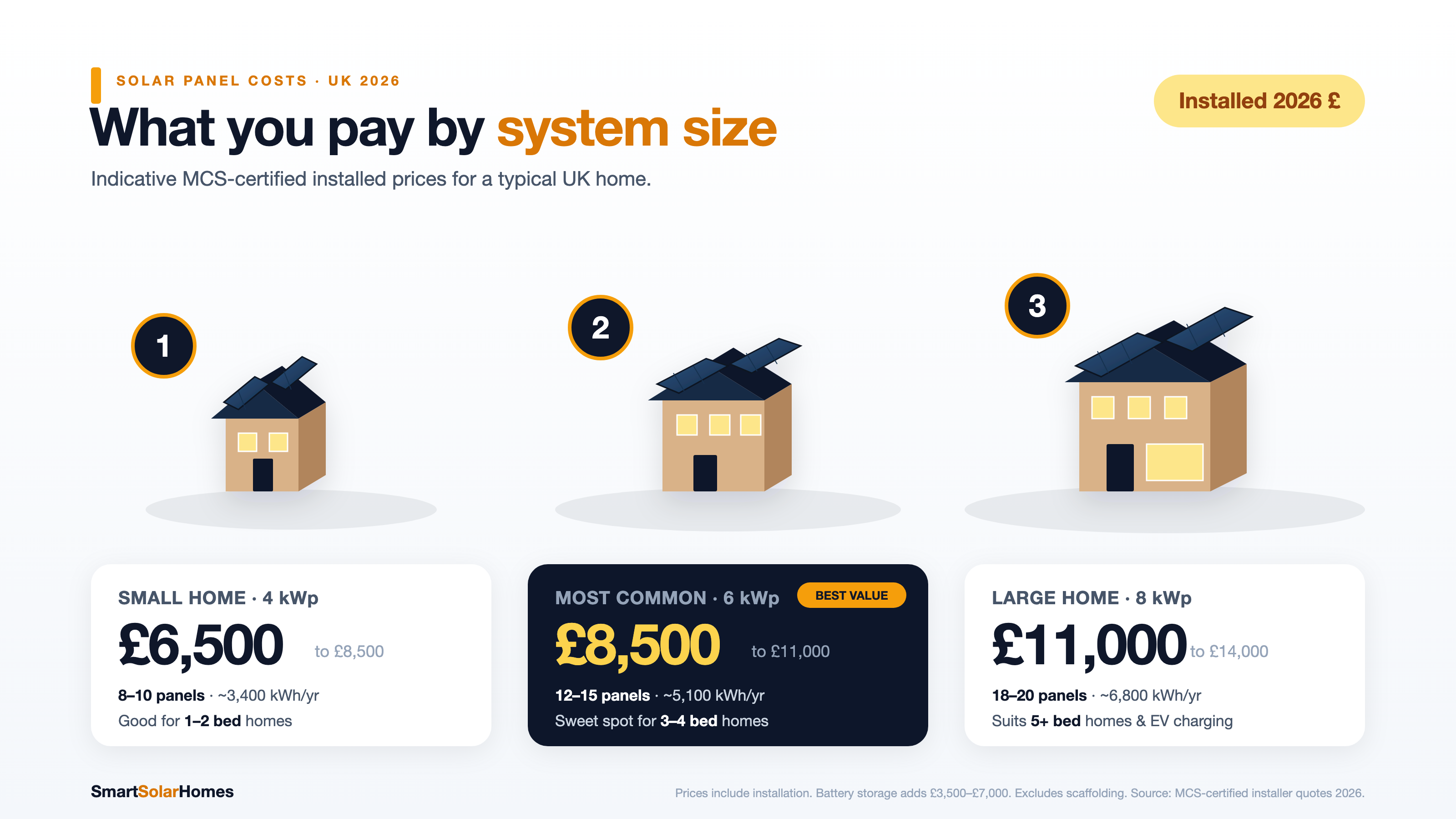
A typical UK residential install — 4kWp to 6kWp, south-facing roof, no shading complications — costs between £6,000 and £10,000 fully installed including VAT. VAT on residential solar is zero-rated in Great Britain until 31 March 2027 (reverting to 5% from 1 April 2027), so the figure you are quoted should already reflect that.
Per kWp installed: £1,500–£2,200 is the typical range. Below £1,400/kWp warrants scrutiny about panel quality, mounting hardware spec, or installer viability. Above £2,500/kWp for a standard install needs a clear justification (complex roof, listed building, premium panels like SunPower Maxeon or REC Alpha).
Indicative bands by system size:
- 3kWp (7–8 panels): £4,800–£6,500. Suits a small terraced property or a low-consumption household.
- 4kWp (10–12 panels): £6,000–£8,000. The single most common UK domestic install.
- 5kWp (12–13 panels): £7,200–£9,500. Typical for a family home without an EV or heat pump.
- 6kWp (15–16 panels): £8,000–£12,000. Sensible for households with EV charging or planned heat-pump electrification.
- 8kWp+ (20+ panels): £11,000–£16,000. Detached homes, larger roofs, or heat-pump households.
Adding a battery: roughly £4,500–£6,500 on top for a 10kWh unit installed alongside the panels, dropping by around £500 if it goes in at the same time as the panels rather than as a retrofit. Home battery storage costs covers the full picture.
What drives the price
Panel brand and technology: Premium panels (REC Alpha, SunPower Maxeon, Aiko Neostar) cost 30–50% more per panel than commodity PERC. The efficiency advantage is real but only matters if your roof space is limited. For most UK roofs, mid-tier TOPCon panels from Jinko, JA Solar, Trina or Aiko deliver near-premium performance at commodity prices. See TOPCon vs PERC for the trade-off.
Roof complexity: Flat roofs need ballasted mounting systems, which add £150–£300 per panel. Multiple roof planes, valleys, and chimneys require more labour and more mounting hardware. A steep roof (above 45°) takes longer and costs slightly more. All of these add cost.
Scaffolding: A standard two-storey terraced house typically costs £400–£800 for scaffold erection and collection. A three-storey or detached property can reach £1,200–£1,800. Some installers include this; others quote it separately. Always clarify.
Inverter type: String inverters are the cheapest option and fine for unshaded roofs. Microinverters (Enphase IQ8+, one per panel) or DC optimisers (SolarEdge) add £200–£600 but improve output on shaded or multi-aspect roofs. For a fully unshaded south-facing roof, a string inverter is the right call. For an east/west split or any chimney shading, optimisers or microinverters typically pay for themselves. See our string inverter vs microinverter guide to choose the right technology for your roof.
DNO and grid connection: Most domestic installs sit comfortably under the 3.68kW per-phase limit for G98 self-notification. Larger systems require G99 approval, which can add £200–£500 to the project and several weeks to the timeline. Some areas with constrained grid capacity also see installs limited to export-zero modes, which doesn't change cost but affects the SEG income.
What the quote should break out
A single combined price with no line items is the biggest warning sign. You cannot compare quotes if you cannot see what each component costs. A reputable installer will break out:
- Panels — brand, model, wattage, quantity, and unit price
- Inverter — brand, model, warranty length
- Mounting hardware — brand and roof type (e.g. K2 SingleRail, Renusol, IronRidge)
- DC and AC isolators, generation meter — line items, not lumped under "sundries"
- Scaffolding — supplier, duration of hire
- Labour — separately from materials
- MCS certification, DNO notification, Building Control — typically £100–£250 combined, but should appear
- Warranty terms — product warranty, performance warranty, installation workmanship warranty
An honest quote runs to two or three pages. A single-line quote with "fully installed price: £8,995" is a sales tactic, not a quotation.
Regional cost variation
Greater London and the South East are typically 5–10% more expensive than the Midlands and the North, driven by labour rates and scaffolding costs. Northern Ireland sits slightly below the GB average. Scotland is broadly in line with the North of England, with Home Energy Scotland interest-free loans changing the equation more than headline prices do. See devolved nation schemes for the loan and grant landscape outside England.
Red flags in a quote
A single combined price with no line items is the biggest warning sign, but several others matter:
- Pressure to sign within 24–48 hours. Reputable installers expect homeowners to consider multiple quotes. Any "today-only discount" is a sales tactic.
- Vague warranty terms. "Up to 25 years warranty" without distinguishing product vs performance vs workmanship warranties is meaningless.
- No MCS certificate number offered upfront. The installer should provide their MCS number on first contact, and you should verify it on mcscertified.com before any visit.
- Free survey turning into a 3-hour sales pitch. A genuine survey takes 30–60 minutes. Anything longer is a sales engagement.
- "Free panels" or 100% finance with no monthly figure quoted. Free panel schemes typically tie you to a 20–25 year roof lease. See free solar panels for what to watch.
- No reference to G98 or G99 DNO notification. A reputable installer will mention the grid connection process before signing.
- Pricing in monthly payments only. A finance deal that hides the total system cost is rarely in your favour.
Finance options that don't damage the payback case
Most reputable installers offer 0% interest finance over 12–24 months as part of the proposal. These rarely change the headline cost in a meaningful way (the cost of finance is absorbed elsewhere) and can be useful if cash flow is tight.
Beyond that:
- Green mortgage top-ups from Barclays, NatWest, Nationwide, and several building societies typically offer 0.25–0.50% off the standard rate when the funds are used for energy-efficiency improvements including solar. The discount usually outweighs the small additional borrowing cost.
- Home Energy Scotland grant and loan — since June 2023, solar PV and battery storage are funded only as part of a package with a heat pump or high heat retention storage heaters (no standalone solar). The package cap is £6,000, of which up to £1,250 can be a cashback grant, with the remainder available as an interest-free loan (Scotland only). See devolved nation schemes for eligibility.
- BNPL through installers — useful only if 0% with no hidden fees. Read the credit agreement carefully.
Personal loans at 6–9% APR rarely make sense — the extra interest cost erodes the payback case meaningfully. If you cannot fund the install from savings or a green mortgage top-up, consider a smaller system to start and add battery or extra capacity later.
The 0% VAT relief in practice
Since 1 April 2022, solar PV and most heat-pump installations have been zero-rated for VAT in Great Britain under a temporary relief running to 31 March 2027 (it reverts to 5% from 1 April 2027). Standalone battery storage was added to the zero-rate from 1 February 2024. This applies to both the equipment and the installation labour, when the work is supplied as a single "supply and install" contract by a VAT-registered installer.
What this means in practice: every reasonable quote you receive should be VAT-inclusive at 0%, not "+VAT". If a quote shows 20% VAT added, the installer is either not VAT-registered (in which case they should not be charging VAT at all) or unaware of the relief. Walk away. See 0% VAT on solar for the small print.
Getting a fair price
Get at least four quotes. The cheapest is rarely the best; the most expensive is rarely justified. Verify every installer's MCS number on mcscertified.com before they visit. MCS-certified work must come with an insured, transferable workmanship warranty of at least two years (many installers offer five or ten under their own insurance-backed guarantee), backed by consumer-code deposit and workmanship protection, and MCS certification is a requirement for Smart Export Guarantee eligibility — there is no legitimate reason to use a non-MCS installer for a new residential system.
The getting a good quote guide covers the questions to ask on a site visit. When you're ready, request quotes through SmartSolarHomes — we share the brief with MCS-certified installers in your area.
Where to go next
For the full picture on environmental impact, read our guide on what solar panels actually contribute to UK net zero, including the carbon payback period and how grid decarbonisation changes the maths over your system's lifetime.
For a quote-ready estimate based on your roof and usage, the solar planner takes a few minutes and gives indicative figures three ways (full install, DIY, or installer-fitted DIY kit). To check whether the savings stack up for your specific consumption, use the savings calculator. When you're ready to compare real quotes, request MCS-certified installer quotes.
Alongside upfront costs, it's worth knowing what your monthly bills will look like after installation. See our breakdown of the average electricity bill with solar panels in the UK.
One often-overlooked cost consideration is home insurance: adding solar panels is a material change to your property, and you must notify your insurer and update your rebuild value to reflect the full installed cost. Read our guide on solar panels and home insurance to make sure your policy covers the system correctly.
Before you buy, it is also worth brushing up on the ten most common solar myths — our solar panel myths debunked guide covers everything from cloudy-day output to council tax implications.
Once your panels are installed, it is worth knowing what happens when they eventually reach end of life. Under the UK WEEE Regulations, the producer funds collection and recycling — read our solar panel recycling UK guide for the full picture on your rights and how to arrange free disposal.
Quote comparisons should account for regional price variation — a London quote and a Yorkshire quote for the same system can differ by over £1,000.
The most-quoted system size in the UK is covered in detail in our 4kW solar system cost breakdown.
Quote comparison should start with the right questions — use our guide to questions to ask about pricing to identify inflated quotes.
Once you have quotes, our guide to how to compare solar installation quotes helps you cut through the variation.
Our detailed 3kW solar system cost breakdown shows what you'll pay and what you'll save.
FAQs
How much does a 4kWp solar system cost in the UK in 2026?
£6,000–£8,000 installed, including 0% VAT, for a standard south-facing roof with no complications. Adding a 10kWh battery raises this to roughly £10,500–£14,000.
Are solar panels still worth it in 2026?
For most UK households with reasonable consumption and a usable south, east, or west-facing roof, yes. Payback typically falls in the 8–12 year range, and panels last 25+ years. See are solar panels worth it for the full breakdown.
Why are quotes so different from each other?
Differences usually come from panel and inverter brand choices, mounting hardware specification, scaffolding inclusion, and installer overhead. A £2,000 spread between three quotes for the same kWp is normal; a £5,000 spread suggests one is materially over-spec'd or one is under-spec'd.
Does the price include scaffolding and the DNO application?
It should. Ask explicitly. Some installers itemise scaffolding (£400–£800), DNO notification (£0–£100 for G98, £200+ for G99), Building Control notification (£50–£150), and MCS certification fee (£50–£100) — others bundle them. Make sure you are comparing like-for-like.
Can I install solar myself to save money?
Technically possible, but you lose MCS certification, SEG eligibility on standard tariffs, and the 0% VAT (which only applies to "supply and install"). You also take on full liability and would still need a qualified electrician to commission the AC side. For most homeowners, the cost saving is smaller than it looks. See the DIY solar installation hub for what it actually involves.
What's the cheapest legitimate UK solar install?
Around £4,500 fully installed for a small 3kWp system on a simple semi-detached roof, with no battery, basic panels, and a string inverter. Below this, the installer is almost certainly cutting corners on hardware, MCS compliance, or workmanship cover.
If upfront cost is the barrier, some installers offer interest-free solar panel finance — see what the terms actually mean before signing.
How much are solar panels and what is the average cost in the UK?
Across the common system sizes, a UK installation runs from about £4,800 for a small 3kWp system up to £11,000-£16,000 for an 8kWp+ array. As a rule of thumb, expect £1,500-£2,200 per kWp installed, including 0% VAT.
How much does a typical solar panel installation cost?
A typical install is a 4kWp system, the single most common UK domestic size, at £6,000-£8,000 fully installed. Adding a 10kWh battery alongside the panels adds roughly £4,500-£6,500 on top.
Sources — verified 5 June 2026
- HMRC / GOV.UK, “Energy-saving materials and heating equipment (VAT Notice 708/6)” — www.gov.uk
- Ofgem, “Changes to energy price cap between 1 April and 30 June 2026” — www.ofgem.gov.uk
- MCS, “Smart Export Guarantee — Consumers” — mcscertified.com
- Renewable Energy Consumer Code (RECC), “About Deposit and Workmanship Warranty Protection” — www.recc.org.uk
- Home Energy Scotland, “Home Energy Scotland Grant and Loan” — www.homeenergyscotland.org
- Energy Saving Trust, “Solar panels” — energysavingtrust.org.uk

About the author
Sepehr
Solar specialist & co-founder, Smart Solar Homes
Solar specialist and co-founder of Smart Solar Homes, which works with MCS-certified UK installer partners. I write all the guides and reviews here; the aim is straight-talking education the industry rarely provides.
Citing this page? Please use a dofollow link back to the original article — it helps us keep the data on this page accurate and up to date.
Browse Solar Panels on Smart Solar Homes


Want to compare these side by side? Use the compare tool →
Or browse all Solar Panels on Smart Solar Homes.
Related reading
More on solar panels from the editorial team.
Find installers near you
MCS-certified solar installers covering these areas.