Are Solar Panels Worth It in the UK?

Written and reviewed by Sepehr. See our editorial policy.
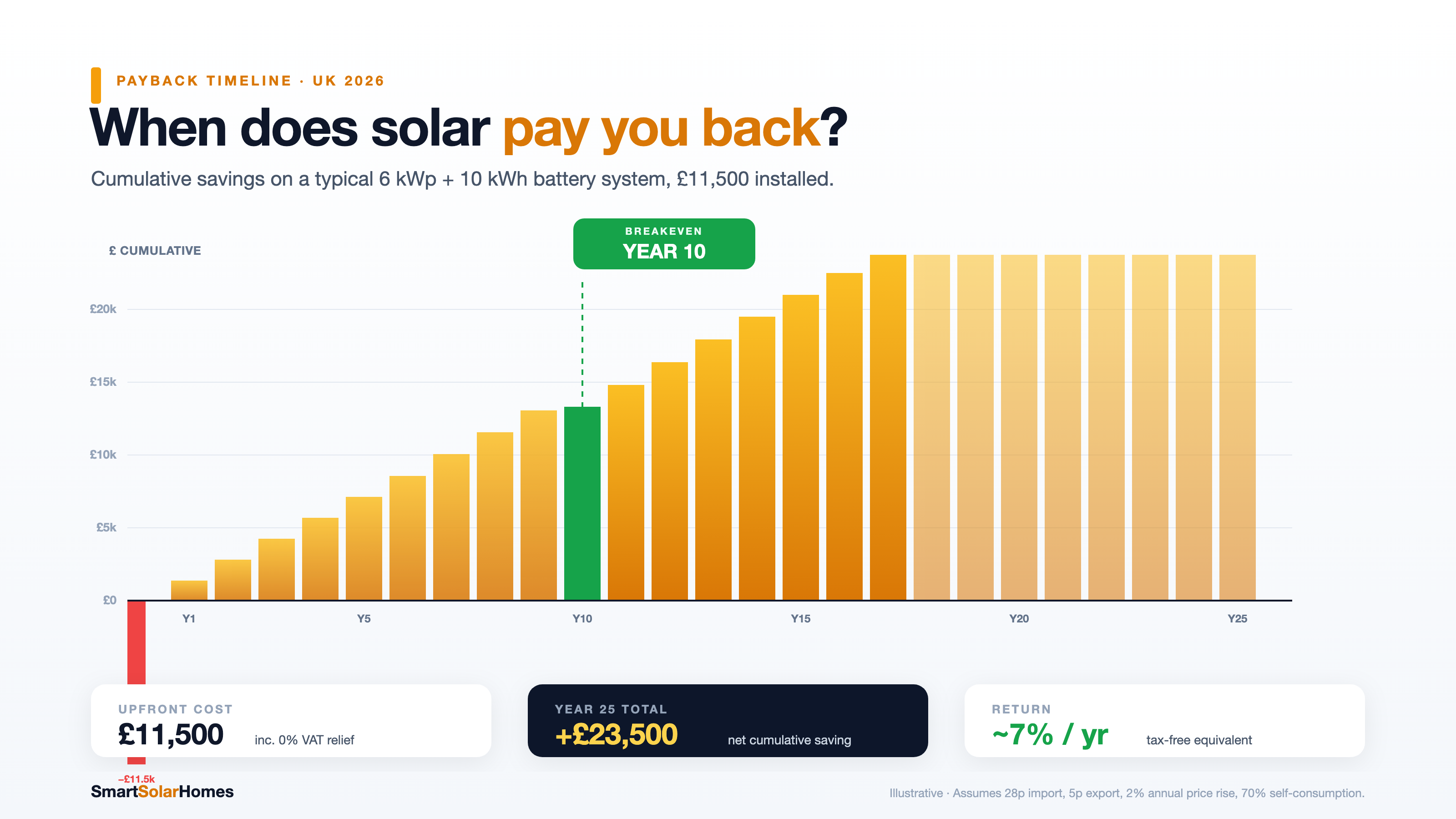
Yes — for most UK homeowners with a suitable roof and moderate electricity use, solar panels are worth it. A typical 4 kWp system costs £6,000–£8,000 installed and saves around £450–£660 per year on bills and exports. Payback typically takes 8–12 years; after that, savings continue for another decade or more.
For most UK households with a south- or southwest-facing roof, reasonable daytime electricity use, and no serious shading, solar panels are worth it — not spectacularly, but reliably. The honest answer, though, is that it depends. A household that ticks those boxes will typically see payback in 8–12 years and meaningful bill savings for 15–20 years beyond that. A household with a north-facing roof, persistent chimney shading, and no one home until 6pm will find the maths much harder to justify. This guide sets out who benefits most, who should think carefully, and what the real numbers look like.
If you rent, live in a flat, or have no suitable roof, plug-in balcony solar is a lower-cost way to start generating your own electricity.
Who benefits most
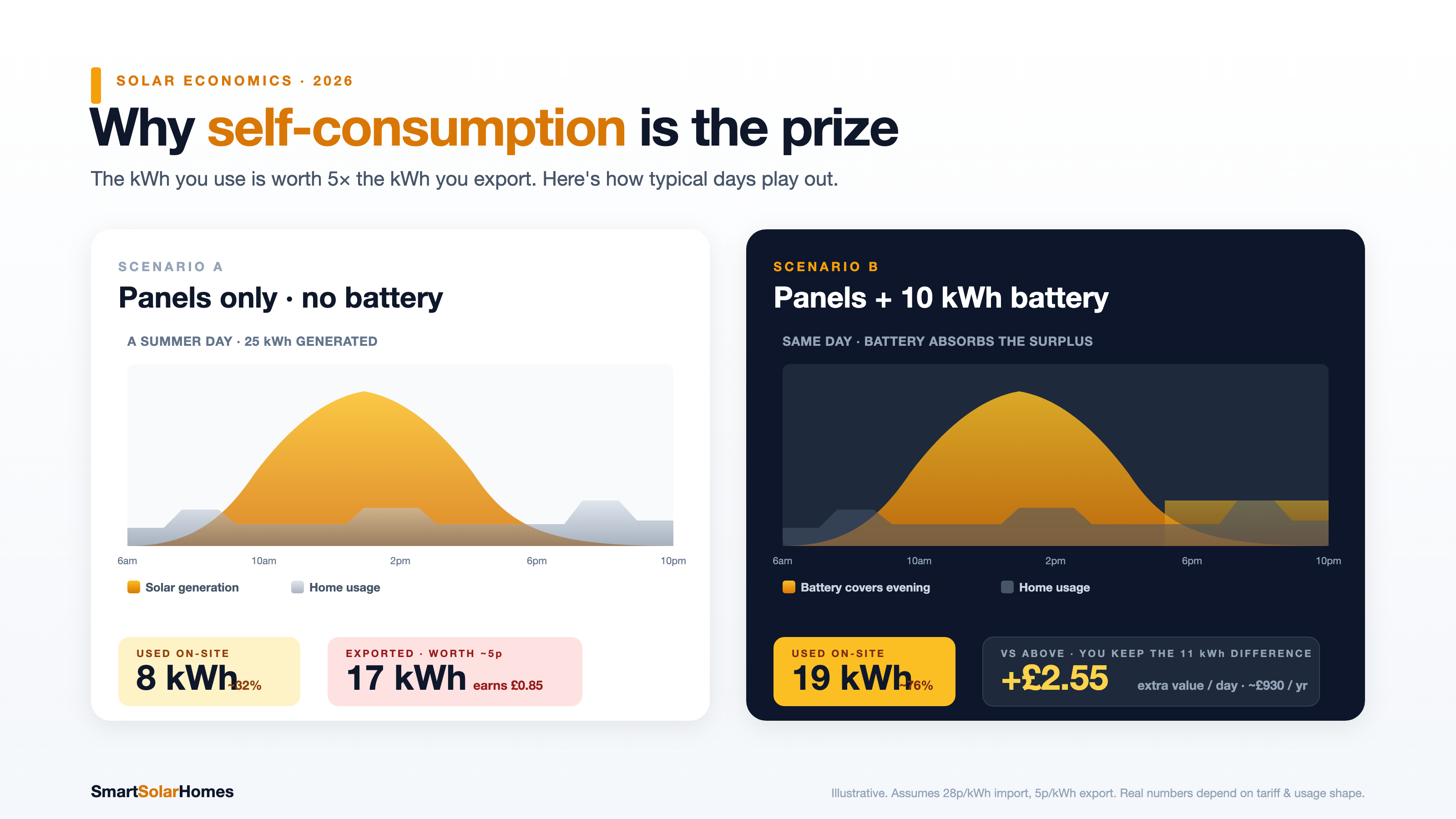
Daytime presence is the single biggest factor in whether solar panels are worth it. UK grid electricity costs around 25p per kWh to import under the Ofgem price cap (24.67p for the cap period to 30 June 2026; see What Is the UK Energy Price Cap? How It Affects Your Solar Savings for a full breakdown). Every unit of solar generation you use yourself — rather than exporting at a typical Smart Export Guarantee rate of around 13p — saves you roughly 12p (our explainer on how solar panels work walks through how that generation flows into your home). Households that are home during the day (remote workers, retirees, parents with young children, shift workers) can self-consume 30–45% of their generation without a battery. That's where most of the financial return comes from.
Moderate-to-high electricity consumption also helps. A household using around 3,500 kWh per year (the UK average for a 3-bed home) will see decent savings from a 4 kWp system. Add an EV (2,000–3,500 kWh extra per year) or a heat pump (3,000–5,000 kWh extra) and the case becomes considerably stronger — there's simply more demand to absorb cheap solar generation. See the full solar panel cost and savings guide for how these factors feed into payback calculations. If the difference between kW, kWh, and kWp is still unclear, our kW vs kWh explained guide walks through each unit with plain-English examples.
South-facing roofs optimise generation. Southwest- and southeast-facing roofs perform well too — typically 85–95% of south-facing output. East–west split arrays (half the panels on each side) can work on some roof types and have the advantage of spreading generation across more hours of the day.
The real return
A 4 kWp system generating around 3,400–3,800 kWh per year in central England, with around 30–35% self-consumed, saves roughly 1,020–1,330 kWh of grid imports per year — worth £250–£330 at current tariffs. Export of the remaining 65–70% under the Smart Export Guarantee adds perhaps £200–£330 per year at typical SEG rates of around 13p/kWh, though rates are supplier-set and range from roughly 3p to 15p. Total annual benefit: roughly £450–£660, against a system cost of around £6,000–£8,000. That implies payback somewhere in the 9–18-year range — which is why self-consumption matters so much. The detailed maths, including how tariff changes affect the numbers, is in the payback period guide.
A battery narrows the range significantly. Adding a 10 kWh battery (£4,500–£6,500) raises self-consumption to 55–70%, which substantially improves the energy cost savings even while extending the total investment. Whether the battery pays for itself in addition to the panels is a separate calculation — see are solar batteries worth it for the detailed ROI maths, or the broader home battery storage guide.
What weakens the case
North-facing roofs generate roughly 40–50% less than south-facing equivalents. The economics rarely stack up. An installer willing to fit panels on a north-facing roof without a clear site-specific justification is not acting in your interest.
Significant shading — from a chimney, neighbouring building, dormer window, or large tree — can cut generation substantially, far more than the affected area alone suggests, depending on your inverter setup. Microinverters or power optimisers can mitigate this but add cost — see our guide to the best solar inverters UK for a brand-by-brand comparison. If shading is moderate-to-severe, get a shading analysis done before committing. The cost by system size guide covers how to factor shading into your specification.
Rented or frequently moved households face a challenge: most of the return comes over 10–25 years, and there's no guarantee the next property will suit solar. Some installers argue panels add to property value, and there is some evidence for this, but it's not yet reliably quantified in UK valuations. If you are planning to sell, see our guide to selling a house with solar panels for the full process.
Very low daytime use with no battery and no plans to add one means a large proportion of generation is exported (typically ~13p under the SEG, though rates vary by supplier) rather than replacing imports at around 25p. The system still saves something, but the payback may stretch to 12–15 years or beyond.
What happens when you're always out during the day
This is one of the most common concerns, and it's legitimate. A household where both adults work full-time outside the home and return at 5–6pm will self-consume very little solar generation without a battery. Most generation occurs between 9am and 4pm; most household demand occurs in the morning before work and in the evening. Without intervention, perhaps 20–25% of generation is consumed — the rest is exported under the SEG (typically ~13p per unit).
The most cost-effective response is often smart appliances and time scheduling before investing in a battery. A dishwasher set to run at 11am, a washing machine set to 1pm, and a smart immersion heater that heats water from solar surplus between those hours can push self-consumption to 30–40% at essentially no extra cost. A battery takes this further, capturing the midday surplus and releasing it in the evening — but adds £4,500–£6,500 to the investment. Whether that's worthwhile for an out-all-day household depends on how much the panels generate and how much the household uses in the evening. See home battery storage for a detailed analysis of when the battery case is strongest.
Winter generation: a common concern
Solar panels do generate in winter — just less. A system that produces, say, 450 kWh in June may produce only 100 kWh in December. The upside is that winter generation tends to arrive in the middle of the day when you may well be home and using heating, lighting, and appliances. The full picture — including data on monthly UK generation patterns — is in do solar panels work in winter?. And if you have wondered why output sometimes dips on the hottest summer days, the answer is in our guide to the solar panel temperature coefficient.
Getting the most from the SEG
Whatever you don't consume, the Smart Export Guarantee ensures you're paid for. Rates range from around 3p to 15p per unit depending on your supplier and tariff — the SEG is supplier-set rather than a fixed rate, with the best widely-available tariffs paying roughly 12–15p. The difference between the worst and best SEG tariffs is meaningful over a year — for a 4 kWp system exporting 2,000 kWh annually, a 5p rate pays £100 while a 15p rate pays £300. Shopping for the best rate costs nothing and takes an afternoon. That said, even the best SEG rate delivers less value per unit than self-consumption at current import prices, so export optimisation is firmly a secondary strategy.
Grants and VAT: the financial context
Since April 2022, solar panel installations have been zero-rated for VAT in Great Britain. That removes 20% from the installed cost — on an £8,000 system, that's around £1,600 compared to the pre-2022 regime. The 0% rate runs until 31 March 2027, after which it reverts to 5% (Northern Ireland rules differ). The solar grants guide covers what else may be available depending on your household income and region. If you own a rental property, solar is also the most effective single measure to improve your EPC rating — often lifting a Band D home into Band C ahead of the October 2030 MEES deadline.
The bottom line
Solar panels are worth it for most UK homeowners with a suitable roof and moderate electricity use — particularly now, with grid prices high and system costs lower in real terms than at any previous point. The return is not dramatic but it is persistent: once the system is paid off, which typically takes 8–12 years, the savings continue for another decade or more. The households for whom it's genuinely marginal are those with significant shading, a predominantly north-facing roof, or very low daytime occupancy and no interest in adding a battery. Everyone else is worth at least getting a quote from a vetted MCS installer to assess. Before you start contacting companies, read our guide on how to choose a solar installer in the UK — MCS accreditation is the minimum bar, not the full story. If the environmental case matters to you as much as the financial one, see our guide on what your solar system actually contributes to net zero — the carbon payback figures may surprise you.
What is a solar panel lease — and can you get out of one?
The “free solar” model of the 2010s left tens of thousands of UK homes with panels they don't own. Between roughly 2010 and 2019, companies offered to install solar panels on your roof at no upfront cost in exchange for a 20–25-year lease over your roof space. The deal suited them because the Feed-in Tariff (FiT) — a government scheme paying a guaranteed rate for every unit of electricity generated — made the economics work handsomely when FiT rates were high. The homeowner got reduced electricity bills and free maintenance; the lease company got the FiT income. Ofgem closed the FiT to new applications on 1 April 2019, so no new lease-based schemes have been set up since. But the existing agreements — many with 10–15 years still to run — remain live on properties across the country.
Why a solar panel lease complicates a house sale
The lease attaches to the property, not the person. When a leased-solar home changes hands, the lease transfers to the buyer — and that is where friction arises. Mortgage lenders require that any lease over roof space meets the requirements set out in clause 5.20 of the UK Finance Mortgage Lenders' Handbook, covering things like the lender's ability to repossess and sell unencumbered. Many of the early rent-a-roof agreements pre-date these standards and are not compliant, meaning a deed of variation must be agreed with the lease company before a sale can complete — a process that can take several weeks and occasionally falls through entirely.
Sellers with leased panels should instruct their conveyancer early, well before the property goes to market, to check compliance and contact the lease company if a deed of variation is needed. Buyers should ask their solicitor to verify who owns the panels, what the remaining lease term is, and whether the lease has been registered at the Land Registry.
How to buy out or transfer a solar panel lease
Buying the panels outright is the cleanest solution and is the option most sellers pursue when a mortgage lender insists on clear title. Most lease agreements include an early buyout clause, though the price is set by the lease company and typically reflects the present value of the remaining FiT income they are giving up. Buyout costs vary significantly — some leases allowed early purchase for £1,000–£3,000 in the final years of a 25-year term, while others had eye-watering penalties in the early years, occasionally running to five figures. There is no standard figure; you must contact the lease company directly for a quote.
Novating (transferring) the lease to the buyer is the alternative. The buyer takes on the lease in the same terms as the seller, gaining the benefit of reduced electricity bills. This is legally straightforward if the lease meets lender requirements, but some buyers and their lenders will still object to taking on a long-term encumbrance they had no part in negotiating.
If the lease company has dissolved, the situation is more complex. If the company went into liquidation and the liquidator disclaimed the lease, the panels may have become a fixture of the property — arguably passing to the freeholder — or the company's rights may have become bona vacantia (passed to the Crown). Check the Land Registry to see whether the lease interest was transferred to a successor company before assuming the panels are yours. A property solicitor can advise on the specific position.
Does a lease still make financial sense for the homeowner?
For most households currently on a lease, the arrangement is broadly neutral to mildly positive: you benefit from free electricity during the day and zero maintenance costs, but the lease company keeps the FiT income (which, for pre-2012 installations, can be 43p per unit generated — a substantial sum). Whether to buy out depends on how many years of FiT remain, the buyout price, and whether you are selling. If you have fewer than five years on the lease and the buyout price is below ~£2,000, buying out may well be worthwhile to simplify the title and potentially improve your SEG earnings once you own the panels. If you are mid-lease and not selling, the free maintenance and bill savings often make staying on the lease the path of least resistance.
Solar panel lease: common questions
How do I know if my house has a solar panel lease? Check your title deeds (available from the Land Registry for a small fee) for any registered lease over your roof space. Your conveyancing solicitor can do this. You can also search the MCS Installations Database by address to see whether the panels were installed under an MCS-certified scheme and, if so, who the registered generator is. If the FiT generator is a company rather than your own name, the panels are almost certainly leased.
Can I get out of a solar panel lease? Yes, but the route — and cost — depends on your agreement. Most leases allow an early buyout at a price set by the lease company. Read your original lease agreement for the specific terms; if you no longer have it, your solicitor can obtain a copy from the Land Registry if it has been registered. You cannot unilaterally terminate the lease without the company's agreement.
Will a solar panel lease stop me selling my house? Not automatically, but it does add complexity. You are legally required to disclose the lease to the buyer, and some mortgage lenders will refuse to lend unless the lease meets UK Finance standards or the panels are bought out. Engaging a solicitor early — ideally before you list the property — gives you time to resolve any compliance issues without delaying your sale.
If you live in a flat or leasehold home, your options are more complex — read our dedicated guide to solar panels for flats and leasehold homes before deciding.
Export rates vary significantly between suppliers — see our British Gas SEG tariff review for a worked example of how the rates compare.
For a concrete sense of what your monthly outgoings look like after installation, see our breakdown of the average electricity bill with solar panels.
If you are also thinking about how solar affects resale price, the evidence is encouraging: see our detailed guide on whether solar panels add value to your home in the UK.
To protect your system's output over the long term, keep panels clean. Our guide to solar panel cleaning in the UK covers how often to clean, the best DIY method (deionised water and a soft-bristle water-fed pole), and how much professional cleaning costs — typically £80–£150 per visit.
For a broader overview of how to reduce your electricity bills beyond solar — including LED lighting, smart thermostats, battery storage, and EV charging — our full guide walks through every measure in order of cost and payback.
Equally important is knowing what your system is actually producing day to day. Our solar panel monitoring guide covers every inverter app, smart meter tool, and third-party platform available to UK homeowners — plus a clear method for spotting underperformance before it silently erodes your returns.
Another important practical step before installation is reviewing your home insurance. Solar panels constitute a material change to your property, and your policy must be updated to reflect the added value. Our guide to solar panels and home insurance explains exactly what buildings cover you need and the common gaps to watch out for.
Still unsure about common solar misconceptions? Read our solar panel myths debunked guide to separate fact from fiction before committing to a purchase.
If you are weighing up whether to lease or buy your system, our guide to the solar lease vs buy UK options explains the full financial trade-offs, including what happens to your SEG income under each route.
If you are exploring alternatives to upfront ownership, it is also worth understanding solar Power Purchase Agreements (PPAs) — a distinct structure where a third party owns the panels and you pay per unit of electricity generated. PPAs carry no upfront cost but tie you to a 20-year contract and mean you cannot claim SEG export income, so they suit a narrow set of circumstances.
When assessing the full lifetime value of a solar system, it is also worth understanding what happens at end of life. UK WEEE regulations mean the cost of recycling your panels falls on the producer, not you — our solar panel recycling UK guide explains your rights and the take-back process.
If roof installation isn't possible, community solar is worth exploring — you still access solar economics without owning panels.
If you are trying to cut costs further, some buyers look at buying secondhand solar panels instead of new ones — but be aware this usually rules out MCS certification and SEG export income, so weigh the saving carefully against a fully certified new system.
For a sense of how many UK homes have already made the switch, see our UK solar statistics and growth overview.
For a structured breakdown of benefits and drawbacks, our guide to the pros and cons of solar panels covers what installers don't always mention.
Installing solar panels can also improve your EPC rating, which may unlock green mortgage benefits — including lower interest rates and cashback from lenders including Nationwide, Barclays, Halifax, and HSBC. If you are remortgaging within the next few years, the EPC uplift from solar is worth factoring into your timing.
FAQs
Are solar panels worth it in the UK?
For most UK homeowners with a suitable roof and moderate electricity use, yes — reliably rather than spectacularly. A typical 4 kWp system costs around £6,000–£8,000 installed and saves roughly £450–£660 a year on bills and exports. Payback usually takes 8–12 years, after which savings continue for another decade or more. The case is weakest with heavy shading, a north-facing roof, or very low daytime occupancy.
Is solar worth it in the UK right now?
It stacks up particularly well at the moment, with grid prices high and system costs lower in real terms than at any previous point. Import electricity costs around 25p per unit, so every unit of solar you use yourself avoids that cost. The return isn't dramatic but it is persistent: once the system is paid off, the savings keep coming for years afterwards.
Should I get solar panels?
It depends mostly on your roof and your daytime habits. A south- or southwest-facing roof, reasonable daytime electricity use, and no serious shading make solar a sound choice. A north-facing roof, persistent shading, or an empty house until 6pm make the maths much harder. If you tick the first set of boxes, it's worth getting a quote from a vetted MCS installer to assess your specifics.
How much do solar panels save per year?
A typical 4 kWp system saves roughly £450–£660 a year in total. That splits into around £250–£330 from avoided grid imports (using the electricity yourself) and perhaps £200–£330 from exporting the surplus under the Smart Export Guarantee. Your actual figure depends heavily on how much generation you use yourself rather than export, since each self-consumed unit is worth more.
Are solar panels worth it without a battery?
Yes, though a battery improves the numbers. Without one, households that are home during the day can self-consume 30–45% of their generation, and that self-consumption is where most of the financial return comes from. Adding a 10 kWh battery (£4,500–£6,500) raises self-consumption to 55–70%, but whether the battery itself pays back is a separate calculation worth checking before committing.
Are solar panels worth it if I'm out all day?
The case is weaker but not hopeless. A household out until 5–6pm self-consumes very little — perhaps 20–25% without intervention — because most generation happens between 9am and 4pm. The most cost-effective fix is usually smart appliances and timing: running a dishwasher at 11am and a washing machine at 1pm can lift self-consumption to 30–40% at essentially no extra cost, before you consider a battery.
How quickly do solar panels pay for themselves?
A typical UK solar installation (3–4kWp, £5,000–£7,000 installed) pays back in 8–12 years through a combination of reduced electricity bills and Smart Export Guarantee (SEG) payments. The payback period shortens if you have high daytime electricity consumption, charge an EV from your panels, or add a battery with a time-of-use tariff like Intelligent Octopus Go. It lengthens on shaded or non-south-facing roofs. Using the Smart Solar Homes estimator with your actual usage data gives a more accurate figure than the industry average.
Are solar panels worth it on a north-facing roof?
A north-facing roof generates roughly 50–60% of the output of an equivalent south-facing system, according to Energy Saving Trust modelling. At that yield, payback periods typically stretch to 15–20 years — which can still be worthwhile if your roof is large enough to compensate with extra panels, or if you pair the system with a battery and a time-of-use tariff. An east-west split across a ridge is usually a better option than north-only, as east and west elevations together produce around 80–85% of south-facing output. See our full guide to solar panels on a north-facing roof.
Are solar panels worth it as a financial investment?
Over a 25-year system life, a well-sited UK solar installation typically delivers an internal rate of return (IRR) of 7–12% — meaningfully above a cash savings account and comparable to a medium-risk ISA. The investment is also index-linked in a sense: as electricity prices rise, the value of generation you avoid buying rises with them. The main risks are that you sell the property before payback, or that future electricity pricing changes the economics. Unlike financial investments, solar panels also reduce your carbon footprint — roughly 0.9 tonnes of CO₂ per kWp per year avoided in the UK grid mix, based on BEIS carbon intensity figures.
Sources — verified 5 June 2026
- Ofgem, “Changes to energy price cap between 1 April and 30 June 2026” — www.ofgem.gov.uk
- GOV.UK, “Smart Export Guarantee (feed-in tariffs / export payments)” — www.gov.uk
- Energy Saving Trust, “Solar panels” — energysavingtrust.org.uk
- HMRC / GOV.UK, “VAT on energy-saving materials and heating equipment (Notice 708/6)” — www.gov.uk
- MCS, “Smart Export Guarantee — consumer eligibility” — mcscertified.com
- Ofgem, “Feed-in Tariffs (FIT) — Scheme Closure” — www.ofgem.gov.uk
- UK Finance, “Solar panels and the Lenders' Handbook” — lendershandbook.ukfinance.org.uk
- MCS, “MCS Certificate Queries” — mcscertified.com

About the author
Sepehr
Solar specialist & co-founder, Smart Solar Homes
Solar specialist and co-founder of Smart Solar Homes, which works with MCS-certified UK installer partners. I write all the guides and reviews here; the aim is straight-talking education the industry rarely provides.
Citing this page? Please use a dofollow link back to the original article — it helps us keep the data on this page accurate and up to date.
Browse Solar Panels on Smart Solar Homes


Want to compare these side by side? Use the compare tool →
Or browse all Solar Panels on Smart Solar Homes.
Related reading
More on solar panels from the editorial team.
Find installers near you
MCS-certified solar installers covering these areas.