Solar Panels and Home Insurance: What Your Policy Must Cover

Written and reviewed by Sepehr. See our editorial policy.
Solar panels home insurance is something most homeowners give little thought to until something goes wrong. Adding a system worth £5,000–£8,000 to your roof is a material change to your property — and if you do not handle it correctly, a claim for storm damage or theft could be declined. This guide walks through exactly what your policy needs to cover, what to tell your insurer, and the gaps that routinely catch UK homeowners out.
Does standard home insurance cover solar panels?
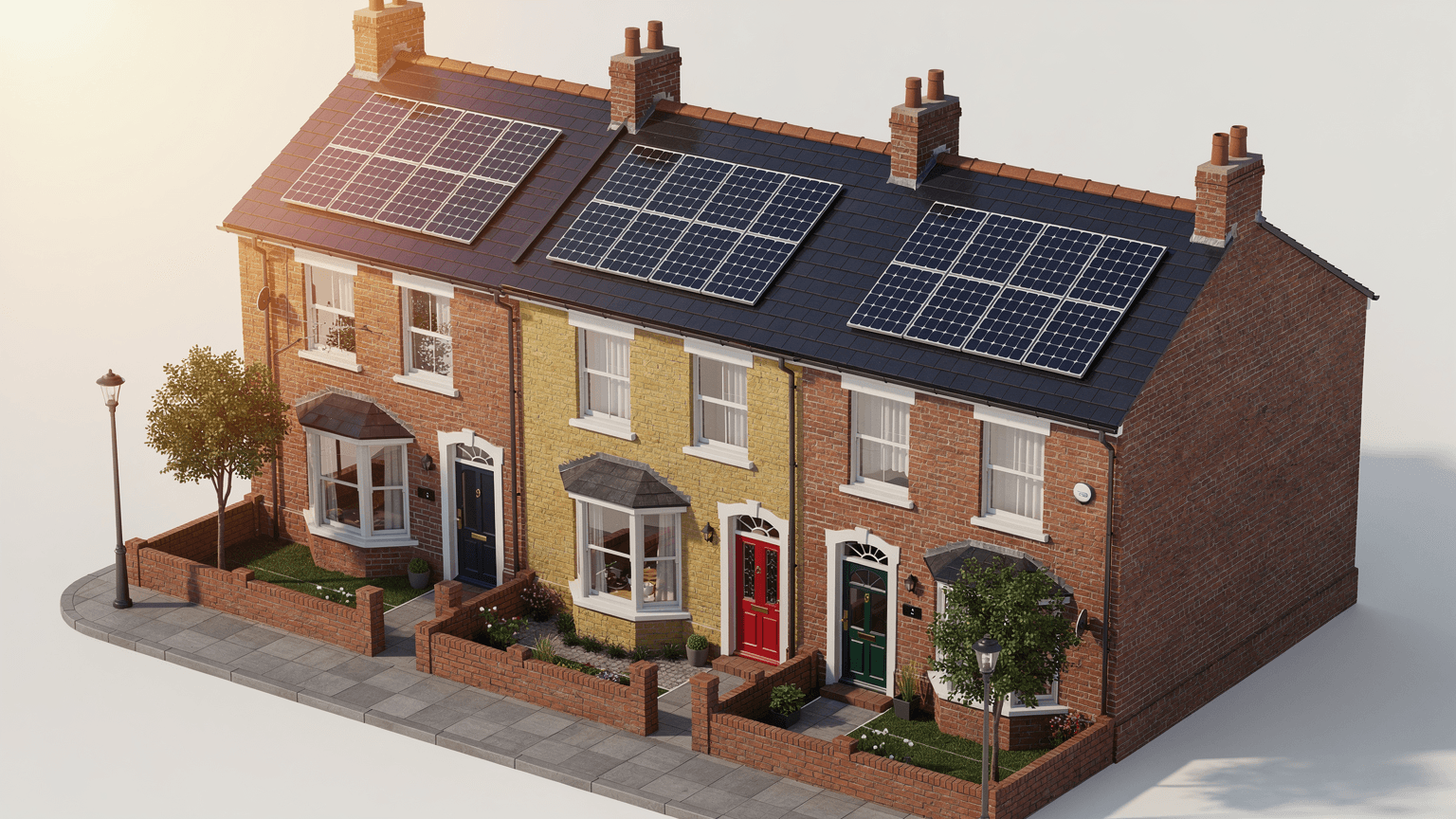
In most cases, yes — but only if you have told your insurer. Rooftop solar panels are permanently fixed to the structure of your home, which means they fall under your buildings insurance, not your contents policy. Major insurers including Aviva, Direct Line, and LV= treat panels as part of the building in the same way as a fitted kitchen or conservatory — they are covered for the same insured perils: fire, storm, flood, impact, theft, and vandalism — see our guide to solar panel theft and security for how likely theft actually is, the security fixings installers use, and what to do if it happens.
The critical catch is that adding thousands of pounds of equipment to your roof is classified as a material change in insurance terms. Most standard policy wordings require you to notify your insurer of any significant alteration to the property. Failing to do so could invalidate a claim, even if the solar panels were not the direct cause of the damage. According to MoneySuperMarket, insurers may refuse a claim or void a policy entirely if panels were installed without notification.
Freestanding panels — for example, ground-mounted arrays or balcony plug-in systems — are not covered under buildings insurance because they are not part of the structure. These may be claimable under contents insurance (if listed as high-value items) or may require specialist cover.
Buildings vs contents: which policy covers what
The buildings/contents split is straightforward for permanently installed systems:
- Rooftop solar panels: Buildings insurance. They are part of the fabric of the property.
- Solar inverter (wall-mounted indoors): Usually buildings insurance, as it is a fixed installation, but check your policy schedule — some insurers treat it as contents.
- Solar battery storage: The split is less clear-cut. A floor-mounted battery in a garage or utility room may be treated as contents; a purpose-built outdoor cabinet fixed to a wall is more likely buildings. Ask your insurer explicitly when you notify them.
- Portable or plug-in panels: Not buildings; may be contents if declared as a single high-value item, otherwise uninsured.
Before installation, the safest approach is to phone your insurer and ask them to confirm in writing which elements of the system will fall under each section of your policy. This prevents disputes at claim time.
What to tell your insurer — and when
Notify your insurer before installation begins, not after. This matters because some policies exclude damage arising from building work. Tell your insurer:
- The planned installation date — so they can note the change on the policy.
- The total installed cost of the system — panels, inverter, battery if included, and installation labour. For a standard 4 kWp domestic system, The Eco Experts cite a typical installed cost of £5,000–£8,000.
- Your updated rebuild value — add the full installed cost to your stated rebuild value. If your home's rebuild value was £250,000 and the solar installation cost £7,500, update the figure to at least £257,500. Under-insuring breaches most policy conditions and will reduce any payout proportionally.
- The installer's credentials — specifically, whether they are MCS-certified (see below).
Premiums will typically increase modestly — the additional insured value is relatively small as a percentage of most rebuild figures. According to The Eco Experts, the average UK buildings premium stands at around £119 per year, and the solar uplift is usually a small single-figure increase.
See our full breakdown of solar panel installation costs in the UK for a detailed look at system pricing by size.
MCS certification and your insurance
MCS (Microgeneration Certification Scheme) certification is not a legal requirement for solar installation, but it carries significant insurance implications. An MCS certificate is the document your MCS-certified installer issues after completing and registering your installation. It confirms the system meets recognised technical standards for design, equipment, and workmanship.
For insurance purposes, MCS certification matters in three ways:
- Claim credibility: In the event of a fire or electrical fault, insurers may investigate whether the installation was carried out to a recognised standard. A non-MCS installation that lacks documented compliance can be harder to defend in a disputed claim.
- Specialist policy eligibility: Some specialist solar insurers and riders require an MCS certificate as a condition of cover. Without it, you may be limited to standard buildings cover with no acknowledgement of the system's output value.
- Workmanship warranty: MCS-certified installers must provide a minimum two-year workmanship warranty under the Renewable Energy Consumer Code (RECC). This warranty sits alongside your insurance and is the first port of call for installation faults in the early years.
Read our detailed explainer on what an MCS certificate covers and why it matters for the full picture.
Does roof penetration affect structural coverage?
Roof penetration is a legitimate question — but rarely a problem when installation is done correctly. Solar panels are typically mounted on racking systems that fix to the roof structure with bolts passing through the tiles or slates. Each penetration point is sealed with flashing or a purpose-made boot to prevent water ingress.
Where insurers or surveyors raise concerns is when:
- The installation was done without proper waterproofing and has caused water ingress — this may not be covered if it is treated as gradual damage or wear and tear rather than a sudden insured event.
- The installer was not MCS-certified and the workmanship standard is disputed.
- The roof was already in poor condition before installation — pre-existing defects are almost always excluded.
A properly installed MCS-certified system carries an installation report confirming the penetrations were sealed to standard. Keep this documentation with your policy documents — it is your evidence if a roof leak is disputed post-installation.
Common coverage gaps to watch for
Standard buildings insurance will not cover everything. The most common gaps UK homeowners encounter are:
- Accidental damage by the homeowner: Knocking a panel with a ladder, for example, is typically excluded from standard cover. You need an accidental damage add-on — check your policy schedule or call your insurer to confirm.
- Loss of generation income: If your panels are damaged and offline for several weeks, standard buildings policies do not compensate for lost Smart Export Guarantee (SEG) payments or savings on electricity bills. Specialist solar insurance policies sometimes include a generation-loss clause — worth asking about if export income is material to your finances.
- Mechanical or electrical breakdown: Inverter failure not caused by an insured peril (fire, storm, etc.) is generally excluded. Your inverter warranty is the correct mechanism here; standard insurance is not designed to cover component end-of-life.
- Bird damage and fouling: Nesting under panels causing damage is a grey area and often excluded. Pigeon-proofing skirts are a practical preventive measure.
- Gradual deterioration: Normal degradation of panel output is not an insurance matter — it is covered (or not) by your performance warranty.
For a broader view of the financial picture — including how much your system could save and the payback period — see our guide on whether solar panels are worth it in the UK.
What to check in your policy before and after installation
Run through this checklist before your panels go up, and again at your next renewal:
- Does the policy schedule confirm rooftop solar panels are covered under buildings?
- Is the sum insured updated to include the full installed cost of the system?
- Is accidental damage cover included, or does it need to be added?
- Does the policy note the installation on record (get written confirmation)?
- Is the solar battery explicitly covered — and under which section?
- Are you holding your MCS certificate, installation report, and all warranty documents?
- Have you checked whether your policy excludes loss of generation income?
Wondering whether a hailstorm or heavy snowfall could actually damage your panels in the first place? See our guide to solar panels and UK weather for what the hail and snow-load standards actually test, and when (rarely) a claim would come into play.
FAQs
Do I need separate solar panel insurance?
Most UK homeowners do not need a standalone solar insurance policy — their existing buildings cover is sufficient provided they have notified the insurer and updated the sum insured. Specialist solar policies (offered by providers such as Howden) are worth considering if you have a large system (installed value over £15,000), want generation-loss protection, or cannot get your current insurer to confirm cover in writing.
Will solar panels increase my home insurance premium?
Yes, but usually only slightly. The additional insured rebuild value is modest relative to the overall property rebuild cost. Expect a single-digit percentage increase at most for a standard domestic system.
Are solar panels covered if they blow off in a storm?
Yes — storm damage is a standard insured peril under UK buildings policies. A properly racked system should not detach in normal UK wind conditions, but if panels are damaged or lost in a severe storm, a declared system under a valid policy should be claimable.
What if my solar installer goes out of business?
Your MCS workmanship warranty is with the installer directly. If they go out of business, check whether they were a member of a consumer code scheme (RECC or HIES) — both schemes have deposit protection and dispute resolution mechanisms that can help even when the installer no longer trades.
Sources — verified 7 June 2026
- MoneySuperMarket — Are Solar Panels Covered by Home Insurance? (2026) — www.moneysupermarket.com
- Citizens Advice — Buildings insurance (notifying insurers of home alterations) — www.citizensadvice.org.uk
- Intelligent Insurance — Are Solar Panels Covered by Home Insurance? — www.intelligentinsurance.co.uk
- Solar By Postcode — Solar Warranties and Insurance UK Guide — solarbypostcode.co.uk
- Howden Insurance — Solar Panel Insurance Quotes and Cover — www.howdeninsurance.co.uk
- MCS — Insurance Backed Guarantee products — mcscertified.com
- Solar Panels Network — Solar Panel Insurance UK: What You Need to Know in 2026 — www.solarpanelsnetwork.com
- GOV.UK, "Home contents insurance" — www.gov.uk
- Financial Conduct Authority, "ICOBS — Insurance Conduct of Business Sourcebook" — www.handbook.fca.org.uk
- Which?, "Does home insurance cover solar panels?" — www.which.co.uk
- Association of British Insurers, "Home insurance" — www.abi.org.uk

About the author
Sepehr
Solar specialist & co-founder, Smart Solar Homes
Solar specialist and co-founder of Smart Solar Homes, which works with MCS-certified UK installer partners. I write all the guides and reviews here; the aim is straight-talking education the industry rarely provides.
Citing this page? Please use a dofollow link back to the original article — it helps us keep the data on this page accurate and up to date.
Browse Solar Panels on Smart Solar Homes


Want to compare these side by side? Use the compare tool →
Or browse all Solar Panels on Smart Solar Homes.
Related reading
More on solar panels from the editorial team.

Find installers near you
MCS-certified solar installers covering these areas.