EV Charging With Solar Panels: The Complete UK Guide

Written and reviewed by Sepehr. See our editorial policy.
Adding an electric vehicle to a solar household raises an obvious question: can you fuel the car from the roof rather than the grid? The short answer is yes — but only if your charger is built to do it properly. Plugging a standard charger into a solar household and hoping for the best won't work; the car will draw heavily from the grid, not from your panels. This guide covers exactly what solar EV charging involves, which equipment qualifies, what the economics look like, and how to size and install a system that genuinely shifts grid miles to sun miles. For a focused practical walkthrough, see our step-by-step guide to charging your EV with solar panels.
How solar EV charging actually works
Solar panels generate power during daylight. Your home uses what it can; the rest is exported to the grid under a Smart Export Guarantee (SEG) tariff. Those export rates are supplier-set and typically run around 3–15p/kWh — useful, but modest. A solar-divert EV charger watches what your system is exporting and redirects that surplus into the car instead. The principle is simple: electricity that would earn you around 5p on the SEG instead saves you about 24.67p of imports (the Ofgem price-cap unit rate for 1 April–30 June 2026), a difference of roughly 20p per kilowatt-hour.
To do this, the charger needs real-time information about your generation and consumption. That information comes from a CT clamp (current transformer) fitted in your consumer unit. The clamp measures the current flowing through the live cable — whether you're importing or exporting, and by how much — and feeds that data to the charger's controller. Without the CT clamp, there is no solar divert; the charger is simply scheduling around a clock, not reacting to actual generation.
Solar divert begins from as little as around 1.4kW of surplus (6A at 230V, the minimum charge current for most Type 2 chargers). On a typical sunny day with a 4–6kWp system, you might sustain 2–4kW of surplus for several hours, adding 10–20 km of range for free each day the car is plugged in.
Solar divert modes explained
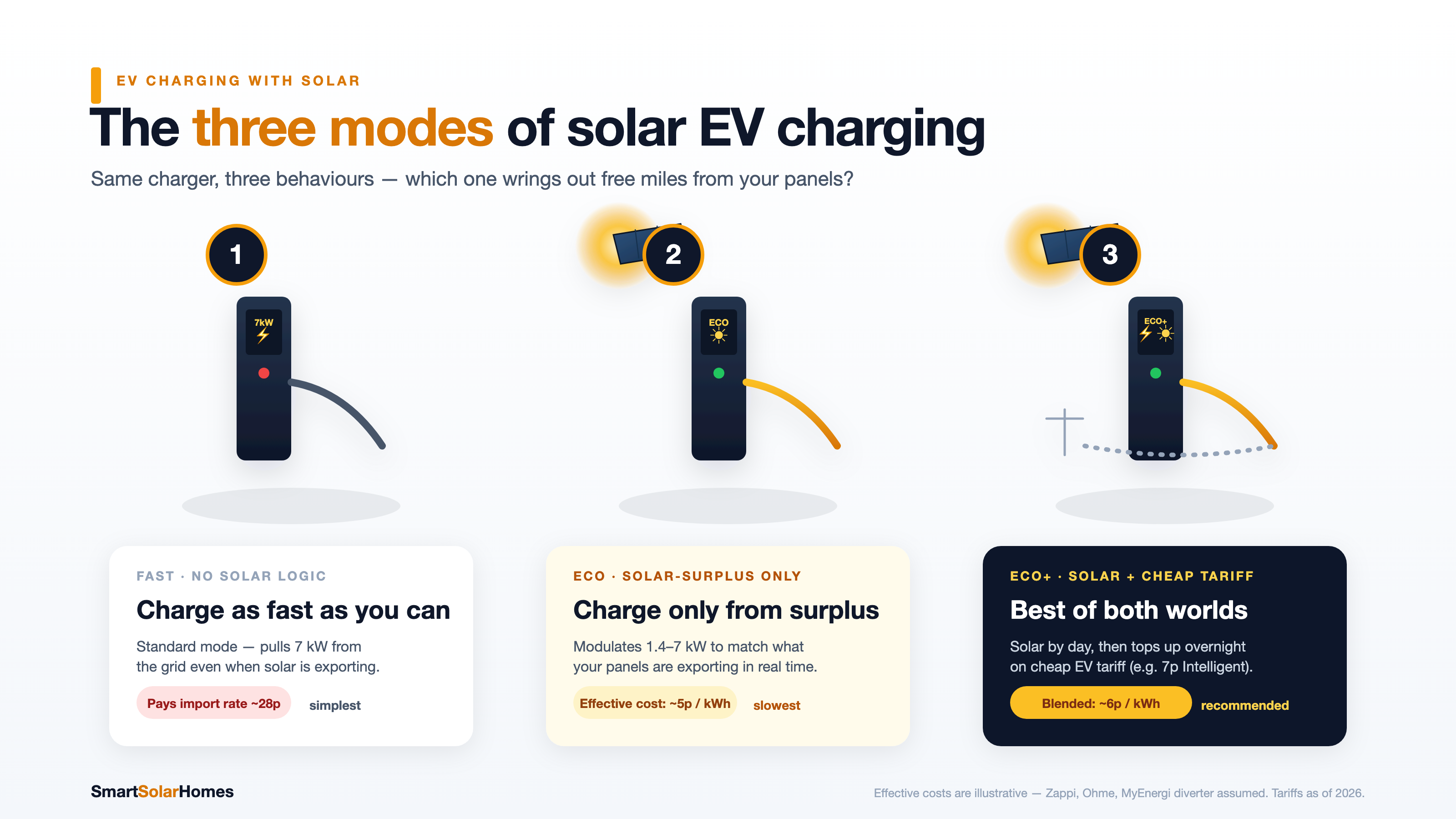
The best-known implementation of solar divert is the myenergi Zappi, which sets the benchmark for how the feature should work. It offers three modes:
- Eco mode: the charger draws the minimum charge current (6A) from the grid to keep the session alive, then tops up with any available solar surplus above that floor. You always charge, but you maximise solar use.
- Eco+ mode: the charger waits until there is enough solar surplus to cover the full minimum charge current. No grid is drawn at all. Charging pauses when surplus falls below 1.4kW and resumes when it rises again.
- Fast mode: standard grid charging at full rate, bypassing solar logic entirely. Useful overnight or when you need a quick top-up.
The Zappi's CT clamp connects at the consumer unit, reads your net import/export every few seconds, and adjusts the charge current in 1A steps. This granular control is what makes genuine solar divert distinct from mere scheduling.
Which chargers offer genuine solar divert?
The distinction between genuine solar divert and smart scheduling is important. Genuine solar divert reacts in real time to your generation, using a CT clamp or equivalent. Smart scheduling charges at pre-set times but cannot adapt to what your panels are actually producing.
Chargers with genuine solar divert
- myenergi Zappi: the reference implementation. CT clamp included. Eco, Eco+, and Fast modes. Integrates with the myenergi hub and Home Assistant. Available at Zappi V2 product page.
- Hypervolt Home 3: genuine solar divert with IP65 weatherproofing, suitable for exposed installations. Requires the Hypervolt energy monitor (a CT-clamp device sold separately). See the Hypervolt Home 3 product page for current pricing.
- Indra Smart PRO: solar divert with V2G (vehicle-to-grid) readiness on compatible vehicles.
Chargers without genuine solar divert
- Wallbox Pulsar Plus: smart scheduling and load balancing, but not solar-aware. It cannot respond to live generation data. Good for households without solar.
- Ohme ePod: integrates with Octopus Agile and similar dynamic tariffs to charge during cheap slots, but it is not solar-aware. It optimises around tariff pricing, not your export. The Ohme ePod remains a strong choice for dynamic-tariff users without solar divert needs — and our Zappi vs Ohme ePod comparison covers both in detail.
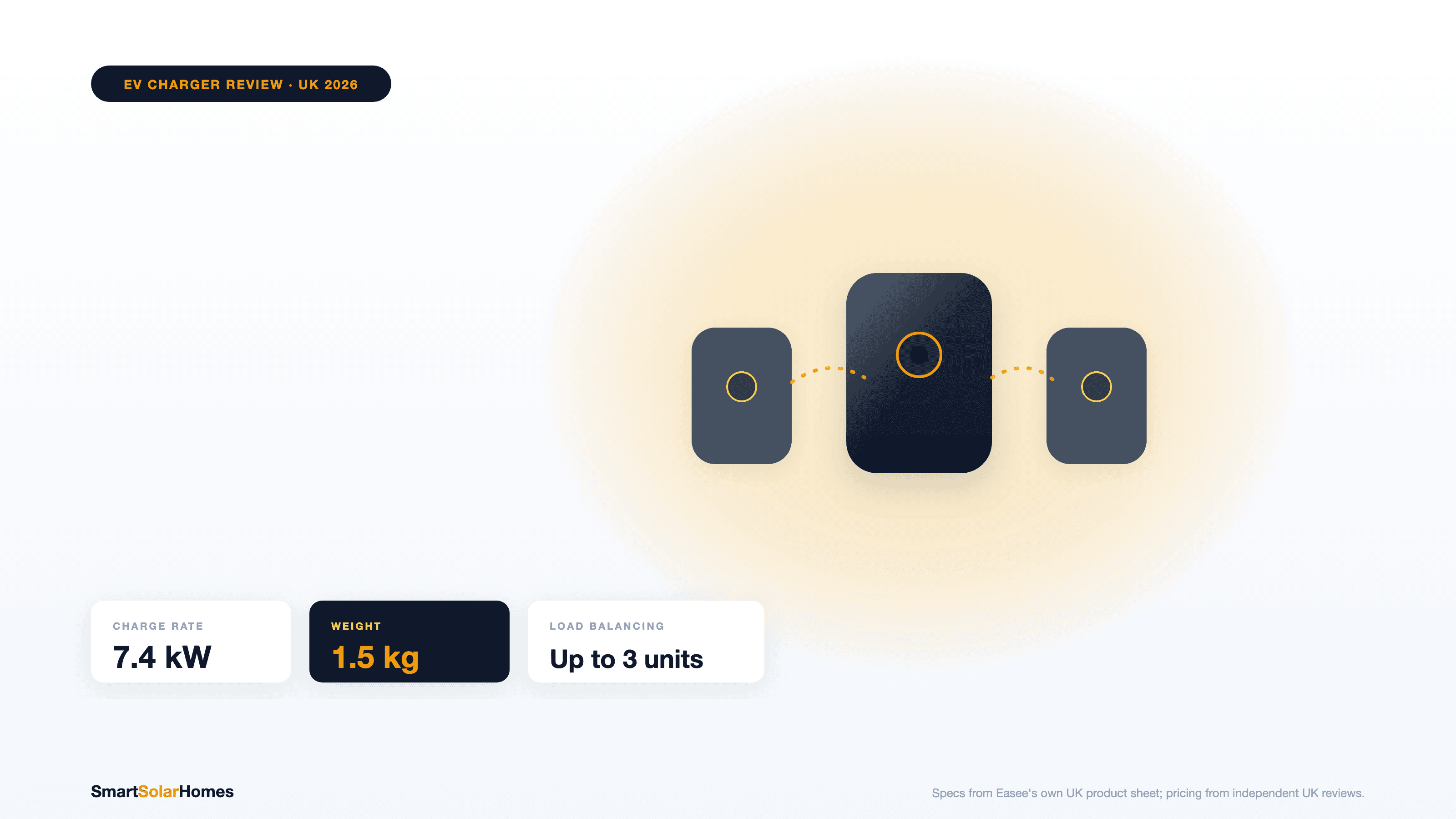
- Easee One: a popular charger with load-balancing and smart scheduling features, but do not expect native solar divert. The Easee One works well in households that prioritise managed grid charging; see our Easee One vs Zappi comparison to weigh it against a solar-divert model. If you are considering the ePod against a budget alternative, our EO Mini Pro 3 vs Ohme ePod comparison is also useful, and our full EO Mini Pro 3 review covers the spec sheet in more depth.
For a broader look at the category, the solar-compatible EV chargers explained article covers what “solar-compatible” really means and what to check before buying. The best EV charger for solar panels in the UK article ranks the current shortlist, and if you want the wider picture beyond solar divert our best home EV charger in the UK roundup compares the leading units overall. You can also browse the full EV chargers product range. If you're an Octopus Energy customer, our Octopus Energy EV charger guide covers the Intelligent Octopus Go tariff and how to stack cheap overnight rates with daytime solar.
The economics: is solar EV charging worth it?
An EV typically adds around 2,000–3,500 kWh per year of home electricity consumption, depending on annual mileage and efficiency. At an import rate of 24.67p/kWh (the Ofgem price cap for 1 April–30 June 2026), that is around £490–£865 per year in charging costs if you draw entirely from the grid.
Solar divert replaces some of those imports with surplus generation. If you divert around 3,000 kWh per year at a saving of roughly 20p/kWh (the difference between an ~5p SEG export rate and a 24.67p import rate), that works out to around £600 per year saved. In practice, the figure depends heavily on your driving pattern, the size of your solar array, whether you are home during daylight, and how much surplus your system generates after meeting household loads. A household that works from home with a 4kWp-plus array and drives regularly will realise the saving reliably; a household where the car is rarely plugged in during daylight will not.
Note on VAT: unlike solar panels and battery storage — which carry 0% VAT in Great Britain until 31 March 2027 — a standalone home EV charger is not on the zero-rated energy-saving materials list and is charged at the standard 20% rate. A Zappi typically costs around £700–£800 supplied and installed; a Hypervolt Home 3 somewhat more. Payback relative to a cheaper non-solar charger depends on how much surplus you divert.
Sizing your solar system for an EV
An EV does not require you to upsize your solar array, but it tilts the case for going larger. With a 3kWp system and average UK generation, you will produce around 2,500–2,700 kWh per year. Much of that goes to the house. An additional 2,000–3,500 kWh of EV demand means a significant portion will still come from the grid.
Moving to 5–6kWp generally produces enough surplus during spring and summer to shift a meaningful share of EV charging to solar, though winter charging will remain largely grid-dependent regardless of array size. Adding battery storage changes the calculation again: a battery can store midday surplus and release it for an evening charge session. For the full picture on system costs and likely generation output, our solar panel cost and savings guide is a good starting point. For a detailed worked example of how many extra panels cover typical UK EV mileage — including self-consumption rates and battery impact — see our solar panels for EV charging sizing guide.
Battery vs solar divert vs dedicated diverter: where should surplus go?
If you have solar, there are three main places surplus can go: a home battery (stores electricity for later use), an EV charger with solar divert (puts the energy into the car), or a solar diverter such as the myenergi eddi or immersun (sends surplus to an immersion heater for hot water). The right answer is household-specific. Our dedicated article on solar diverter vs battery vs EV charging works through the honest trade-offs; for the battery storage side of the question, the home battery storage guide covers costs, capacities, and payback in depth.
The short version: if you heat water with electricity or have an immersion cylinder, a diverter often offers the fastest payback at the lowest hardware cost. A battery offers the most flexibility and value on a time-of-use tariff. EV solar divert is most valuable if you drive regularly and the car is reliably plugged in during the day.
Installation
Solar divert chargers must be installed by a qualified electrician. In the UK, EV charger installation falls under the current wiring regulations, BS 7671:2018+A2:2022 (Section 722, updated by Amendment 3 in 2024), and typically requires a notification to your local authority building control or registration through a competent person scheme. The CT clamp itself is fitted in the consumer unit; this is not a job for a non-electrician.
The charger mounts on an external wall, post, or garage wall within a reasonable cable run of the consumer unit. Most chargers come with a 7.5m or 8m tethered or untethered cable. Installation typically takes around half a day — for a full walkthrough of EV charger installation UK: what to expect on the day, see our dedicated guide. If you are getting solar and a charger installed at the same time, some installers offer a combined quote.
To compare quotes from MCS-accredited installers, use our free quotes tool.
Practical considerations before installation
A few things are worth thinking through before you commit to a solar divert charger.
Your driving pattern matters more than your array size. Even a modest 3kWp system will generate surplus on clear spring and summer days. But if the car is rarely plugged in during daylight — because you drive to work and back, or the car lives elsewhere during the week — very little of that surplus will be captured. The best results come from households where someone is home most weekdays and the car is parked at home from mid-morning.
Summer and winter behave very differently. In June and July a south-facing 4kWp system might generate 25–30 kWh on a clear day, producing several hours of divert-eligible surplus. In December and January the same system might produce 3–5 kWh on a good day, most of which will be consumed by the house before the car sees any. Solar EV divert is primarily a spring-to-autumn feature. For year-round charging reliability, most households combine Eco+ daytime divert with a scheduled overnight charge.
The CT clamp must be correctly positioned. The clamp goes on the live conductor of the main import/export cable — the cable between the meter and the consumer unit — not on a generation feed or ring main. Incorrect placement leads to the charger misreading export and either failing to divert or drawing from the grid when it shouldn't. Your installer should be familiar with the correct placement for the charger brand they are fitting.
Consumer unit space. The CT clamp is small, but the installer needs room to work on the consumer unit. Some older or crowded boards can present challenges. If your consumer unit is due for replacement anyway, timing that alongside the charger installation can be efficient.
Where to go next
If you are ready to go deeper on a specific aspect, the following pages cover the detail: the practical setup guide walks through installation and configuration step by step; the solar-compatible chargers article explains what to look for before buying; and the best EV charger for solar panels shortlist narrows down the current options. For free, no-obligation quotes from local installers, use the quotes tool.
Before installing a charger, check whether you need planning permission for an EV charger — listed buildings and some flats are not covered by permitted development.
When sizing solar for EV charging, a 6kW solar system example is often the right baseline for a family with one electric vehicle.
A solar carport combines generation with covered EV charging — see our guide to solar carport EV charging setups.
Portable chargers lack CT clamp solar divert, but some support smart scheduling — see our guide to portable EV chargers and solar compatibility.
For more sophisticated solar/EV setups, a smart consumer unit setup for solar EV charging can manage surplus more granularly than a standard diverter.
Manufacturers are also extending this kind of load-balancing and solar-aware charging to buyers who do not already own their ecosystem hardware — see our news coverage of the Enphase IQ EV Charger 2 smart meter expansion to the UK, which now works standalone via a compatible smart meter rather than requiring an Enphase battery or solar system.
FAQs
Do I need a specific EV to use solar divert?
No. Solar divert is managed entirely by the charger and CT clamp. Any EV that accepts AC charging via a Type 2 connector will work. The charger modulates how much current it delivers; the car simply accepts whatever is offered above its minimum charge threshold.
Does solar divert work on a three-phase supply?
Yes, though the charger and CT clamp must be matched to the supply. Some chargers, including the Zappi, are available in single-phase and three-phase versions. On a three-phase supply you can charge at much higher rates (up to 22kW), though solar surplus rarely reaches that level on a domestic array.
Can I use solar divert without a battery?
Yes. Solar divert works independently of battery storage. You can add a battery later; the CT clamp setup is compatible with most battery inverter configurations, though the interaction between a battery and a solar divert charger needs to be configured carefully to avoid one drawing from the other unintentionally.
What happens on a cloudy day?
In Eco+ mode, the charger simply waits until surplus reappears. In Eco mode, it tops up from the grid at the minimum charge rate. Most households use Eco or Eco+ during the day and switch to scheduled overnight charging for reliability.
Sources — verified 5 June 2026
- Ofgem, “Changes to energy price cap between 1 April and 30 June 2026” — www.ofgem.gov.uk
- Energy Saving Trust, “Solar panels” (Smart Export Guarantee rates, self-consumption figures) — energysavingtrust.org.uk
- myenergi, “zappi EV Charger — Eco, Eco+ and Fast modes, CT clamp, 7kW/22kW” — www.myenergi.com
- Indra Renewable Technologies, “Smart PRO — solar matching above 1.4kW minimum” — www.indra.co.uk
- GOV.UK, “VAT on energy-saving materials and heating equipment (Notice 708/6)” — www.gov.uk
- IET, “BS 7671 FAQs — Electric Vehicle Charging Installations” — electrical.theiet.org
- Ofgem, “Smart Export Guarantee (SEG)” — www.ofgem.gov.uk

About the author
Sepehr
Solar specialist & co-founder, Smart Solar Homes
Solar specialist and co-founder of Smart Solar Homes, which works with MCS-certified UK installer partners. I write all the guides and reviews here; the aim is straight-talking education the industry rarely provides.
Citing this page? Please use a dofollow link back to the original article — it helps us keep the data on this page accurate and up to date.
Browse EV Chargers on Smart Solar Homes


Want to compare these side by side? Use the compare tool →
Or browse all EV Chargers on Smart Solar Homes.
Related reading
More on ev chargers from the editorial team.
Find installers near you
MCS-certified solar installers covering these areas.