Best Home EV Charger UK 2026: Buyer's Guide

Written and reviewed by Sepehr. See our editorial policy.
Finding the best home EV charger for a UK driveway is less about chasing the highest power figure and more about matching a unit to your home's electrics, your car and how you actually charge. Most single-phase homes are capped at 7kW anyway, so the real decisions come down to tethered or untethered cables, how good the app and scheduling are, whether you want it ready to pair with solar, and which installer you trust to fit it. This guide walks through all of that in plain terms, with honest cost ranges rather than invented precision, so you can shortlist a charger with confidence. Before buying, check our full checklist of home EV charger installation requirements to make sure your property is ready.
What to look for in the best home EV charger
Before comparing brands, it helps to know what separates a good home EV charger from a merely cheap one. Five things matter most: power rating, cable type, smart controls, build quality for the British weather, and how cleanly it integrates with cheap overnight tariffs (and, if you have them, solar panels). Almost every reputable unit sold here carries a three-year warranty as standard, is rated for outdoor mounting, and meets the regulations that came in with the Smart Charge Points Regulations 2021 — meaning it must default to off-peak charging windows and offer randomised start delays.
If you want to weigh several units side by side, our roundup of home EV chargers lists current models with specs and pricing, and the get quotes page connects you with installers who can confirm what your property needs.
7kW vs 22kW: why most homes cap at 7kW
The single biggest source of confusion is power. A standard UK home has a single-phase supply, and that physically limits a wall charger to 7.4kW (usually marketed as 7kW). That delivers roughly 20–30 miles of range per hour of charging, depending on the car’s efficiency — enough to refill almost any EV overnight from near-empty. A 22kW charger only works if you have a three-phase supply, which is rare in UK homes and expensive to install if you don't have it, often running into several thousand pounds for a DNO upgrade.
For the overwhelming majority of buyers, 7kW is the right and only sensible choice. You will not benefit from paying extra for a 22kW unit on single phase; it simply throttles back to 7kW. If you genuinely have three-phase power and a car that can accept it, 22kW is worth considering — but verify both before spending. Our explainer on EV charger speed and tethering goes deeper into the numbers if you want the full picture.
Tethered vs untethered
A tethered charger has the charging cable permanently attached, so you simply unwind it and plug in — convenient, tidier in daily use, and slightly cheaper to buy because the cable is included. The trade-offs are a fixed cable length (typically 5m or 7.5m) and a connector type locked to today's standard. Nearly all modern EVs use Type 2, so this is rarely a problem, but it does mean less flexibility if you change cars years down the line.
An untethered (or "socketed") charger has just a socket; you bring your own cable and plug it in each time. It's neater on the wall when not in use, future-proofs you against connector changes, and suits homes with two different cars. The downside is the faff of handling a cable each session and buying one separately (£100–£200). There is no universally correct answer here — pick tethered for everyday ease, untethered for flexibility and a cleaner look.
Smart features that actually matter
The label "smart" is now mandatory, but quality varies enormously. The features worth caring about:
Tariff scheduling. The whole point of charging at home is to use a cheap overnight EV tariff (often 7p–10p per kWh versus 25p+ at peak). The best units let you set charging windows easily, or integrate directly with tariffs like Intelligent Octopus Go so the charger and supplier coordinate automatically. A charger that fights you on scheduling will cost you real money over its life.
App quality. You'll live in the app: starting, stopping, scheduling and checking session costs. Look for stable, well-reviewed apps rather than flashy spec sheets. Plenty of capable hardware is let down by clunky software.
Load balancing. If your home's main fuse could be overwhelmed when the oven, shower and charger all run at once, dynamic load balancing throttles the charger to protect the supply. On older or lower-rated supplies this can be the difference between needing an expensive upgrade and not. Most quality installers will fit a CT clamp to enable it.
The chargers worth considering
A handful of units consistently make UK shortlists. None is objectively "the best" for everyone — it depends on your tariff, your need for solar and whether you value an integrated app over a minimalist look.
| Pick | Charger | Stands out for | Best for |
|---|---|---|---|
| All-rounder | Ohme Home Pro | Deep tariff integration; screen on the unit | Drivers wanting price-led automatic charging without fiddling |
| Design & app | Hypervolt Home 3 Pro | Polished app, sharp design, solid smart features | Buyers who value looks and software |
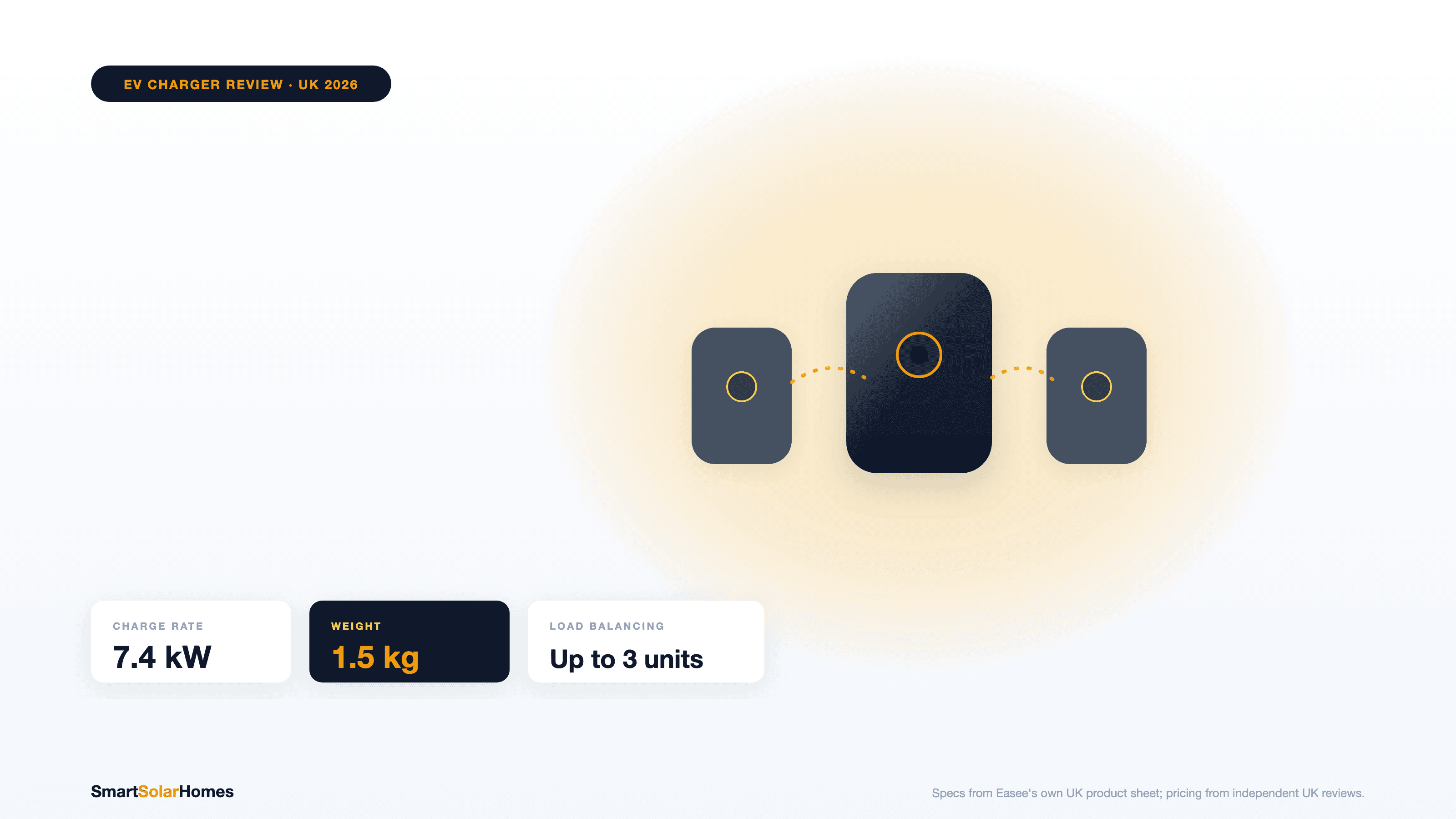
| Constrained supplies | Easee One | Compact and light; built-in load balancing | Homes on constrained electrical supplies |
| Solar owners | myenergi Zappi | Eco / eco+ solar-divert modes | Solar owners diverting surplus generation to the car |
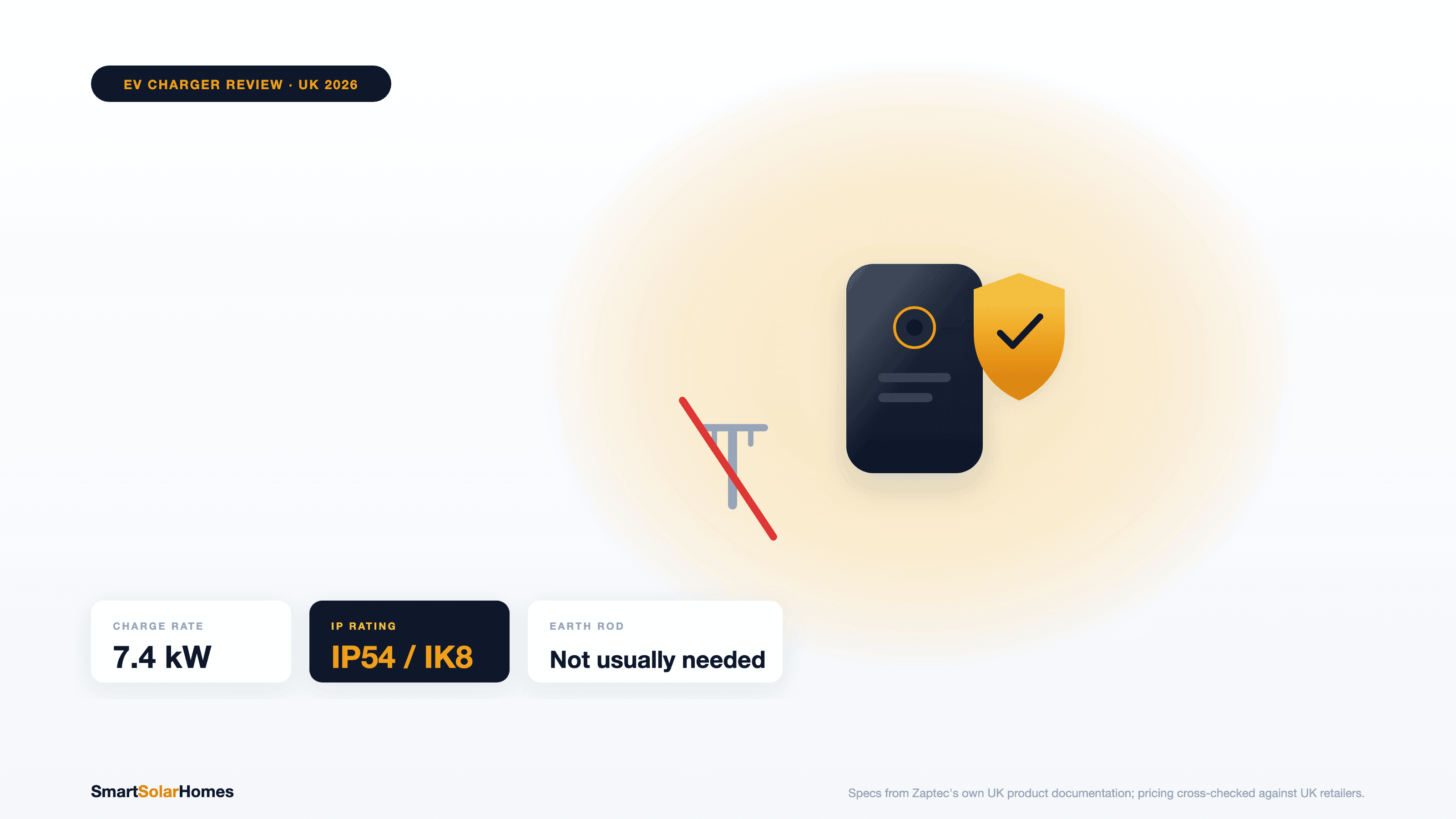
The Ohme Home Pro is a strong all-rounder, well regarded for deep tariff integration and a screen on the unit itself, which suits drivers who want price-led automatic charging without much fiddling. The Hypervolt Home 3 Pro earns its following for a polished app, sharp design and solid smart features, making it a popular choice where looks and software matter. The Easee One is compact, light and flexible, with built-in load balancing that appeals on constrained supplies, though some drivers prefer a chunkier unit. And the myenergi Zappi stands out for solar owners thanks to its eco modes, even if its tariff handling is less seamless than tariff-first rivals. If a long warranty matters more to you than pinpoint solar diversion, our Pod Point Solo3 review covers a charger backed by the longest standard cover in this list — 5 years on hardware and installation. If your supply is exposed outdoors or you want to skip the cost of an earth rod on a TN-C-S supply, our Zaptec Go review covers a compact, weatherproof charger with built-in PEN fault protection.
If you're torn between two of the popular options, our head-to-head on Zappi vs Ohme ePod lays out where each one wins, and our full myenergi Zappi review covers its solar-diversion modes, pricing and warranty in detail, and our full Ohme Home Pro review covers its pricing, tariff integration and Solar Boost feature in depth.
Home EV charger installation: what it involves and what it costs
Home EV charger installation is a regulated electrical job, not a DIY task. A competent installer will run a dedicated circuit from your consumer unit (fuse board) to the charge point, fit the appropriate protective devices, mount and commission the unit, and test the installation. A straightforward fit — charger near the board, short cable run, modern consumer unit with spare capacity — typically takes a few hours.
For a realistic budget, a standard home EV charger installation in the UK usually lands somewhere around £800–£1,400 all-in, including the charger and labour for a typical 7kW unit. The wide range reflects the unit chosen and the awkwardness of the job. Costs climb where the cable run is long, where the charger sits far from the board, or where groundworks are needed to reach a detached space. Always get an itemised quote and an on-site or photo survey before committing.
Crucially, use an installer who is competent and qualified for EV work — ideally registered with a scheme that was formerly the OZEV-approved list and who is part of a recognised competent-person scheme so the work can be self-certified to Building Regulations. Good installers notify the DNO (the local network operator) where required and handle the paperwork for you. You can line up vetted fitters through our quote service, which is the simplest way to compare specification and installation options on a like-for-like basis.
When a consumer-unit upgrade is needed
An older fuse board may lack the spare way, the modern RCD protection, or the overall capacity to take a charger safely. If yours is dated or already full, the installer may recommend a consumer-unit upgrade, which typically adds £400–£800 on top. It's worth flagging early so it doesn't surprise you on the day. A reputable installer will assess this during the survey rather than discovering it mid-job.
Pairing your home charging point with solar
If you have, or plan to add, solar panels, a home charging point can divert your surplus generation straight into the car instead of exporting it cheaply to the grid. This "solar divert" turns daytime sunshine into nearly free miles, and it's where chargers like the Zappi made their name with dedicated eco and eco+ modes that only draw power when you're generating a surplus.
Solar pairing is a distinct topic with its own trade-offs, so we cover it in depth elsewhere. Start with our guide to the best EV charger for solar panels, then read how EV charging with solar works in practice and which units make the cut in our list of solar-compatible EV chargers. If solar is on your horizon, choosing a divert-capable charger now saves swapping it later.
Choosing the best home EV charger for you
To pull it together: assume 7kW unless you've confirmed three-phase power; pick tethered for everyday convenience or untethered for flexibility; prioritise genuine tariff scheduling and a stable app over spec-sheet bragging; and budget around £800–£1,400 installed, with a possible consumer-unit upgrade on top for older properties. If solar is in your plans, lean toward a divert-capable model from the outset. Compare current models on our EV charger listings, and when you're ready, get tailored prices and a survey through our quote service so the figures reflect your actual home rather than a generic estimate.
Looking ahead: if you own a BYD Dolphin or a Nissan Leaf, you may also be eligible for vehicle-to-grid (V2G) charging through Octopus Power Pack — one of the only UK residential vehicle-to-grid options, which uses your car’s battery to support the grid in exchange for free charging (eligible car and bidirectional-charger combinations only).
Most home charger installs are permitted development, but there are exceptions — read our guide to EV charger planning permission to check your situation.
If a fixed charger isn't possible, our guide to portable EV chargers as a backup option covers the best OZEV-approved units.
Manufacturer smart-meter compatibility is also widening: Enphase has extended its IQ EV Charger 2 to the UK, adding load balancing and solar-aware charging via a compatible smart meter rather than requiring existing Enphase solar or battery hardware.
Once your charger is installed, don’t overlook the tariff it’s plugged into — our comparison of the best EV charging tariffs in the UK covers which suppliers pair well with which chargers, and the overnight rates on offer.
FAQs
How much does it cost to install a home EV charger in the UK?
Is a 22kW charger worth it for a home, or is 7kW enough?
Should I buy a tethered or untethered EV charger?
Can I install a home EV charger myself?
Which home EV charger is best if I have solar panels?
Sources — verified 14 June 2026
- Ohme, “Ohme Home Pro — tethered home EV charger with colour screen (7.4kW, 3-year warranty, tariff integration)” — ohme-ev.com
- Hypervolt, “Home 3 Pro Technical Specification (7.4kW, tethered Type 2, Eco/Super Eco modes, full app control)” — support.hypervolt.co.uk
- Easee, “Easee One — compact single-phase home charger up to 7.4kW with built-in load balancing” — easee.com
- myenergi, “zappi EV charger — 7kW/22kW, ECO/ECO+ solar self-generation modes, 3-year warranty” — www.myenergi.com
- Octopus Energy, “Intelligent Octopus Go (smart EV charging, automatic scheduling)” — octopus.energy
- The Electric Vehicles (Smart Charge Points) Regulations 2021, “Regulation 10 (off-peak charging) and Regulation 11 (randomised delay)” — www.legislation.gov.uk
- Energy Saving Trust, “Charging electric vehicles (install cost, 7kW power, range per hour)” — energysavingtrust.org.uk
- GOV.UK / OZEV, “Electric vehicle chargepoint grants” — www.gov.uk
- GOV.UK, “Building regulations approval: electrics (competent person scheme self-certification)” — www.gov.uk
- Octopus Energy, “Power Pack (vehicle-to-grid; eligible vehicles include BYD Dolphin and Nissan Leaf)” — octopus.energy

About the author
Sepehr
Solar specialist & co-founder, Smart Solar Homes
Solar specialist and co-founder of Smart Solar Homes, which works with MCS-certified UK installer partners. I write all the guides and reviews here; the aim is straight-talking education the industry rarely provides.
Citing this page? Please use a dofollow link back to the original article — it helps us keep the data on this page accurate and up to date.
Browse EV Chargers on Smart Solar Homes


Want to compare these side by side? Use the compare tool →
Or browse all EV Chargers on Smart Solar Homes.
Related reading
More on ev chargers from the editorial team.
Find installers near you
MCS-certified solar installers covering these areas.