Solar Diverter vs Battery vs EV Charging

Written and reviewed by Sepehr. See our editorial policy.
Every solar household eventually faces the same question: your panels are producing more than you're using — where should that surplus go? You have three main options. A solar diverter sends it to your immersion heater for free hot water. A home battery stores it as electricity for use later in the day. An EV charger with solar divert puts it in your car's battery as free miles. None of these is universally the right answer. The best choice depends on your household setup, your heating system, whether you own an EV, and how much surplus your array generates. This article sets out the honest trade-offs so you can decide which suits your situation. For the broader context on solar EV charging, see our complete guide to EV charging with solar panels.
Solar diverter: surplus goes to hot water
A solar diverter monitors your export and diverts surplus to your immersion heater instead of sending it to the grid. The most established UK options are the myenergi eddi and the immersun. Both use a CT clamp in the consumer unit and modulate the power sent to the immersion element in real time, so the divert closely follows generation rather than switching on and off crudely.
What it costs
A diverter unit typically costs around £300–£500 supplied and installed, depending on the brand and any additional wiring required. It is the cheapest of the three options by a significant margin.
What you save
The saving depends on what you currently pay for hot water. If you heat water with a gas boiler, the saving per kWh diverted is modest — around 6p/kWh, the unit cost of gas under the Ofgem price cap, not the full import rate. If you heat water electrically, you save the full import rate for each kWh diverted — around 25p/kWh under the current Ofgem cap. Electric water heating on a standard tariff therefore makes a diverter an attractive proposition.
Who it suits
A diverter is well suited to households with an electric immersion cylinder (common in all-electric homes or as a backup in homes with a heat pump). It needs no changes to your car or EV charger setup. It is often the lowest-cost, fastest-payback way to use surplus — particularly if you already heat water electrically and have a reasonable-sized array.
To compare the two main UK diverter units head to head, see our immersun vs myenergi eddi comparison or our full best solar diverter UK review: eddi vs iBoost+.
Home battery: surplus stored as electricity
A home battery stores your solar surplus as electricity and releases it when the panels are not generating — typically in the evening. Instead of exporting at a supplier-set Smart Export Guarantee rate (typically around 3–15p/kWh), you use that stored electricity at home and avoid imports at around 25p/kWh. The GivEnergy All-in-One is a widely installed UK option combining inverter and battery in a single unit.
What it costs
Home batteries are the most expensive of the three options. A 5–10kWh system typically costs around £4,000–£8,000 installed, depending on capacity, brand, and whether your existing inverter is compatible. Costs vary significantly; get multiple quotes before committing.
What you save
The saving is the avoided import rate for every kWh you store and use at home rather than exporting and re-importing later. On a standard tariff this is broadly similar to a diverter, but the battery's advantage is flexibility: you can store surplus at any time and use it when demand is highest, including on an evening peak. On a time-of-use tariff such as Octopus Go or Agile, a battery can also be charged cheaply overnight and discharged during expensive periods, adding further value independent of solar generation.
Who it suits
A battery suits households with a larger array that generates meaningful surplus, significant evening consumption, and ideally a time-of-use tariff. Payback periods are typically around 8–12 years at current prices and tariffs; the case improves as electricity prices rise and battery costs fall. Note that battery storage qualifies for 0% VAT in Great Britain until 31 March 2027. Our home battery storage guide covers the economics, main brands, and installation in depth.
EV solar divert: surplus goes into the car
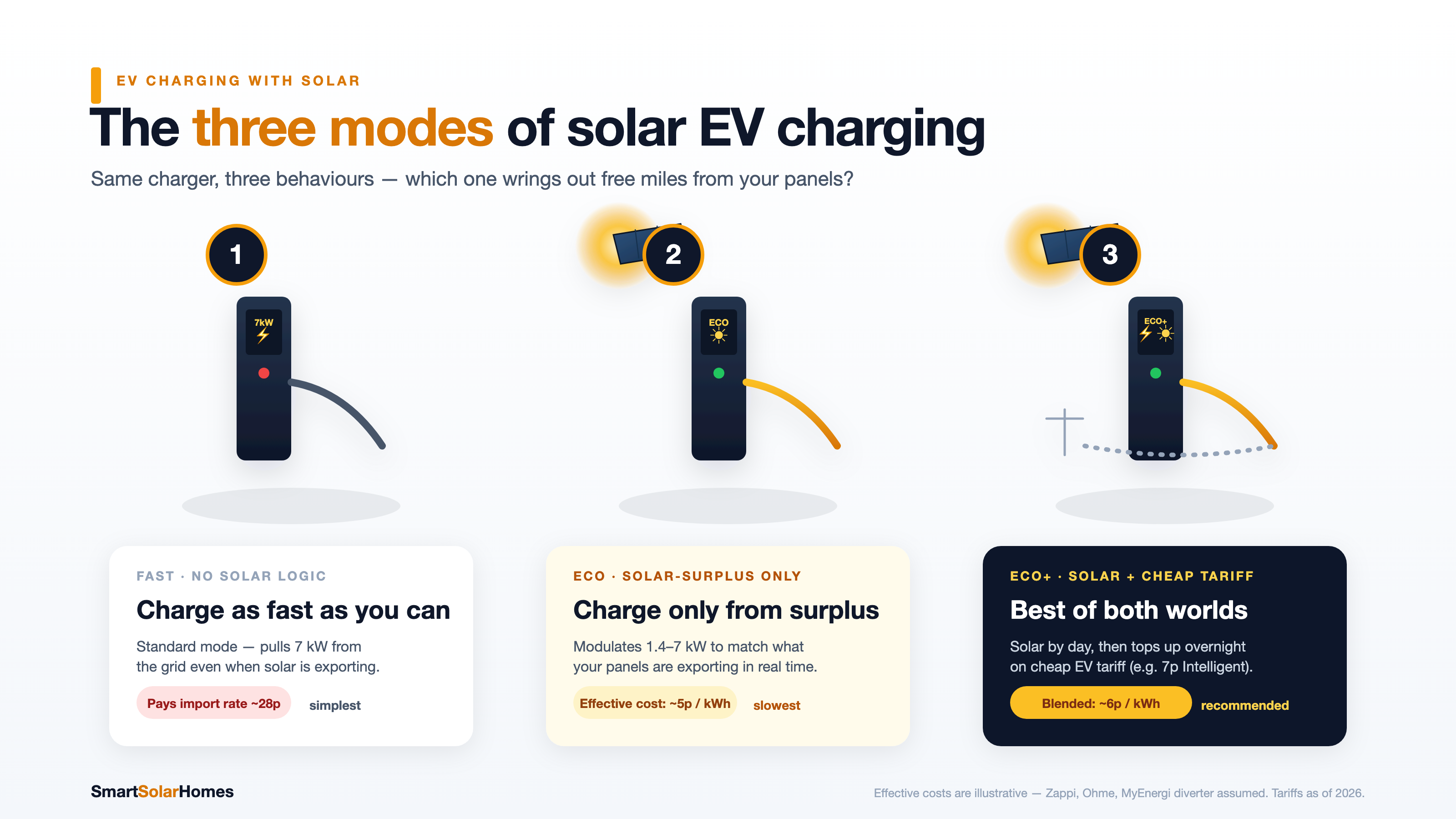
An EV charger with solar divert — most notably the myenergi Zappi — monitors your export via a CT clamp and routes surplus into the car's battery. You can think of the car as a large, mobile battery that happens to be plugged in during the day. Each kilowatt-hour diverted into the car instead of being exported saves the difference between the import rate you avoid (around 25p) and the export rate you forgo (typically around 3–15p) — broadly the same economics as a home battery, but the energy ends up as miles rather than household electricity.
What it costs
A solar-divert EV charger such as the Zappi typically costs around £900–£1,200 installed — less than a home battery but more than a diverter. Note that a home EV charger fitted on its own carries 5% VAT under the energy-saving materials rules; only when the charger is installed as part of a wider qualifying solar PV or battery package in the same contract does the 0% rate apply.
What you save
If you divert around 3,000 kWh per year at a net saving of around 15p/kWh (the avoided import rate less the export rate you forgo), that is around £450 per year. The saving is conditional on the car being plugged in and present during daylight regularly. A car that is mostly away from home during the day will not capture much surplus.
Who it suits
EV solar divert suits households where the car is regularly plugged in at home during daylight — notably those with someone working from home, or households with two cars where one is often parked. It works best with a 4kWp-plus array generating meaningful surplus. For the practical setup details, our article on how to charge your EV with solar panels covers CT clamp fitting and charge modes.
Can you combine them?
Yes, and many households do. A Zappi for EV divert and an eddi for hot water can both share a single CT clamp and controller hub (the myenergi hub handles priority between them). A home battery alongside either is also common. The question then becomes one of priority: when surplus is limited, which device gets it first? myenergi's system allows you to set priority between the eddi and Zappi. Adding a battery into a system with a Zappi requires careful configuration to ensure the battery isn't charging the car via the battery rather than from generation directly.
A quick comparison
- Solar diverter: lowest upfront cost (~£300–£500), fast payback if you heat water electrically, no EV required.
- Home battery: highest upfront cost (~£4,000–£8,000), most flexibility, best value on time-of-use tariffs, independent of car presence.
- EV solar divert: mid-range upfront cost (~£900–£1,200 for charger), strong saving per kWh, requires car to be home during daylight.
There is no universal winner. If your car is regularly home during the day and you drive enough to keep the battery below full, EV divert often makes the most of your surplus. If the car is mostly absent or you don't own an EV, a diverter or battery will capture the same surplus more reliably. For quotes on any of the above, our free quotes tool connects you with local MCS-accredited installers.
If you're considering skipping battery storage altogether, our guide to solar panels without battery storage explains when that makes financial sense and how to decide.
Pool heating can be included in a solar divert comparison alongside battery and EV — see our guide to solar surplus for pool heating.
A smart consumer unit automates the switching decisions that a diverter handles manually — our guide covers smart consumer units for automated solar switching.
FAQs
Is a solar diverter or a battery better for using surplus solar?
How much can an EV solar diverter save per year?
How long does a home battery take to pay back?
Can I combine a solar diverter, battery and EV charger?
Is a solar diverter worth it if I heat water with gas?
Sources — verified 5 June 2026
- Ofgem, “Changes to energy price cap between 1 April and 30 June 2026” — www.ofgem.gov.uk
- Ofgem, “Energy price cap unit rates and standing charges” — www.ofgem.gov.uk
- HMRC / GOV.UK, “VAT on energy-saving materials and heating equipment (Notice 708/6)” — www.gov.uk
- Energy Saving Trust, “Solar panels” — energysavingtrust.org.uk

About the author
Sepehr
Solar specialist & co-founder, Smart Solar Homes
Solar specialist and co-founder of Smart Solar Homes, which works with MCS-certified UK installer partners. I write all the guides and reviews here; the aim is straight-talking education the industry rarely provides.
Citing this page? Please use a dofollow link back to the original article — it helps us keep the data on this page accurate and up to date.
Browse Solar Diverters on Smart Solar Homes


Want to compare these side by side? Use the compare tool →
Or browse all Solar Diverters on Smart Solar Homes.
Related reading
More on solar diverters from the editorial team.


Find installers near you
MCS-certified solar installers covering these areas.