Best EV Charger for Solar Panels UK 2026: Solar Divert Explained

Written and reviewed by Sepehr. See our editorial policy.
If you have solar panels — or are planning them — the EV charger you buy matters more than most homeowners realise. A solar-divert charger converts your roof surplus into miles in your car, instead of exporting it to the grid for a few pence per kWh. The right choice can pay for itself in 2–3 years. The wrong choice costs you the £200–£300 premium of a smart charger and delivers none of the benefit.
This guide explains how solar divert actually works, which UK chargers do it properly, and how to think about charger choice if you also want time-of-use tariff integration with Octopus Agile, Intelligent Octopus Go, or similar.
What "solar divert" actually means
Solar divert is the ability of a smart EV charger to monitor your home's net export to the grid in real time, and only deliver power to the car when there is surplus solar to send. The car effectively absorbs what would otherwise be exported at SEG rates (typically around 3–15p/kWh, supplier-set and unregulated) and uses it at the value of avoided grid imports (the Ofgem price-cap unit rate is 24.67p/kWh for 1 April–30 June 2026) — broadly a 2–5x uplift per kWh.
Two requirements make this work:
- A current-transformer (CT) clamp on your incomer: the charger needs to see your net import/export at the meter to know whether you're exporting solar.
- Variable-rate charging from low (around 1.4kW for a 6A single-phase minimum) up to the panel surplus, smoothly: not all "smart" chargers can do this. Many can only dump fixed-rate 7.4kW, which means they can't track partial solar surplus.
The chargers worth knowing about
In the UK market in 2026, four chargers have credible solar divert capability:
myenergi Zappi v2.1
The reference standard. Three modes: Fast (constant 7.4kW from the grid, ignores solar), Eco (uses available solar plus grid top-up to maintain at least 6A), and Eco+ (uses only surplus solar, pauses when surplus falls below 1.4kW). The Eco+ mode is what makes the Zappi different from most rivals.
The Zappi has its own ecosystem — when paired with a myenergi Eddi (a solar immersion diverter that dumps surplus to your hot water cylinder), Hub (cloud monitoring), and Libbi (battery), the four devices share a single CT clamp and coordinate automatically. Price: around £779 installed. 3-year warranty. See the Zappi product page for full specs.
Best for: any household with solar that wants set-and-forget surplus diversion. Worth the premium over commodity chargers if your panels are 4kWp or larger.
Ohme ePod (and ePro)
Tariff-smart rather than solar-smart. The ePod connects to Octopus Energy via API and reads half-hourly Agile pricing to schedule charging when grid electricity is cheapest. It does not have a CT clamp and does not do real solar divert — claims to the contrary are marketing.
Hardware price: around £499–£599 (ePod) inc. VAT, before install labour. If you go through Octopus Energy's own turnkey install service, the ePod starts from £949 including installation, engineer commissioning, and Intelligent Octopus Go setup — a fuller quote than the bare hardware price. 3-year warranty. See the Ohme ePod product page.
Best for: households on Octopus Agile or Intelligent Go without solar, or with solar where the panel array is too small to do meaningful daytime EV charging anyway.
Indra Smart PRO
UK-designed, supports both solar divert and tariff-smart charging. Two CT clamps included. Open OCPP protocol means it works with multiple back-end management platforms, including Octopus Intelligent. Price: around £750 installed. 5-year warranty (industry-leading).
The interface is less polished than the Zappi's app, but the open standards and warranty terms are compelling for people who want flexibility.
Hypervolt Home 3
Solar divert via CT clamp, tethered cable, OCPP compatibility. Sleek design. App-controlled tariff scheduling and load balancing. Price: around £899 installed. 3-year warranty.
The Home 3 is the design-conscious choice. Functional parity with Zappi for solar households, slightly nicer hardware aesthetics, app is less mature than myenergi's. See the full Hypervolt Home 3 Pro review.
Chargers that don't do real solar divert
Plenty of chargers are marketed as "compatible with solar" but only support fixed-rate scheduled charging or simple PV-mode switching (charge only when daytime). These miss the entire point of solar divert, which is dynamic real-time tracking of net surplus.
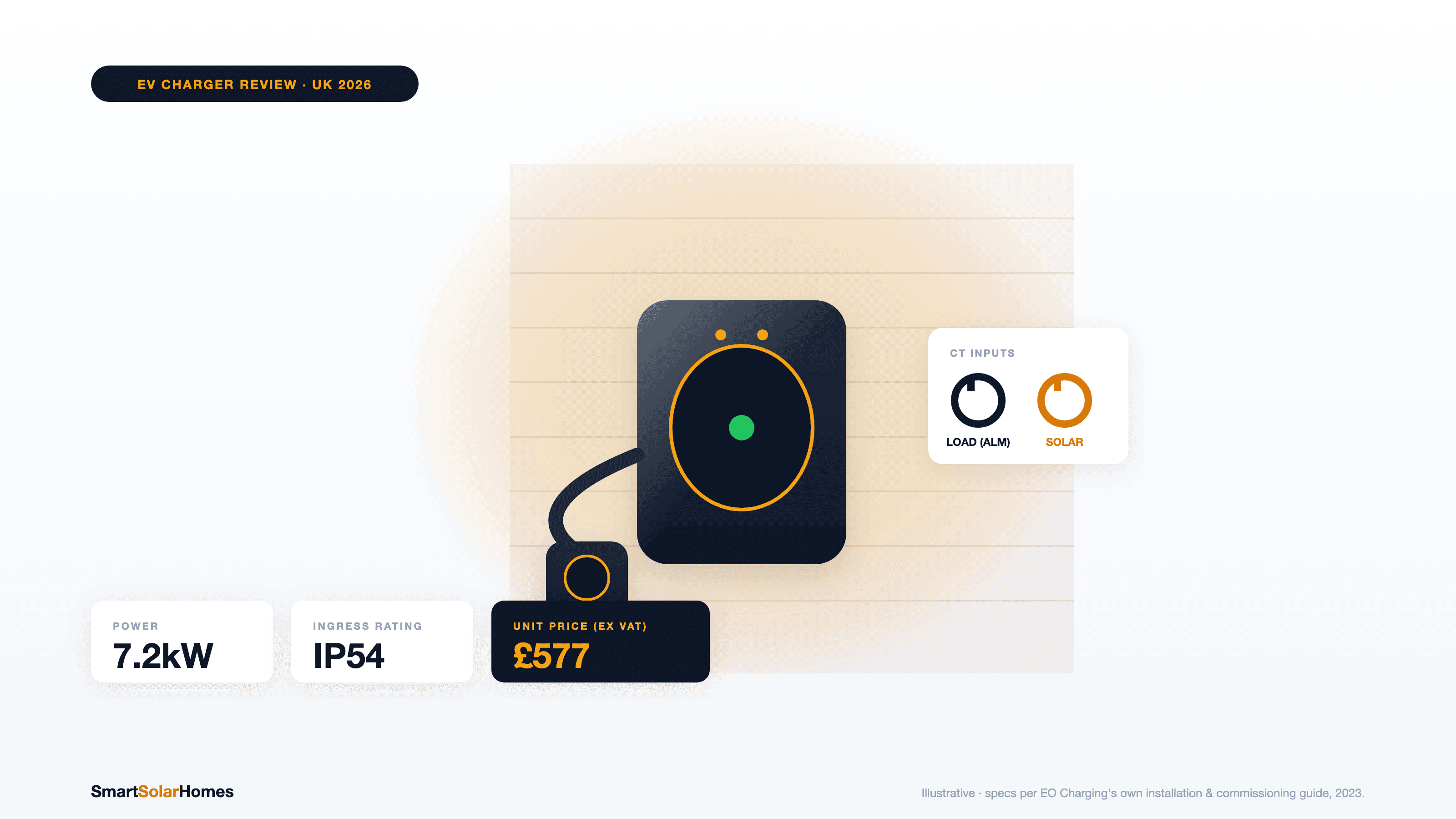
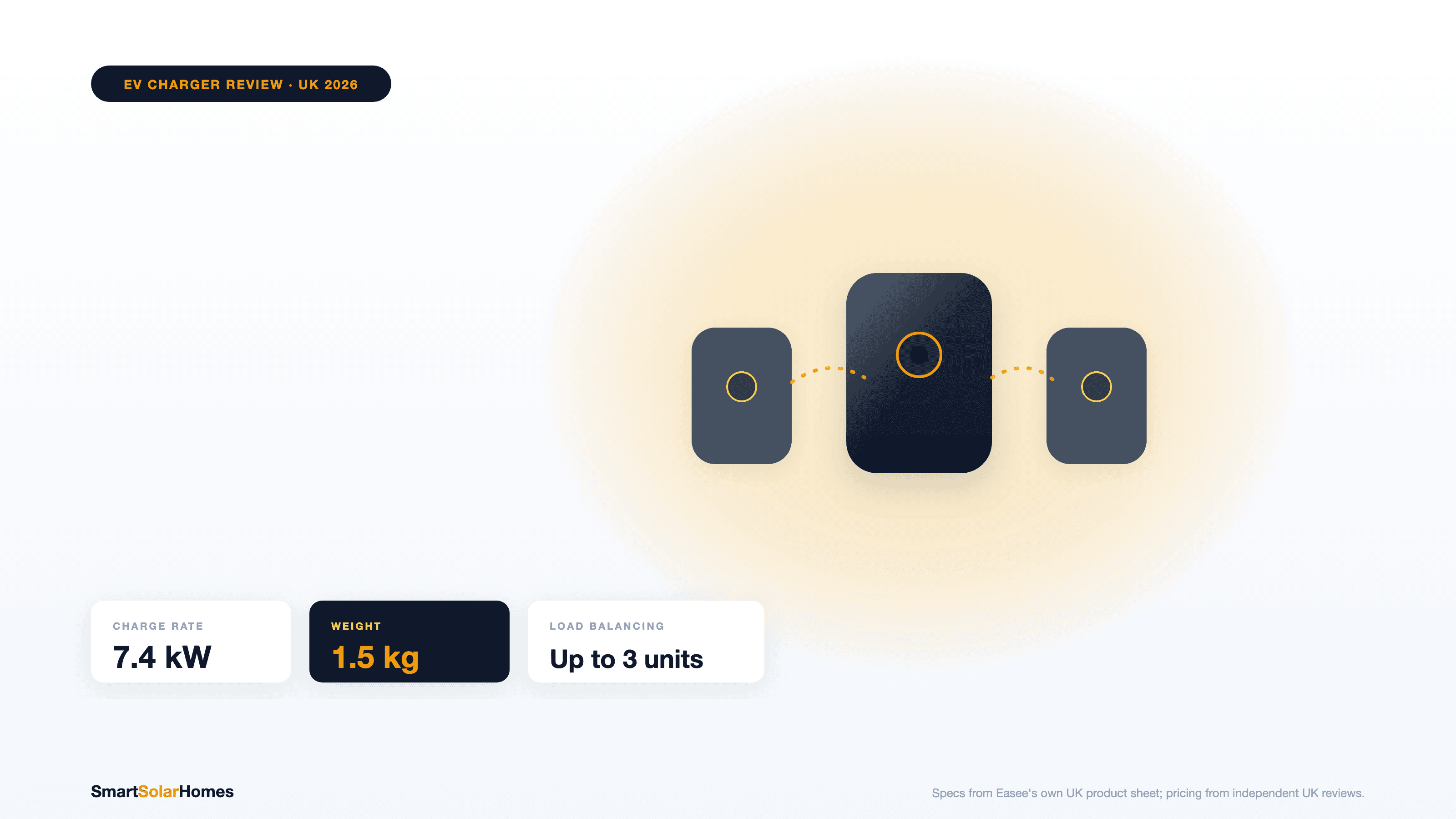
Notable mentions: Pod Point Solo 3 (good charger, no solar divert), EO Mini Pro 3 (no solar divert), Wallbox Pulsar Plus (claims solar divert but requires the additional Power Boost module and CT — read the small print), Easee One (no native solar divert, no CT). These are good chargers, but for solar households they leave money on the table.
How much does solar divert actually save?
Indicative numbers for a UK household with a 6kWp south-facing system charging an EV for 8,000 miles/year (around 2,200 kWh of EV electricity):
- Without solar divert, charging on the standard price-cap rate (24.67p/kWh): around £540/year
- Without solar divert, charging on Intelligent Octopus Go (8p off-peak): around £175/year
- With Zappi Eco+, ~50% from solar divert (free at 4p SEG-loss opportunity cost) + rest off-peak: around £85/year
- Zappi solar divert + Intelligent Go for top-up: around £55/year
For a 6kWp solar household, the Zappi premium over a basic charger pays back in 2–4 years. For a 3kWp solar household, payback stretches to 4–6 years because there's less surplus to divert.
Not sure how much solar capacity to add for an EV? Our solar panels for EV charging sizing guide works through the maths for typical UK mileage, with self-consumption rates and battery impact.
OZEV grant context
The EV chargepoint grant covers 75% of the install cost up to £500 per socket (raised from £350 on 1 April 2026), but it is restricted to people who rent their home or own a flat and have dedicated off-street parking — homeowners living in a house no longer qualify, and on-street parking does not count. Most homeowners with their own driveway are therefore not eligible. Don't rely on it when comparing quotes; the headline price is what you'll pay. See UK energy schemes for the broader landscape.
PEN fault detection and the safety side
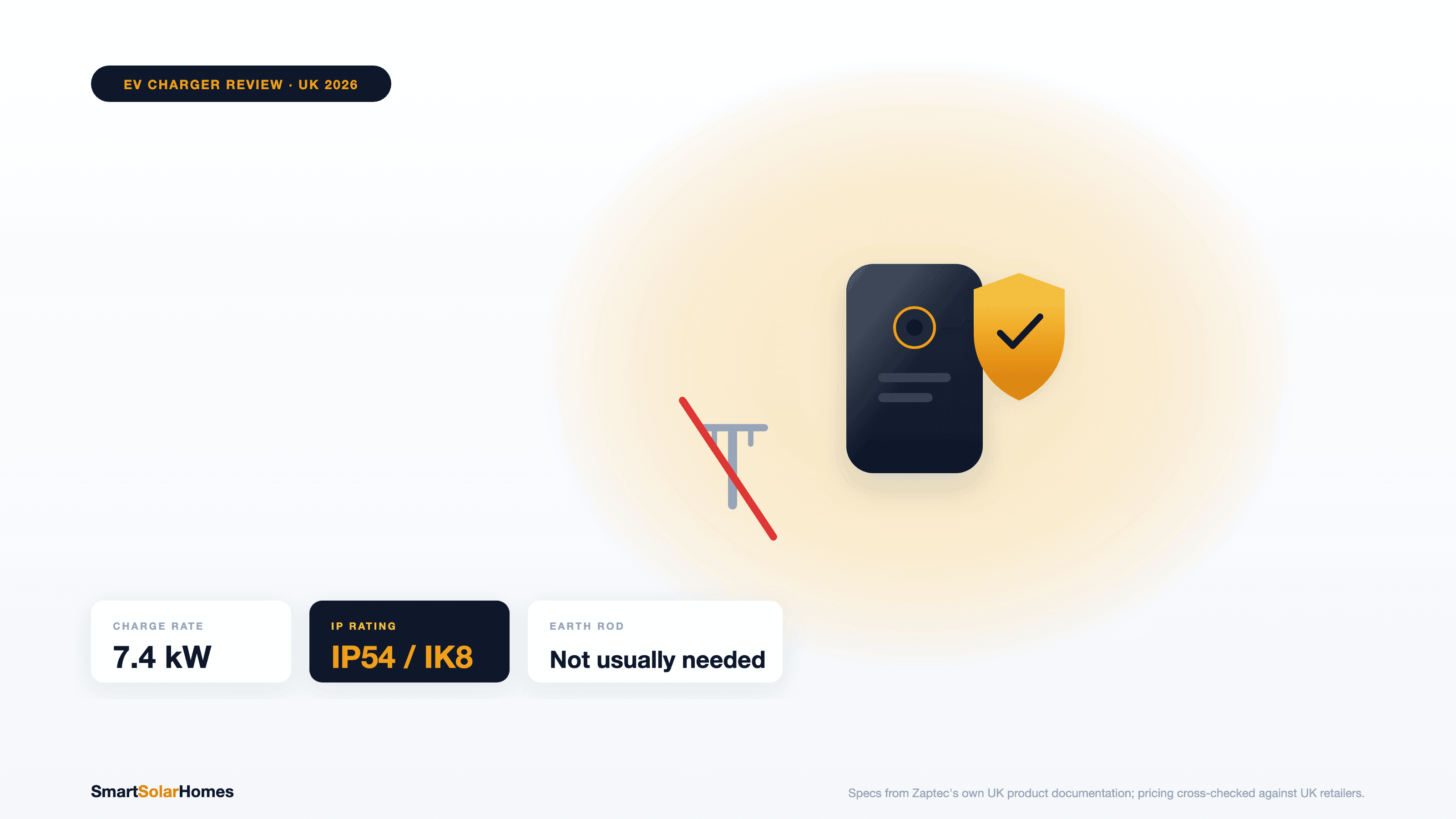
Modern UK EV chargers must include PEN (Protective Earth Neutral) fault detection or an earth rod. PEN fault protection isolates the car from the supply if the incoming neutral fails, preventing the car body becoming live. All four chargers above have integrated PEN protection, which means the installer doesn't need to fit an earth rod in your garden.
If a quote includes an earth rod for a charger that has integrated PEN, that's a £150–£300 line item you don't actually need. Ask the installer to confirm which approach they're using.
The smart-tariff vs solar question
For most UK households with both solar and an EV, the answer is "both, layered":
- Daytime: Zappi (or similar solar-divert charger) handles surplus diversion automatically.
- Overnight: Intelligent Octopus Go provides 6 hours of cheap rate (8p/kWh) for any remaining top-up the car needs after the solar window closes.
This is well within the Zappi's capabilities — set Eco+ for daytime and a scheduled charge window for the off-peak hours. The Indra Smart PRO and Hypervolt Home 3 handle the same pattern via OCPP and Intelligent Octopus.
What about Vehicle-to-Home (V2H/V2G)?
V2H lets your EV battery discharge back into your home (or in some cases the grid) during peak periods. As of 2026, the only domestic V2G system widely available in the UK is the Indra V2G with selected Nissan models on Octopus's Powerloop tariff. The list of compatible vehicles is short. CCS-based V2G is on the way (the standard exists; the chargers and tariffs are slowly arriving) but it's not yet a practical buying decision for most households.
If V2H matters to you, the Wallbox Quasar 2 is the most advanced CCS-V2G unit available, but UK availability and supplier-side tariff support remain limited as of 2026.
Installation considerations
An EV charger install typically involves: a dedicated 32A radial circuit from your consumer unit (or a sub-board), 16mm² SWA armoured cable to the charger location, an isolator at the consumer unit, the charger itself, the CT clamp at the incomer, and DNO notification.
Most installs take 3–5 hours and cost £350–£750 in addition to the charger hardware itself. Long cable runs (over 15m) add cost. A new consumer unit (if yours is outdated) adds £500–£800.
For multi-EV households, dynamic load balancing matters — without it, a second charger might trip the main supply during simultaneous fast charges. All four chargers above support load balancing.
Quick comparison: solar divert chargers, 2026
| Charger | Solar divert | Approx. price | Warranty | Best for |
|---|---|---|---|---|
| myenergi Zappi v2.1 | Yes — Eco+ mode, dedicated CT clamp | ~£779 installed | 3 years | Set-and-forget solar households, especially with an Eddi/Libbi ecosystem |
| Indra Smart PRO | Yes — two CT clamps, open OCPP | ~£750 installed | 5 years | Budget-conscious solar households wanting open standards |
| Hypervolt Home 3 | Yes — CT clamp, tethered, OCPP | ~£899 installed | 3 years | Design-conscious buyers who want the most polished app |
| Ohme ePod | No — tariff-smart only, no CT clamp | £499–£599 hardware; ~£949 via Octopus's turnkey install | 3 years | Non-solar or small-array households prioritising off-peak tariffs |
Where to go next
For an editorial round-up of how charger choice fits the bigger picture, see the EV charging with solar guide and the solar-compatible EV chargers breakdown. If solar divert isn't your only priority, our best home EV charger in the UK guide ranks the leading units across all use cases. For a head-to-head between the two most-quoted chargers, see Zappi vs Ohme ePod. When you're ready to buy, browse UK EV chargers or request quotes from MCS-certified installers.
FAQs
Do I need solar panels to benefit from a Zappi?
No, but you lose most of the differentiation. Without solar, the Zappi is an expensive smart-tariff charger; a £499 Ohme ePod does the same job. Solar households get the Zappi's full value.
Does solar divert work in winter?
It works, but there's much less to divert. In December, a 4kWp system in Birmingham produces around 75kWh — enough for around 250 EV miles if every kWh diverted. Overnight tariff charging is the bigger lever in winter.
What's the minimum solar array for divert to be worthwhile?
Around 4kWp. Below that, the surplus available for divert is too small to justify the smart-charger premium — you'd be better with a cheaper tariff-smart charger and using more of your solar in the house.
Can I have both solar divert and tariff-smart charging?
Yes. The Zappi handles both natively: Eco+ during the day, scheduled charge window for off-peak overnight. The Indra Smart PRO does the same via OCPP and Octopus Intelligent.
Will Vehicle-to-Grid be standard soon?
Not for most cars. As of 2026, CCS-based V2G is launching but limited. Most existing EVs don't support it. If V2H is a priority, your car choice matters as much as your charger choice.
Sources — verified 5 June 2026
- Ofgem, “Changes to energy price cap between 1 April and 30 June 2026” — www.ofgem.gov.uk
- Energy Saving Trust, “Solar panels” (Smart Export Guarantee rates) — energysavingtrust.org.uk
- myenergi, “zappi EV Charger — 7kW & 22kW, Eco/Eco+ modes, CT clamp included” — www.myenergi.com
- Ohme, “Ohme ePod — Compact Untethered Home EV Charger” — ohme-ev.com
- Indra Renewable Technologies, “Smart PRO — solar divert, 5-year warranty, OCPP” — www.indra.co.uk
- Hypervolt, “Home 3.0 Technical Specification (IP54, 7.4kW)” — support.hypervolt.co.uk
- GOV.UK, “Changes to electric vehicle chargepoint grant schemes from 1 April 2026” — www.gov.uk
- Octopus Energy, “Intelligent Octopus Go” — octopus.energy

About the author
Sepehr
Solar specialist & co-founder, Smart Solar Homes
Solar specialist and co-founder of Smart Solar Homes, which works with MCS-certified UK installer partners. I write all the guides and reviews here; the aim is straight-talking education the industry rarely provides.
Citing this page? Please use a dofollow link back to the original article — it helps us keep the data on this page accurate and up to date.
Browse EV Chargers on Smart Solar Homes


Want to compare these side by side? Use the compare tool →
Or browse all EV Chargers on Smart Solar Homes.
Related reading
More on ev chargers from the editorial team.
Find installers near you
MCS-certified solar installers covering these areas.