Zappi v2.1 vs Ohme ePod: Solar Divert vs Tariff-Smart Charging

Written and reviewed by Sepehr. See our editorial policy.
The Zappi and Ohme ePod are the two most frequently recommended smart EV chargers in the UK market, and they are aimed at genuinely different use cases. Buying the wrong one for your situation costs money — here is how to tell which fits, and how to think about charger choice if you have (or are planning) solar.
The core difference in one paragraph
The Zappi is built for solar households. Its primary intelligence is routing surplus solar generation into your car rather than exporting it at low Smart Export Guarantee rates. Without solar panels, most of its differentiating features are irrelevant and you'd be better off with a cheaper charger.
The Ohme ePod is built for tariff-smart grid charging. It integrates with time-of-use tariffs — particularly Octopus Agile and Octopus Intelligent Go — to automatically charge your car when grid electricity is cheapest. Without a dynamic tariff, most of its differentiating features are irrelevant and you'd be paying a premium for unused capability.
Zappi in detail
Three modes: Fast (constant 7.4 kW from the grid, ignores solar), Eco (supplements with grid as needed to maintain at least a minimum charge rate), and Eco+ (only charges from solar surplus, pausing if surplus drops below the ~1.4 kW minimum charge rate, which equals the 6 A minimum charging current EVs accept on single phase) (source).
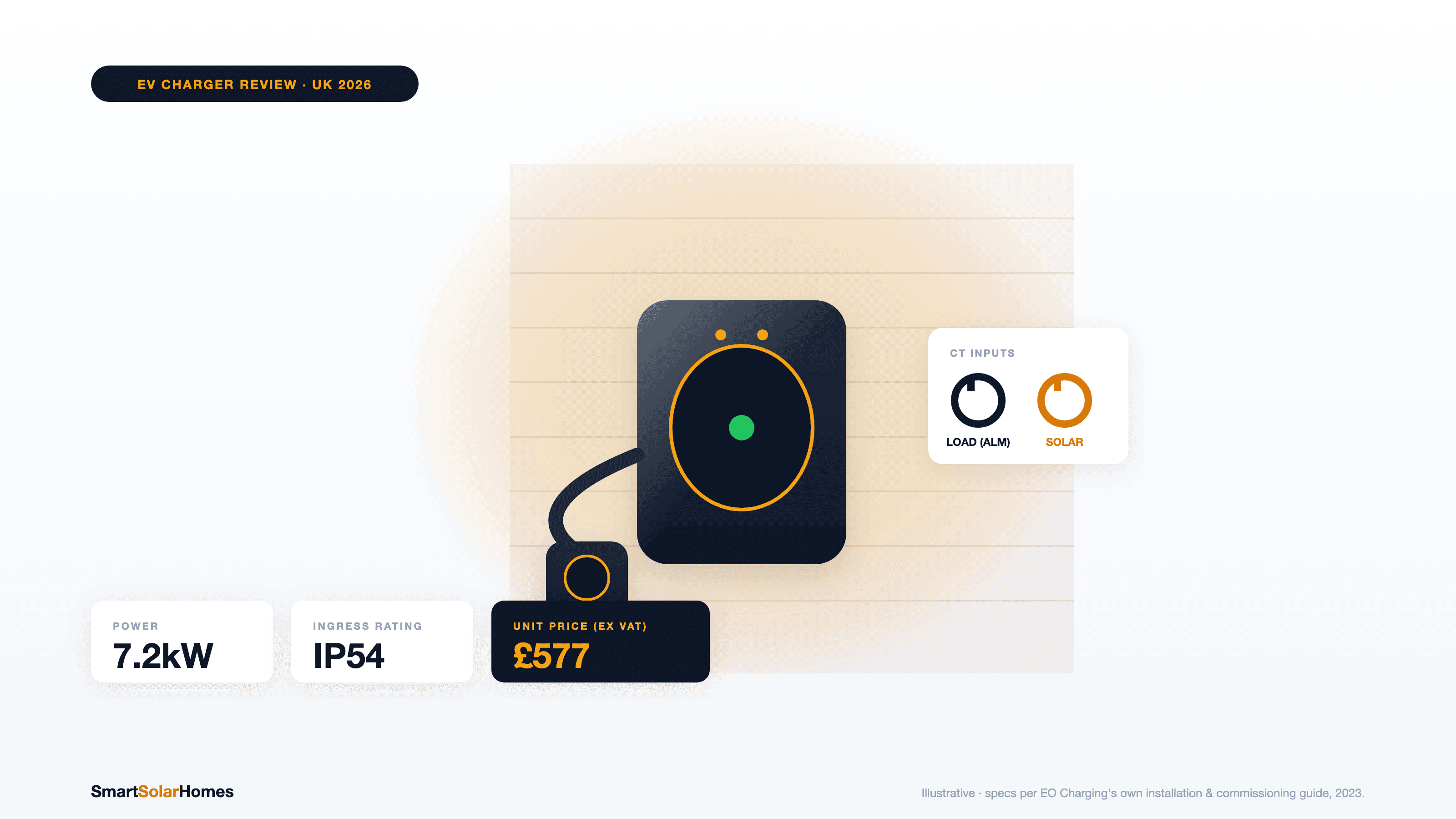
The CT clamp installation is mandatory for solar divert to work — without it, the Zappi cannot see your solar generation. Reputable installers fit the clamp at the incomer as part of the standard install.
Price: typically around £800–£1,000 installed, depending on your home setup and installer. IP65 weatherproof rating, 3-year warranty, and a 6.5 m tethered cable as standard (an untethered version is available for slightly less). 7.4 kW single-phase (also available as a multiphase unit charging up to 22 kW on the few homes with a three-phase supply) (source).
The Zappi works without solar as a standard scheduled charger, but you're paying a premium for functionality you're not using. See the Zappi product page for specifications.
Ohme ePod in detail
Connects to Octopus Energy (and several other suppliers including OVO, EDF and British Gas) via API (source). When you have a dynamic tariff, the ePod receives half-hourly pricing data and automatically schedules charging for the cheapest periods — sometimes below 10p/kWh on Agile, occasionally negative prices on plunge events.
You set a departure time and target state of charge in the Ohme app; the ePod figures out when to charge. With Octopus Intelligent Go specifically, Ohme has direct integration that turns the standard 6-hour off-peak window into a smart charging window that adapts to your departure schedule.
Price: from around £949 including standard installation for the untethered, screenless ePod; the tethered Ohme Home Pro, which adds an on-device display, starts from around £999 installed. IP54 weatherproof rating, 3-year warranty, and no solar divert (source).
See the Ohme ePod product page for full specs.
Which one for which situation
You have solar panels (any size)
Zappi — full stop. Its solar divert pays for itself for anyone who drives regularly: on a 6 kWp system with an EV doing 8,000 miles/year, divert can cover a large share of annual EV electricity from your own free surplus rather than buying it from the grid. The Ohme has no equivalent capability.
You're on Octopus Agile or a similar dynamic tariff, no solar
Ohme ePod. The tariff integration is seamless. The Zappi would work as a scheduled charger but its solar features add cost you can't use.
You have solar AND a dynamic tariff
Zappi, set to Eco for daytime solar divert and a scheduled charge window for overnight off-peak top-ups. The Zappi handles both; the ePod only handles one. The slight extra complexity of dual-mode is worth the cost saving across the year.
You have neither solar nor a dynamic tariff
Both chargers are premium products for use cases you don't have. Consider the Wallbox Pulsar Plus or the Pod Point Solo3 at a similar (or lower) price point with simpler smart scheduling and a longer 5-year warranty. If your tariff is a flat rate, all you really need is a reliable scheduled charger.
App and ecosystem
The myenergi app is mature and stable. It manages multiple myenergi devices (Zappi, Eddi water diverter, Libbi battery, Hub) from one interface and provides solid solar generation reporting via the Zappi's CT clamp. Firmware updates are routine. Some users prefer the desktop portal for detailed reporting; the mobile app is fine for daily use.
The Ohme app is the slickest charger app in the UK market. The Octopus Intelligent Go integration is best-in-class. Reporting is clean. The trade-off: it's a single-device app, no broader ecosystem.
OCPP and future-proofing
Neither charger exposes OCPP (Open Charge Point Protocol) by default, which means you're locked into the manufacturer's app and tariff integrations. For most homeowners this doesn't matter — the integrations work. For homeowners who want to use third-party management platforms (e.g. ev.energy, Smappee), the Indra Smart PRO is the only mainstream UK-supported option with native OCPP. See best EV chargers for solar for the broader picture.
Vehicle-to-Home / V2G
Neither the Zappi v2.1 nor the Ohme ePod supports V2H or V2G. CCS-based V2G is in early UK rollout but limited to a small set of chargers (notably the Wallbox Quasar 2) and even smaller set of compatible vehicles. If V2G matters to you, plan around the car first, then choose the charger.
Installation considerations
Both chargers fit standard UK domestic install requirements: a dedicated 32A circuit from the consumer unit (or a sub-board), 16mm² SWA armoured cable to the charger location, isolator at the consumer unit, and DNO notification.
Standard install costs: £350–£600 in addition to the charger hardware, for a typical garage-wall or external-wall location within 10m of the consumer unit. Long cable runs (over 15m) add cost. A new consumer unit (if yours is outdated) adds £500–£800.
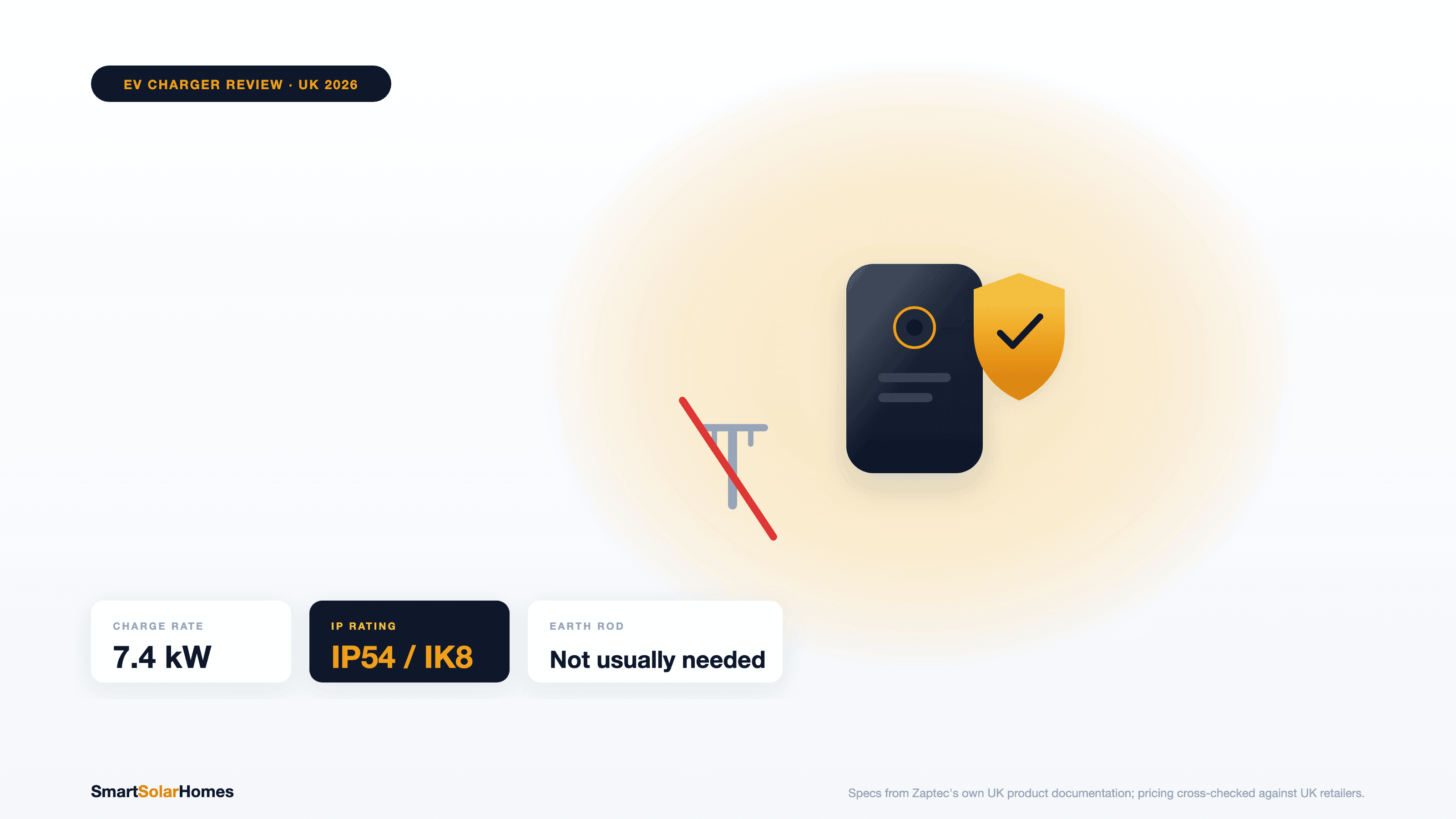
Both chargers include PEN fault detection, so an additional earth rod is not required.
Reliability and field record
Both have well-established UK track records. The Zappi has been on the market since 2017 (v2.1 from 2022) with strong reliability. Failure modes are typically related to the consumer's home wiring rather than the charger itself.
The Ohme ePod is newer (launched late 2022) but with no major reliability issues surfaced in field data. Both have UK service teams with reasonable response times.
Tariff specifics
If you're on Octopus Intelligent Go specifically, the Ohme has direct API integration that the Zappi doesn't. With Intelligent Go on a Zappi, you set a scheduled charge window that aligns with the 11:30pm–5:30am cheap window, and accept that the Zappi won't dynamically adjust to plunge pricing events on Agile-like tariffs.
For Octopus Agile and Cosy Octopus, neither charger has native first-party integration — both work with Agile via scheduled charge windows or third-party platforms. Active Agile users sometimes prefer the Indra Smart PRO or pair the Zappi with a tariff-aware home assistant integration.
Where to go next
For a deeper look at the Zappi specifically — pricing, warranty, the app and honest downsides — see our myenergi Zappi review. For the broader charger landscape, see best EV chargers for solar panels UK 2026 and solar-compatible EV chargers. For the full EV-and-solar picture, see the EV charging with solar guide. To browse UK chargers, see EV chargers. When you're ready to install, request MCS-certified installer quotes.
FAQs
Can the Zappi work with Octopus Intelligent Go?
Yes, via a scheduled charge window. The Ohme ePod has tighter native integration with Octopus Intelligent Go — for Intelligent Go users without solar, that's a real ePod advantage.
Does the Ohme have any solar features at all?
No real solar divert. The marketing sometimes refers to "PV mode" or daytime scheduling, which is fundamentally just charging when there's daylight — not the same as dynamic real-time solar surplus tracking.
Is the Zappi worth it on a 3 kWp solar system?
Marginal. With a 3 kWp system in central England, daily surplus may average 4–6 kWh. At that surplus rate the Zappi's price premium over a basic scheduled charger takes several years to recover, so the case is weaker than on a larger system.
Can I switch chargers later without rewiring?
Mostly yes — the 32A circuit and SWA cable installation is standard, so swapping a charger only requires unmounting and reconnecting. The Zappi's CT clamp can stay or be removed depending on the replacement.
What about the cheaper Zappi alternatives?
The genuine alternatives with solar divert are the Indra Smart PRO (5-year warranty, OCPP, similar price) and the Hypervolt Home 3 (slightly more expensive, sleeker design). Most other "solar compatible" chargers don't do dynamic divert. See best EV chargers for solar panels.
Sources — verified 5 June 2026
- myenergi, “zappi EV Charger — 7kW & 22kW, Eco/Eco+ modes, 3-year warranty” — www.myenergi.com
- myenergi, “zappi v2.1 User Manual (charging modes detail)” — www.myenergi.com
- Ohme, “Ohme ePod — Compact Untethered Home EV Charger” — ohme-ev.com
- Ohme, “Ohme Home Pro — Tethered Home EV Charger” — ohme-ev.com
- Octopus Energy, “Intelligent Octopus Go with Ohme: your questions answered” — octopus.energy
- GOV.UK, “Changes to electric vehicle chargepoint grant schemes from 1 April 2026” — www.gov.uk

About the author
Sepehr
Solar specialist & co-founder, Smart Solar Homes
Solar specialist and co-founder of Smart Solar Homes, which works with MCS-certified UK installer partners. I write all the guides and reviews here; the aim is straight-talking education the industry rarely provides.
Citing this page? Please use a dofollow link back to the original article — it helps us keep the data on this page accurate and up to date.
Browse EV Chargers on Smart Solar Homes


Want to compare these side by side? Use the compare tool →
Or browse all EV Chargers on Smart Solar Homes.
Related reading
More on ev chargers from the editorial team.
Find installers near you
MCS-certified solar installers covering these areas.