TOPCon vs PERC Solar Panels: What the Spec Sheet Tells You

Written and reviewed by Sepehr. See our editorial policy.
If you're being quoted solar panels in the UK in 2026, the headline cell technology is almost certainly TOPCon — and almost certainly being marketed as a meaningful step up from "old" PERC. This guide cuts through the language and explains what the technology actually is, what the spec sheet differences mean for a UK roof, and whether the price premium (or sometimes the absence of one) is justified.
The short version
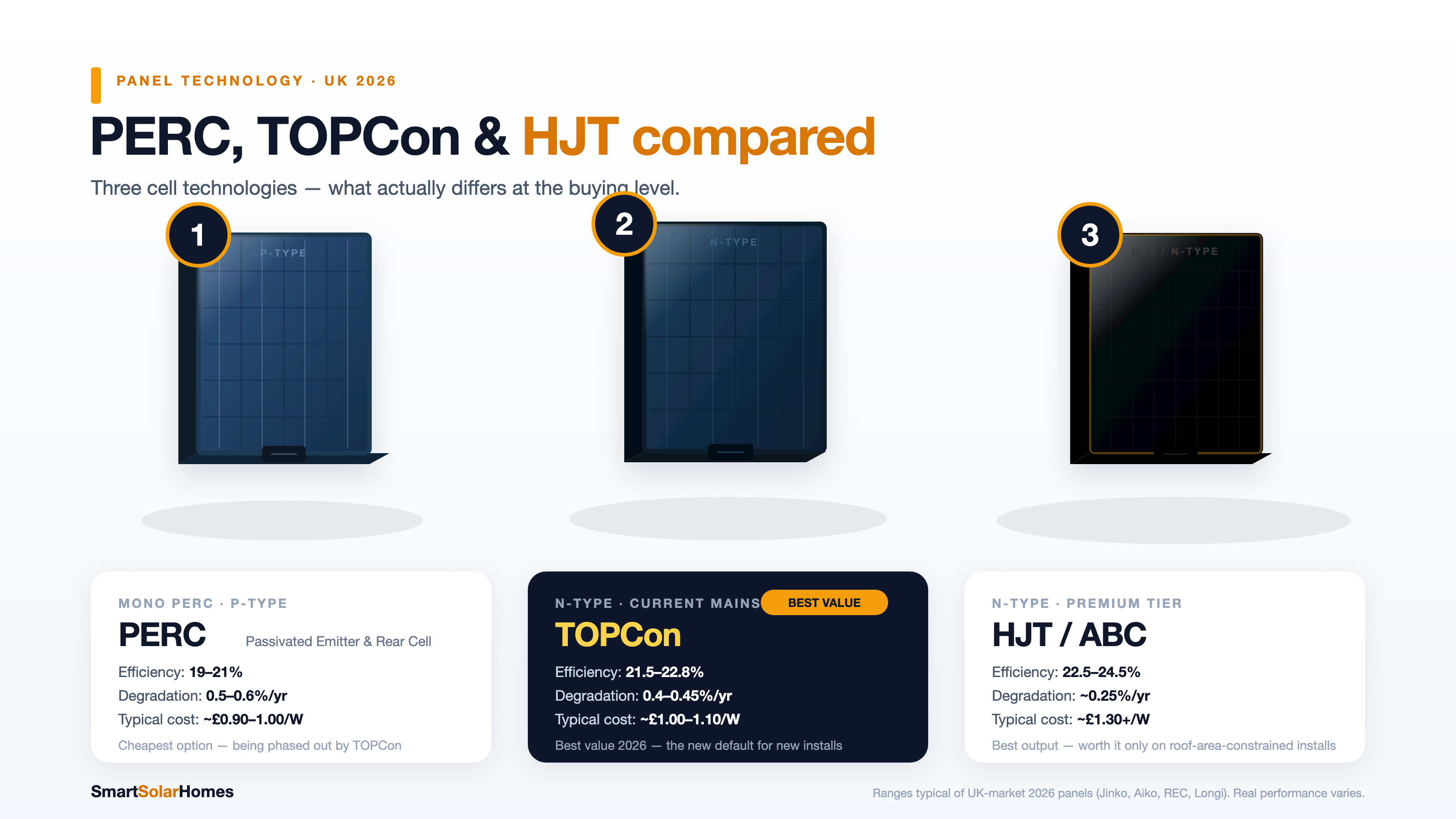
- TOPCon (Tunnel Oxide Passivated Contact) is the dominant cell technology in 2026, delivering ~22% module efficiency, lower temperature coefficient, and 80–85% bifaciality (source).
- PERC (Passivated Emitter and Rear Contact) was the dominant technology from 2017–2023, delivering ~20.5% module efficiency. Still made, mostly as commodity panels.
- HJT (Heterojunction) is the premium step beyond TOPCon, delivering ~23% efficiency and excellent temperature performance, at a price premium of 15–25%.
- For a typical UK home with adequate roof space, TOPCon vs PERC is a marginal cost-per-kWh-generated difference. For limited roof space, TOPCon meaningfully outperforms.
| Spec | PERC | TOPCon | HJT |
|---|---|---|---|
| Module efficiency | ~20.5% | ~22% | ~23% |
| Temperature coefficient (per °C) | -0.34 to -0.37% | -0.29 to -0.32% | -0.24 to -0.26% |
| Annual degradation | 0.45–0.55%/yr | 0.30–0.40%/yr | ~0.25%/yr |
| Warranted output at year 25 | ~80–84% | ~87–89% | — |
| Indicative price | £0.40/W | £0.45/W | 15–25% premium over TOPCon |
| Silicon doping | P-type | N-type | N-type |
What's actually different at the cell level
Both PERC and TOPCon are monocrystalline silicon technologies. The difference is in the rear-side cell architecture and how electrical current is captured.
PERC adds a thin passivation layer on the rear of the cell to reduce recombination losses (electrons being lost before they reach the contact). This improves rear-side reflection of unabsorbed light back into the cell. Efficient, well-understood, has been the volume technology for nearly a decade.
TOPCon adds an ultra-thin tunnel oxide layer plus a poly-silicon contact on the rear surface. This delivers better passivation than PERC alone, reduces electrical contact resistance, and lifts efficiency by typically 1.0–1.5 absolute percentage points at the cell level (source).
At the module level (the whole panel with glass, encapsulant, frame, and electrical connections), the gain is smaller than the cell-level gain — typically 0.8–1.2 absolute percentage points (e.g. 21.0% TOPCon vs 20.0% PERC for two equivalent-sized 144-cell panels).
What this means for a UK roof
For a fixed roof area, TOPCon delivers roughly 5–7% more annual generation than PERC. On a 4 kWp install (around 30 m² roof area), that's the difference between 3,400 kWh/year (PERC) and 3,570 kWh/year (TOPCon) in central England.
If you have unlimited roof space and budget is the priority, PERC at £0.40/W is cheaper than TOPCon at £0.45/W and gets you the same generation by adding a panel or two. If your roof is space-limited (10 panels' worth, not 12), TOPCon delivers more generation per square metre and pays for the premium.
In 2026 the market trend has tilted strongly toward TOPCon — most manufacturers have shifted volume away from PERC, and the cost premium has narrowed to under 10% at module level. For new builds and complex roofs, TOPCon is now the default.
Temperature coefficient — TOPCon's underrated advantage
UK solar panels rarely operate at the 25°C reference temperature for which their nameplate wattage is specified. On a sunny summer day, panel surface temperatures can reach 55–65°C, derating output by typically 10–15%.
The temperature coefficient measures how much output drops per degree above 25°C. Typical datasheet figures (source):
- PERC: -0.34 to -0.37% per °C
- TOPCon: -0.29 to -0.32% per °C
- HJT: -0.24 to -0.26% per °C
On a 35°C panel temperature day (typical UK summer noon), TOPCon loses around 0.5% less than PERC. Across the highest-generation hours of the year, this adds 1.5–2% to TOPCon's annual yield advantage. Not dramatic — but real.
HJT's temperature performance is genuinely best-in-class, and over the panel lifetime (25–30 years), the cumulative generation advantage is meaningful in hot climates. In the UK, the gap is smaller because we rarely hit extreme heat — but it remains the technical winner for temperature performance.
Bifaciality — useful only in specific cases
Most modern TOPCon and HJT modules are bifacial: they generate from both the front and rear surfaces. Rear-side generation depends on light reflected back onto the panel — from snow, white roofing material, light gravel, or specifically designed reflective surfaces.
For a standard UK rooftop install with the panel mounted close to a dark roof, bifaciality contributes near zero. The rear surface sees no useful light.
For specific UK use cases — vertical mounting on a south-facing balcony, ground-mounted arrays in a field, agrivoltaic installs, or carport canopies above a light-coloured surface — bifaciality contributes 5–15% additional generation. For a typical residential roof install, you can largely ignore the bifaciality claim.
Degradation rates
Standard PERC modules degrade at around 0.45–0.55% per year over a 25-year warranty period, with warranties typically guaranteeing ~80–84% of nameplate output at year 25. Panels must pass MCS 005 product standard (which references IEC 61215 type-approval testing) to qualify for MCS-certified UK installations (source).
TOPCon modules degrade slightly slower, at 0.30–0.40% per year, with manufacturer warranties typically guaranteeing ~87–89% at year 25 (source). Across a 25-year lifetime, TOPCon retains roughly 3–4 percentage points more capacity than PERC at end of life.
HJT degrades slowest of the three commercial technologies, at around 0.25% per year. For a household intending to keep the system 25+ years, HJT's lifetime yield can offset the higher upfront cost.
Common UK panel brands by technology (2026)
TOPCon (mainstream 2026 offerings):
- Jinko Tiger Neo (440–470W)
- JA Solar JAM54D40 (440–460W)
- Trina Vertex S+ (440–470W)
- Aiko Neostar 2P (455–480W)
- Longi Hi-MO 6 / Hi-MO 7 (440–460W)
- Astronergy ASTRO N5s (440–460W)
PERC (commodity and budget):
- Jinko Tiger Pro (400–420W)
- JA Solar JAM60S20 (400–420W)
- Trina Vertex S (400–420W)
HJT (premium):
- REC Alpha Pure RX (460–480W)
- SunPower Maxeon 7 (440–470W)
- Meyer Burger HJT-based panels (limited UK availability)
Browse the full solar panel catalogue for current UK pricing.
The TOPCon premium in real installer quotes
As of mid-2026, the price difference between equivalent PERC and TOPCon panels in installer quotes is typically:
- Per-panel: £15–£35 more for TOPCon
- Per-kWp: £80–£200 more for TOPCon
- For a 4 kWp install (10 panels): £320–£800 more for TOPCon than PERC
For the additional generation (~5–7% per kWp), TOPCon pays back its premium in roughly 4–6 years of operation through additional self-consumption and export. Over a 25-year system life, that's 19+ years of additional yield.
At current installer pricing, TOPCon is the default rational choice. PERC remains relevant for very tight budgets, large flat roofs where you can simply add more panels, or used/refurbished panel deals.
When PERC still makes sense
- You have abundant unused roof space and can size up rather than upgrade tech
- Your budget is tight enough that the £400–£800 saving matters
- You're combining old and new panels — replacing a damaged PERC with a like-for-like PERC keeps the array consistent
- You're sourcing through a clearance distributor with significant discount
When HJT is worth the upgrade from TOPCon
- Severe roof space constraint where every watt counts
- You expect to live in the home for 30+ years and value the lower degradation
- You want the absolute best temperature performance (rare to matter in the UK)
- You want a premium-branded product (REC, SunPower) for reputational reasons
For most UK installs, HJT's 15–25% premium over TOPCon doesn't pay back within a typical residence period. TOPCon is the price-performance winner.
What about back-contact (IBC) and shingled cells?
Some panels (notably SunPower Maxeon) use Interdigitated Back Contact (IBC) architecture, which eliminates the front-side metallic grid lines and improves aesthetic and efficiency. Aiko's Neostar 2P series uses a similar back-contact design.
Shingled cell panels (Hyundai HiE-S, some Astronergy) overlap cells like roof tiles, eliminating the bus-bar gap and improving energy density by ~3–5%. They're more shade-tolerant than standard cells, which is genuinely useful for roofs with partial chimney shading.
Both are niche-but-credible alternatives at modest premiums. Worth considering only if your install has specific shading or aesthetic constraints.
Where to go next
For the full panel-buying decision framework, see panels and batteries explained, and for the models we rate most highly this year see our best solar panels in the UK for 2026 roundup. For specific panel comparisons, see the solar panel catalogue and the compare tool. For the broader cost picture, see solar panel cost UK 2026. If you are looking at aesthetics-first options or have a planning-sensitive property, it is also worth reading about solar roof tiles in the UK — the best models now use the same N-Type TOPCon cells and reach comparable efficiency figures. When you're ready, request MCS-certified installer quotes — MCS certification is a requirement for panels to qualify under the Smart Export Guarantee (SEG), the scheme that pays you for surplus electricity exported to the grid.
Beyond the current silicon technologies, next-generation perovskite solar cells are reaching commercial scale — Oxford PV is leading UK development.
Most TOPCon panels are also bifacial — our guide to bifacial panel technology explains when the rear-side gain is worth paying for.
Technology choice and tier classification overlap but aren't the same thing — our guide to panel tier and technology choice explains the difference.
JA Solar's DeepBlue TOPCon range is one of the most competitive on price — our review covers JA Solar TOPCon panels in detail.
TCL's own T5 Pro line is a recent example of TOPCon shingled design at both residential and commercial scale — see what TCL showed alongside its Home Energy Management System at IFA Berlin 2026.
FAQs
Is TOPCon worth the premium over PERC?
For most new UK installs in 2026, yes. The cost premium has narrowed to under 10% and the generation advantage is 5–7%. Payback on the premium is 4–6 years.
Will PERC panels become obsolete?
Not in the sense of stopping working. PERC panels installed today will run for their full 25-year warranty period. They'll just be lower-yield than what you could install today.
Are TOPCon panels reliable?
Yes — TOPCon has been in volume production since 2022 and overtook PERC as the dominant cell technology in 2024 (source). Reliability is broadly on par with PERC, though some 2025 field studies have flagged TOPCon-specific UV- and damp-heat-induced degradation that manufacturers are actively addressing (source).
Does TOPCon work better in cloudy UK weather?
Slightly. TOPCon's low-light performance is incrementally better than PERC due to less recombination loss at low irradiance. On bright overcast days, expect ~3–5% more generation from TOPCon vs PERC.
What about N-type and P-type cells?
P-type is the older silicon doping technology used by most PERC panels. N-type is the silicon doping for TOPCon, HJT, and IBC panels. N-type has lower light-induced degradation (LID) and is the architecture of choice for premium cells.
Sources — verified 4 June 2026
- Fraunhofer ITRPV (via PV Europe), “ITRPV: TOPCon to surpass PERC in coming years” — www.pveurope.eu
- Wang et al., Progress in Photovoltaics, “Electrical Performance, Loss Analysis, and Efficiency Potential of Industrial-Type PERC, TOPCon, and SHJ Solar Cells” — onlinelibrary.wiley.com
- SurgePV, “Solar Cell Efficiency Records 2026: NREL Champion Chart Decoded for Installers” — www.surgepv.com
- pv magazine — TOPCon vs PERC — www.pv-magazine.com
- SolarQuarter, “TOPCon Solar Panels Show New Reliability Challenges Compared To PERC Technology – Study” — solarquarter.com
- MCS, “MCS 005 — Requirements for Photovoltaic Panels” (references IEC 61215 type-approval) — www.mcs.org.uk
- Ofgem, “Smart Export Guarantee (SEG)” — www.ofgem.gov.uk
- Energy Saving Trust, “Solar panels” — energysavingtrust.org.uk

About the author
Sepehr
Solar specialist & co-founder, Smart Solar Homes
Solar specialist and co-founder of Smart Solar Homes, which works with MCS-certified UK installer partners. I write all the guides and reviews here; the aim is straight-talking education the industry rarely provides.
Citing this page? Please use a dofollow link back to the original article — it helps us keep the data on this page accurate and up to date.
Browse Solar Panels on Smart Solar Homes


Want to compare these side by side? Use the compare tool →
Or browse all Solar Panels on Smart Solar Homes.
Related reading
More on solar panels from the editorial team.
Find installers near you
MCS-certified solar installers covering these areas.