Zaptec Go Review UK: Price, PEN Protection & Specs
Written and reviewed by Sepehr. See our editorial policy.
The Zaptec Go is a compact, Norwegian-engineered smart charger that's built its UK reputation on one standout feature: fully integrated PEN fault protection that removes the need for a separate earth rod on most homes. This review covers the current specs straight from Zaptec's own UK product documentation, real installed pricing, and the trade-off solar households should weigh before choosing it over an Ohme Home Pro or myenergi Zappi.
Zaptec Go: specs and price in 2026
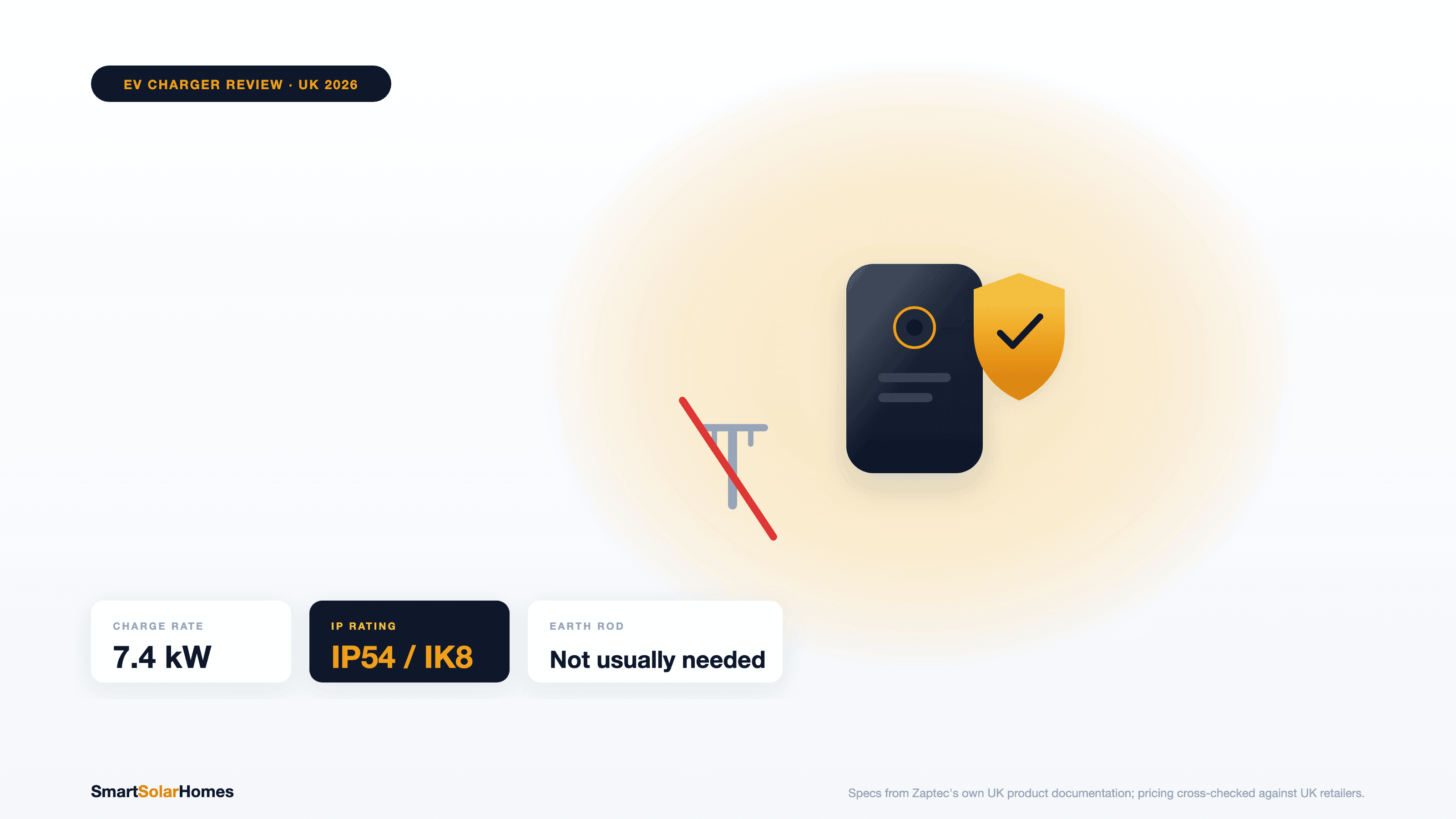
The Zaptec Go is an untethered, single-phase charger rated at 7.4kW, drawing up to 32A from a 230VAC ±10% supply. Per Zaptec's own UK product documentation, it measures a compact 242 x 180 x 75mm and is built around a UV-resistant, UL94 5VB-rated enclosure with an IP54 rating and IK8 impact protection, making it suited to outdoor mounting in exposed UK weather. It connects to a Type 2 socket (you supply your own cable, since the unit ships untethered), and carries integrated 6mA DC residual current protection (RDC-DD, to IEC 62955) alongside built-in temperature, overcurrent and humidity monitoring.
- Power output: 7.4kW, 32A, single-phase only — Zaptec's three-phase models are aimed at commercial/fleet installs, not this residential unit
- Cable: untethered IEC 62196-2 Type 2 socket — you provide your own cable
- Connectivity: Wi-Fi (2.4GHz, IEEE 802.11 b/g/n) and 4G LTE-M as standard, plus Bluetooth Low Energy (BLE 4.2) for setup, RFID (ISO/IEC 14443 Type A) for access control, and OCPP 1.6J compatibility for third-party platform integration
- Earthing: integrated open-PEN-conductor (broken-PEN) fault protection, meaning no separate earth rod is normally required on a TN-C-S (PME) supply
- Warranty: per this site's own product listing, the Go carries a 3-year warranty (Zaptec's own UK marketing separately advertises a 5-year guarantee on some models/regions, so confirm the exact term with your installer or retailer before buying)
- Price: around £417–£466 for the unit alone depending on retailer, before installation — this site's own listing has it at £416.95 ex VAT
That unit price sits in the same competitive band as the Easee One and below premium tethered units, and the PEN-protection saving on earthing work (see below) can bring the realistic installed total down further. Our wider best home EV charger UK roundup compares it directly against tethered and pricier alternatives if you want the full field.
PEN fault protection: the Go's headline feature
The Zaptec Go has fully integrated open-PEN-conductor (broken-PEN) fault protection built in as standard, satisfying the BS 7671 requirement for outdoor EV charge points connected to a PME (Protective Multiple Earthing) supply without needing a separate earth-rod electrode. Per Zaptec's own technical documentation, the protection monitors the line-to-neutral voltage continuously and disconnects live, neutral and earth to the vehicle if it detects more than 253V or less than 207V for longer than 5 seconds — the signature of a broken PEN conductor upstream. Charging resumes automatically once normal voltage has been detected for 30 seconds, up to ten times before the unit locks out and needs the cable disconnected to reset.
Because that protection is built into the charger itself rather than requiring an add-on earthing device, installers can skip driving a separate earth rod on most TN-C-S (PME) supplies — the most common earthing arrangement on UK homes. That's a genuine saving in both material and labour cost on install day, similar to the approach used by the Easee One, and it's one reason the Go's real-world installed price often undercuts its unit-price positioning relative to chargers that need a rod fitted.
The catch: solar charging isn't the Go's strength
Unlike the Ohme Home Pro, Hypervolt Home 3 Pro and myenergi Zappi, the Zaptec Go's smart features are scheduling-led rather than built around real-time solar-surplus tracking. The Zaptec Portal handles scheduling, charge limits, energy reporting, and automatic phase balancing across multiple Go units on the same account — genuinely useful for households planning a second EV or a shared driveway — but it doesn't match the moment-to-moment PV-output tracking that dedicated solar-divert chargers are built around.
In practice this means buyers who want to charge purely from surplus solar generation, second-by-second, are better served elsewhere. Our best EV charger for solar panels guide and the wider EV charging with solar explainer cover where the Zappi and Hypervolt's built-in solar modes pull ahead, and our solar-compatible EV chargers list has the full comparison if solar diversion is your priority.
Multi-charger balancing and installer familiarity
Automatic phase and load balancing across multiple Zaptec Go units connected to the same Zaptec Portal account is a genuine differentiator for households or small developments planning more than one charger — the units coordinate without an installer needing to configure anything beyond the initial account pairing. Set against that, UK installer familiarity with Zaptec is lower than with Zappi, Ohme or Easee, all of which have a longer UK retail track record — worth confirming your installer has fitted a Go before, particularly for the PEN-protection wiring, which needs to be commissioned correctly.
The OZEV grant
As of 2026, the domestic Electric Vehicle Chargepoint Grant pays up to £500 per socket, but it's restricted to renters, flat owners, and households without off-street parking who rely on street charging — homeowners with a driveway are not eligible regardless of which charger they choose. See our EV charger installation guide for the current full eligibility rules and realistic all-in installed cost ranges.
Who the Zaptec Go suits
The Zaptec Go is the right pick if you want a compact, durable 7kW charger for an exposed outdoor location on a TN-C-S supply, where the built-in PEN protection cuts installation cost by skipping the earth rod, or if you're planning to add a second charger and want automatic multi-unit balancing. It's a weaker fit for solar households chasing tight, real-time surplus-only charging without paying for add-on kit — look at the myenergi Zappi or Hypervolt Home 3 Pro instead if solar diversion out of the box matters more to you than price and weatherproofing.
FAQs
How much does the Zaptec Go cost installed in the UK?
Does the Zaptec Go support solar charging?
Does the Zaptec Go need an earth rod installed?
What happens if the Zaptec Go detects a PEN fault?
Is the Zaptec Go eligible for the OZEV grant?
Sources — verified 17 September 2026
- Zaptec, “Zaptec Go — Award Winning Home EV Charger (UK product page)” — www.zaptec.com
- Zaptec Help Center, “Integrated PEN fault protection for Zaptec Go (UK 7kW open PEN fault version)” — help.zaptec.com
- GOV.UK, “Electric Vehicle Chargepoint Grant for renters and flat owners” — www.gov.uk
- Electrical2Go, “Zaptec Go Asphalt Black 7.4kW EV Charger, Type 2, IP54, Wi-Fi Enabled” — www.electrical2go.co.uk

About the author
Sepehr
Solar specialist & co-founder, Smart Solar Homes
Solar specialist and co-founder of Smart Solar Homes, which works with MCS-certified UK installer partners. I write all the guides and reviews here; the aim is straight-talking education the industry rarely provides.
Citing this page? Please use a dofollow link back to the original article — it helps us keep the data on this page accurate and up to date.
Browse EV Chargers on Smart Solar Homes


Want to compare these side by side? Use the compare tool →
Or browse all EV Chargers on Smart Solar Homes.
Related reading
More on ev chargers from the editorial team.
Find installers near you
MCS-certified solar installers covering these areas.