Easee One Review UK: Price, Specs & Solar Charging
Written and reviewed by Sepehr. See our editorial policy.
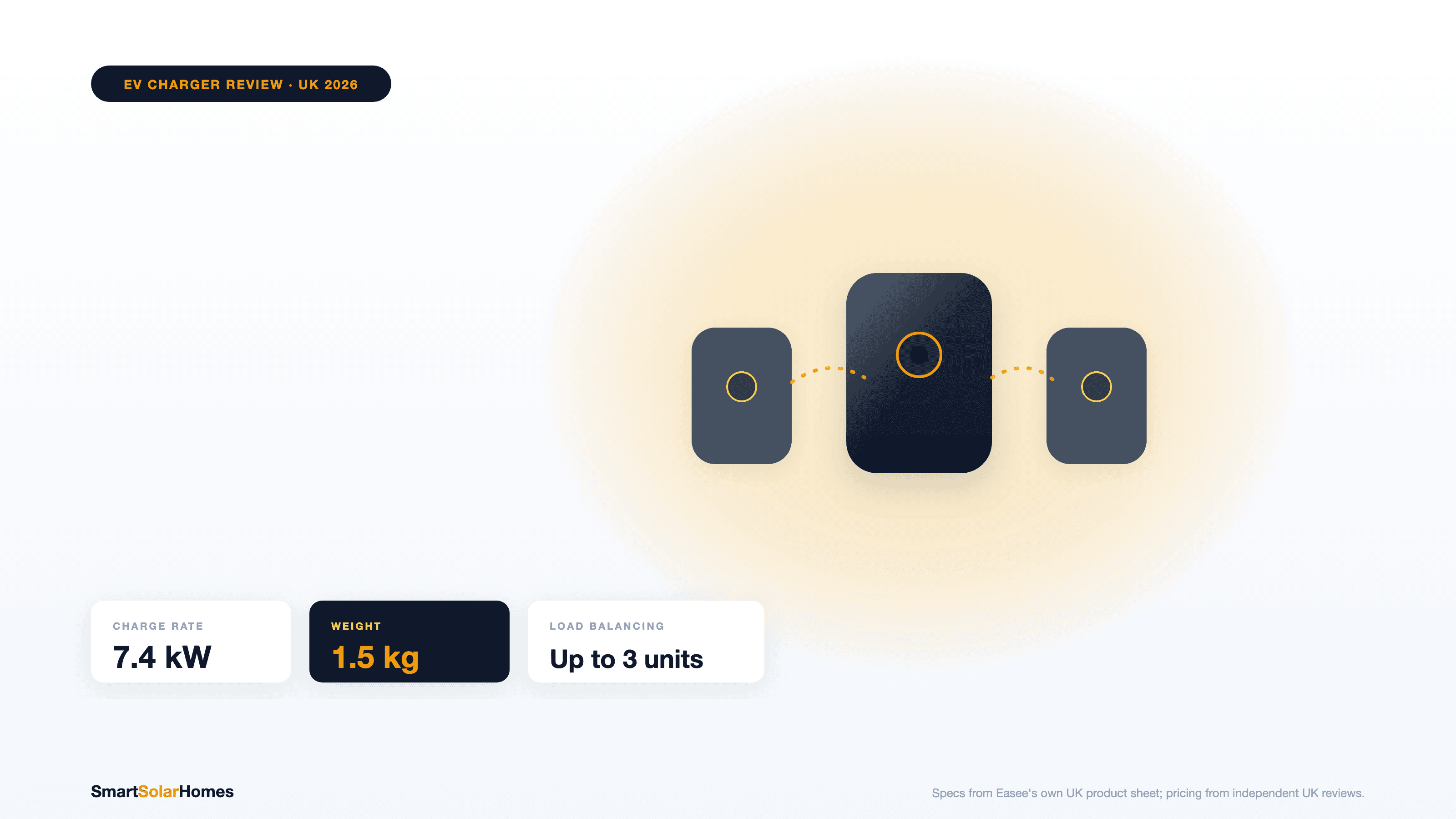
The Easee One is a Norwegian-made smart charger that's become one of the most widely installed units in the UK, prized for its compact size and a headline feature few rivals match: native load balancing across up to three chargers on a single fuse. This review covers the current specs straight from Easee's own UK product sheet, real installed pricing, and the one important catch solar households need to know about before choosing it over an Ohme Home Pro or myenergi Zappi.
Easee One: specs and price in 2026
The Easee One is an untethered, single-phase charger with fully dynamic output from 1.4kW to 7.4kW (6–32A). Per Easee's official UK product sheet, it measures a compact 256mm (H) x 193mm (W) x 106mm (D) and weighs just 1.5kg — noticeably smaller and lighter than most rivals. It connects to a Type 2 cable (which you supply yourself, since the unit ships untethered), carries an IP54 rating with IK10 impact resistance, and is UKCA marked and compliant with the Electric Vehicles (Smart Charge Points) Regulations 2021.
- Power output: 1.4–7.4kW dynamic, 230V AC single-phase only — there is no three-phase version of the One (Easee sells the separate Easee Charge for that)
- Cable: untethered Type 2 socket only, with a permanent-locking mechanism — you provide your own cable
- Connectivity: Wi-Fi 2.4GHz b/g/n, built-in eSim (LTE Cat M1) with no separate SIM contract, OCPP 1.6, and an open API
- Access control: built-in RFID/NFC reader as standard
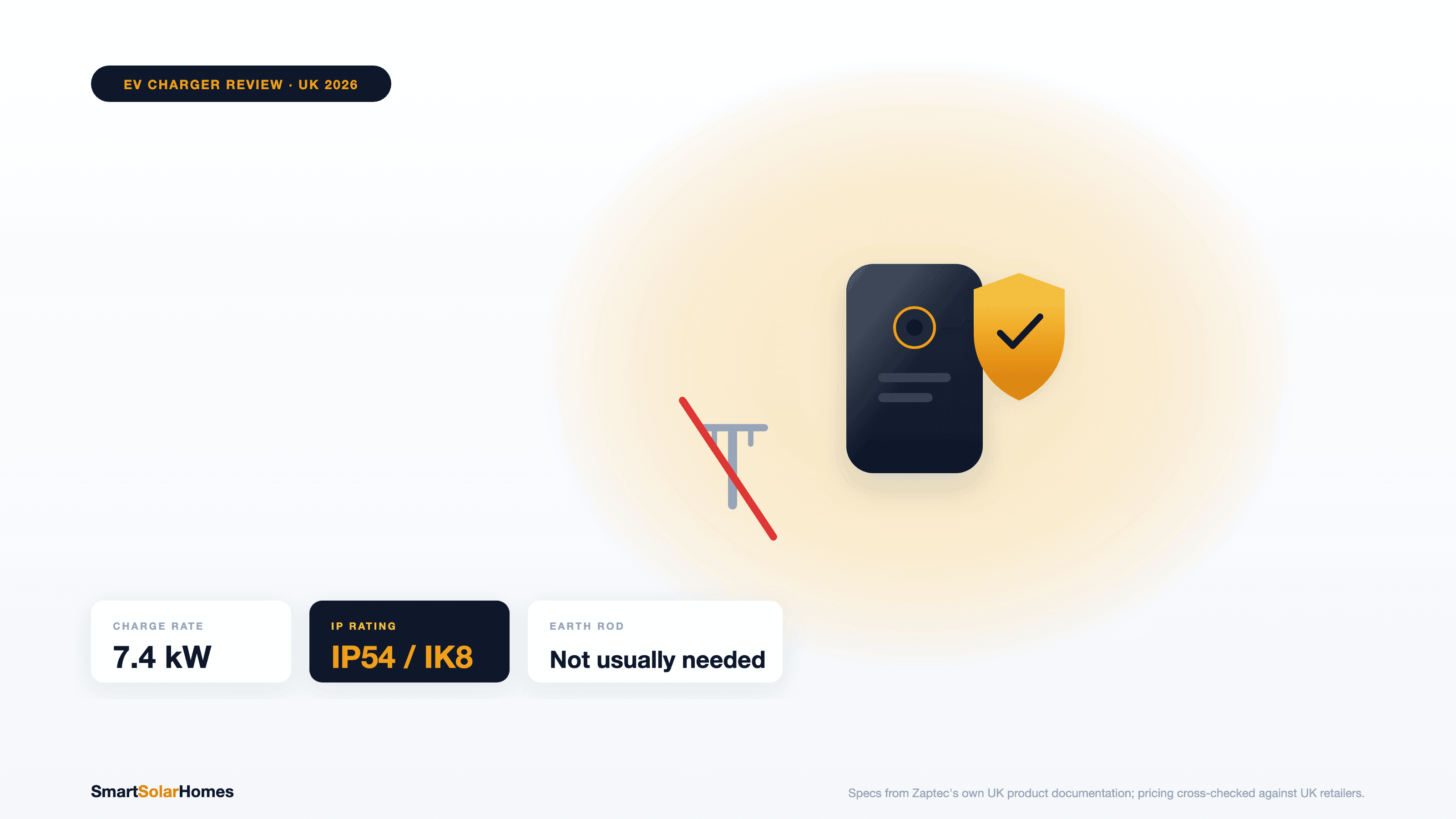
- Earthing: integrated open-PEN-conductor (broken-PEN) protection to BS 7671:2018/A1:2020, meaning no separate earth rod is required on a TN-C-S supply — a real saving on installation cost and time
- Warranty: 3 years, UK manufacturer guarantee
- Price: Easee doesn't publish a fixed RRP; UK retailer pricing puts the unit alone in roughly the £405–£630 range, with installation typically adding £400–£600 on top — independent reviewers put a realistic fully installed total around £900–£1,000
That mid-market installed price, combined with the PEN-protection saving on earthing work, makes the One one of the more cost-competitive 7kW units once you factor in labour. Our wider best home EV charger UK roundup compares it directly against tethered and pricier alternatives if you want the full field.
Dynamic load balancing: the One's headline feature
Up to three Easee One chargers can share and balance the available current on the same circuit automatically, via built-in wireless communication (Easee Link™) — no extra hardware required. If you're thinking ahead to a second EV, a shared driveway, or a small block of flats sharing one supply, this is the feature that sets the One apart from most single-charger-focused rivals: the units queue and rebalance load between themselves without an installer having to configure anything beyond the initial pairing.
This native multi-charger balancing is distinct from — and doesn't replace — whole-property load management. For balancing the charger against the rest of the house's electricity consumption (not just against other chargers), Easee sells a separate Equalizer accessory, which brings us to the charger's main limitation for solar households.
The catch: solar charging needs the Easee Equalizer
Unlike the Ohme Home Pro, Hypervolt Home 3 Pro and myenergi Zappi, the Easee One does not include a CT clamp or divert solar power on its own out of the box. Per Easee's own documentation, automatic charging from solar generation, automatic phase balancing and advanced load distribution against the whole property all require the separate Easee Equalizer energy-monitoring accessory. Once fitted, the Equalizer unlocks two surplus-charging modes — a blended “limited grid usage” mode broadly comparable to Zappi's Eco, and a solar-only “surplus only” mode comparable to Zappi's Eco+.
In practice this means the One's advertised price doesn't include solar-divert functionality the way its rivals' does — you need to budget for the Equalizer on top if solar charging matters to you. If solar diversion is your priority and you'd rather not add an accessory, our best EV charger for solar panels guide and the wider EV charging with solar explainer cover where the Zappi and Hypervolt's built-in solar modes pull ahead out of the box, and our solar-compatible EV chargers list has the full Equalizer breakdown.
Installation: the PEN-protection saving
Because the One has integrated open-PEN-conductor protection built in, installers don't need to drive a separate earth rod on most TN-C-S (PME) supplies — the most common earthing arrangement on UK homes. That's a genuine saving in both material cost and time on the day, and it's one reason the One's real-world installed price often undercuts its unit-price positioning relative to rivals that need a rod fitted. As with any charger, get a proper survey first: older consumer units without spare capacity may still need an upgrade regardless of which charger you choose, which our EV charger installation guide covers in full, including realistic all-in cost ranges.
How the Easee One compares
Against the Ohme Home Pro, the One is smaller, lighter and cheaper to install thanks to PEN protection, but loses out on Ohme's deep half-hourly tariff integration built in from the box. Against the Hypervolt Home 3 Pro, the One is the more budget-friendly, function-first option, where Hypervolt leans into design and app polish. Against the myenergi Zappi, the One needs the extra Equalizer to match Zappi's out-of-the-box solar diversion, though Easee's native multi-charger load balancing is a feature none of the other three offer as standard. If you're also comparing supplier-bundled options, see how it stacks up against Octopus Energy's own EV charger offer.
The OZEV grant
The Easee One is approved under the OZEV-accredited installer scheme, but that's installer accreditation, not a personal grant guarantee. As of 2026, the domestic Electric Vehicle Chargepoint Grant pays up to £500 per socket, but it's restricted to renters, flat owners, and households without off-street parking who rely on street charging — homeowners with a driveway are not eligible. See our EV charger installation guide for the current full eligibility rules.
Who the Easee One suits
The Easee One is the right pick if you want a compact, competitively-priced 7kW charger, especially on a TN-C-S supply where the built-in PEN protection cuts installation cost, or if you're planning to add a second charger and want native load balancing without extra kit. It's a weaker out-of-the-box fit for solar households chasing the tightest possible divert accuracy without spending extra — budget for the Equalizer accessory, or look at the Zappi or Hypervolt instead, if solar-only charging matters more to you than price and footprint.
FAQs
How much does the Easee One cost installed in the UK?
Does the Easee One support solar charging?
Can I install more than one Easee One on the same circuit?
Does the Easee One need an earth rod installed?
Is the Easee One eligible for the OZEV grant?
Sources — verified 15 September 2026
- Easee, “Easee One (UK) Product Sheet” — download.easee.com
- Easee, “Solar and surplus charging with Easee chargers (Equalizer)” — easee.com
- GOV.UK, “Electric Vehicle Chargepoint Grant for renters and flat owners” — www.gov.uk
- Expert Sure, “Easee One Review 2026” — www.expertsure.com

About the author
Sepehr
Solar specialist & co-founder, Smart Solar Homes
Solar specialist and co-founder of Smart Solar Homes, which works with MCS-certified UK installer partners. I write all the guides and reviews here; the aim is straight-talking education the industry rarely provides.
Citing this page? Please use a dofollow link back to the original article — it helps us keep the data on this page accurate and up to date.
Browse EV Chargers on Smart Solar Homes


Want to compare these side by side? Use the compare tool →
Or browse all EV Chargers on Smart Solar Homes.
Related reading
More on ev chargers from the editorial team.
Find installers near you
MCS-certified solar installers covering these areas.