Hypervolt Home 3 Pro Review UK: Price & Specs
Written and reviewed by Sepehr. See our editorial policy.
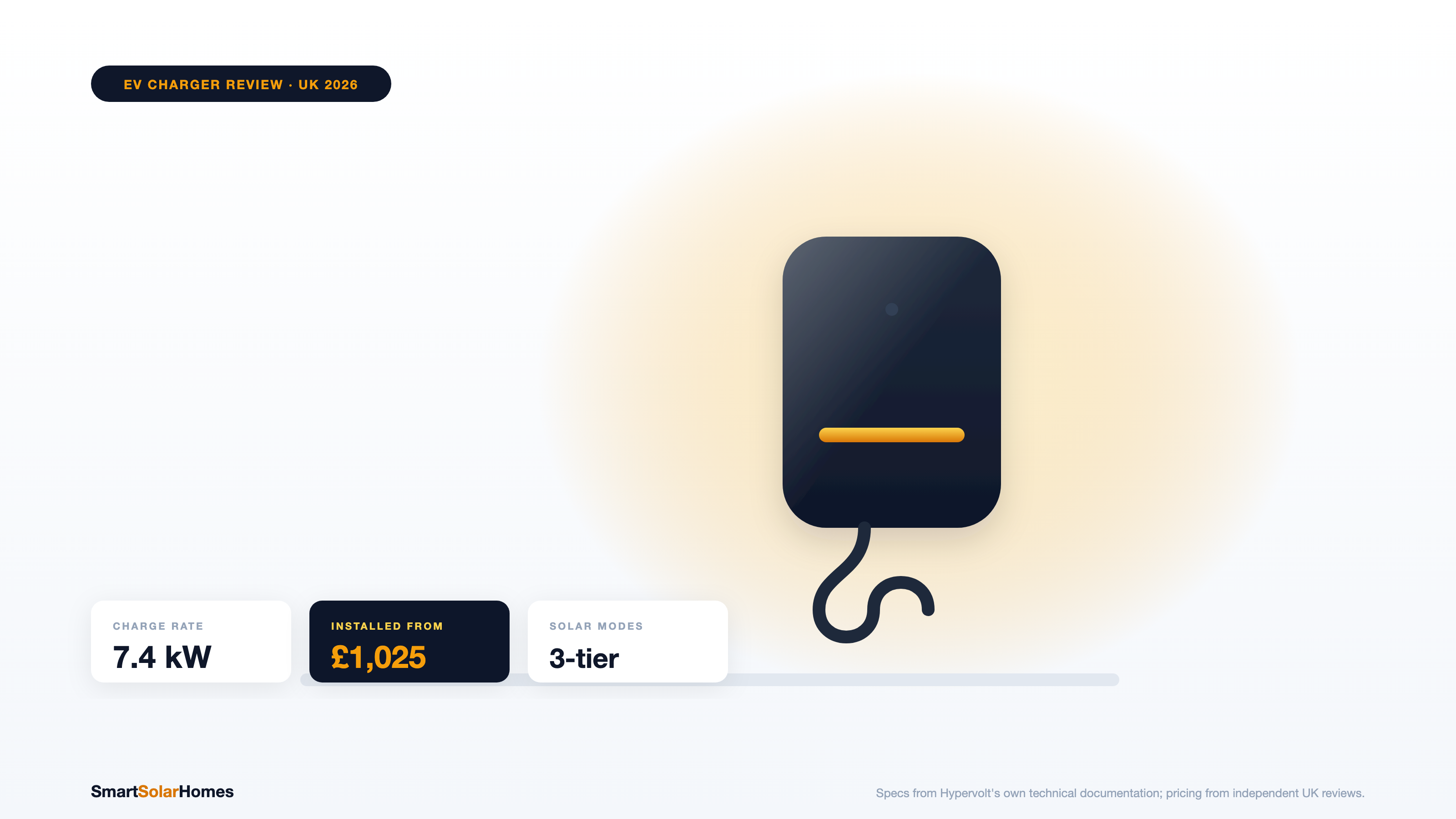
The Hypervolt Home 3 Pro is one of the most recognisable smart chargers in the UK, built by a UK manufacturer and consistently rated among the best-looking units you can put on a wall. This review covers the current 2026 specs, real installed pricing, the three solar charging modes, and how the Home 3 Pro compares to Ohme's own Home Pro and myenergi's Zappi, so you can see whether it's worth the premium before you book an installer.
Hypervolt Home 3 Pro: specs and price in 2026
The Home 3 Pro is a tethered 7.4kW (32A) single-phase charger housed in a compact, design-led casing. Per Hypervolt's own technical specification, it measures 328mm (H) x 243mm (W) x 101mm (D), carries an IP66 weatherproof rating and IK10 impact rating, and ships in a tethered Type 2 configuration with a 5-metre cable as standard — 7.5m and 10m upgrades are available. It connects over Wi-Fi (802.11 b/g/n) and Bluetooth LE rather than a built-in SIM, and it's UKCA marked, EN 61851-1:2019 compliant, and available in three finishes: Ultra White, Ultra Black and Space Grey.
- Power output: 7.4kW / 32A maximum, 230V AC single-phase
- Cable: tethered Type 2, 5m standard, 7.5m/10m optional upgrades
- Connectivity: Wi-Fi 2.4GHz + Bluetooth LE — no home Wi-Fi signal at the charger location can be a real-world weak point some owners report
- Control: Hypervolt smartphone app, no on-device screen
- Warranty: 3 years standard, with a 5-year extension reportedly available for around £100 if bought within 30 days of installation (installer-quoted, not on Hypervolt's own spec sheet — treat as indicative)
- Price: no fixed RRP from Hypervolt; independent reviewers and installer network pricing put the unit alone from roughly £625–£690, with a typical installed total around £1,025–£1,225 depending on cable length and install complexity
That installed range sits at the top of the single-phase 7kW market — you're paying for the finish and the app rather than extra power. If that's more than you want to spend, our wider roundup of the best home EV chargers in the UK covers cheaper alternatives alongside the Home 3 Pro.
Three solar modes, not one
Solar households get three distinct charging modes rather than a single on/off toggle. Per Hypervolt's own technical documentation, these are Boost (full-rate 7.4kW charging topped up from the grid regardless of solar output), Eco (solar-priority charging with a small grid baseline so the car still charges on cloudier days), and Super Eco (solar-only — the car draws exclusively from surplus PV generation via a CT clamp, even if that means a slower session). A CT clamp for measuring solar export is included as standard, and the app also supports scheduling and load balancing on a single clamp install.
This three-tier system gives more granular control than a simple divert toggle, but it isn't the deepest solar integration on the market — myenergi's Zappi built its entire reputation on solar-diversion precision, and reviewers consistently rate the Zappi's eco+ mode as marginally more responsive to fast-changing cloud cover. If solar charging is your main priority, our best EV charger for solar panels guide and the EV charging with solar explainer go further into how the two compare in practice.
Smart tariff support: solid, not exhaustive
The Hypervolt app has direct, named support for Intelligent Octopus Go and OVO Charge Anytime, letting the charger schedule around each tariff's known off-peak window automatically. For other suppliers, manual scheduling covers most fixed off-peak tariffs, though the charger doesn't currently offer the same breadth of direct half-hourly-tariff integrations as Ohme, which is built specifically around that job. If you're shopping around Octopus Energy's EV charging options and want the deepest possible tariff integration rather than the nicest app, the Ohme Home Pro is worth cross-checking before you commit.
Home 3 Pro vs the standard Home 3
Hypervolt sells the Home 3 Pro alongside an earlier Home 3 model. The two look almost identical — the most visible external change is the cable exiting from the back of the unit rather than the bottom — with the real differences sitting in the internal hardware and firmware rather than the spec sheet. If you see a cheaper Home 3 listed by an installer, confirm which generation you're actually being quoted before assuming it's the same unit reviewed here.
The OZEV grant — what "OZEV approved" actually means
Hypervolt markets its chargers as OZEV approved, which refers to installer accreditation rather than a guarantee that your household personally qualifies for a grant. As of 2026, the domestic Electric Vehicle Chargepoint Grant pays up to £500 per socket, but it's restricted to renters, flat owners, and (from April 2026) households with no off-street parking who rely on street charging — homeowners with a driveway are not eligible. See our EV charger installation guide for the full current eligibility rules and what else affects your final installed cost.
Who the Hypervolt Home 3 Pro suits
The Home 3 Pro is the right choice if you want the smartest-looking charger on the wall and a genuinely polished app experience, and you're happy to pay a premium over screenless or budget rivals for that finish. It suits Octopus Intelligent Go and OVO Charge Anytime customers particularly well, since both get native support. It's a weaker fit if you want the single deepest tariff-integration option on the market — the Ohme Home Pro edges ahead there — or best-in-class solar-diversion accuracy, where the Zappi remains the reference point. For most solar households wanting one charger that does tariffs, solar and good looks all reasonably well, the Home 3 Pro is a legitimate all-rounder; just go in expecting to pay toward the top of the market for it.
FAQs
How much does the Hypervolt Home 3 Pro cost installed?
Does the Hypervolt Home 3 Pro support solar charging?
Does the Hypervolt Home 3 Pro work with Octopus Energy or OVO tariffs?
What's the difference between the Hypervolt Home 3 and Home 3 Pro?
Is the Hypervolt Home 3 Pro eligible for the OZEV grant?
Sources — verified 13 September 2026
- Hypervolt, “Home 3 Pro Technical Specification” — support.hypervolt.co.uk
- GOV.UK, “Electric Vehicle Chargepoint Grant for renters and flat owners” — www.gov.uk
- Expert Sure, “Hypervolt Home 3 Pro Review 2026” — www.expertsure.com
- We Power Your Car, “Hypervolt 3 Pro Review: Pros, Cons & The Final Verdict” — wepoweryourcar.com

About the author
Sepehr
Solar specialist & co-founder, Smart Solar Homes
Solar specialist and co-founder of Smart Solar Homes, which works with MCS-certified UK installer partners. I write all the guides and reviews here; the aim is straight-talking education the industry rarely provides.
Citing this page? Please use a dofollow link back to the original article — it helps us keep the data on this page accurate and up to date.
Browse EV Chargers on Smart Solar Homes


Want to compare these side by side? Use the compare tool →
Or browse all EV Chargers on Smart Solar Homes.
Related reading
More on ev chargers from the editorial team.
Find installers near you
MCS-certified solar installers covering these areas.