New Build EV Chargers UK: Part S Explained

Written and reviewed by Sepehr. See our editorial policy.
If you're buying a new-build home in England, there's a good chance it already comes with an electric car charger fitted to the wall — not because the developer chose to add one, but because the law requires it. Since 15 June 2022, Part S of the Building Regulations has made an EV chargepoint a standard feature of most new homes with parking, in much the same way a boiler or a consumer unit is. Few buyers know the rule exists, which makes it easy to either assume too little ("I'll need to arrange my own charger") or too much ("every parking space must have one"). Neither is quite right.
What Part S of the Building Regulations actually requires
Requirement S1, set out in Approved Document S, applies to the erection of a new residential building with associated parking. It requires an electric vehicle chargepoint to be installed for a minimum number of parking spaces equal to whichever is lower: the total number of parking spaces, or the number of dwellings the car park serves. In practice, that means a small development where every home gets one space typically gets one chargepoint per home; a development with more parking spaces than homes doesn't need a chargepoint at every single space, just enough to cover one per dwelling.
The same requirement (S2) applies where dwellings are created through a material change of use — for example, converting a commercial building into flats — and a related requirement (S3) applies to residential buildings undergoing major renovation that will end up with more than 10 associated parking spaces. Non-residential and mixed-use new buildings (S4–S6) are covered too, though there the default is usually cable routes for future chargepoints rather than a chargepoint at every space. This article focuses on the residential rules, which are what matter if you're buying a house or flat.
The £3,600 cost cap — and when cable routes replace a charger
The requirement isn't unconditional. Regulation 44D caps a developer's obligation at an average connection cost of £3,600 per chargepoint (the extra cost of the incoming electrical supply needed for that connection, compared with the cost without it). Where installing a full chargepoint at every required space would push the average connection cost above that cap, the developer only has to install chargepoints up to the point the cap is reached — and must instead install cable routes (a safe, unobstructed route for cabling to be added later) at the remaining spaces that would otherwise have needed one.
Cable routes alone can also apply, separately from the cost cap, wherever a development has more than 10 associated parking spaces and more spaces than dwellings: any space above the one-per-dwelling minimum gets a cable route rather than a live chargepoint. If a developer wants to show the £3,600 cap applies, they need at least two formal quotes at the planning stage, one of which must come from a distribution network operator (DNO) — this isn't a figure a developer can simply assert.
The practical upshot for a buyer: a chargepoint on the wall is the norm for most single-home plots, but on larger developments with shared parking courts, don't assume every bay has one — check whether your allocated space has a live chargepoint or just a cable route ready for a future one.
The minimum charger spec: 7kW, a dedicated circuit, a universal socket
Where Part S does require a chargepoint, Regulation 44J sets a minimum technical standard. Every chargepoint installed to meet the requirement must:
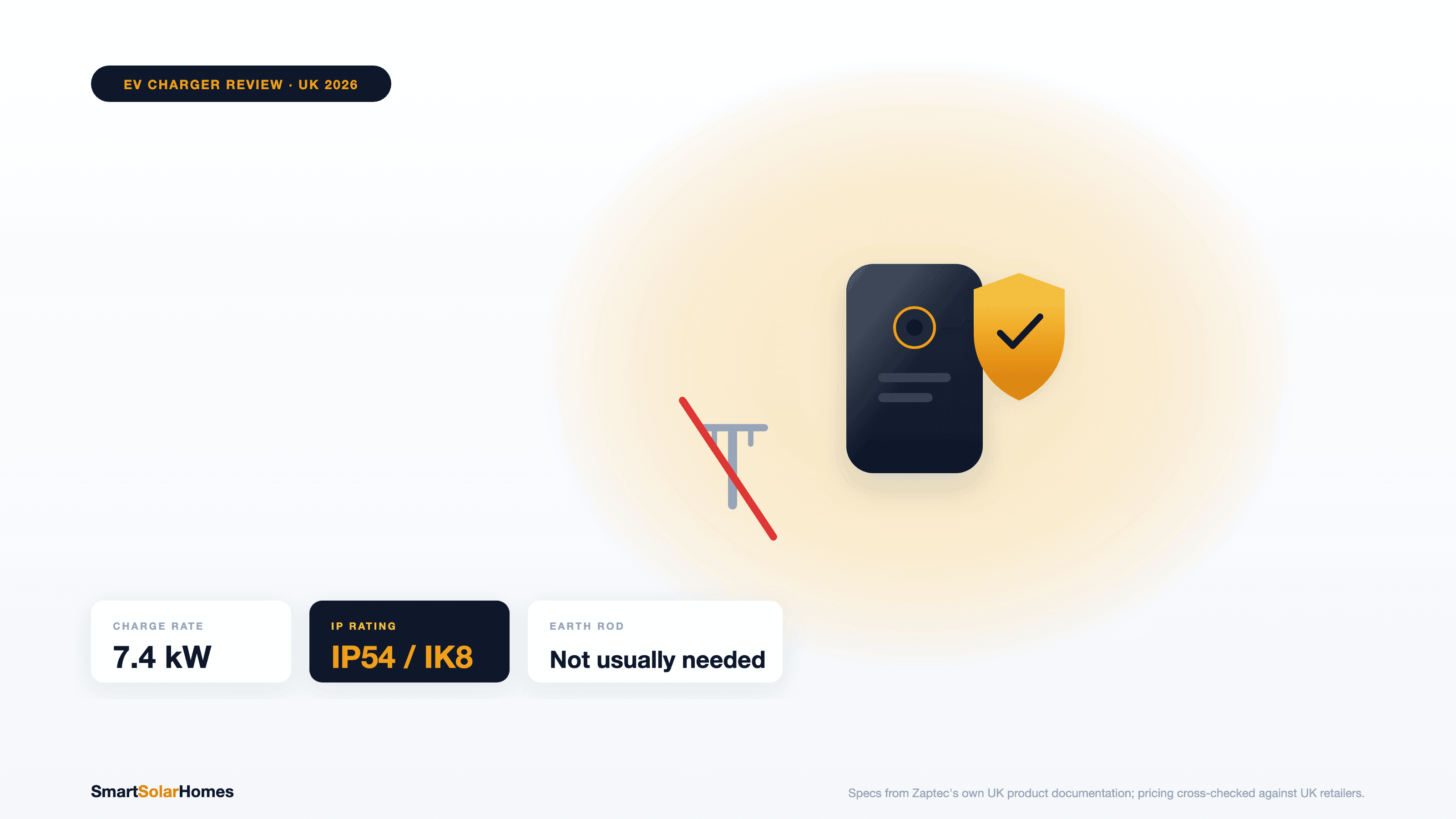
- Have a minimum nominal rated output of 7kW — the same power band as most dedicated home chargers bought separately (see our home EV charger buyer's guide for how 7kW compares to slower and faster options).
- Be fitted with a universal (untethered) socket in most cases, so it works with any EV's own cable, rather than a fixed cable tied to one connector type. A tethered chargepoint is only acceptable in exceptional circumstances, such as a self-build where the vehicle is already known.
- Run on a dedicated circuit, be a minimum Mode 3 charging system, and meet the general wiring rules in BS 7671 — the same wiring regulations that govern any domestic electrical installation.
- Show a charging-status indicator, so you can see at a glance whether the vehicle is charging.
This is a genuine baseline, not a ceiling — a developer can install a smarter or faster charger if they choose, and increasingly do, since a smart charger that can shift charging to cheaper overnight rates is a selling point in its own right (see our guide to EV charger installation for how smart, tariff-aware chargers differ from a basic 7kW unit).
Renovations, conversions and exemptions
The rules aren't universal. A residential building undergoing major renovation is only caught by Part S if, after the work, it has more than 10 associated parking spaces, and if fitting the chargepoints and cable routes wouldn't cost more than 7% of the total renovation cost — above that threshold, the requirement doesn't apply at all. Listed buildings, buildings in a conservation area, and scheduled monuments are exempt from the material-change-of-use requirement (S2) where compliance would unacceptably alter the building's character.
And where no parking is provided for a new home at all, there's no requirement to install a chargepoint — Part S only bites where there's parking to attach one to.
What this means if you're buying a new-build home
If you're weighing up a new-build purchase, three things are worth checking with the developer or estate agent before you exchange: whether your specific parking space has a live 7kW chargepoint fitted or only a cable route, whether the chargepoint is a basic unit or a smart, app-controlled one that can schedule cheap overnight charging, and — if the property also has rooftop solar, increasingly common on new developments under the Future Homes Standard (see our guide to solar panels on new-build homes) — whether the charger and any solar-diverting hardware are wired to work together, rather than as two unrelated systems bolted on separately.
None of this is exotic homework. It's the same due-diligence spirit as checking any other fixed installation on a house you're about to buy, covered in more general terms in our guide to buying a house with solar panels. The difference with Part S is that, unlike solar, the EV chargepoint on a post-2022 new-build genuinely isn't optional for the developer — it's a legal minimum most of them have to meet before the sale even completes.
FAQs
Do all new-build homes in the UK have to have an EV charger?
What is the minimum EV charger power output required by law?
Does Part S apply if I'm renovating my house rather than buying new?
Can a developer install a slower charger than 7kW to cut costs?
Sources — verified 21 August 2026
- HM Government / GOV.UK, “Approved Document S: Infrastructure for the charging of electric vehicles (2021 edition, in effect from 15 June 2022)” — assets.publishing.service.gov.uk
- legislation.gov.uk, “The Building Regulations etc. (Amendment) (England) Regulations 2021 (SI 2021/1392)” — www.legislation.gov.uk

About the author
Sepehr
Solar specialist & co-founder, Smart Solar Homes
Solar specialist and co-founder of Smart Solar Homes, which works with MCS-certified UK installer partners. I write all the guides and reviews here; the aim is straight-talking education the industry rarely provides.
Citing this page? Please use a dofollow link back to the original article — it helps us keep the data on this page accurate and up to date.
Browse EV Chargers on Smart Solar Homes


Want to compare these side by side? Use the compare tool →
Or browse all EV Chargers on Smart Solar Homes.
Related reading
More on ev chargers from the editorial team.


Find installers near you
MCS-certified solar installers covering these areas.