New Build Solar Panels UK: Future Homes Standard Explained

Written and reviewed by Sepehr. See our editorial policy.
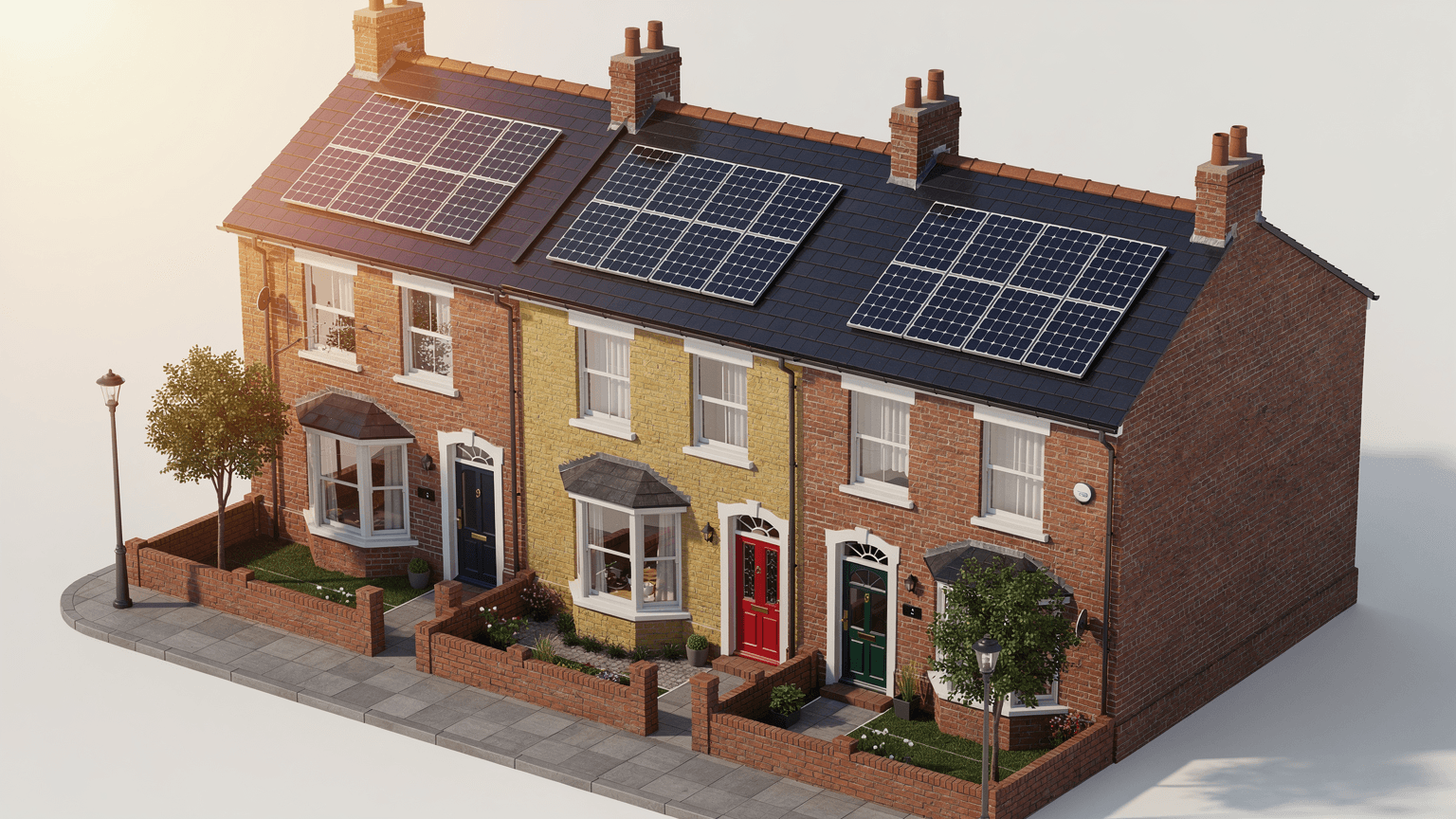
New builds in England increasingly come with solar panels already fitted to the roof — and from March 2027, this will be a requirement rather than a developer choice. The Future Homes Standard (FHS) mandates that new homes emit at least 75% less carbon over their lifetime than those built to the 2013 Building Regulations, and rooftop solar PV is the primary technology developers use to meet it. If you're buying a new build now or in the coming years, understanding what those panels mean — what you're getting, what you should ask, and what you need to do as the new owner — will save you time and potentially money.
What the Future Homes Standard requires
The FHS was confirmed in final form on 24 March 2026, with Approved Documents published the same day. The new regulations come into force on 24 March 2027, with a 12-month transitional period running through to 24 March 2028 for projects already under way. The headline requirement is a 75% reduction in carbon emissions compared with homes built to the 2013 Part L standard — a dramatic increase from the 30% target under the 2021 Part L update.
Solar PV plays a central role. Under Approved Document L1 (paragraph 5.73), developers must install panels equivalent to approximately 40% of the dwelling's ground floor area, where this is technically feasible. Crucially, the solar requirement is non-tradeable: a developer cannot substitute better insulation or a more efficient heat pump to avoid fitting panels. Exemptions apply only where shading, orientation or structural constraints make generation impractical, and the developer must document the technical justification in the Home Energy Model (HEM) or SAP 10.3 compliance file. Homes above 18 metres in height containing dwellings may also be exempt.
Alongside solar, the FHS prohibits gas, oil, LPG or hydrogen-ready boilers. New-build heating will be predominantly air source heat pumps (ASHPs) or connections to a heat network. This combination — solar PV plus ASHP — is the standard package that most new builds from 2027 onwards will carry, though many housebuilders are already delivering it ahead of the mandate. For background on how building regulations govern solar installations, including Part P electrical compliance, see our detailed guide.
SAP, HEM, and energy ratings explained
SAP (Standard Assessment Procedure) is the methodology used to demonstrate that a new home meets Part L of the Building Regulations. It calculates a home's energy performance rating (the EPC band) and its carbon emissions. Solar panels contribute directly to the SAP score by reducing the home's net energy demand — every kWh generated on-site offsets electricity that would otherwise be imported from the grid. The updated SAP 10.3 and its successor, the Home Energy Model (HEM), both treat on-site generation as a direct credit in the carbon calculation, which is why solar PV is so integral to achieving the 75% carbon reduction target.
When you receive your new build's EPC, the solar system's estimated annual generation should be included in the property information. If it is not, ask the developer's sales team or your solicitor to provide the SAP/HEM output file. This document is produced during building control sign-off and contains the system specification used in the compliance calculation.
What to ask before you exchange contracts
New build buyers often have very limited opportunity to inspect technical specifications before contracts are exchanged. Raising these questions early — ideally via your solicitor at the enquiries stage — gives you the best chance of getting complete answers:
The same enquiries-stage approach applies to the EV chargepoint most new builds now come with — since 2022, Part S of the Building Regulations has required one at most new homes with parking, so it is worth confirming exactly what is fitted alongside the solar specification.
- System size (kWp): Most new build houses will have systems in the range of 2.5–5 kWp depending on the property's footprint and the developer's specification. Ask for the exact watt-peak figure and the number of panels.
- Inverter make and model: The inverter brand matters for long-term servicing and any future battery retrofit. Ask whether it is a standard string inverter or a hybrid inverter with battery-ready DC inputs.
- MCS certificate number: Every installer who fitted the panels should hold MCS certification, and you should receive an MCS certificate confirming the installation meets the MCS 012 standard for solar PV. This document is essential for SEG registration and for future sale of the property. Ask the developer to confirm the certificate number and that it has been lodged with the MCS database.
- Roof restrictions: Some developers include covenants or estate management rules that restrict alterations to the external appearance of properties. Check whether any such restriction would prevent you from adding more panels later — see our guide on adding more solar panels to an existing system.
- Monitoring portal access: Many inverters come with a cloud monitoring app. Ask for login details and confirm the system has been commissioned and is generating.
G98 notification: the builder's responsibility
Any solar installation below 3.68 kW per phase must be notified to the local Distribution Network Operator (DNO) under the G98 standard. For most new build domestic systems this notification is the installing contractor's responsibility — not yours — and must be submitted within 28 days of commissioning. Before completion, ask your developer or solicitor to confirm that G98 notification has been submitted and to provide a copy of the notification reference. If the system is larger and exceeds the G98 threshold, a G99 application with prior DNO approval will have been required. Our detailed G98 notification guide explains both processes if you need to verify the paperwork.
Registering for the Smart Export Guarantee
Registering for a SEG tariff is your responsibility as the new homeowner — it is not done by the developer or builder. The Smart Export Guarantee (SEG) is an Ofgem-mandated scheme under which licensed electricity suppliers must offer a tariff to small-scale generators who export electricity to the grid. Payments are made based on your actual export meter readings, and rates — which must by law always be above zero — vary by supplier.
As soon as you move in and have confirmed the system is generating, contact your chosen electricity supplier (or shop around on Ofgem's published SEG Licensee list) to register for a SEG tariff. You will need your MCS certificate number and, in most cases, your export MPAN (the metering point reference for grid export). If a smart meter has been installed as part of the new build — which is now standard — the smart meter's export register is used to settle SEG payments automatically. See our comparison of SEG tariff rates in 2026 to find the best available deal.
Battery storage: typically not included
The Future Homes Standard does not mandate battery storage, and most developers do not include a battery as standard. However, some forward-thinking housebuilders are running conduit from the consumer unit to a suitable wall location — or installing a hybrid inverter — to make future battery retrofit straightforward. Before you complete, ask whether conduit has been run for battery wiring and whether the inverter is battery-compatible.
Adding a battery later is generally straightforward if the inverter supports it, though costs vary depending on the size and chemistry you choose. Our guide to whether solar batteries are worth it covers the payback maths in detail. If you move in with an ASHP and solar panels already running, a battery can shift your self-generated electricity into the evening hours when the heat pump operates most, meaningfully reducing your import bill.
New build solar vs retrofit: the key differences
Factory-fitted panels carry some genuine advantages over retrofit. The installation is integrated into the roof structure from the outset, meaning no retrospective penetrations or tile-cutting, and panels are typically warrantied as part of the overall building guarantee (check with your developer and the NHBC warranty terms). The system is also designed to work alongside the building's heating and ventilation — an ASHP paired with solar from day one is a more optimised setup than bolting solar onto an existing gas-heated home.
The main limitation is specification control. Developers make procurement decisions at scale and will choose a panel and inverter brand that suits their supply chain, not necessarily the most efficient available. The system size may also be sized to the regulatory minimum (the 40% ground-floor-area rule) rather than to your specific energy demands. If your household uses significantly more electricity than average — due to an electric vehicle, a home office or a large ASHP — the included system may cover a smaller proportion of your annual consumption than you would like.
For volume housebuilders and developers, the compliance picture is more complex than for a single install — see our guide on solar requirements for new build developers.
FAQs
Are solar panels required on new build homes in the UK?
How big is the solar system on a new build house?
Do I need to register for the Smart Export Guarantee myself on a new build?
Who is responsible for the G98 notification on a new build solar system?
Do new build solar panels come with a battery?
Sources — verified 7 June 2026
- GOV.UK — Future Homes and Buildings Standards: 2023 consultation and government response (March 2026) — www.gov.uk
- Ofgem — Smart Export Guarantee (SEG) — www.ofgem.gov.uk
- MCS — MCS certification for solar PV installers — mcscertified.com
- GOV.UK — Standard Assessment Procedure (SAP) — www.gov.uk
- Home Energy Model — Future Homes Standard 2026: Full Guide — home-energy-model.co.uk
- Pinsent Masons Out-Law — Future Homes and Buildings Standards confirmed for England (March 2026) — www.pinsentmasons.com

About the author
Sepehr
Solar specialist & co-founder, Smart Solar Homes
Solar specialist and co-founder of Smart Solar Homes, which works with MCS-certified UK installer partners. I write all the guides and reviews here; the aim is straight-talking education the industry rarely provides.
Citing this page? Please use a dofollow link back to the original article — it helps us keep the data on this page accurate and up to date.
Browse Solar Panels on Smart Solar Homes


Want to compare these side by side? Use the compare tool →
Or browse all Solar Panels on Smart Solar Homes.
Related reading
More on solar panels from the editorial team.
Find installers near you
MCS-certified solar installers covering these areas.