UK EV Charging VAT: Home vs Public
Written and reviewed by Sepehr. See our editorial policy.
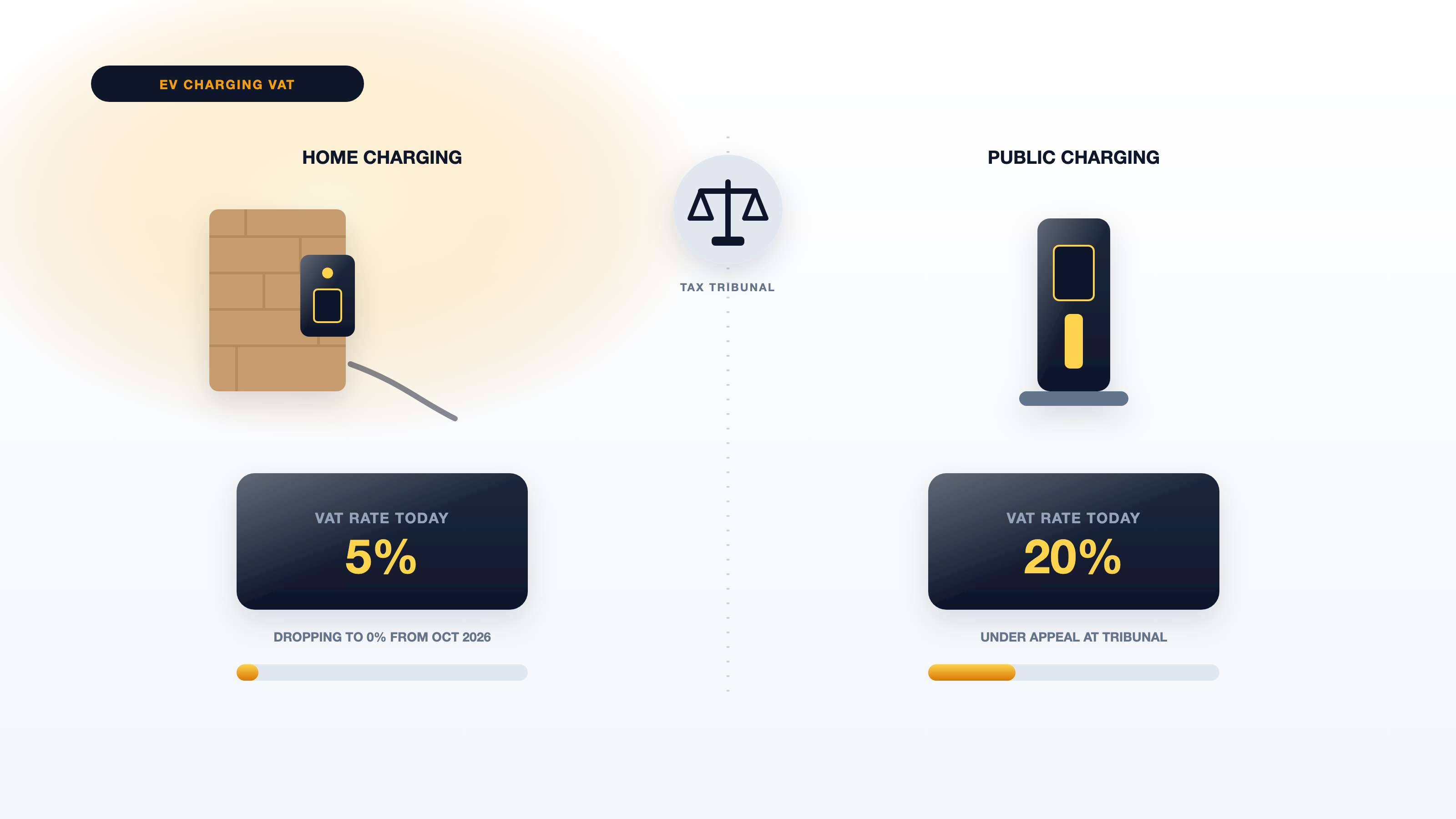
World EV Day fell on 9 September 2026, and the UK's National Franchise Dealers Association used the occasion to point at something most electric car owners rarely think about: the VAT rate on charging your car at home is a fraction of what it is charging in public — and the gap is about to get wider. Home electricity, including the power used to charge an EV overnight on your driveway, carries a reduced 5% VAT rate today and drops to 0% from 1 October 2026. Public charge points remain standard-rated at 20%, a position HMRC is actively defending in a live tribunal appeal.
The VAT gap today: 5% at home, 20% in public
Per HMRC's own guidance, supplies of electricity to a domestic premises are taxed at the reduced VAT rate of 5%, under the same rule that applies to your household gas and electricity generally. That covers a home EV charger just as it covers every other appliance plugged into your consumer unit. Public EV charge points, by contrast, are standard-rated at 20% — HMRC's published position, restated in Revenue and Customs Brief 4 (2026), is explicit: "charging electric vehicles at public charge points is standard rated for VAT." The result is that identical electricity, delivered to charge the identical car, is taxed at four times the rate if you can't charge at home.
The gap is about to widen: home drops to 0% from October
From 1 October 2026, VAT on qualifying domestic electricity — including home EV charging — drops further, from 5% to 0%, as part of the government's temporary VAT relief on household electricity running to 31 March 2027 (covered in full in our VAT on electricity bills guide). Public charging isn't included in that relief. Unless HMRC's position changes, from October a driver who can charge at home will pay no VAT at all on the electricity, while a driver relying on the public network keeps paying 20% on top of a unit price that's often already several times higher than a domestic tariff.
A live legal fight over the 20% rate
The 20% public rate isn't as settled as HMRC would like. In February 2026, the First-tier Tribunal ruled in Charge My Street Ltd v HMRC that electricity supplied to an identified driver at an identifiable charge point should qualify for the reduced 5% domestic rate, provided the supply to that person at that location doesn't exceed 1,000 kWh in a calendar month — comfortably covering ordinary car charging. HMRC has applied to appeal the ruling, and its published guidance confirms the standard 20% rate remains in force while that appeal is pending. If HMRC eventually loses, the gap between home and public charging would narrow, since public charging would join home charging on the reduced (or, from October, zero) rate. Until then, the 20% rate is what applies at the plug.
UK EV growth by the numbers
The VAT debate is playing out against a fast-growing EV market. New battery-electric car registrations rose 28.6% year-on-year to 355,746 between January and August 2026, taking BEVs to 25.6% of the new car market — among the figures the NFDA's EVApproved scheme highlighted on World EV Day. Separately, a forecast reported around World EV Day suggests the UK's EV stock could grow by 509% over the next decade, which, without a large scale-up in charging infrastructure, could push the ratio as high as 527 vehicles per public charger. That number is a forecast rather than a confirmed government figure, but it underlines the same point the NFDA made: growth in EV ownership is running ahead of public charging capacity in a lot of places, particularly rural areas the NFDA specifically flagged as needing more investment.
Why this matters if you can charge at home
None of this changes what you pay if you already have a driveway charger and mostly avoid the public network — you're already on the cheaper side of this gap, and from October you'll pay no VAT on that electricity at all. It's a reminder of just how much the economics of EV ownership depend on being able to charge at home rather than relying on public infrastructure, on top of the unit-rate difference between a home tariff and a public rapid charger. If you're weighing up a home charger, our best home EV charger guide and EV charger installation guide cover the hardware and process, and our guide to charging an EV with solar panels covers pushing the cost down further by charging from your own generation rather than the grid at all. If you're renting or don't have off-street parking, our EV charger planning permission guide and the wider access questions around public charging are worth reading alongside this piece, since the VAT gap is one more reason off-street parking has become a meaningful financial advantage, not just a convenience.
The NFDA's World EV Day statement also called for more charging investment specifically in rural areas, where the public network is thinnest and drivers without off-street parking are most exposed to both the higher unit rates and the 20% VAT rate at once. Recent EV sales data, covered in our UK EV sales record article, shows the market growing fast enough that this gap is only going to matter to more drivers, not fewer, as adoption climbs.
FAQs
What VAT rate applies to charging an EV at home in the UK?
What VAT rate applies to public EV charging in the UK?
Could public EV charging VAT drop to 5%?
How much has the UK EV market grown in 2026?
Sources — verified 10 September 2026
- GOV.UK / HMRC, “Revenue and Customs Brief 4 (2026): VAT liability of supplies of electricity from public electric vehicle charge points” — www.gov.uk
- Fleet News, “HMRC appealing court ruling on 5% public charging VAT rate for EVs” — www.fleetnews.co.uk
- Transport Xtra / Local Transport Today, “Tax Tribunal rules reduced 5% VAT rate applies to public EV charging” — transportandenergy.com
- am-online, “NFDA calls for consumer focus as EV registrations rise” — www.am-online.com
- EV Infrastructure News, “World EV Day: Highlighting UK EV market growth” — www.evinfrastructurenews.com

About the author
Sepehr
Solar specialist & co-founder, Smart Solar Homes
Solar specialist and co-founder of Smart Solar Homes, which works with MCS-certified UK installer partners. I write all the guides and reviews here; the aim is straight-talking education the industry rarely provides.
Citing this page? Please use a dofollow link back to the original article — it helps us keep the data on this page accurate and up to date.
Browse EV Chargers on Smart Solar Homes


Want to compare these side by side? Use the compare tool →
Or browse all EV Chargers on Smart Solar Homes.
Related reading
More on ev chargers from the editorial team.
Find installers near you
MCS-certified solar installers covering these areas.