Which Roof Type Is Best for Solar Panels? A UK Guide

Written and reviewed by Sepehr. See our editorial policy.
Your roof is the foundation of any solar installation, yet most homeowners only discover its quirks when the installer turns up with a ladder. The type of roof covering, its pitch, age, and underlying structure all affect which mounting system is used, whether additional structural checks are required, and — in a small number of cases — whether solar is even viable without remedial work first. Getting this right early saves both money and surprises.
Why roof type matters for solar
Mounting systems are roof-specific. A hook designed for interlocking concrete tiles will not seat correctly on a Roman-profile clay tile, and a ballasted frame intended for flat EPDM will overload a cold-deck felt roof that was never designed to carry point loads. The MCS installation standard MIS 3002 — updated to V6.0 in March 2026 and mandatory from 18 June 2026 — requires every installer to obtain documented structural sign-off, with wind load calculations referenced to current Eurocodes, before fixing any array to a roof.
Weight is the other key variable. A standard residential solar panel weighs roughly 18–21 kg, and the mounting rails, hooks, and clamps add a further 4–6 kg per panel. Spread across the rafter span, this typically adds around 15–25 kg per square metre of dead load. Most British roofs built to modern standards can carry this comfortably — a typical rafter has a capacity of around 140 kg/m² — but older or modified structures may need a chartered structural engineer's assessment before the survey concludes.
Pitched roofs: concrete and clay tiles
Concrete and clay tiles are the most common roofing material on UK homes and the easiest starting point for solar. Installers use tile hooks or roof anchors that slide beneath the tile course directly above the rafter, fixing to the rafter with a structural screw. The tile itself is never drilled. Concrete interlocking tiles (the flat, modern kind) allow a wide choice of bracket and are generally the least complicated surface to work with.
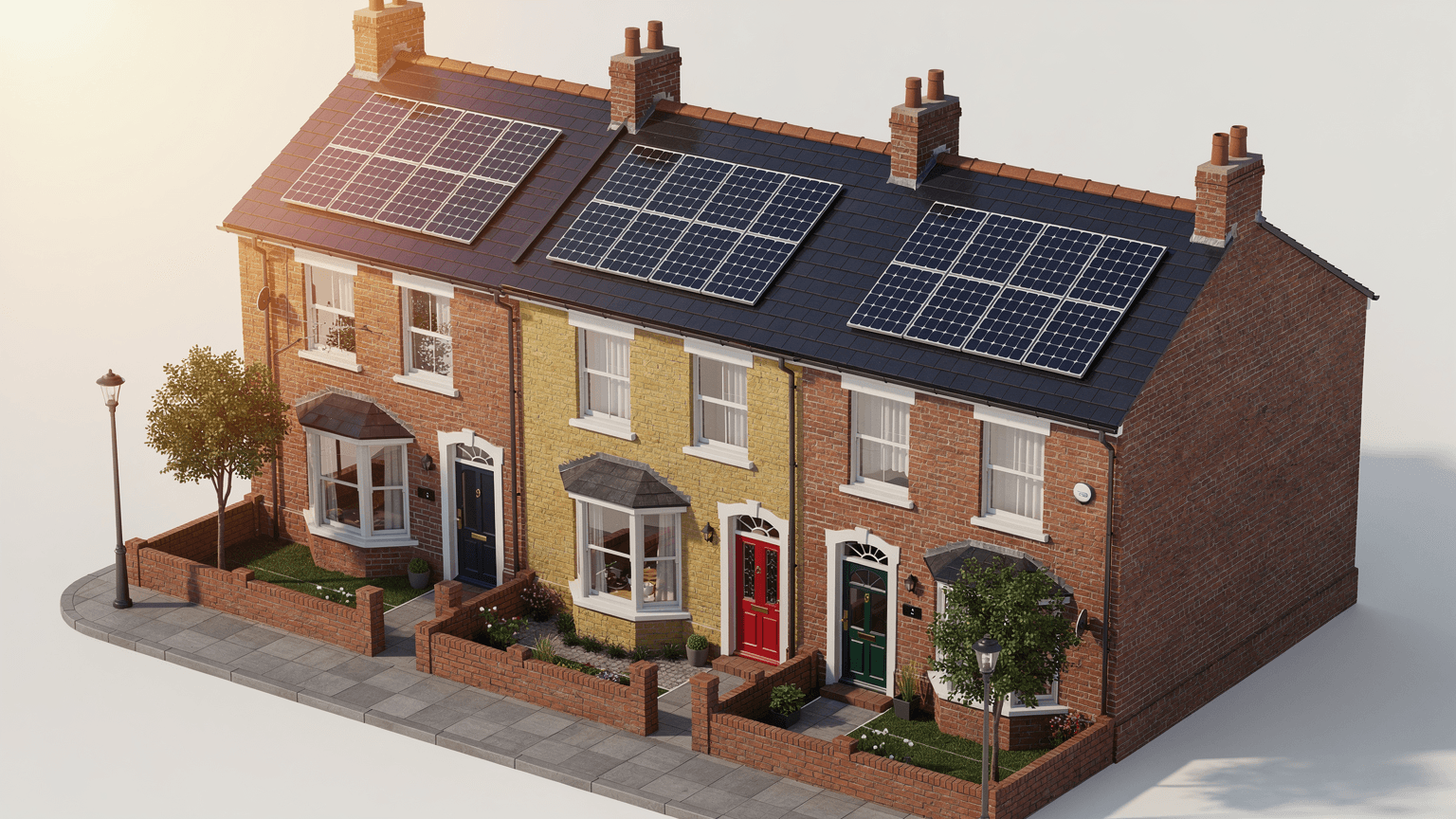
Clay plain tiles — smaller, double-lapped, common on Victorian and Edwardian terraces — need more hooks per run because each tile is narrower, but the technique is identical. Roman tiles, with their distinctive round ridges, require profile-specific hooks to ensure the rail sits level; a competent installer will carry the correct profile for the most common variants. Pantile (s-profile clay) is similar — workable, but requires matching hooks and a slightly more careful alignment to avoid cracking the profile lip.
Slate roofs: natural and fibre cement
Natural slate — including Welsh slate — is brittle and cannot be hooked in the same way as tiles. Instead, installers use a lead-flashed or resin-bedded roof anchor that passes between slates at the rafter position and is fixed directly to the rafter or batten beneath. The surrounding slates are lifted carefully, the anchor bolted to the rafter, and the slates re-laid. Done correctly this is a weathertight, long-lasting fixing; done poorly it is a source of leaks, so slate work is where an installer's experience shows most clearly.
Fibre cement (sometimes called "man-made slate") is more uniform in thickness than natural slate and slightly more forgiving to work around, but the same lead-flashed anchor approach applies. Welsh slate in particular is among the most prized roofing materials in the UK; if the roof is in a conservation area, the local authority may require that any tiles lifted and re-laid are done by a roofing specialist to preserve the historic character of the covering.
Flat roofs: EPDM, GRP, felt, and TPO membranes
Flat roofs need a fundamentally different approach because there are no rafters to hook into from above, and penetrating the waterproof membrane introduces leak risk. The standard solution is a ballasted low-angle frame: an aluminium tray system weighted with concrete blocks (typically 20–25 kg per ballast pad) that holds the panels at a tilt of 10–15° without any roof penetration. This allows the array to drain and self-clean while keeping the fixing completely non-penetrative.
From 10 August 2025, MCS requires that any solar mounting system used on a flat roof must hold MCS 012 certification, confirming it has been independently tested for wind uplift and structural performance. Under the permitted development rules updated in December 2023, panels on flat roofs may now protrude up to 600 mm above the roof surface without requiring planning permission — up from the previous 200 mm limit — making low-angle framing fully compliant on most properties.
One caveat: if the flat roof covering is old felt (pre-1990s) or a cold-deck construction that was never rated for point loads, your installer may recommend re-roofing or at minimum a structural survey before proceeding. EPDM rubber, GRP fibreglass, and modern TPO membranes are all compatible with ballasted systems; aged felt may not be.
Metal seam roofs
Standing-seam metal roofs — common on contemporary new builds, barn conversions, and commercial-residential hybrid properties — are among the easiest surfaces for solar. Specialist S-5! or equivalent clamps grip the raised seam without any drilling or penetration at all. The clamp is tightened onto the seam profile with set-screws, the mounting rail bolts to the clamp, and panels are installed as normal. No holes, no sealant, no leak risk. The result is structurally very secure and fully reversible.
Corrugated metal sheets (profiled steel, common on agricultural outbuildings) require profiled mounting feet that sit in the troughs of the corrugation and are fixed through the sheet with sealed stainless-steel screws. The seals are critical to weatherproofing; a quality installer will use EPDM-backed fixings rated for roof use.
Asbestos cement: the one roof you cannot drill
Asbestos cement roof sheets, still found on some pre-1980s garages, outbuildings, and older commercial units, represent a specific hazard. The Health and Safety Executive makes clear that drilling or cutting asbestos-containing materials releases fibres linked to mesothelioma and other serious conditions. While the HSE classifies drilling asbestos cement as a non-licensed activity (meaning a specialist licence is not legally required for the drilling itself), the practical and health risks are severe enough that responsible MCS installers will not drill these roofs.
The standard recommended approach is either to overclad the asbestos sheeting with a new steel or aluminium roof (which then becomes the mounting substrate), or to use a non-penetrative ballasted system if the structure can take the load. In both cases, an asbestos survey by a qualified surveyor is the necessary first step, and any disturbance of ACMs must be handled in line with the HSE's Control of Asbestos Regulations 2012.
Thatched roofs: not suitable
Traditional thatch is not compatible with rooftop solar. The combustible nature of the material, the absence of rigid rafters at standard positions, and the significant fire insurance implications make it impractical. Some insurers will void cover if solar panels are installed on a thatched roof. Ground-mounted solar may be an option for thatched properties with sufficient garden space — see our guide to ground-mounted solar in the UK for details on planning and costs.
Conservation areas and listed buildings
Solar panels are permitted development on most UK homes regardless of whether the property is in a conservation area, but there are important exceptions. In a conservation area, panels on a flat roof require prior approval from the local planning authority. Panels on a listed building always require listed building consent, and consent is not guaranteed — the local authority may require that any fixings are fully reversible and that the visual impact on the building's character is minimised. If you are unsure, the Planning Portal provides the definitive guide to conditions and limitations.
What an MCS installer checks at survey
A pre-installation survey covers more than just the roof covering. Expect the installer to check: rafter spacing and depth; the condition of the batten beneath the tiles; evidence of sagging, rot, or previous repair; the age and type of felt underlay; any existing penetrations (chimney, velux, flashing); and the number of panels the proposed roof area will support. For flat roofs, they will also check the condition and type of membrane and whether existing drainage will remain unobstructed by the array. This is also the point at which a structural sign-off decision is made — and if a structural engineer's report is needed, budget one to two weeks for that before installation can proceed.
Understanding your roof type before requesting quotes means you can have a more informed conversation with each installer and compare like-for-like proposals. If you are ready to look at costs, our full guide to solar panel costs in the UK covers what to expect for different system sizes and roof configurations. And if you are already extending or re-roofing, read our guide to adding solar panels during a renovation before your roof shape and orientation are finalised.
FAQs
What roof type is best for solar panels in the UK?
Can you put solar panels on a flat roof?
Can solar panels go on an asbestos roof?
Can you fit solar panels on a thatched roof?
How much weight do solar panels add to a roof?
Sources — verified 8 June 2026
- MCS — MIS 3002 Solar PV Installation Standard (V1.0 2025) — mcscertified.com
- HSE — Asbestos: the analysts' guide (A9), Health and Safety Executive — www.hse.gov.uk
- Planning Portal — Solar Panels: Planning Permission (domestic) — www.planningportal.co.uk
- Legislation.gov.uk — The Town and Country Planning (General Permitted Development) (England) Order 2015, Part 14 — www.legislation.gov.uk
- Solar Surveys — MIS 3002 V6.0 Structural Sign-Off (mandatory 18 June 2026) — solarsurveys.co.uk
- HSE — Control of Asbestos Regulations 2012 — www.hse.gov.uk

About the author
Sepehr
Solar specialist & co-founder, Smart Solar Homes
Solar specialist and co-founder of Smart Solar Homes, which works with MCS-certified UK installer partners. I write all the guides and reviews here; the aim is straight-talking education the industry rarely provides.
Citing this page? Please use a dofollow link back to the original article — it helps us keep the data on this page accurate and up to date.
Browse Solar Panels on Smart Solar Homes


Want to compare these side by side? Use the compare tool →
Or browse all Solar Panels on Smart Solar Homes.
Related reading
More on solar panels from the editorial team.
Find installers near you
MCS-certified solar installers covering these areas.