Renusol ConSole+ Review UK: Flat-Roof Mounting System
Written and reviewed by Sepehr. See our editorial policy.
The Renusol ConSole+ is a ballasted flat-roof mounting system that holds solar panels in place with weight instead of roof fixings. It is a common choice for garage, extension and outbuilding roofs, but the documents we could find for it are old. This Renusol ConSole+ review works through the technical datasheet and installation manual, and flags what no longer lines up with the panels sold in 2026. For the wider picture on flat roofs, start with our flat roof solar panels guide.
What is the Renusol ConSole+?
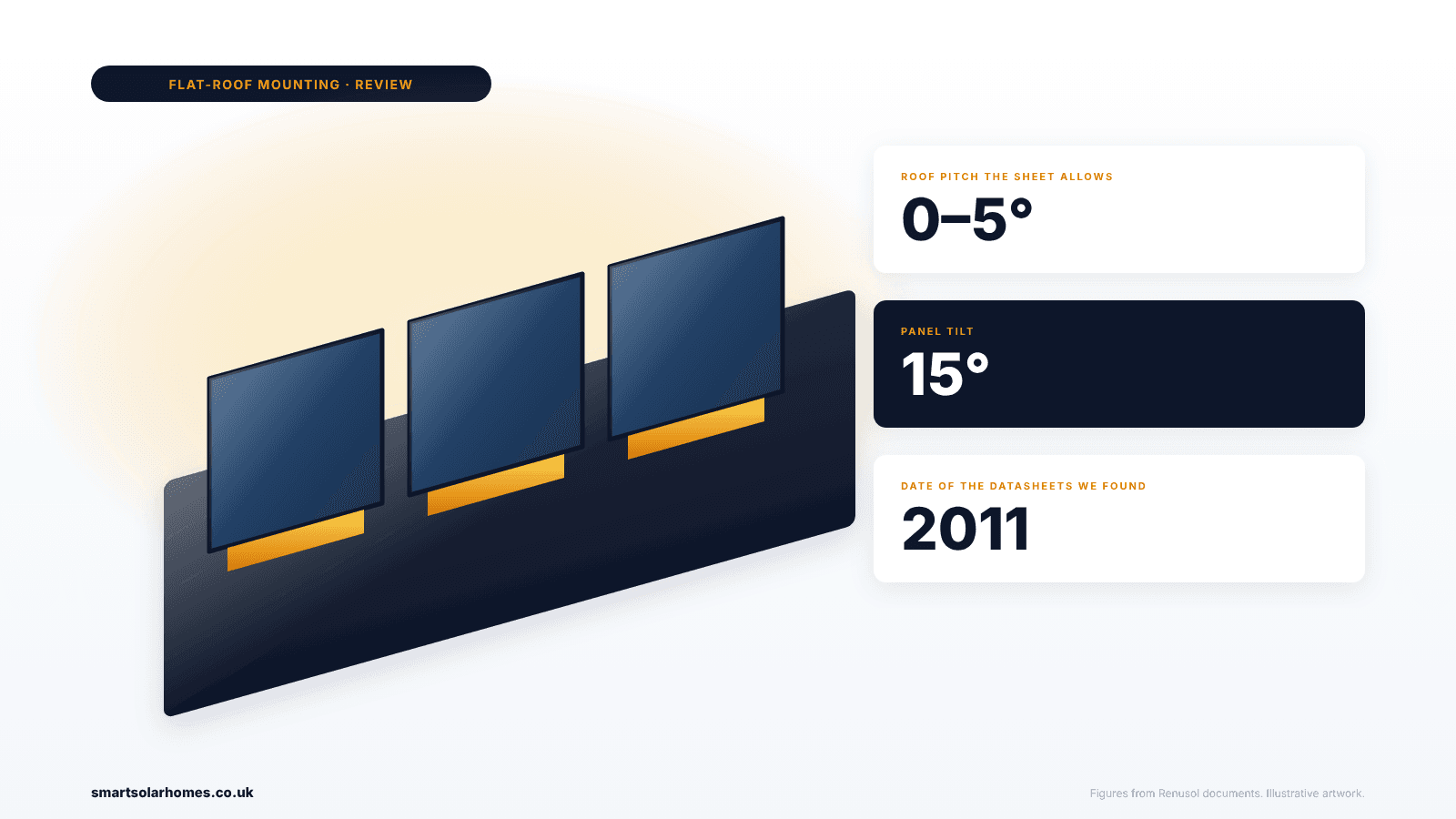
The datasheet describes a “ballasted flat roof system, without penetration” made from HDPE (a plastic) and aluminium, for industrial, agricultural and residential buildings. It lists polymer and asphalt roofs as the roof types, and a roof pitch of 0° to 5°. Each module sits in a tray at a 15° angle, and Renusol says the angle allows rows to sit close together. Air slots in the upper and lower parts of the tray are meant to cool the modules. Our catalogue lists two kits (8-panel and 10-panel) at roughly £320 and £420, hardware only, and says ballast slabs are not included.
Datasheet and manual figures
- Ballast: the system “requires low ballasting” and can be used on flat roofs with load-bearing reserves as low as 15kg/m². The exact ballast depends on the site, and Renusol says its application team can help calculate it.
- Weight: about 6kg per ConSole+ in the datasheet and about 7kg in the manual, plus about 2kg for the optional Streamliner+ wind deflector.
- Wind protection: the Streamliner+ is required on the wind-exposed outer sides of an installation, and it reduces the wind load on the outer rows.
- Layout: a minimum distance of more than 0.6m between rows, and a building protection mat of about 1,500 × 900mm under each tray.
- Installation time: a preliminary maximum of one hour for 10 modules with two experienced installers.
- Loads: wind resistance up to wind load zone 4 and snow resistance up to zone 3, tested and calculated to Eurocode 1 (EN 1991-1-4:2005) and a German appendix, with TUV certification listed as “in progress”.
- Warranty: 10 years on the product.
The documents are from 2011
The datasheet is “Version N°3 August 2011” and the installation manual (IM A04 EN) is dated October 2011. Both are hosted by distributor Segen, and the datasheet still says the web configurator is “in progress”. Renusol may have updated its documents since, but these are what a buyer will find. Ask your supplier for the current datasheet, installation manual and ballast calculation for your exact roof before you rely on any figure here. The wind and snow zones also refer to a German appendix, so ask for a calculation done for your UK location. Our structural checks guide explains what an installer should verify.
Will modern panels fit?
Possibly not. The datasheet lists compatible modules as framed panels measuring 1,650–1,710mm by 950–1,070mm in landscape orientation. Panels in our recent reviews are bigger: the Suntech STP400S is 1,724 × 1,134mm, the DMEGC DM465G12RT is 1,762 × 1,134mm, the Aiko Neostar 3S+ is 1,954 × 1,134mm and the Risen RSM144-7-450M is 2,108 × 1,048mm. The manual’s own worked example uses a 1,730 × 1,080mm module, which already exceeds the datasheet maximum. Always confirm in writing that your exact panel is approved for the tray. See our roof layout guide for sizing.
Roof checks and warranty
Ballast adds weight and the building protection mat spreads it, but the roof still needs to carry the load and stay watertight. Check the structure, the roof covering and any manufacturer limits before you order; our roof preparation guide and roof warranty guide cover both. The documents also tell buyers to follow local standards and building rules, so ask your MCS installer to handle this (see our MCS certificate guide).
Catalogue conflicts
Our own catalogue listings disagree with the documents. One lists a 10° tilt and aluminium, the other a 15° tilt and plastic composite, and one says typical ballast is 10 to 15kg per tray. The datasheet says 15° and HDPE plus aluminium, and gives its 15kg figure per square metre of roof reserve, not per tray. We are treating the manufacturer documents as authoritative.
Who it suits
It suits an MCS installer fitting a modest array on a sound, low-pitch flat roof where drilling through the membrane is unwelcome. It suits you less if you want to fit current large panels without a written compatibility check, or if the roof has little spare load capacity. Compare costs in our solar panel cost guide and get quotes from an MCS-certified installer.
Our verdict
The ConSole+ is a proven-looking ballasted design with a sensible 15° tilt and no roof penetrations, but the documentation we found is more than a decade old and its module size limits are tighter than today’s panels. Get current documents, a site-specific ballast calculation and written panel approval before you buy.
FAQs
What is the Renusol ConSole+?
How much ballast does the Renusol ConSole+ need?
What panel sizes fit the Renusol ConSole+?
What warranty does the Renusol ConSole+ have?
Does the ConSole+ need drilling into the roof?
Sources — verified 19 November 2026
- Renusol, “ConSole+ technical datasheet, Version N°3 (August 2011)” — portal.segen.co.uk
- Renusol, “ConSole+ installation manual (IM A04 EN, October 2011)” — portal.segen.co.uk

About the author
Sepehr
Solar specialist & co-founder, Smart Solar Homes
Solar specialist and co-founder of Smart Solar Homes, which works with MCS-certified UK installer partners. I write all the guides and reviews here; the aim is straight-talking education the industry rarely provides.
Citing this page? Please use a dofollow link back to the original article — it helps us keep the data on this page accurate and up to date.
Browse Solar Panels on Smart Solar Homes


Want to compare these side by side? Use the compare tool →
Or browse all Solar Panels on Smart Solar Homes.
Related reading
More on solar panels from the editorial team.
Find installers near you
MCS-certified solar installers covering these areas.