DMEGC Solar Panels Review UK: DM465G12RT 465W Specs
Written and reviewed by Sepehr. See our editorial policy.
DMEGC solar panels are N-type TOPCon modules from Hengdian Group DMEGC, a Chinese manufacturer that sells into the UK mainly through distributors. This DMEGC solar panels review works through the DM465G12RT-G48HBB all-black 465W panel using two manufacturer datasheets and the DMEGC limited warranty, and flags a point most quotes skip: the datasheets published a month apart give different warranty and electrical figures. If you are still choosing between technologies, see our TOPCon vs PERC guide.
DMEGC DM465G12RT-G48HBB: datasheet specs
Figures below are from DMEGC’s datasheet document EN DS-G12RT-G48HBB-20261015 (the newer of the two), 465W column.
- Power and efficiency: 465W at standard test conditions and 23.3% module efficiency, in a family running from 460W to 485W. The datasheet gives a 0 to 3% power sorting range and a Pmax measurement tolerance of ±3%.
- Construction: N-type monocrystalline cells (96, arranged 6×16) behind 2mm heat-strengthened glass on both faces. DMEGC describes it as a monofacial double-glass module, so there is no bifacial gain to count on. IP68 junction box with three diodes and PV-D01 or MC4-EVO 2A connectors.
- Size and weight: 1,762 × 1,134 × 30mm and 24.0kg, about 2.0m². That is a standard residential footprint; our roof layout guide shows how to fit it around chimneys and dormers.
- Heat behaviour: Pmax temperature coefficient of −0.29%/°C and NMOT of 42±2°C. That is the same coefficient as the TOPCon panel in our Jinko review and a little behind the −0.26%/°C on the back-contact panel in our Aiko review. See our temperature coefficient guide for what that means on a roof.
- Ratings: 1,500V DC maximum system voltage, Class II, IEC fire class C, hail class HW3, maximum test load 5,400Pa front and 2,400Pa rear and design load 3,600Pa front and 1,600Pa rear.
- Certification: IEC 61215 and IEC 61730, plus extended stress tests listed for ammonia corrosion, salt mist, LeTID and dust and sand.
The two datasheets disagree
The September 2026 and October 2026 datasheets for the same panel family do not match. For the 465W model, the October sheet (20261015) lists Vmp 30.75V, Imp 15.13A, Voc 36.03V, Isc 15.78A and a 30A overcurrent rating. The September sheet (20260915) lists Vmp 31.21V, Imp 14.91A, Voc 36.46V, Isc 15.88A and 25A. Efficiency is 23.3% on both. Those electrical differences matter when an installer sizes strings against an inverter’s voltage and current limits, so ask which datasheet and which batch your panels belong to. Our Tier 1 vs Tier 2 guide explains why paperwork consistency is worth checking.
Warranty: read the small print
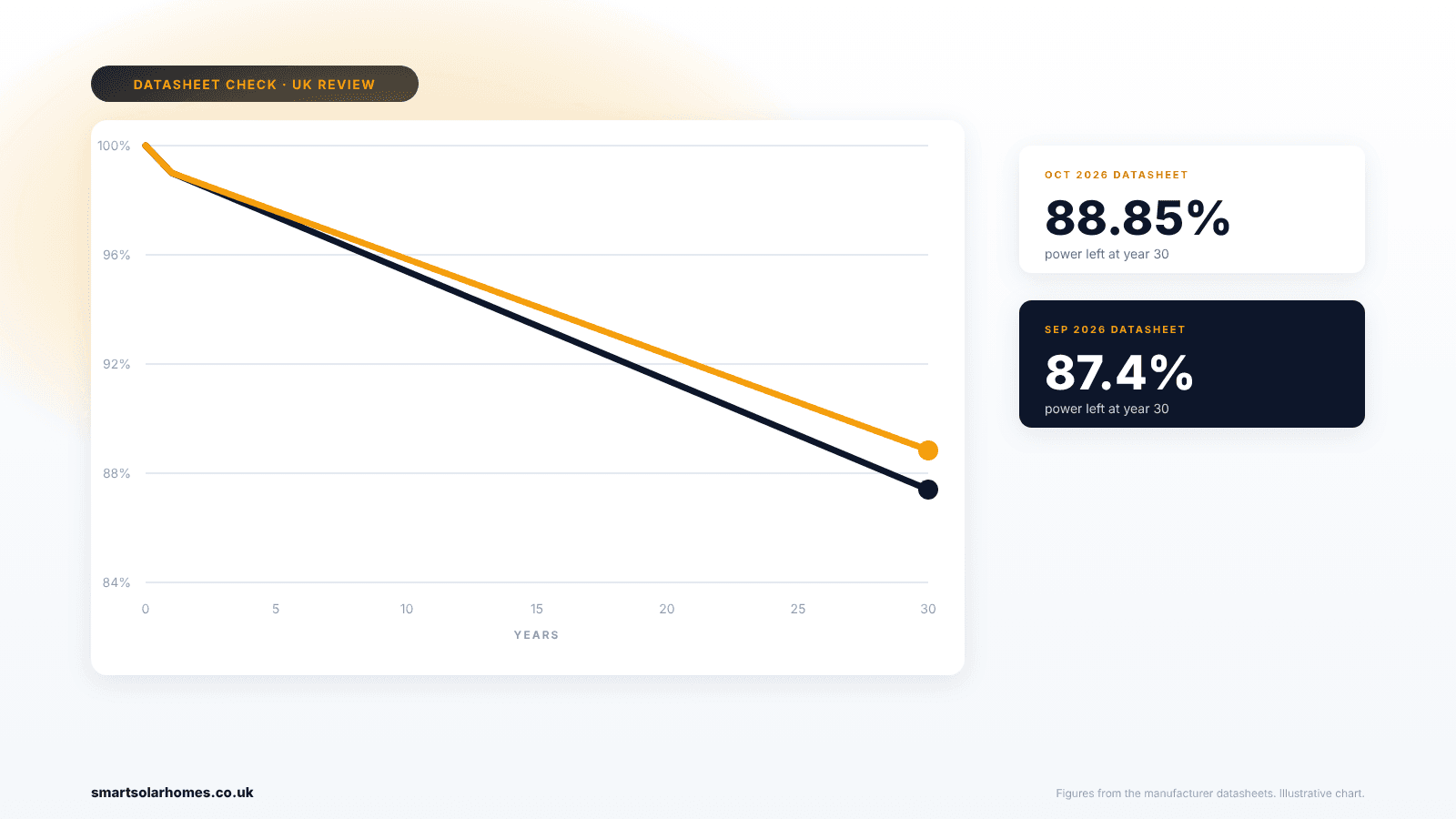
The October datasheet states a 25-year product warranty and a 30-year linear power warranty, with at least 88.85% of rated output at year 30. That assumes no more than 1% loss in year one and 0.35% a year after. The September sheet instead shows 0.4% a year and 87.4% at year 30, and does not state a product warranty term on its front page.
The DMEGC limited warranty for N-type modules (DMW-STD02N-2026002, applying after 1 June 2026) explains why. Its standard terms are 1% first-year and 0.40% annual degradation, leaving 87.40% at year 30, and the better 0.35% and 88.85% figures apply to modules whose serial number has “3” as the seventh digit. Its product-warranty table appears to list 300 months (25 years) for G12RT 48-cell glass-glass modules. Three more terms to know:
- The warranty starts on the earlier of first installation or six months after the modules leave the factory.
- Claims must be made in writing within 30 days of discovering the problem, to DMEGC’s office in Dongyang, China.
- DMEGC pays shipping for replacement modules, but dismantling and reinstallation costs fall to the customer.
In practice, your installer or distributor is your first port of call. Ask who handles claims and whether they will cover labour. Our degradation and warranties guide covers what each line means.
Price and MCS
Our catalogue lists the DM465G12RT-G48HBB at around £68.77 per panel, roughly £0.15 per watt, a hardware price that varies by supplier and volume. That is well under premium back-contact panels, so DMEGC is a value pick rather than an efficiency pick. The datasheets do not mention MCS, so ask your installer to confirm the exact model is on the MCS product database, as Smart Export Guarantee payments need an MCS-certified install (see our MCS certificate guide). For installed costs see the solar panel cost guide.
Who it suits
It suits budget-conscious buyers who want an all-black N-type panel in a standard size. It is less compelling if you are short of roof area and need the highest watts per square metre, or if you want a manufacturer with a long UK track record. DMEGC lists a European office in Pijnacker, the Netherlands, on its datasheets, and describes 40+ years of high-tech manufacturing, but it is newer on UK roofs than Trina, Jinko or LONGi. For the wider field, see solar panel manufacturers in the UK and our best solar panels UK ranking.
Our verdict
The DM465G12RT-G48HBB offers 23.3% efficiency, dual-glass construction and a long power warranty at a low hardware price. The catch is documentation: two datasheets with different figures and a warranty whose better terms depend on a serial number. Get the exact datasheet version and warranty terms in writing from an MCS-certified installer before you sign.
FAQs
Are DMEGC solar panels any good?
What warranty do DMEGC solar panels have?
Who makes DMEGC solar panels?
Are DMEGC panels bifacial?
How much do DMEGC solar panels cost?
Sources — verified 16 November 2026
- DMEGC Solar, “DMxxxG12RT-G48HBB datasheet (EN DS-G12RT-G48HBB-20261015)” — www.dmegcsolar.com
- DMEGC Solar, “DMxxxG12RT-G48HBB datasheet (EN DS-G12RT-G48HBB-20260915)” — www.dmegcsolar.com
- DMEGC Solar, “Limited Warranty for N-type PV Modules (DMW-STD02N-2026002)” — www.dmegcsolar.com
- DMEGC Solar, “Infinity RT 3.0 series product page” — www.dmegcsolar.com

About the author
Sepehr
Solar specialist & co-founder, Smart Solar Homes
Solar specialist and co-founder of Smart Solar Homes, which works with MCS-certified UK installer partners. I write all the guides and reviews here; the aim is straight-talking education the industry rarely provides.
Citing this page? Please use a dofollow link back to the original article — it helps us keep the data on this page accurate and up to date.
Browse Solar Panels on Smart Solar Homes


Want to compare these side by side? Use the compare tool →
Or browse all Solar Panels on Smart Solar Homes.
Related reading
More on solar panels from the editorial team.
Find installers near you
MCS-certified solar installers covering these areas.