EV Charging Without a Driveway: New Planning Rules
Written and reviewed by Sepehr. See our editorial policy.
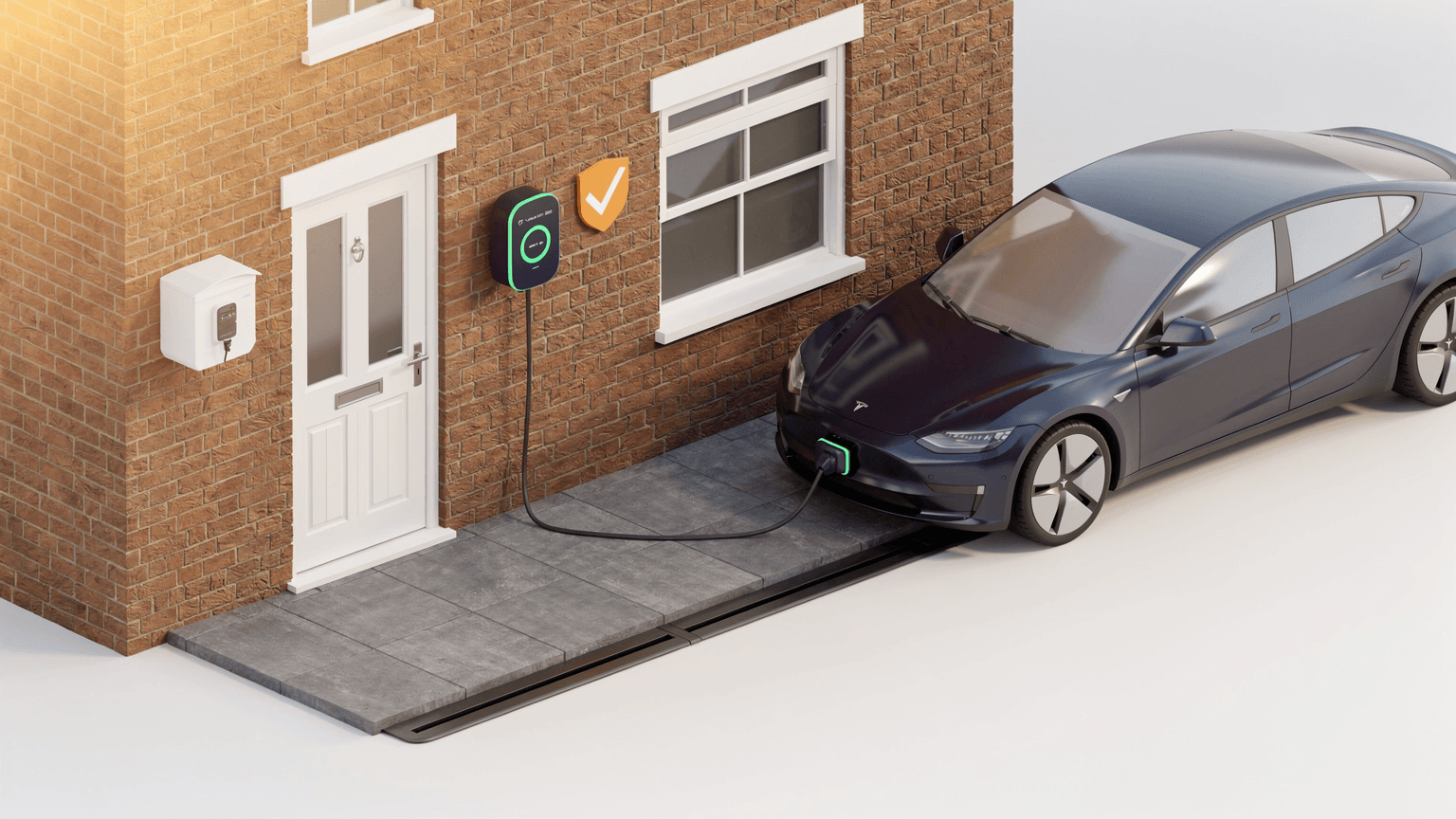
If you live in a terraced house or flat with no driveway, EV charging without a driveway has until now meant public chargers or a trailing cable across the pavement. England is about to change the planning side of that. A new permitted development order, reported to take effect from 21 October 2026, lets households without off-street parking fit a wall-mounted charger and, with highway-authority approval, a cable channel across the pavement without a separate planning application. Here is what the rules say, what they do not do, and what to check before you book an installer.
What is changing for EV charging without a driveway
The problem it fixes. Existing permitted development rights for EV chargers generally cover land lawfully used for off-street parking, which has left households without a driveway outside their scope (see our guide to planning permission for a home EV charger). According to Transport & Energy, roughly 40% of UK households lack off-street parking.
Three permissions down to two. The Department for Transport's consultation document says a cross-pavement installation currently needs three separate permissions: highway-authority permission to lay a cable across the pavement under section 178 of the Highways Act 1980, planning permission for the solution and the chargepoint, and street works permissions. The change grants the planning permission nationally through permitted development, so only the highways and street-works consents remain.
The rules reported for the new order
The legislation is the Town and Country Planning (General Permitted Development) (England) (Amendment) (No. 2) Order 2026 (SI 2026/1056). Planning Geek reports it was made on 25 September 2026, laid before Parliament on 30 September and applies in England only. It describes three new classes:
- Wall-mounted outlet (Class D): one outlet per house or flat curtilage, no more than 0.2 cubic metres in casing volume, no higher than 1.6 metres and projecting no more than 0.2 metres from the wall, with at least 1.5 metres of clear footway left between it and the carriageway edge.
- Upstand (Class E): a freestanding charger post, limited to 1.6 metres in height.
- Pavement channel (Class F): a cable channel set into the footway. It needs highway-authority authorisation under section 178 of the Highways Act 1980, and the pavement must be reinstated as soon as reasonably practicable once the channel is no longer needed.
The same report says these rights exclude conservation areas, scheduled monuments and the curtilage of listed buildings. Check the exact wording of the order and your local authority's guidance before relying on any limit above, as we have taken these figures from a secondary report rather than the statutory text.
What it does not change
It is not a licence to dig up the pavement. The DfT consultation response, as reported by Planning Geek, is clear that permitted development does not replace highway permissions. Section 178 approval and street-works licences (section 50 of the New Roads and Street Works Act 1991) are still needed, and the local authority keeps oversight of anything touching the public highway. Many councils already run cross-pavement trials, so ask yours what process applies.
Timing is still moving. The 21 October date comes from one trade report, and we could not confirm commencement on legislation.gov.uk at the time of writing. Treat it as expected rather than guaranteed.
What to do if you have no driveway
- Check your property type. Conservation areas and listed-building settings are excluded from the new rights.
- Ask your council about section 178. This highways consent is the real gatekeeper for a pavement channel.
- Choose a smart charger. A smart charger lets you schedule charging onto cheap overnight tariffs; see our best home EV chargers and the home requirements checklist.
- Use a qualified installer. Installation still needs competent electrical work, covered in our installation guide.
Where solar fits in
Charging at home matters because the grid electricity price cap is currently 26.32p per kWh, according to UKEM, and public charging typically costs more. If you have a roof, solar generation can offset part of that cost; our guide to sizing solar panels for EV charging explains how much, and the Electric Car Grant explainer covers the upfront saving on a new car. Solar on the roof of a terraced house can still power a kerbside car, but only if the charger can be installed legally, which is the gap this order closes.
FAQs
Do I need planning permission for an EV charger if I have no driveway?
Can I run an EV charging cable across the pavement in the UK?
Do the new EV charging planning rules apply in Scotland or Wales?
What percentage of UK homes have no off-street parking?
Sources — verified 3 October 2026
- GOV.UK, “Changes to various permitted development rights for EV charging (Department for Transport consultation)” — www.gov.uk
- Planning Geek, “GPDO changes unlock home EV charging from 21st October” — www.planninggeek.co.uk
- Planning Geek, “Government confirms new EV charging permitted development rights” — www.planninggeek.co.uk
- Transport & Energy, “UK Government confirms plans to simplify cross-pavement charging installations” — transportandenergy.com
- UKEM, “Energy Price Cap October 2026: Up 4% to £1,723” — www.ukem.co.uk

About the author
Sepehr
Solar specialist & co-founder, Smart Solar Homes
Solar specialist and co-founder of Smart Solar Homes, which works with MCS-certified UK installer partners. I write all the guides and reviews here; the aim is straight-talking education the industry rarely provides.
Citing this page? Please use a dofollow link back to the original article — it helps us keep the data on this page accurate and up to date.
Browse EV Chargers on Smart Solar Homes


Want to compare these side by side? Use the compare tool →
Or browse all EV Chargers on Smart Solar Homes.
Related reading
More on ev chargers from the editorial team.


Find installers near you
MCS-certified solar installers covering these areas.