E.ON Next Battery Boost: Free Home Battery Explained
Written and reviewed by Sepehr. See our editorial policy.
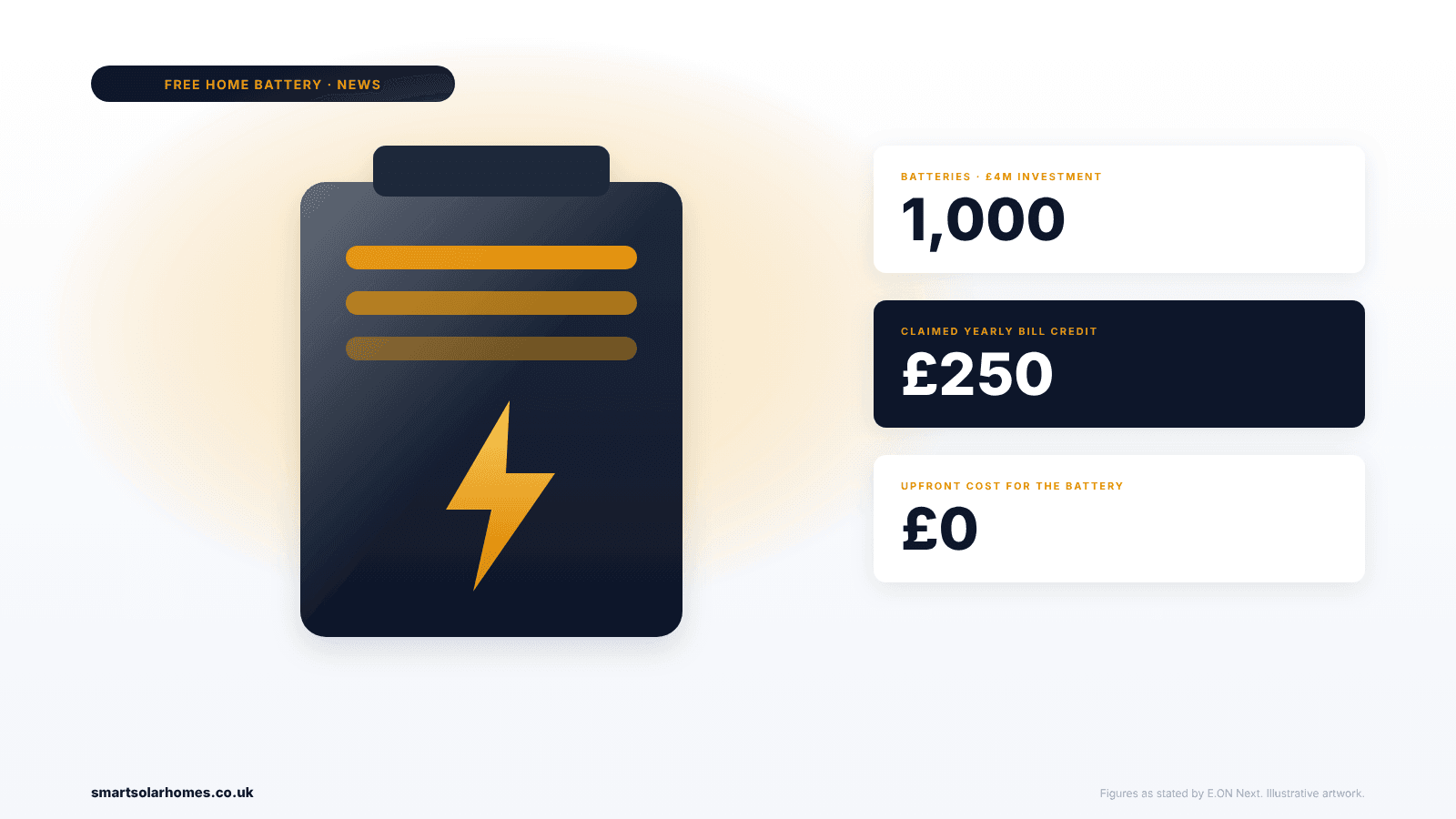
E.ON Next has expanded Battery Boost, its free home battery programme, with a £4 million investment in 1,000 more batteries. The expansion was announced on 10 November 2026 and adds partnerships with SP Electricity North West and UK Power Networks to its existing one with Northern Powergrid, according to E.ON’s press release. Here is how the E.ON Next free home battery offer works, who can apply, and the catches in the small print. Every figure below is E.ON’s own claim, not independently verified.
What is E.ON Next Battery Boost?
E.ON Next owns the battery and pays for it, its installation and its maintenance. You host it at home, move to the E.ON Next Battery Boost electricity tariff and receive a monthly bill credit. E.ON says the money comes from electricity network operators, who pay it for grid stability services, and describes the batteries as a “Flex Fleet” working together like a virtual power plant. Our virtual power plants guide explains that model. The release names the areas as north Lincolnshire, Yorkshire, the east and north east of England and Greater Manchester.
Who is eligible?
The Battery Boost page lists these conditions:
- You own your home and have suitable outdoor space for a battery described as “large suitcase-sized”.
- You have a working smart meter or are happy to have one fitted. Our smart meter guide covers the basics.
- Your home does not already have solar panels, an EV charger or a heat pump.
- You are an E.ON Next customer or switch to an E.ON Next electricity tariff before joining.
The solar exclusion is unusual, because most home battery advice assumes you have panels. If you plan to add solar, ask E.ON how that would affect your agreement before signing. Registration is free, but you need an E.ON Next electricity account number.
How the battery works day to day
The battery is run by E.ON, not by you. According to the page, it charges overnight and your home may use stored power at busy peak times, typically 4pm to 7pm on weekdays. E.ON also exports surplus energy when the grid needs it, and says you do not get a control portal. It is not a backup: the page states it does not keep your home powered during a power cut. Our home battery backup guide explains what a backup-capable battery involves. The page lists the battery as a Fox ESS unit with a 10.24kWh capacity and 10kW maximum output, though its FAQ refers to an 11kW model, so confirm the exact unit.
What you get: the £250 credit
E.ON says you receive £20.83 a month, or £250 a year, as a bill credit for hosting the battery, and describes the headline as “up to” £250 over 12 months. Its worked example assumes 2,500kWh a year at 25p per kWh and a 57p daily standing charge, giving a bill of about £833 without the scheme and about £599 with it, roughly £234 a year saved. E.ON says the example assumes import rates do not change and allows for 2.5% more consumption. Treat it as an illustration, not a quote, and compare the tariff rate itself with the price cap and with our time-of-use tariffs guide.
Timeline and the catches
- Places: the page says spaces are limited to 1,000 batteries for the first rollout. It does not say whether that is the same 1,000 as the £4 million investment.
- Timing: E.ON says it will email selected applicants from November 2026 and onboard customers in stages from November 2026 to March 2027.
- Installation: a G99 grid application takes two to eight weeks, and the export MPAN can take up to four weeks after installation before credits start. See our export MPAN delays guide.
- Exit fees: after the first 12 months you can cancel and have the battery removed at no cost. Leaving earlier means a £250 exit fee, plus £50 per fuel for leaving a fixed tariff early. Credits stop when you leave.
What the earlier trials claimed
E.ON ran earlier trials with Northern Powergrid in Crowle and Starbeck. A November 2025 release described households “saving almost £500 a year”, but gave no sample size or method, so we would not rely on it. E.ON also says its modelling shows the programme could save around £150 million a year across about 615,000 households and address most of a potential 3.74GW grid constraint by 2035; that is a forecast, not a result.
Should you apply?
It can suit homeowners without solar who want a battery at no upfront cost and are happy to hand control to E.ON. The trade-offs are the tariff lock-in, no control over the battery, no backup and an early-exit fee. If you want a battery you control, or you have solar, compare buying one in our home battery cost guide and best home batteries ranking. Check the full terms and the tariff unit rate before registering.
FAQs
Is the E.ON Next Battery Boost battery really free?
Who is eligible for E.ON Next Battery Boost?
How much does E.ON Battery Boost pay?
Does the E.ON Next free battery work in a power cut?
How do I apply for E.ON Next Battery Boost?
Sources — verified 18 November 2026
- E.ON Next, “Batteries cut bills: E.ON Next expands Battery Boost programme (10 November 2026)” — news.eonenergy.com
- E.ON Next, “Battery Boost: eligibility, terms and FAQs” — www.eonnext.com
- E.ON Next, “E.ON ramps up home battery investment (23 September 2026)” — news.eonenergy.com
- E.ON Next, “First customers see big savings from E.ON Next and Northern Powergrid battery trial (5 November 2025)” — news.eonenergy.com

About the author
Sepehr
Solar specialist & co-founder, Smart Solar Homes
Solar specialist and co-founder of Smart Solar Homes, which works with MCS-certified UK installer partners. I write all the guides and reviews here; the aim is straight-talking education the industry rarely provides.
Citing this page? Please use a dofollow link back to the original article — it helps us keep the data on this page accurate and up to date.
Browse Battery Storage on Smart Solar Homes


Want to compare these side by side? Use the compare tool →
Or browse all Battery Storage on Smart Solar Homes.
Related reading
More on battery storage from the editorial team.
Find installers near you
MCS-certified solar installers covering these areas.