Bill Discount Scheme: £250 Off Electricity Bills Near Pylons
Written and reviewed by Sepehr. See our editorial policy.
The Bill Discount Scheme will take up to £250 a year off the electricity bills of households living close to new or significantly upgraded high-voltage power lines. It is not a solar grant, but it lands squarely on the same bill that solar panels and home batteries are meant to shrink, and it will run alongside the rest of the 2026 energy-bill changes. Here is what the government and Ofgem have actually confirmed, what is still open, and what it means if you own (or are thinking of buying) solar.
What is the Bill Discount Scheme?
It is a government scheme, administered by Ofgem on behalf of the Department for Energy Security and Net Zero (DESNZ), that gives ongoing electricity bill discounts to households living near new or significantly upgraded transmission network infrastructure such as pylons. The idea is to reward the communities that host the grid upgrades needed to connect more wind, solar and batteries, rather than leaving them with the visual impact and nothing else.
On 12 August 2026 the government published an initial list of expected eligible projects across England, Scotland and Wales, and Ofgem welcomed the first wave of projects. More projects are expected to be added, so the list is a starting point rather than a final map.
Who qualifies, and how much do they get?
| Detail | What has been confirmed |
|---|---|
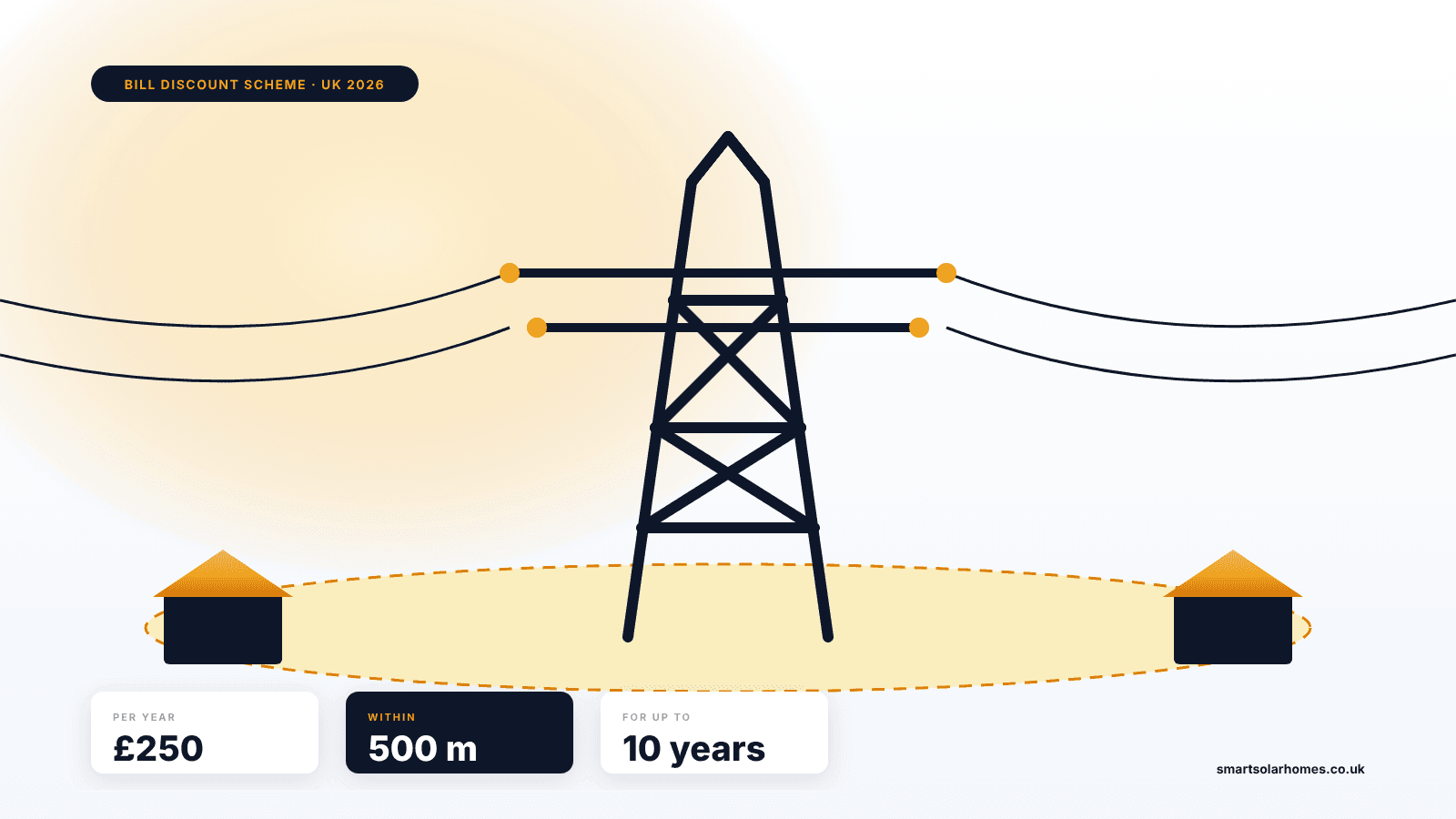
| Who | Households living within 500 metres of new or significantly upgraded transmission infrastructure, such as pylons |
| Amount | Up to £250 a year off the electricity bill |
| Duration | Up to 10 years |
| How you get it | Most eligible households will receive it automatically; if action is needed, DESNZ or Ofgem will send further information |
| When | Eligibility confirmed from the first half of 2027 for projects that have started construction; payments expected to start in early 2027 |
| Who runs it | Ofgem, for DESNZ |
Not every project on the list has full planning consent yet. Eligibility is tied to projects that have actually started construction, so living within 500 metres of a proposed line is not enough on its own. DESNZ is also aiming to lay the implementing regulations before the end of 2026, so the precise rules could still be refined.
Who pays for it?
The discount is funded through bills rather than from general taxation. Ofgem has decided to add a Bill Discount Scheme cost allowance to the energy price cap methodology from 1 April 2027, reflecting the cost suppliers will incur. In practice that means the cost is spread across other electricity customers, so expect a small upward nudge in the cap rather than a free lunch. Ofgem has not published a per-household figure on the pages we checked, so treat any specific pence-per-year estimate you see in the press with caution until the cap itself includes it.
What it means if you have solar panels
The published eligibility rules turn on where you live, not on how you generate or use electricity. Nothing in the government's or Ofgem's material says owning solar panels or a battery excludes you, and nothing says it boosts your discount either. Because the discount is applied to your electricity bill, a few practical points follow:
- It is separate from export income. Smart Export Guarantee payments are for electricity you sell; this discount is for living near the infrastructure. See our solar export payments guide for how SEG works.
- The value is a fixed bill reduction. If solar and a battery cut your grid imports sharply, a flat £250 a year is still a flat £250 a year, but whether it is shown against your import bill, or how it is treated when your bill is low or in credit, has not been spelled out. Check with your supplier once your address is confirmed.
- Pick the tariff on its own merits. The discount is paid via your supplier, so it should not change which tariff is cheapest; our tariff guide for solar owners still applies.
Why this matters for the wider grid
The scheme exists because the grid has to be rebuilt to carry far more renewable power. That is the same programme behind the Great British Grid plans and what they mean for home solar. Faster grid upgrades are good news for anyone waiting on a connection, but they come with local disruption, which is what the discount is meant to offset.
How to check whether you are likely to be eligible
- Open the government's expected eligible projects list and look for lines near your area.
- Check whether the project has started construction, since that is when eligibility begins to be confirmed.
- Measure roughly how far your home is from the new or upgraded line; the test is 500 metres.
- Wait for your supplier or Ofgem to contact you, and be wary of anyone cold-calling to "register" you for a fee, as most eligible households should receive it automatically.
Other 2026 bill changes to keep in view
The discount sits alongside other changes announced this autumn, including those in the Budget; our Budget 2026 energy changes explainer covers VAT and levies, and the Warm Home Discount guide for solar households explains the other main bill-support scheme. None of these replaces the bigger lever for most homes: generating and storing your own electricity.
FAQs
How much is the Bill Discount Scheme?
Who is eligible for the Bill Discount Scheme?
Do I have to apply for the Bill Discount Scheme?
When does the Bill Discount Scheme start?
Does having solar panels affect the Bill Discount Scheme?
Sources — verified 12 November 2026
- GOV.UK, “Electricity Bill Discount Scheme for transmission network infrastructure: expected eligible projects” — www.gov.uk
- Ofgem, “Ofgem welcomes first Bill Discount Scheme projects” — www.ofgem.gov.uk
- Ofgem, “Proposed methodology for Electricity Bill Discount Scheme cost allowance” — www.ofgem.gov.uk
- GOV.UK, “Energy bills cut for communities helping electrify Britain” — www.gov.uk

About the author
Sepehr
Solar specialist & co-founder, Smart Solar Homes
Solar specialist and co-founder of Smart Solar Homes, which works with MCS-certified UK installer partners. I write all the guides and reviews here; the aim is straight-talking education the industry rarely provides.
Citing this page? Please use a dofollow link back to the original article — it helps us keep the data on this page accurate and up to date.
Browse Battery Storage on Smart Solar Homes


Want to compare these side by side? Use the compare tool →
Or browse all Battery Storage on Smart Solar Homes.
Related reading
More on battery storage from the editorial team.
Find installers near you
MCS-certified solar installers covering these areas.