Home Battery Backup Power: What Can You Run in a Grid Outage?

Written and reviewed by Sepehr. See our editorial policy.
Most UK homes lose power around once every two and a half years, for roughly 95 minutes at a time — inconvenient rather than catastrophic for most households, but a genuine problem if you work from home, have medical equipment, or simply want to know your fridge won't defrost overnight. A home battery with a backup mode can bridge exactly that gap. The question is what it can actually power, for how long, and whether your battery even supports it.
EPS vs full backup: what's the difference?
Emergency Power Supply (EPS) is the most common backup mode fitted to UK hybrid batteries. When the grid fails, the inverter detects the outage and switches selected circuits or a dedicated socket over to battery power — typically within 1.5 to 2 seconds. That pause is enough to reboot a router or make a screen flicker, but most fridges and lights won't even notice. EPS systems protect one or more pre-wired circuits rather than your whole consumer unit.
True UPS (Uninterruptible Power Supply) or whole-home backup goes further. Switchover happens in under 20 milliseconds — fast enough that computers stay running, clocks keep time, and you may not even notice the grid dropped. Whole-home backup requires an automatic transfer switch (ATS) or a dedicated backup box that sits between your consumer unit and the meter. This hardware isolates your home from the grid before re-energising the property from the battery, which is both a safety requirement and the reason it costs more to install.
The practical upshot: EPS is fine for essentials on pre-wired circuits; whole-home backup is the choice if you need uninterrupted power for a home office, medical devices, or simply want seamless operation.
Which UK batteries support backup?
Not every battery on the market includes backup capability — and among those that do, the implementation varies. Here is where the main UK brands currently stand:
- Tesla Powerwall 3 — whole-home backup is built in. The Powerwall 3 uses an integrated transfer switch and can island your entire home within 20 ms. It is the only mainstream UK product that protects whole circuits out of the box without additional hardware. It is also the most expensive option.
- Fox ESS (All-in-One / PowerQ series) — supports both EPS and whole-home backup depending on the model. The PowerQ switches in approximately 20 ms; the All-in-One EPS output activates in 1.5–2 seconds. Fox ESS is widely installed by UK MCS-certified contractors.
- GivEnergy AIO (All-in-One) — offered EPS mode with a sub-20 ms switchover. Note that GivEnergy entered administration in early 2025; new installations carry warranty uncertainty. If you already own a GivEnergy system the EPS function continues to operate, but consult your installer about ongoing support.
- Solis hybrid inverters — the RHI and S6 hybrid range support an EPS output. Switchover is typically 1.5–2 seconds on pre-configured circuits. Solis inverters pair with a range of third-party batteries.
- SolarEdge Home Hub + Backup Interface — SolarEdge does offer backup capability in the UK via a separate Backup Interface module, but it is an optional add-on rather than standard. Without the Backup Interface, SolarEdge systems do not provide any backup power — the inverter shuts down when the grid drops, a deliberate safety design. If backup matters to you, confirm the Backup Interface is included at the point of sale.
For a deeper look at how these systems compare on cost and performance, see our guide to home battery storage.
What can you actually run — and what you cannot
Essential loads (low draw, long runtime). A typical UK household can sustain these comfortably on a battery backup circuit:
- Fridge-freezer: approximately 100–150 W running draw (cycles on and off)
- LED lighting across several rooms: 30–200 W depending on how many circuits are backed up
- Phone, laptop, and tablet charging: 30–100 W combined
- Broadband router and smart home hub: 10–20 W
- Gas combi boiler controls and pump: typically 100–200 W (check your boiler plate)
Running these together — fridge, a few lights, router, and phone chargers — adds up to roughly 400–600 W of continuous draw. If protecting the fridge specifically is your main worry rather than whole-home backup, a dedicated single-appliance UPS such as the Jackery FridgeGuard is a cheaper, plug-in alternative to a full home battery installation.
What a battery cannot sensibly power. These appliances draw too much current to make backup practical:
- Electric shower: 7,000–10,500 W — would flatten a 10 kWh battery in under an hour
- Electric oven or hob: 2,000–3,000 W — similarly unsuitable for extended backup
- EV charger: 3,700 W (7 kW on a Type 2 charger) — not a backup candidate
- Tumble dryer or washing machine on a hot cycle: 2,000–2,500 W
- Immersion heater: 2,500–3,000 W
The rule of thumb: if an appliance has a heating element, leave it off during a backup event. Focus the battery on low-draw essentials and it will last far longer.
How long will a 10 kWh battery last?
Using the essential-load scenario above (400–600 W continuous), a 10 kWh battery gives you approximately 17–25 hours of runtime before it reaches zero. In practice, most backup configurations reserve a proportion of capacity — typically 20–30% — as a permanent buffer, leaving around 7–8 kWh usable for emergencies. At 500 W average draw that is around 14–16 hours.
Run the load lighter — fridge, router, and a single LED light only, say 200–250 W — and the same battery covers 28–40 hours: more than enough for virtually any realistic UK grid outage. The average outage lasts under two hours according to Ofgem's RIIO-2 Electricity Distribution Annual Report 2023–24, so even a 5 kWh battery with EPS mode will comfortably cover most events.
A 5 kWh battery at the same essential-load draw (500 W) provides roughly 7–10 hours, or 14–20 hours at the lighter 250 W level.
Do you need extra hardware?
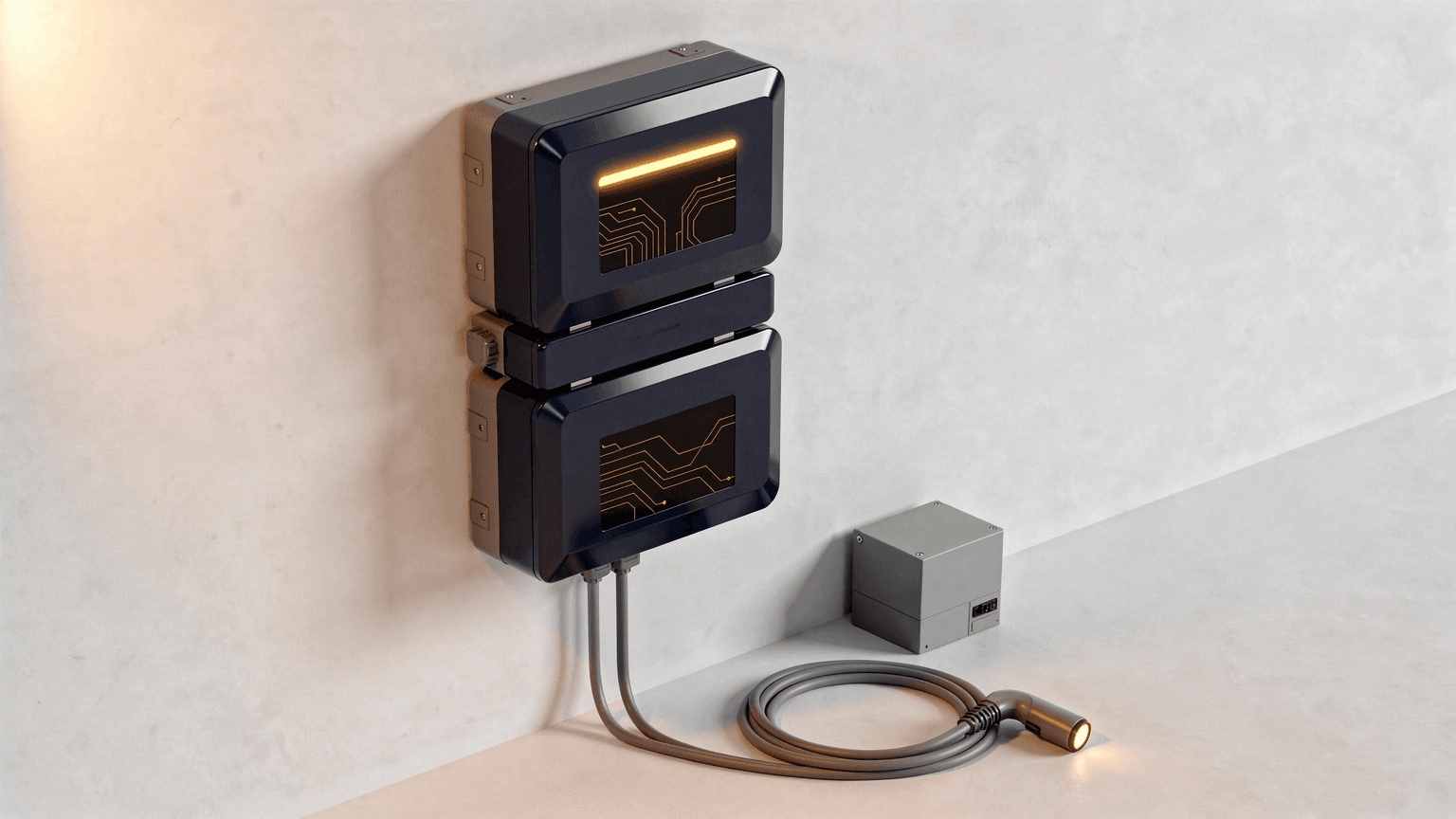
EPS mode usually requires either a dedicated EPS output socket wired by your installer, or an EPS box that sits between the inverter and specific circuits. The inverter itself handles the switch; no additional transfer hardware is needed. Expect the EPS wiring to add £200–£500 to your installation cost.
Whole-home backup requires an automatic transfer switch (ATS) or backup box to isolate your property from the grid before re-energising it from the battery. This is mandatory for safety — you cannot back-feed a dead grid (doing so would endanger network engineers working on the line). The ATS monitors grid voltage and frequency; when both disappear it opens the grid connection in milliseconds, then closes the battery circuit. For Tesla Powerwall 3, this hardware is integrated; for other systems it is a separate component, typically adding £300–£700 to the project.
Your MCS-certified installer is responsible for the correct design and certification of backup wiring. For more on the installation process, see our home battery installation guide.
Is backup worth paying for?
For most UK households, power cuts are rare enough that backup is a comfort feature rather than a necessity. Ofgem's data shows the average household experiences around 0.4 outages per year, with planned interruptions averaging 95 minutes roughly once every 2.5 years. That said, rural properties, homes with medical equipment, and remote workers increasingly find the peace of mind worth the extra cost.
The stronger financial case for a home battery remains its daily arbitrage value — charging cheaply overnight on an Octopus Agile or Economy 7 tariff, then discharging during expensive peak hours — with backup as a secondary benefit. If you're weighing whether the wider investment stacks up, read our analysis of whether solar batteries are worth it in the UK.
Note on off-grid solar. Battery backup — even whole-home backup — is not the same as going fully off-grid. A grid-tied battery still relies on the DNO connection; it simply insulates you from outages. If you are considering cutting the grid connection entirely, that requires a much larger and more expensive system. Our guide to off-grid solar panels UK explains what a genuine off-grid setup entails and when it makes financial sense.
Key takeaways
- EPS mode switches in 1.5–2 seconds and covers pre-wired circuits; whole-home backup switches in <20 ms and covers your entire consumer unit.
- Tesla Powerwall 3 offers integrated whole-home backup; Fox ESS, Solis, and (previously) GivEnergy AIO support EPS; SolarEdge requires an optional add-on Backup Interface.
- A 10 kWh battery running essentials (fridge, lights, router, phone charging) lasts approximately 14–40 hours depending on load and reserved capacity.
- Do not attempt to run high-draw heating appliances — shower, oven, immersion — on backup power.
- Whole-home backup requires an automatic transfer switch; EPS mode needs only dedicated wiring to selected circuits.
Portable power stations as a lighter-weight option
Not every household needs a wired backup circuit. A portable power station can cover short outages for a router, laptop or medical device without an installer, though runtime and output are far smaller than a fixed home battery. See our coverage of EcoFlow's RIVER Gen4 and PowerRock 4000 for what a current-generation portable unit can and cannot run.
FOSSiBOT’s F3000 power station, shown at IFA Berlin 2026, is a recent example of this category — a 2,048Wh portable unit built for exactly this kind of short-outage backup role.
FAQs
What's the difference between EPS and whole-home battery backup?
How long will a 10kWh battery last in a power cut?
Can I run an electric shower or oven on battery backup?
Which UK home batteries support backup power?
Do I need extra hardware for home battery backup?
Sources — verified 7 June 2026
- Ofgem — RIIO-2 Electricity Distribution Annual Report 2023–24 (published April 2025) — www.ofgem.gov.uk
- Tesla Support UK — Powerwall backup configuration — www.tesla.com
- SolarEdge UK — Home Backup Interface product page — www.solaredge.com
- SolarEdge — Home Hub Inverter UK announcement — corporate.solaredge.com
- Energy Saving Trust, "Battery storage" — energysavingtrust.org.uk
- Viable Power — EPS vs whole home backup: UK comparison — www.viablepower.co.uk

About the author
Sepehr
Solar specialist & co-founder, Smart Solar Homes
Solar specialist and co-founder of Smart Solar Homes, which works with MCS-certified UK installer partners. I write all the guides and reviews here; the aim is straight-talking education the industry rarely provides.
Citing this page? Please use a dofollow link back to the original article — it helps us keep the data on this page accurate and up to date.
Browse Battery Storage on Smart Solar Homes


Want to compare these side by side? Use the compare tool →
Or browse all Battery Storage on Smart Solar Homes.
Related reading
More on battery storage from the editorial team.
Find installers near you
MCS-certified solar installers covering these areas.