Home Battery Cost UK (2026): What You'll Pay

Written and reviewed by Sepehr. See our editorial policy.
Home battery storage prices have fallen considerably over the past few years, but the range is wide enough that “how much does a home battery cost?” doesn't have a single answer. A basic AC-coupled retrofit starts from around £3,200 installed; a large DC-coupled system with an integrated hybrid inverter can reach £8,500 or more. What sits between those figures depends on capacity, coupling type, inverter, and installation complexity. This page breaks down what drives the cost, what you can realistically expect to pay, and what the financial return actually looks like — honestly, without the inflated payback claims you sometimes see from installers. For the full picture of how batteries fit into your solar setup, the complete home battery storage guide covers everything from coupling types to warranties.
Pricing keeps shifting as new brands enter the UK market — watch for models like Hinen's slim A15 battery, launching in August 2026, which could pressure prices at the compact end once UK installer pricing is confirmed.
Price by capacity: what to expect in 2026
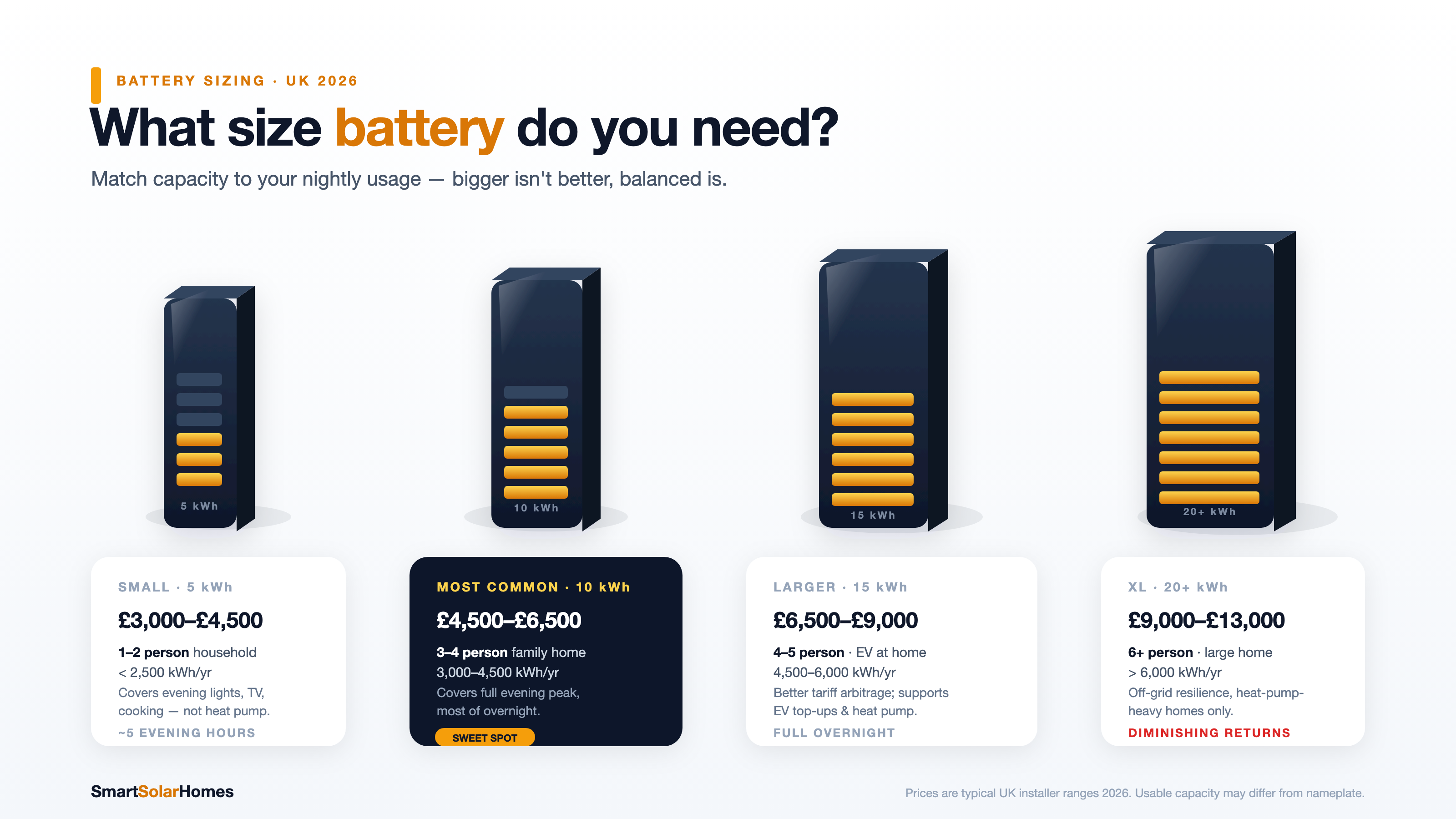
These figures are installed costs (hardware plus labour) and include zero-rated VAT, which has applied to standalone battery storage in Great Britain since 1 February 2024.
- 5–8kWh usable: typically around £3,500–£5,500. This range covers AC-coupled retrofits and entry-level DC-coupled systems such as the GivEnergy All-in-One (8.2kWh usable, around £5,500 installed).
- 8–10kWh usable: typically around £4,800–£6,500. The Fox ESS H3 with ECS2900 modules lands at around £4,800 for roughly 10kWh usable, making it one of the more competitive options at this capacity.
- 10–14kWh usable: typically around £5,200–£9,000. The Tesla Powerwall 3 (13.5kWh usable) runs to around £8,500 installed. The Huawei LUNA2000-10 (10kWh) is around £5,200 but requires the Huawei SUN2000 inverter, which adds to the total if you don't already have one.
These are ranges, not quotes. Prices vary by region, installer, whether scaffolding is needed, and how complex your existing electrical setup is. Getting three quotes from MCS-certified installers is the only reliable way to establish what you'll actually pay.
What drives the cost variation
Chemistry and build quality
All mainstream home batteries in 2026 use lithium iron phosphate (LFP) chemistry, which is safer and longer-lasting than older NMC cells. Within LFP, build quality — cell sourcing, thermal management, BMS sophistication — varies and is reflected in price. A battery with a weaker BMS may have a lower sticker price but degrade faster, effectively costing more per usable cycle over its lifetime.
Coupling type: DC versus AC
DC-coupled batteries (integrated with a hybrid inverter) are more efficient and now the standard choice for new installations, but they typically cost more upfront because the hybrid inverter is included in the package. AC-coupled batteries like the Powervault 4 are cheaper to install as retrofits because they don't require replacing your existing solar inverter — but their round-trip efficiency is lower, meaning you recover slightly less of the electricity you store. For a detailed explanation of the coupling trade-off and which products suit each approach, see the 2026 home battery storage roundup.
Inverter inclusion
Some products include a hybrid inverter as part of the system; others require you to purchase the inverter separately. The GivEnergy All-in-One includes the hybrid inverter, which simplifies quoting. The Huawei LUNA2000-10 requires a Huawei SUN2000 inverter — if your installer is quoting hardware only, make sure both are included. The comparison tool at GivEnergy AIO vs Tesla Powerwall 3 includes a like-for-like installed cost comparison that accounts for inverter differences.
Installation complexity
Labour typically accounts for £500–£1,500 of an installed cost, but it can be higher if:
- your consumer unit needs upgrading to accommodate the new circuits
- the battery is sited away from the inverter, requiring a longer DC or AC cable run
- your installation requires DNO notification under G99 (prior approval, which adds time but not usually significant cost)
- scaffolding is needed for roof-access during a simultaneous solar and battery installation
VAT: zero-rated since February 2024
Battery storage installed alongside solar panels has been zero-rated since April 2022, but standalone battery storage — a retrofit fitted on its own, without solar — was only added to the zero rate in Great Britain from 1 February 2024. Before that date a standalone retrofit was charged at the standard 20% rate. The zero rate now applies to both the hardware and the installation labour, and it is scheduled to revert to 5% from 1 April 2027. On a £6,000 installation, zero-rating instead of the standard 20% rate saves £1,000; once the rate reverts to 5% in 2027, the saving versus 5% would be £300. When comparing quotes, confirm they are zero-rated and that VAT is not being added incorrectly — some installers who don't handle many battery jobs occasionally quote with VAT applied in error. For help with sizing before you seek quotes, the home battery sizing guide establishes the capacity you actually need so you're not quoting for more than necessary.
Ongoing and replacement costs
Home batteries have no consumable parts and require no scheduled maintenance. The main long-term costs are:
- Battery replacement: LFP batteries degrade slowly. At end of a 10–12 year warranty, a daily-cycled battery typically still holds 70–80% of original capacity. Replacement modules — rather than the whole system — are increasingly available for modular systems like the Fox ESS H3.
- Inverter replacement: Hybrid inverters typically carry a 10-year warranty. Inverters are replaceable independently of the battery in most DC-coupled systems.
- Monitoring: Most systems include free cloud monitoring via the manufacturer's app. Some premium monitoring integrations or home automation platforms carry a subscription cost, though these are optional.
Is a battery worth it financially?
For most UK homeowners with solar panels, a home battery is worth it if your system generates surplus you currently export. A 5–10kWh battery costs £3,500–£6,500 installed (zero-rated VAT applies) and saves money by storing cheap overnight electricity and reducing grid imports at 24.67p/kWh. It is most valuable on a time-of-use tariff.
The honest answer depends heavily on your solar generation profile, consumption patterns, and the tariff you're on.
A battery's financial value comes from two sources: avoided import costs — the Ofgem price cap puts the average import unit rate at around 24.67p/kWh for April–June 2026 — and time-of-use arbitrage on tariffs like Octopus Agile where you can charge cheaply overnight and avoid peak rates in the evening. The avoided import value is passive and reliable. The arbitrage value requires either a smart system or active management.
What a battery does not do is shorten your solar payback period. It adds cost, and that cost needs to be recovered. The typical effect is to make your solar installation more valuable in use — more self-consumption, less grid dependency — while extending the combined payback period modestly. For realistic figures on what solar plus battery returns look like, the solar panel cost and savings guide covers both scenarios. For context on whether solar itself is worth it before adding a battery, this assessment of whether solar panels are worth it in the UK is a sensible starting point.
The cases where a battery adds clearest value: you have a large solar system relative to daytime consumption, leaving substantial surplus; you're on a time-of-use tariff; or you have an EV and the arbitrage opportunity is significant. The cases where it's marginal: small solar system, low electricity usage, flat-rate tariff with no time-of-use benefit.
Once you've decided on a budget, the installation process guide explains what happens on the day.
Getting accurate quotes
The installed cost figures above are reference points, not firm prices. Regional variation, installer margin, and site-specific factors all move the final number. Getting quotes from MCS-certified installers is the only way to establish your actual cost. Three quotes is a reasonable minimum — the spread between the cheapest and most expensive is often 20% or more for identical hardware, and comparing written quotes reveals discrepancies in what is and isn't included.
FAQs
How much does a home battery cost in the UK?
Do you pay VAT on home battery storage?
Is a home battery worth it financially?
What is the difference between AC-coupled and DC-coupled batteries?
How long do home batteries last?
Sources — verified 5 June 2026
- HMRC / GOV.UK, “VAT on energy-saving materials and heating equipment (Notice 708/6)” — www.gov.uk
- Ofgem, “Changes to energy price cap between 1 April and 30 June 2026” — www.ofgem.gov.uk
- Energy Saving Trust, “Solar panels” — energysavingtrust.org.uk
- MCS, “Battery Storage” — mcscertified.com
- Which?, “Solar Panel Battery Storage: Can You Save Money Storing Energy?” — www.which.co.uk

About the author
Sepehr
Solar specialist & co-founder, Smart Solar Homes
Solar specialist and co-founder of Smart Solar Homes, which works with MCS-certified UK installer partners. I write all the guides and reviews here; the aim is straight-talking education the industry rarely provides.
Citing this page? Please use a dofollow link back to the original article — it helps us keep the data on this page accurate and up to date.
Browse Battery Storage on Smart Solar Homes


Want to compare these side by side? Use the compare tool →
Or browse all Battery Storage on Smart Solar Homes.
Related reading
More on battery storage from the editorial team.
Find installers near you
MCS-certified solar installers covering these areas.