Thunder Energy Storm 710W Review UK: Specs and Rules
Written and reviewed by Sepehr. See our editorial policy.
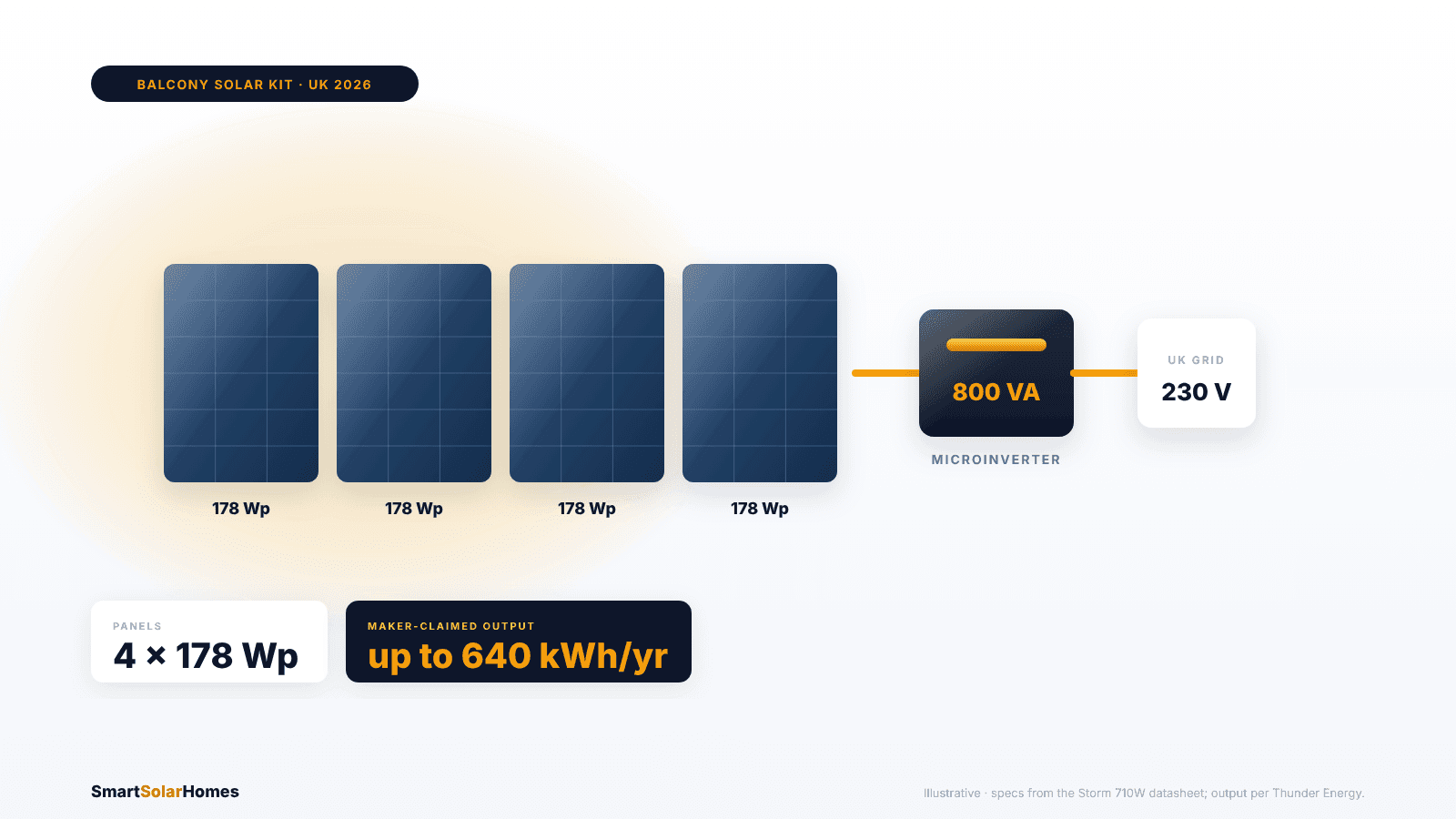
The Thunder Energy Storm 710W is a four-panel balcony solar kit built around flexible panels and an 800VA microinverter, sold in the UK from £699.99 on Thunder Energy's own page. This review goes through what the datasheet says, what the maker claims, and the one thing to check before you buy: as of 12 November 2026 the Storm range does not appear on the public ENA register of plug-in devices.
Thunder Energy Storm 710W specs
Thunder Energy's product page gives few technical details, so the figures below come from the Storm 710W datasheet published by the UK distributor Plug In Solar. We have not tested the kit.
- Panels: four flexible 178Wp panels, 712Wp in total, using monocrystalline TOPCon cells rated at 25% module efficiency.
- Panel size: 1170 × 820 × 3mm each, IP67, with 600mm cables and a rated design load of ±1600Pa.
- Temperature coefficient: −0.32%/°C on power, so output dips a little on hot days.
- Microinverter: model HMS-800W-2T, 800VA rated AC output at 230V, two MPPTs, 96.7% peak efficiency, built-in Wi-Fi, IP67, 3.2kg.
- Certification: the panels carry a TÜV NORD test certificate, according to the datasheet.
- Output claim: Thunder Energy says the kit can generate up to 640kWh a year in typical UK conditions.
- Battery: optional. The battery version is sold separately as the Storm Plus 710W at £1,699.99.
The datasheet describes the panels as 178Wp each while the product name says 710W, so treat 710W as the marketing figure and 712Wp as the arithmetic.
Is the Storm 710W legal to plug in?
Plug-in solar became legal in the UK on 27 August 2026. The rules cap the kit's maximum rated alternating current output at 800 watts, and the Storm's 800VA inverter is designed to sit at that limit. The government says each kit produces up to 800W and points buyers to a list of accredited devices and manufacturers.
That is where the Storm raises a question. A third-party mirror of the register, Plug-In Solar, Explained, was last checked on 12 November 2026. It lists six Thunder Energy products, all from the Thunder Bolt range, and no Storm entry. It also has no entry for the HMS-800W-2T inverter. Thunder Energy itself says only that its systems "meet UK electrical standards and G98 requirements" and are "designed for DIY installation if you are a competent installer". It does not claim a register listing for the Storm.
A mirror can lag the official register, so check the official list yourself and ask Thunder Energy to confirm in writing before you order. Our plug-in solar guide explains the rules, and registering plug-in solar covers the notification step.
Flexible panels: the trade-offs
Flexible panels are light and can be fixed where glass panels would be awkward, which is the Storm's pitch for balconies, fences and sheds. The trade-offs are the ones we set out in our Lionshee flexible kit review: flexible panels are generally expected to last less long than rigid ones, and how you fix them matters for heat and airflow. The Storm's 25% efficiency claim is high for a flexible panel and comes from the distributor datasheet, so it is unverified by us.
What does it cost, and does it pay back?
Thunder Energy lists the 710W from £699.99. Our own arithmetic, not a maker claim: at the Ofgem price cap rate of 26.32p per kWh, £699.99 is recovered after roughly 2,660kWh of output that you use yourself (699.99 ÷ 0.2632). At the claimed 640kWh a year, with every unit used at home, that is around four years. A plug-in kit has no battery, so units you cannot use as they are generated displace nothing, and payback is longer in an empty daytime home.
One warning on the maker's page: its general warranty line is a 2-year panel warranty for balcony kits. Some distributor listings advertise longer terms, so get the exact warranty for the Storm in writing.
Who it suits
It could suit someone with a sunny balcony, fence or outbuilding wall who wants lightweight panels and is at home in the day. It is less obvious for anyone who wants a clearly listed, register-confirmed device today: look at the Thunder Bolt kits, or compare rigid options in our look at plug-in solar at Argos and Screwfix and the Octopus plug-in solar review.
Before you buy
- Check permissions. The government says to check whether any are needed for your property, including from a landlord, freeholder or council.
- Confirm register status for the exact Storm model and inverter with Thunder Energy and the official list.
- Check the mounting. The datasheet does not cover fixings, so ask what is supplied and how flexible panels should be mounted.
- Skip the battery for now. Plug-in batteries are not yet covered by the current rules.
FAQs
Is the Thunder Energy Storm 710W on the ENA register?
How much power does the Storm 710W produce?
How much does the Thunder Energy Storm 710W cost?
Does the Storm 710W come with a battery?
Who makes the Storm 710W inverter?
Sources — verified 13 November 2026
- Thunder Energy, “Balcony solar panels (Storm 360W and 710W)” — www.thunderenergy.co.uk
- Plug In Solar, “Storm 710W Solar Kit datasheet” — www.pluginsolar.co.uk
- Plug-In Solar, Explained, “ENA Register: every plug-in solar device listed” — www.pluginsolarexplained.co.uk
- legislation.gov.uk, “SI 2026/848: Plugs and Sockets etc. (Safety) Regulations 1994 and Electricity Safety, Quality and Continuity Regulations 2002 (Amendment) Regulations 2026” — www.legislation.gov.uk
- GOV.UK (DESNZ), “Households can save as plug-in solar panels come to market” — www.gov.uk
- UKEM, “Energy Price Cap October 2026: Up 4% to £1,723” — www.ukem.co.uk

About the author
Sepehr
Solar specialist & co-founder, Smart Solar Homes
Solar specialist and co-founder of Smart Solar Homes, which works with MCS-certified UK installer partners. I write all the guides and reviews here; the aim is straight-talking education the industry rarely provides.
Citing this page? Please use a dofollow link back to the original article — it helps us keep the data on this page accurate and up to date.
Browse Solar Panels on Smart Solar Homes


Want to compare these side by side? Use the compare tool →
Or browse all Solar Panels on Smart Solar Homes.
Related reading
More on solar panels from the editorial team.

Find installers near you
MCS-certified solar installers covering these areas.