Clean Electrification Roadmap 2026: What It Means for Homes
Written and reviewed by Sepehr. See our editorial policy.
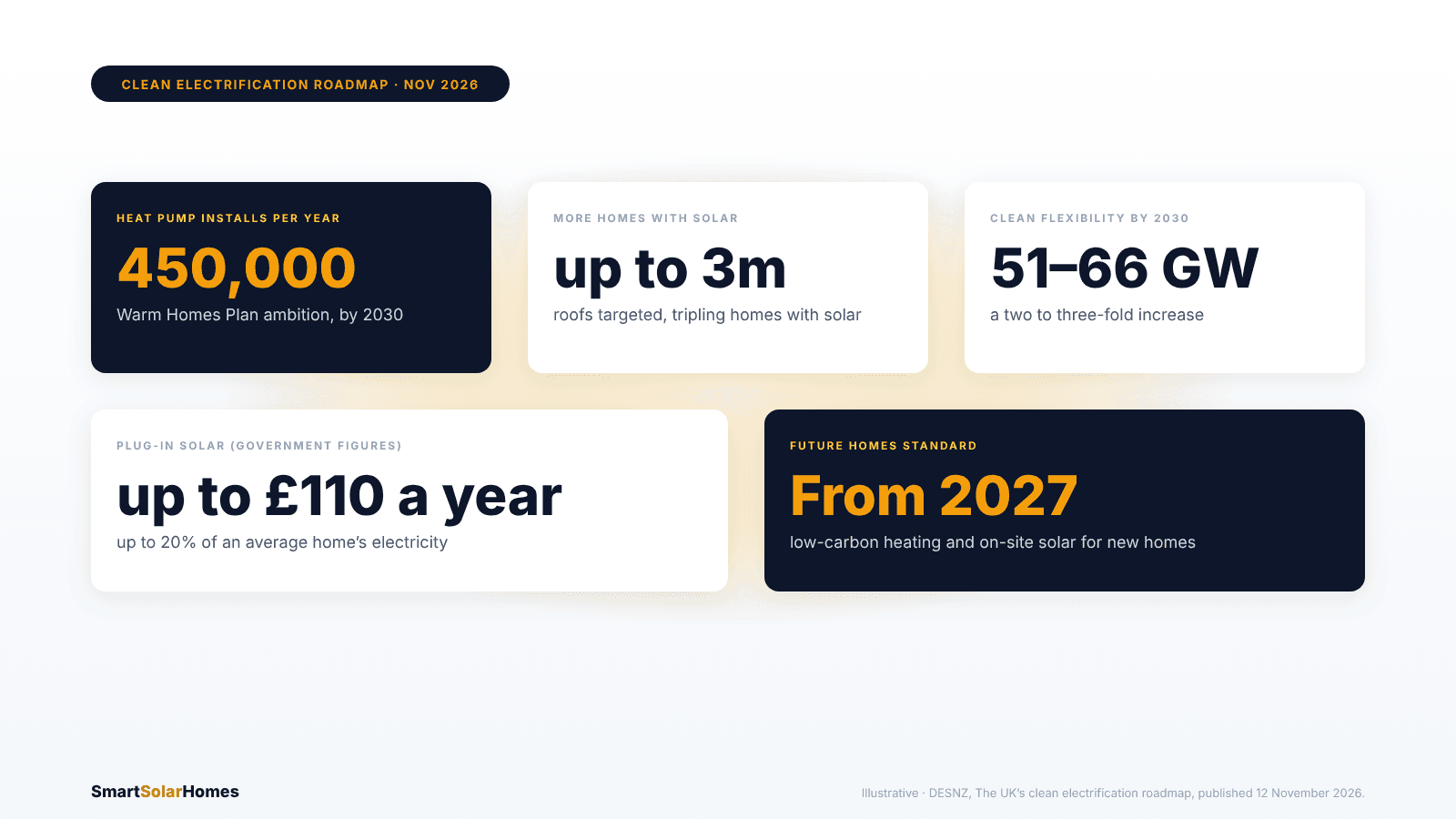
The government’s clean electrification roadmap, published on 12 November 2026, restates plans to treble homes with solar, reach 450,000 heat pump installations a year by 2030 and make electricity bills more flexible, but it mostly brings together existing policies rather than announcing new support. This explainer picks out what it says for homeowners with, or considering, solar panels, a heat pump, a battery or an EV. The paper is from the Department for Energy Security and Net Zero (DESNZ), and describes itself as setting out actions that are “legislated for, funded or in delivery”. We have flagged which figures are the government’s own.
What does it say about solar and heat pumps?
The roadmap says the Warm Homes Plan sets out the UK’s ambition to deliver 450,000 heat pump installations per year by 2030 and to triple the number of homes with solar by deploying panels on the rooftops of up to 3 million more homes. It adds that the Warm Homes Loan Scheme, which provides no- and low-interest loans, was launched “last month” (that is, October), and that the Boiler Upgrade Scheme “received a record number of applications in the past year”. Our Warm Homes Plan guide and Warm Homes Loan Scheme guide cover the detail.
What about plug-in solar?
The paper says plug-in solar panels became available to households in Great Britain in August 2026, “providing up to 20% of an average home’s electricity and saving up to £110 a year”. Those are government figures, cited to a DESNZ release of 26 August 2026, and your result will depend on your home. See our plug-in solar retailers guide.
What does it say about bills?
- Costs moved off bills: from April 2026, an average of £150 was taken off household energy bills, with most of those costs coming off electricity bills and onto general taxation.
- VAT: the paper refers to the removal of VAT on electricity bills from October 2026. It gives no end date; our VAT on electricity bills guide covers the dates.
- Flexibility: it says smart tariffs, smart charging and home batteries shift use to when electricity is cheapest and most plentiful. The government’s ambition is a two to three-fold increase in clean flexibility capacity, to between 51 and 66GW by 2030. See our Clean Flexibility Roadmap explainer.
New homes and rented homes
From 2027 the Future Homes and Buildings Standards are described as ensuring new buildings are designed with low-carbon heating, high energy efficiency and on-site renewable electricity generation. For existing homes, the paper says Minimum Energy Efficiency Standards for rented homes are being raised. See solar panels on new builds.
EVs
The paper cites the Electric Car Grant, with £2 billion committed until March 2030, taking up to £3,750 off eligible new electric cars costing £37,000 or less, and says drivers can save up to £1,750 a year on running costs. It also cites £400m for local authorities in England for on-street charging. These are the government’s figures, and savings depend on how and where you charge.
What does it not say?
- It does not announce new grants for solar or batteries; it summarises existing schemes.
- Many figures are ambitions or the government’s own estimates, such as the plug-in solar saving.
- Industry examples in the paper, such as Octopus’s Zero Bills homes, are company schemes, not government commitments.
If you are planning a project, rely on the scheme rules at the time you apply, not on a roadmap’s headline numbers.
FAQs
What is the UK's clean electrification roadmap?
Does the roadmap announce new solar or heat pump grants?
What heat pump and solar targets does it repeat?
How much can plug-in solar save, according to the government?
What does it say about VAT on electricity?
What is the flexibility target?
Sources — verified 26 November 2026
- DESNZ, “The UK's clean electrification roadmap (12 November 2026)” — www.gov.uk

About the author
Sepehr
Solar specialist & co-founder, Smart Solar Homes
Solar specialist and co-founder of Smart Solar Homes, which works with MCS-certified UK installer partners. I write all the guides and reviews here; the aim is straight-talking education the industry rarely provides.
Citing this page? Please use a dofollow link back to the original article — it helps us keep the data on this page accurate and up to date.
Browse Solar Panels on Smart Solar Homes


Want to compare these side by side? Use the compare tool →
Or browse all Solar Panels on Smart Solar Homes.
Related reading
More on solar panels from the editorial team.
Find installers near you
MCS-certified solar installers covering these areas.