Solar & Battery DNO Registration: What Government Proposes
Written and reviewed by Sepehr. See our editorial policy.
The Department for Energy Security and Net Zero (DESNZ) has floated moving responsibility for telling the network operator about home solar, batteries and similar equipment from the householder to the installer, but the government page we found sets out options and questions, not a decision. This explainer covers what DESNZ’s call for evidence on “improving the visibility of distributed energy assets” says, what it means for you today, and what we could not confirm. For the current process, see our G98 notification guide and DNO application guide.
What is the government looking at?
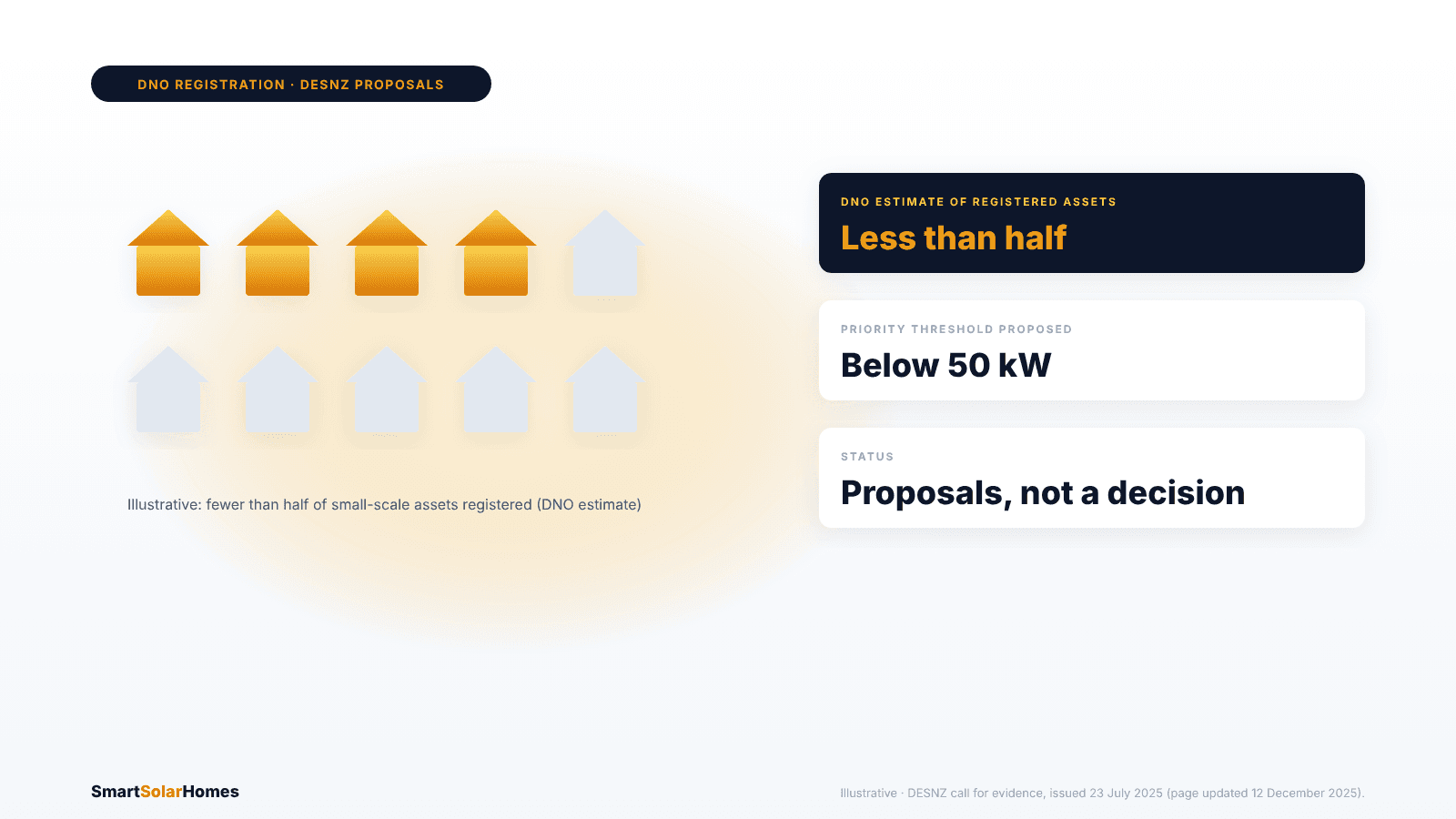
The call for evidence was issued on 23 July 2025, with responses requested by 10 September 2025, and the GOV.UK page shows an “Updated 12 December 2025” date. It asks 18 questions and covers distributed energy assets generally, with home solar, batteries, heat pumps and EV chargers as the main small-scale examples. DESNZ says “DNOs estimate that less than half of small-scale distributed energy assets are registered with them”. A distribution network operator (DNO) is the company that runs your local electricity network, and knowing what is connected helps it plan and operate the grid.
It proposes that “future policies should prioritise assets below the 50 kW threshold”, which covers typical homes. It does not propose a separate regime for any one type of device.
What options are on the table?
- A clearer legal duty on installers: a new obligation that “could place responsibility for DNO registration compliance on installers only”. A related option would amend the Electricity Safety, Quality and Continuity Regulations (ESQCR) so notification sits with installers, removing the consumer responsibility.
- Awareness campaigns: described as unlikely to “substantially increase registrations without complementary obligations and improvements to registration processes”.
- A single point of notification: installers would submit data once, for sharing with DNOs, MCS, certification bodies and others. The paper calls this an ambitious option.
- Smart device self-registration: through device standards. The page says this would not cover solar that is not linked to smart devices and would need new primary powers.
- Finding unregistered assets: using data sources such as smart meter and MCS database data.
The paper says obligations currently fall partly on consumers, and that “consumers may also be unaware of their obligation to notify”. It also says it may not be suitable for consumers to remain responsible because the information is technical and the process lengthy.
What does this mean for you today?
Nothing in the paper we read requires homeowners to take new action, and none of the options has been decided. Until policy changes, the current rules apply. Under the Energy Networks Association’s G98 and G99 process, the DESNZ paper describes generation compliance as the owner’s responsibility, and in practice your installer normally handles the paperwork. If you are installing, ask your installer in writing whether they will notify your DNO, and keep the confirmation. If you have an existing system and are not sure it was registered, ask the installer or check with your DNO. Our guide to choosing an installer and MCS certificate guide cover what paperwork to expect.
What we could not confirm
- We found no government response or summary of responses linked from the page, so we cannot say which option, if any, has been chosen.
- The page says the government would respond by the end of 2025, but we only saw that in a summary, not verbatim, so treat it as unverified.
- Ofgem committed in the Clean Flexibility Roadmap to consult by end-2025 on new network licence requirements for asset registers; we did not read that consultation.
Check GOV.UK and Ofgem for the latest position before relying on anything here. Related: our export limitation guide and home battery installation guide.
FAQs
Do I have to tell my network operator about my solar panels or battery?
Is the government changing who has to register solar panels?
What share of home energy assets are registered?
Do the proposals affect heat pumps and EV chargers too?
What size of system would the proposals prioritise?
Where can I check the latest position?
Sources — verified 24 November 2026
- DESNZ, “Improving the visibility of distributed energy assets: call for evidence” — www.gov.uk

About the author
Sepehr
Solar specialist & co-founder, Smart Solar Homes
Solar specialist and co-founder of Smart Solar Homes, which works with MCS-certified UK installer partners. I write all the guides and reviews here; the aim is straight-talking education the industry rarely provides.
Citing this page? Please use a dofollow link back to the original article — it helps us keep the data on this page accurate and up to date.
Browse Solar Panels on Smart Solar Homes


Want to compare these side by side? Use the compare tool →
Or browse all Solar Panels on Smart Solar Homes.
Related reading
More on solar panels from the editorial team.
Find installers near you
MCS-certified solar installers covering these areas.