Clean Flexibility Roadmap 2026: What It Means for Homes
Written and reviewed by Sepehr. See our editorial policy.
The government, Ofgem and NESO’s July 2026 update to the Clean Flexibility Roadmap points towards more time-of-use tariffs, smarter home batteries and EV chargers, and possibly flexible tariffs linked to government support, though most of it is still a plan, not a rule. This explainer picks out the parts that matter to households with, or considering, solar, a battery, a heat pump or an EV. It is based on the 41-page update (DESNZ, Ofgem and NESO, July 2026), and we flag what is a commitment and what is only under assessment. For a related policy item, see our Ofgem time-of-use price cap review explainer.
What is the Clean Flexibility Roadmap?
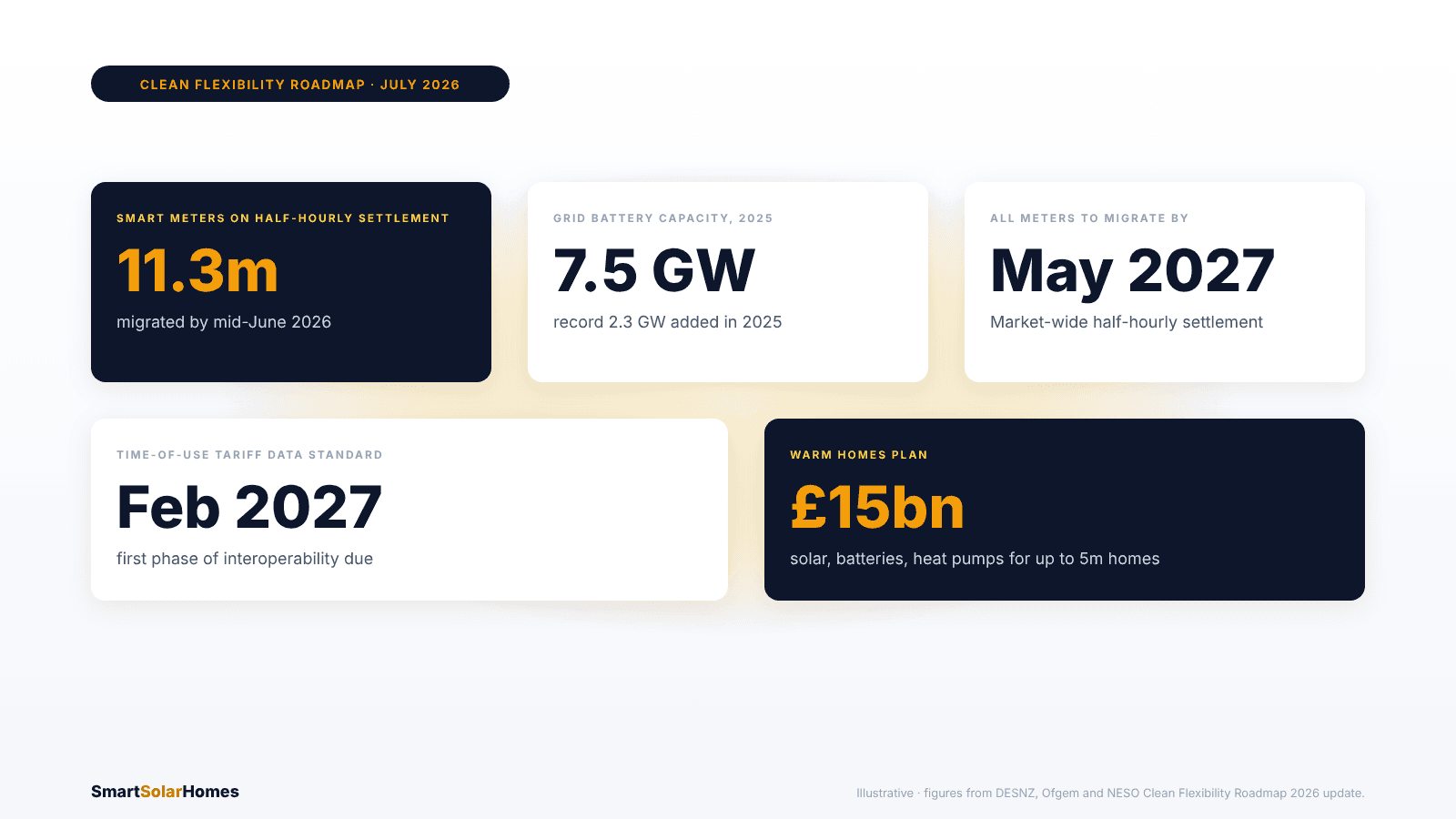
It is a joint plan from DESNZ, Ofgem and NESO, first published in July 2025, for the flexibility the electricity system needs for clean power by 2030. “Consumer-led flexibility” means, in the document’s words, the voluntary shifting of electricity use away from peak periods. The 2026 update reports progress and adds new commitments. It says UK grid-scale battery storage power capacity reached 7.5GW in 2025, with a record 2.3GW energised in that year alone, and it refers to the Warm Homes Plan, which it describes as delivering £15bn of public investment in heat pumps, solar panels, batteries and more to upgrade up to 5m homes by 2030.
Half-hourly settlement: the plumbing behind cheaper tariffs
The update says that by mid-June 2026 more than 11.3 million smart meters had been migrated to half-hourly settlement, and that a third of Britain’s electricity metering systems now operate under it. The programme is on track to migrate all meters by May 2027. The point, the document explains, is that half-hourly settlement will incentivise suppliers to offer new flexible products, so tariffs can reward you for using power at cheaper times. If you have a battery, an EV or a heat pump, that is the kind of tariff you would want. See our guide to charging a home battery on a flat-rate tariff.
Could flexible tariffs be tied to government support?
One new commitment says: “Government will rapidly assess the feasibility of consumers accessing government support for low carbon technologies to do so using a flexible tariff, with the option for the consumer to opt out.” That is an assessment, not a policy, and the update does not say which schemes might be affected. Nothing in the text we read changes the conditions of any current grant or loan.
What about the price cap?
In March 2026 Ofgem published a call for input on reflecting half-hourly settlement in the price cap, covering how the cap is set for single-rate customers, the design of at least one time-of-use variant, and further mitigations for greater cost diversity across the market. The update says Ofgem would develop proposals for the cap from 2027 after engaging stakeholders in summer 2026. We have not seen the outcome, so check Ofgem for the current position. Our price cap explainer covers the basics.
Smart batteries and EV chargers
The Smart Secure Electricity Systems programme aims to make smart appliances work with any tariff or flexibility service without changing the device. The update says government has consulted on draft legislation including minimum standards for smart battery energy storage systems and improvements to the framework for smart EV chargepoints, and expects to introduce secondary legislation in Parliament later in 2026. It also says the first phase of standardising how suppliers share time-of-use tariff data is due in February 2027. Separately, government commits to take primary legislative powers, when parliamentary time allows, to remove final consumption levies for “demand turn up”, which it says would boost the commercial case for bidirectional EV chargers and domestic batteries. Our demand turn up trial article explains that idea.
Heat pumps versus storage heaters
The update reports initial analysis showing that electric storage heaters create a higher burden on the electricity system than heat pumps, even accounting for their greater potential to be used flexibly. It says this will inform how government shapes deployment of low carbon technologies. It does not set out a policy decision on storage heaters.
What should you do now?
- Nothing changes automatically. These are plans and consultations, and dates such as February and May 2027 are targets.
- If you are buying a battery or EV charger, ask whether it is “smart” and compatible with time-of-use tariffs, since minimum standards are being developed. See are solar batteries worth it.
- Check your smart meter and tariff options, and watch for Ofgem decisions on the price cap.
FAQs
What is the Clean Flexibility Roadmap?
What is half-hourly settlement?
Will flexible tariffs be required for government grants?
Will home batteries have to be smart?
Does the update change the price cap?
Does the update say anything about heat pumps?
Sources — verified 24 November 2026
- DESNZ, Ofgem and NESO, “Clean Flexibility Roadmap: 2026 update (July 2026)” — assets.publishing.service.gov.uk

About the author
Sepehr
Solar specialist & co-founder, Smart Solar Homes
Solar specialist and co-founder of Smart Solar Homes, which works with MCS-certified UK installer partners. I write all the guides and reviews here; the aim is straight-talking education the industry rarely provides.
Citing this page? Please use a dofollow link back to the original article — it helps us keep the data on this page accurate and up to date.
Browse Battery Storage on Smart Solar Homes


Want to compare these side by side? Use the compare tool →
Or browse all Battery Storage on Smart Solar Homes.
Related reading
More on battery storage from the editorial team.
Find installers near you
MCS-certified solar installers covering these areas.