BS 7671 Amendment 4: What Changes for Solar and Batteries
Written and reviewed by Sepehr. See our editorial policy.
BS 7671 Amendment 4 becomes the only current edition of the UK wiring regulations on 15 October 2026. If you are having solar panels, a home battery or an EV charger installed, your electrician will be working to it, and a few of its changes show up on the paperwork you are handed. Here is what has changed, what has not, and what to ask your installer.
What is BS 7671 Amendment 4 and when does it apply?
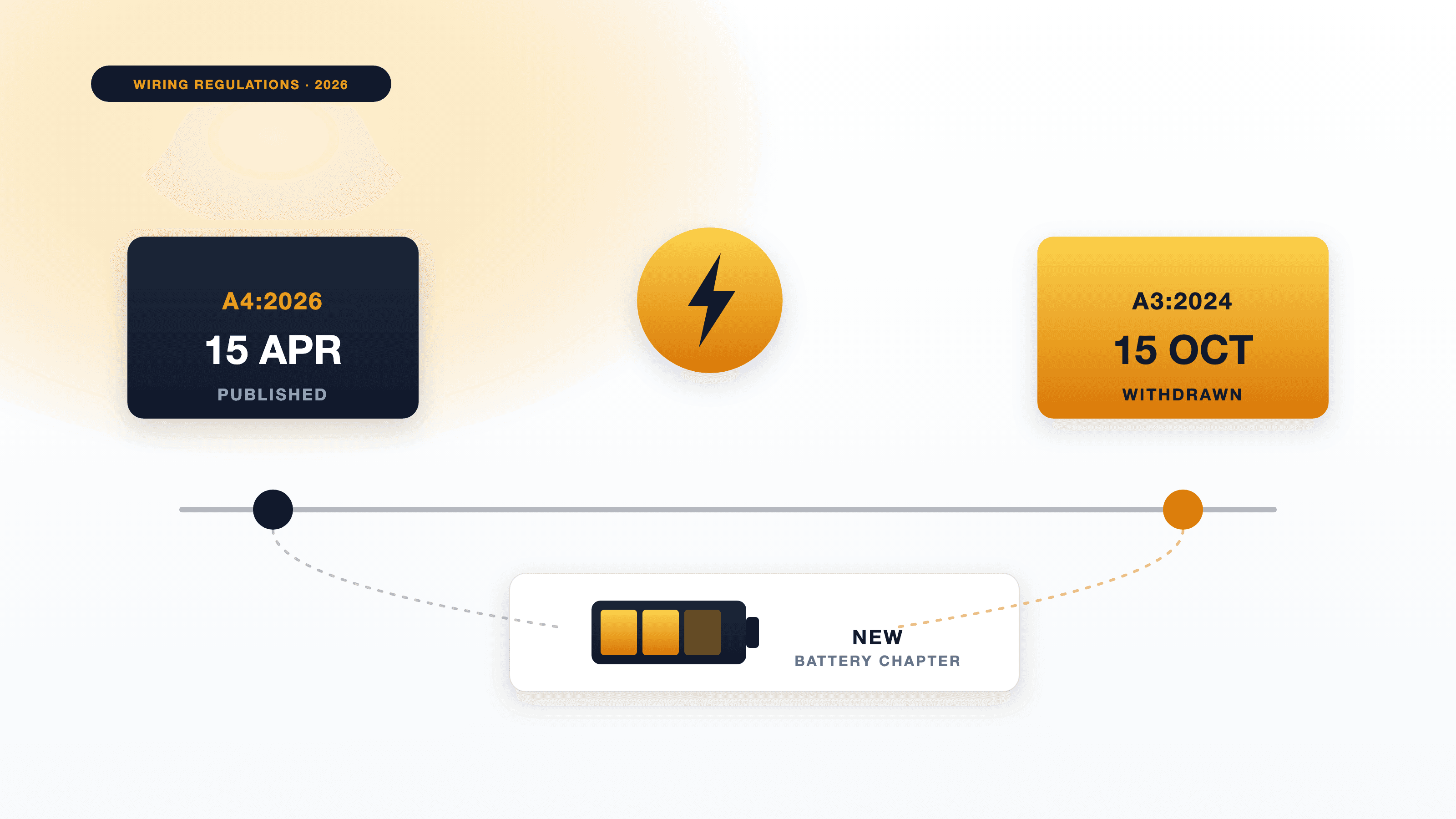
BS 7671, the IET Wiring Regulations, is the standard UK electricians design and certify installations to. Amendment 4 (formally BS 7671:2018+A4:2026) was published by the IET and BSI on 15 April 2026 and could be used from that day, according to NICEIC. The previous edition, BS 7671:2018+A2:2022+A3:2024, is withdrawn on 15 October 2026. Until then both editions are current.
The transition is not a cliff edge for jobs already under way. NICEIC says work designed to Amendment 3 before the cut-off can still be completed to it, but that designs from 15 October should use Amendment 4 and its certificates. So a battery install quoted and designed in September may legitimately be certified to the old edition, while the same job designed in November will not.
What it means for home batteries
The headline change for energy storage is a new chapter on stationary secondary batteries. The ECA and IET announcement describes it as covering electrical storage and supply for installations, and ECA's technical manager Darren Crannis said battery storage systems must meet strict installation requirements. Trade commentary summarised by UK Electrical News says the chapter covers bidirectional inverters and protective devices for current flowing in both directions, and explicitly addresses battery location, ventilation and fire mitigation.
For a homeowner, the practical effect is that where and how a battery goes in should now be designed against a dedicated section of the standard rather than by analogy. That sits alongside the existing guidance in our home battery installation guide, and the debate about batteries in lofts and home battery fire risk. NICEIC also notes one clarification: BS 7671 does not require arc fault detection devices (AFDDs) on circuits supplying battery energy storage systems.
Amendment 4 is a wiring standard, not a product ban. It does not change which batteries you can buy, and the sources above do not describe any new rule that stops an existing, compliant battery from operating.
What it means for solar panels and EV chargers
The sources I could verify do not list a standalone rewrite of the solar PV section, so do not expect your panel layout to change. Solar owners are most affected indirectly, through the new battery chapter if they add storage, and through the certificate and earthing changes below.
For EV charging, NICEIC says Amendment 4 introduces residual direct current (RDC) protective devices to electric vehicle charging installations, but its page gives no further detail, so the exact requirements are for your installer to confirm against the standard. Many chargers already have built-in DC fault detection, which is worth asking about. Our EV charger installation guide covers what a standard install involves, and the installer qualification rules explain who should be doing the work.
Changes that affect your paperwork
- Certificates: NICEIC says work to Amendment 4 is declared as "BS 7671 2026", and certificates reference 18.4 where Amendment 3 work references 18.3. Check which edition your Electrical Installation Certificate cites.
- Earthing: Protective neutral bonding (PNB) is now a recognised earthing arrangement that installers can select on certificates. NICEIC says the distribution network operator must supply earthing information free of charge.
- Inspection reports: Under Amendment 4, only C1 and C2 codes make an electrical condition report (EICR) unsatisfactory. C3 and FI (further investigation) are recorded as observations and no longer cause a fail, according to UK Electrical News. If you are buying or selling a home with solar, see our guides on selling a house with solar panels and smart consumer units.
- Qualifications: NICEIC says existing 18th Edition qualifications do not need upgrading, though supervisors need to understand the changes relevant to their work.
What to ask your installer
- Which edition of BS 7671 is the design and certificate based on?
- If a battery is included, how does the location meet the new storage chapter?
- If an EV charger is included, does it have RDC protection built in or is a separate device needed?
- Will I get an Electrical Installation Certificate, and the usual MCS certificate for the solar and battery?
A reputable installer will answer these without fuss. If you are still comparing firms, how to choose a solar installer is a good place to start. Quotes dated before 15 October that were designed to Amendment 3 are not invalid, but you are entitled to know which edition they use, and any cost uplift should be explained.
FAQs
When does BS 7671 Amendment 4 come into force?
Does BS 7671 Amendment 4 affect home batteries?
Do I need to replace my existing solar or battery installation because of Amendment 4?
Is Amendment 4 changing EV charger installations?
Does an EICR fail under Amendment 4?
Sources — verified 11 October 2026
- NICEIC, “Understanding BS 7671:2018 + Amendment 4:2026 IET update” — niceic.com
- Voltimum (ECA), “IET & BSI publish Amendment 4 (2026) to BS 7671:2018 (IET Wiring Regulations)” — www.voltimum.co.uk
- UK Electrical News, “BS 7671 Amendment 4 tracker” — ukelectricalnews.co.uk
- IET, “IET and BSI officially publish Amendment 4 (2026) to BS 7671:2018” — www.theiet.org

About the author
Sepehr
Solar specialist & co-founder, Smart Solar Homes
Solar specialist and co-founder of Smart Solar Homes, which works with MCS-certified UK installer partners. I write all the guides and reviews here; the aim is straight-talking education the industry rarely provides.
Citing this page? Please use a dofollow link back to the original article — it helps us keep the data on this page accurate and up to date.
Browse Battery Storage on Smart Solar Homes


Want to compare these side by side? Use the compare tool →
Or browse all Battery Storage on Smart Solar Homes.
Related reading
More on battery storage from the editorial team.
Find installers near you
MCS-certified solar installers covering these areas.