Best Angle for Solar Panels in the UK: 30–40° Tilt Explained
Written and reviewed by Sepehr. See our editorial policy.
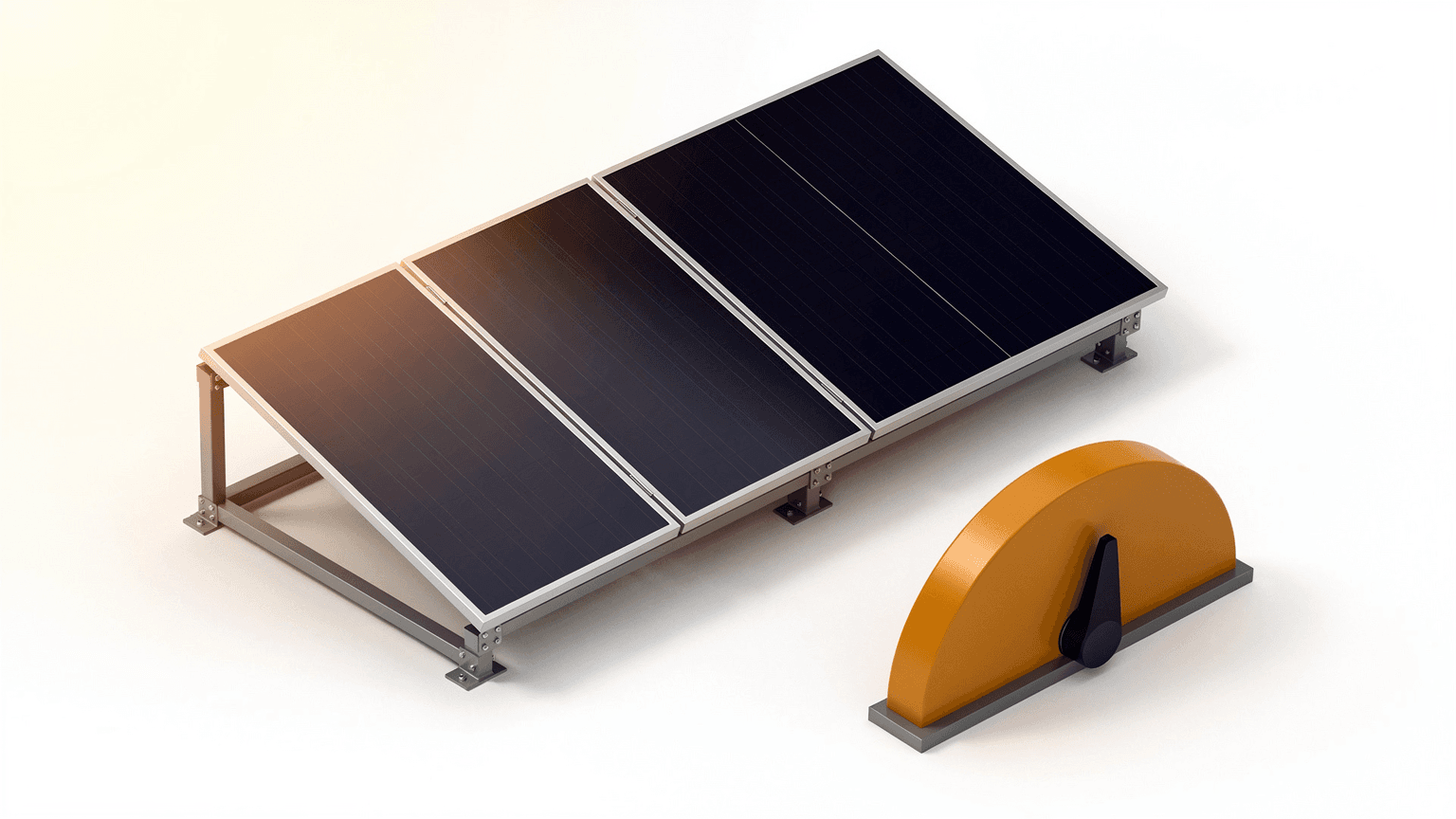
The best angle for solar panels in the UK is roughly 35–40° from horizontal, facing south. That figure comes from the European Commission's PVGIS tool, which gives an optimal fixed slope of about 39–43° for locations from Plymouth to Edinburgh. The good news is that the curve is very flat: anything from 30° to 50° delivers 98–100% of the best-case annual output, so the pitch of an ordinary UK roof is almost never the problem. This guide shows the numbers, what changes if your roof is shallower or steeper, and when a different angle is actually worth choosing.
What is the optimal tilt angle for solar panels in the UK?
About 40° for a south-facing, fixed array. We ran PVGIS (the Photovoltaic Geographical Information System from the EU Joint Research Centre) for four UK locations, using a 1 kWp system, its default 14% system losses and a due-south orientation. PVGIS's own optimal-slope calculation returned:
- Plymouth: 39°
- Manchester: 39°
- London: 40°
- Edinburgh: 43°
You will often see "30–35°" quoted as the UK rule of thumb. It is not wrong, because the output curve is so flat around the peak, but the strict annual optimum sits a little steeper. The further north you are, the steeper it gets, because the sun is lower in the sky for more of the year.
How much output do you lose at other angles?
Very little between 30° and 50°; a lot at the extremes. The table shows annual yield for a south-facing array as a percentage of that location's best result (our PVGIS runs, rounded to the nearest per cent).
| Panel tilt | Plymouth | London | Manchester | Edinburgh |
|---|---|---|---|---|
| 0° (flat) | 83% | 83% | 84% | 81% |
| 10° | 91% | 90% | 91% | 89% |
| 20° | 96% | 96% | 96% | 94% |
| 30° | 99% | 99% | 99% | 98% |
| 40° | 100% | 100% | 100% | 100% |
| 50° | 99% | 99% | 99% | 99% |
| 60° | 95% | 96% | 95% | 97% |
| 70° | 89% | 90% | 90% | 92% |
| 90° (vertical) | 71% | 73% | 73% | 75% |
Two practical readings. First, a pitch of 25–55° on a south-facing roof costs you only a few per cent against the theoretical best, which is within the noise of shading and weather. Second, a vertical panel (a wall or balcony rail) still produces roughly three-quarters of the optimum if it faces south; see our guides to wall-mounted solar panels and plug-in balcony solar.
Does angle matter as much as direction?
No: direction matters more than tilt. Here is the same London run with different compass directions, each as a percentage of the best result (south-facing at 40°).
| Tilt | South | South-east | East | West | North |
|---|---|---|---|---|---|
| 10° | 90% | 88% | 83% | 82% | 74% |
| 20° | 96% | 92% | 82% | 80% | 66% |
| 30° | 99% | 94% | 81% | 79% | 57% |
| 40° | 100% | 95% | 79% | 76% | 49% |
| 50° | 99% | 93% | 76% | 73% | 41% |
The pattern is clear: the further a roof faces from south, the shallower the best angle becomes. East- and west-facing panels do best at around 10° and lose output as they steepen, while a north-facing slope falls from 74% at 10° to 41% at 50°. If you are weighing up which roof slope to use, our roof orientation guide goes through each direction in detail, and the roof types guide covers tiles, slate, hips and gables.
What angle is best for winter?
Steeper, if winter generation is what you care about. Annual totals favour about 40°, but the seasons pull in different directions. In our London run, a 1 kWp array produced the following in the two extreme months:
- 15° tilt: about 26 kWh in December and 128 kWh in June
- 35° tilt: about 37 kWh in December and 123 kWh in June
- 60° tilt: about 45 kWh in December and 103 kWh in June
So a steep 60° array gains roughly 75% more in December than a 15° one but gives up around a fifth of its June output. For a standard grid-connected home, that trade rarely pays: summer months carry most of the annual kWh, and exports are paid under the Smart Export Guarantee. The steeper angle makes more sense for off-grid setups or wherever winter demand dominates; see off-grid solar panels, and solar panel output by month for the seasonal pattern.
Should you change the angle on a pitched roof?
Almost always, no. Most domestic systems are mounted on rails parallel to the roof, so the panel angle is simply the roof pitch. Tilting panels up off the roof slope adds cost, wind loading and a more prominent look for a gain of a few per cent at most, and a roof that is already between roughly 25° and 55° and faces south or near-south is in the flat part of the curve. Your effort is better spent on shading: a chimney or tree can cost far more than a 10° angle error. Read solar panel shading and consider optimisers or microinverters if a roof is partly shaded (DC power optimisers).
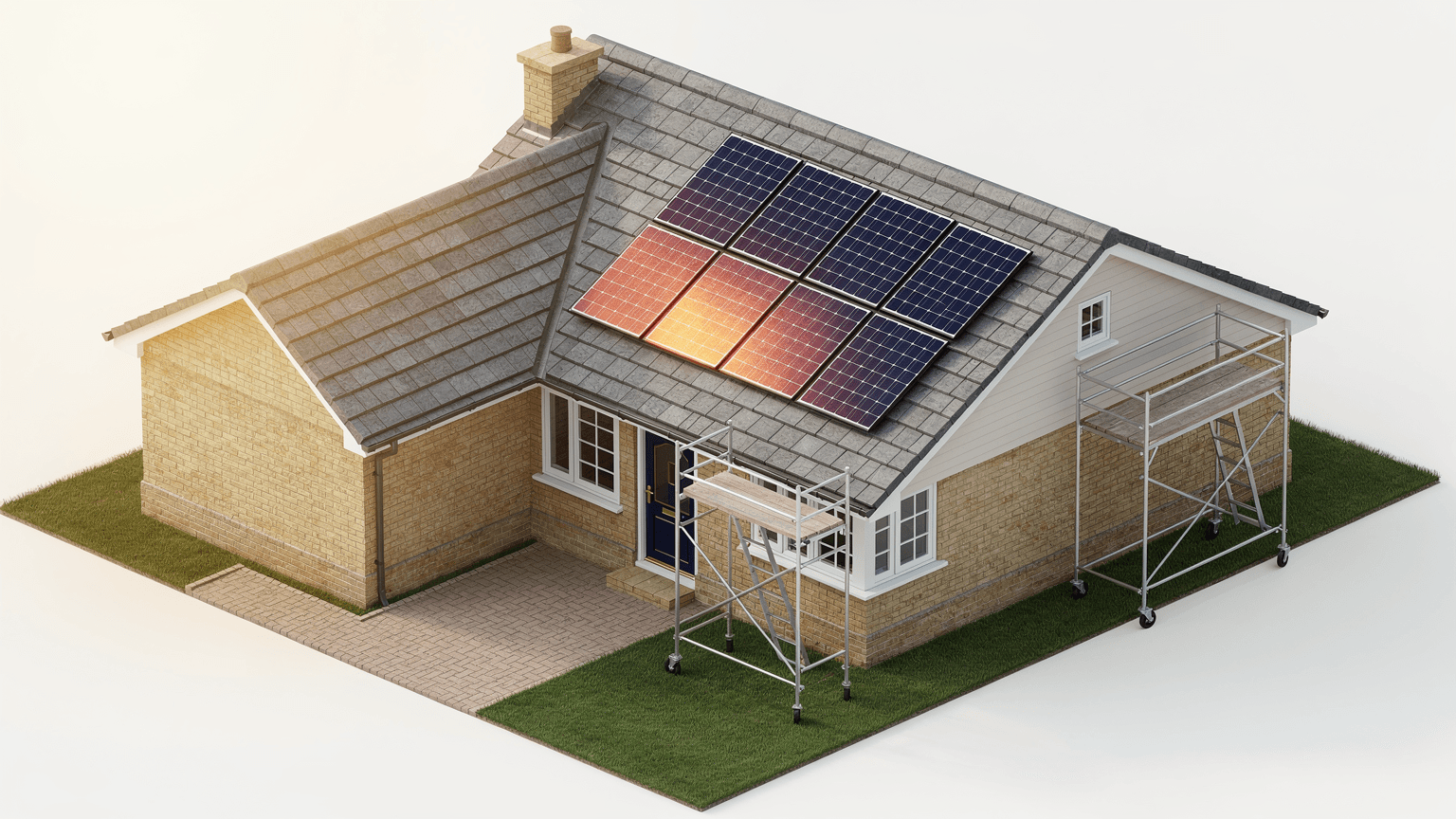
Low-pitch roofs deserve a quick check rather than a fix. A 10–15° south-facing bungalow roof still gives about 90% of the optimum in our runs, which is why a bungalow is a perfectly good candidate; our bungalow solar guide covers it.
What about flat roofs and ground mounts?
This is where you choose the angle, and where it is worth getting right. On a flat roof or a ground-mounted array you can pick any tilt. Two common options:
- South-facing frames at 30–40°: the highest output per panel, but the frames need spacing so rows do not shade each other, so you fit fewer panels in the same area.
- East-west pairs at around 10°: in our London run each side delivers about 82–83% of the best case at 10°. They pack tightly with little row-to-row shading and spread generation across the day, which can help self-consumption.
Which is better depends on the space you have, not on the angle alone. The flat roof solar guide and the ground-mounted solar guide cover mounting, structure and planning. Whatever you choose, ask your installer for a PVGIS or equivalent yield estimate for your own angle and direction, and check the system sizing in how to use PVGIS for solar.
How to check your own roof angle
Use the roof pitch from your plans, a phone inclinometer app or your installer's survey. Place the phone along a rafter or the roof slope and read the angle from horizontal. Then enter that angle and your roof's compass direction into PVGIS, which returns annual and monthly yield for your exact location. Your installer should give you a yield estimate for your system, and you can compare it against your own PVGIS run as a sanity check.
FAQs
What is the best angle for solar panels in the UK?
Does the angle of solar panels matter in the UK?
What is the best roof pitch for solar panels?
What is the best solar panel angle for winter?
What angle should flat roof solar panels be?
Sources — verified 28 October 2026
- European Commission Joint Research Centre, “PVGIS – Photovoltaic Geographical Information System (PV performance tool)” — re.jrc.ec.europa.eu
- European Commission Joint Research Centre, “PVGIS data sources and calculation methods” — joint-research-centre.ec.europa.eu
- Energy Saving Trust, “Solar panels for your home” — energysavingtrust.org.uk
- MCS, “Microgeneration Certification Scheme: consumer information” — mcscertified.com

About the author
Sepehr
Solar specialist & co-founder, Smart Solar Homes
Solar specialist and co-founder of Smart Solar Homes, which works with MCS-certified UK installer partners. I write all the guides and reviews here; the aim is straight-talking education the industry rarely provides.
Citing this page? Please use a dofollow link back to the original article — it helps us keep the data on this page accurate and up to date.
Browse Solar Panels on Smart Solar Homes


Want to compare these side by side? Use the compare tool →
Or browse all Solar Panels on Smart Solar Homes.
Related reading
More on solar panels from the editorial team.

Find installers near you
MCS-certified solar installers covering these areas.