How Shading Affects Solar Panel Output: What to Do About It

Written and reviewed by Sepehr. See our editorial policy.
Shading is one of the first things a solar salesperson will try to brush past, and one of the first things you should press them on. Even a modest shadow — a chimney, a TV aerial, a neighbouring tree catching the low winter sun — can reduce output far beyond what the shaded area would suggest. Understanding why that is, and what technology can do about it, will help you get an honest answer to the question most homeowners are really asking: is my roof good enough for solar to be worth it?
Why shading hits string inverters so hard
In a standard string inverter system, panels are wired in series like batteries in a torch. The total current flowing through the string is set by the weakest panel in it. If one panel is partially shaded and producing only half its rated current, the output of every other panel in that string is dragged down to match — the shaded cell becomes the bottleneck for the whole circuit.
This is sometimes called the “Christmas lights effect”: one failed bulb in an old-fashioned series string takes the whole run out. A cell producing the least current in a series circuit limits the current for all the cells connected to it. The consequence is that even a small shaded area can cause a disproportionately large output loss. Research and industry testing consistently show that shading just 5–10% of a string-connected array can reduce total output by 30–40% or more.
Bypass diodes provide some relief. Modern panels contain three bypass diodes internally, wired across groups of cells. When a group of cells is shaded, its diode activates and reroutes current around that group, preventing the worst of the drag. However, this only limits the damage — it does not eliminate it. The bypassed group contributes no power at all, and a heavily shaded panel may have all three diodes conducting, effectively taking the whole panel offline. Bypass diodes are a partial mitigation, not a complete solution.
Common shading causes on UK roofs
UK homes create a particular set of shading challenges. The most frequent culprits a surveyor will flag include:
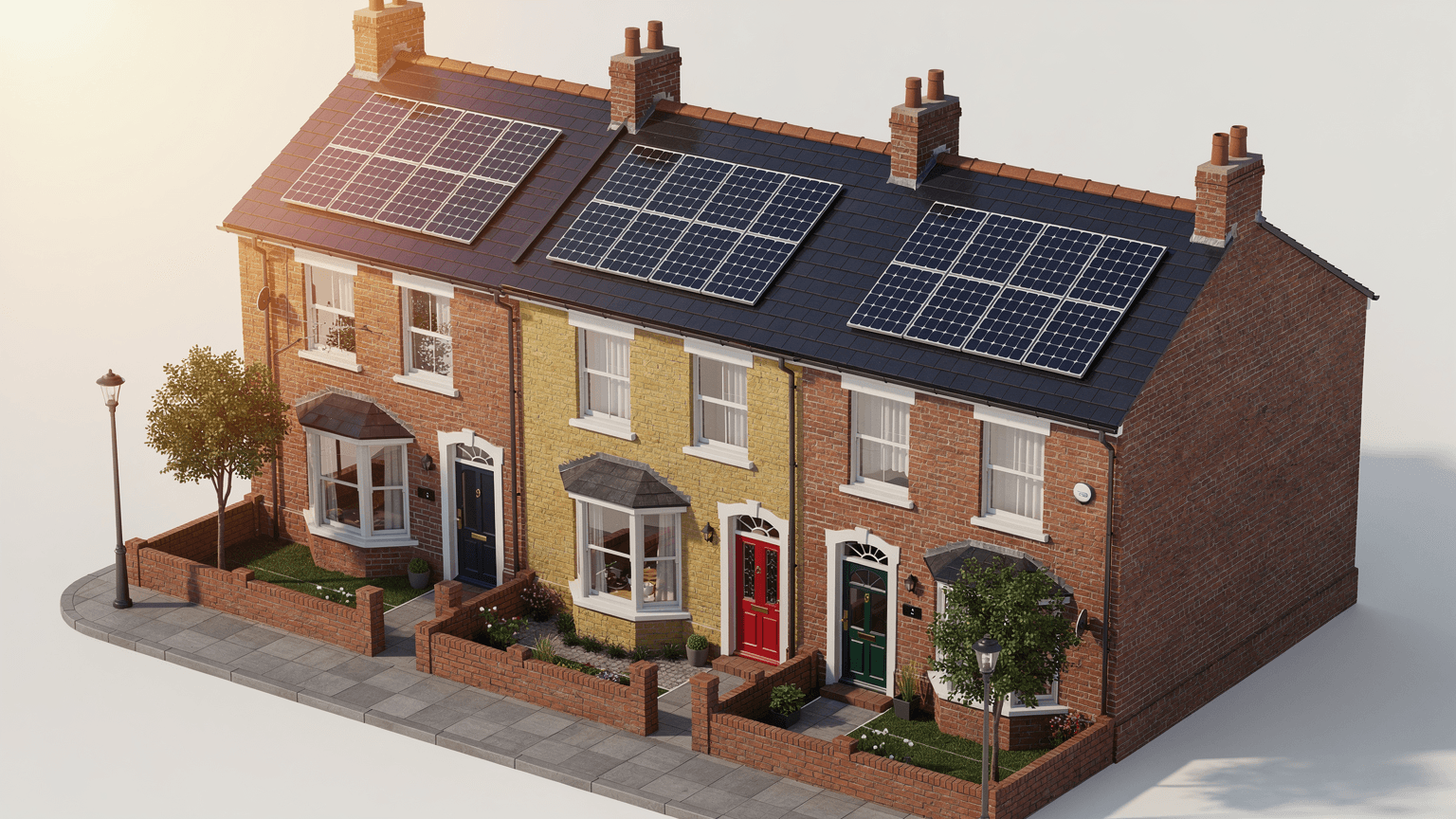
- Chimney stacks: A chimney on the ridge of a terraced or semi-detached house casts a hard, moving shadow across the panels as the sun tracks from east to west. Because UK sun is lower in the sky than in southern Europe, the shadow sweeps a larger arc across the panel surface.
- Dormer windows: Dormers project upwards from the roof slope, creating a raised obstruction directly on the generating surface. Panels placed either side of a dormer will see shading from it in the morning or afternoon depending on orientation.
- TV aerials and satellite dishes: Small but often poorly positioned, these cast thin but significant shadows across cells below them — a single aerial shadow running across a panel edge can activate bypass diodes.
- Neighbouring trees: Trees to the south are a particularly serious problem. A large tree that looks manageable in summer may cast heavy shade through winter when the sun is lowest and the branches are bare but the sun arc is lowest.
- Neighbouring buildings: Taller buildings to the south can shade the lower courses of panels, especially in the morning and afternoon shoulder hours of the day.
For help thinking through how many panels a roof can actually take once shading constraints are applied, our guide to solar panel dimensions and roof layout walks through the physical planning in detail.
How much does shading reduce solar output?
The losses are larger than most people expect on a standard string inverter. Industry testing and published data from system design software point to the following rough ranges:
- Shading 5% of a string-connected panel’s surface can reduce that string’s output by around 30%.
- Shading 10% of surface can cause 30–40% output loss on the affected string.
- If the shading falls at a critical point — across a cell row that spans the full panel width, for example — the loss can exceed 50% even with bypass diodes active.
These are not edge cases. A chimney shadow sweeping across a south-facing array on a typical British winter morning is enough to put a string in partial bypass for several hours. Across a full year, shading losses of 10–20% on an otherwise well-designed system are common where shading has not been properly assessed or mitigated.
Solutions: microinverters and power optimisers
The most effective solution to solar panel shading is to break the series-string dependency entirely. Two competing technologies do this, and both are well-established in the UK market.
Microinverters (such as the Enphase IQ8 series) attach one small inverter under each panel and convert DC to AC at the panel itself. Because each panel operates as a completely independent unit, a shaded panel has no effect on the panels next to it. If one panel is in shadow, it produces less — but the rest continue at full output. On a roof with moderate shading, microinverters can recover 5–25% of the output that a string inverter would lose, depending on the severity and pattern of shading. In heavily shaded conditions, the advantage can reach 3–5 percentage points above even power-optimised string systems.
Power optimisers (such as the SolarEdge range) take a different architectural approach: a DC-to-DC converter is fitted at each panel and tracks that panel’s maximum power point independently, but the conditioned DC is then fed to a single central string inverter rather than converted to AC at the panel. The practical shading performance is very similar to microinverters — the panel-level independence means one shaded panel no longer drags down its neighbours. In typical residential shading scenarios, the yield gap between power optimisers and microinverters is less than 1%; both outperform a standard string system by 5–15% where shading is present.
To understand how these inverter architectures fit into a complete system, our guide to string inverters, microinverters and hybrid inverters explains the differences and trade-offs in full.
String inverter with bypass diodes: the budget option
If shading on your roof is minimal and predictable — a single chimney casting a narrow shadow only in the early morning before it moves off the panels, for example — a standard string inverter with well-positioned panels may be perfectly adequate. Good installers will design the string layout to keep shaded panels in a separate string where possible, and modern panels with three bypass diodes limit the damage from small shadows on a single panel.
This is the lowest-cost option on equipment, and for a mostly unshaded roof it is the right call. The risk is that shading assessments done poorly — a desktop satellite view rather than an on-site survey — underestimate real-world losses. Make sure any installer who recommends a plain string system has actually modelled the shading at your specific site.
Is a shaded roof worth installing solar on?
The honest answer depends on how much of your generating area is actually affected. There is no bright-line rule, but as a rough guide:
- If shading affects fewer than 10–15% of your available south-facing roof area, and you use microinverters or power optimisers, solar is almost certainly still viable and worthwhile.
- If shading affects 20–30% of the generating area, or if the shading falls in the middle of the day when output should be highest, the economics become much tighter and you need a careful site-specific calculation before committing.
- If more than 30% of your usable roof area is significantly shaded for a meaningful part of the solar day, or if a large tree or building sits to the south and casts shade for several hours around midday, the roof is a poor candidate for solar. No technology fully compensates for serious all-day shading.
A north-facing roof is a separate issue — orientation alone does not make a roof unviable, but combined with significant shading it almost always does. Our guide to how many solar panels you need covers the sizing side of the calculation once you know how much usable roof area you have. If you haven't checked basic suitability first, our house sun suitability guide covers orientation, regional output and how to check shading before you get quotes.
What a pre-install shade survey looks for
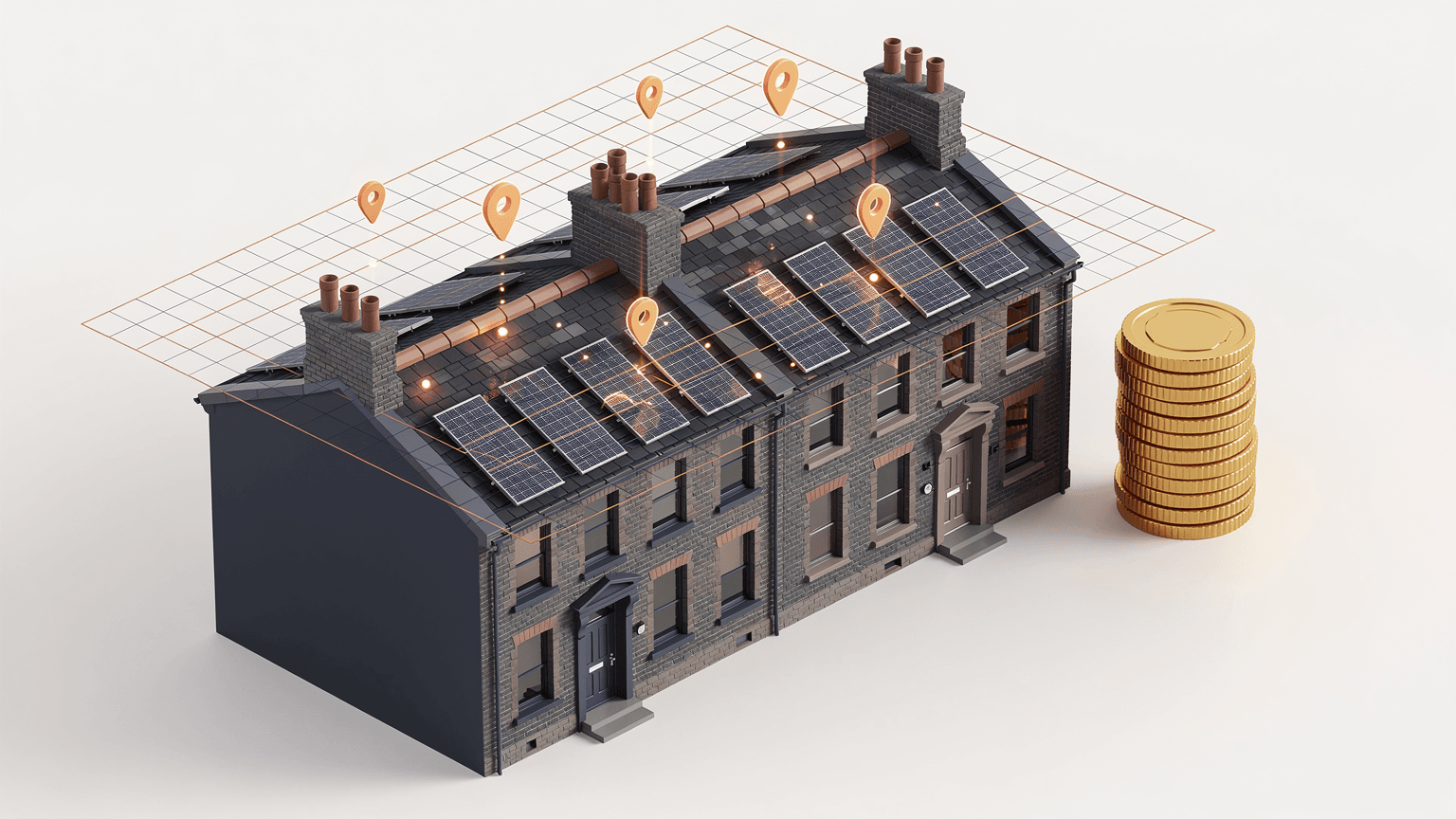
MCS-certified installers are required to carry out a shading assessment as part of the design process. This is not optional box-ticking — the MCS standard requires that installers record a shade or horizon line on a sun-path diagram, with each shading element mapped to the times of year when it will intercept direct sun. The result is a quantified estimate of the yield reduction you can expect, and it should be included in any compliant installer quote.
In practice, a good survey will visit the site rather than relying on satellite imagery. The surveyor will check all four compass points for obstructions, note the height and distance of trees and neighbouring buildings, and assess how shadows will move through the day and through the seasons. Tools like the Solar Pathfinder or software like PVsyst can model the full annual impact.
If the obstruction is a neighbour's tree or a new extension rather than something fixed on your own roof, the legal position is different from a simple design tweak — see our guide on what UK law actually says about a neighbour blocking your solar panels.
If an installer has not mentioned shading analysis, or is vague about it, ask directly. Any MCS-certified installer offering a system over 4 kWp in size is required to show you a shading analysis. If they cannot, that is a serious quality flag. To find certified installers, the get quotes tool connects you with MCS-registered professionals who will conduct a full site assessment.
FAQs
How much does shading reduce solar panel output?
Do microinverters or power optimisers help with shading?
Is it worth installing solar panels on a shaded roof?
What causes shading on UK roofs?
Do installers have to carry out a shading assessment?
Sources — verified 6 June 2026
- MCS, “MCS 012: Solar Photovoltaic Systems Installation Standard” (shading assessment requirements) — mcscertified.com
- MCS, "MGD-005 — Solar PV Shade Analysis" — mcscertified.com
- Aurora Solar, “Shading losses in PV systems, and techniques to mitigate them” — aurorasolar.com
- PVEducation.org, "Bypass Diodes" — www.pveducation.org
- Enphase Energy, “IQ8 Series Microinverters” (panel-level independence and shading tolerance) — enphase.com
- MCS, "MIS 3002 — Solar PV Systems Standard V5.0" (module-level power electronics for shading) — mcscertified.com

About the author
Sepehr
Solar specialist & co-founder, Smart Solar Homes
Solar specialist and co-founder of Smart Solar Homes, which works with MCS-certified UK installer partners. I write all the guides and reviews here; the aim is straight-talking education the industry rarely provides.
Citing this page? Please use a dofollow link back to the original article — it helps us keep the data on this page accurate and up to date.
Browse Solar Panels on Smart Solar Homes


Want to compare these side by side? Use the compare tool →
Or browse all Solar Panels on Smart Solar Homes.
Related reading
More on solar panels from the editorial team.
Find installers near you
MCS-certified solar installers covering these areas.