NESO Winter Outlook 2026/27: Will the Lights Stay On?
Written and reviewed by Sepehr. See our editorial policy.
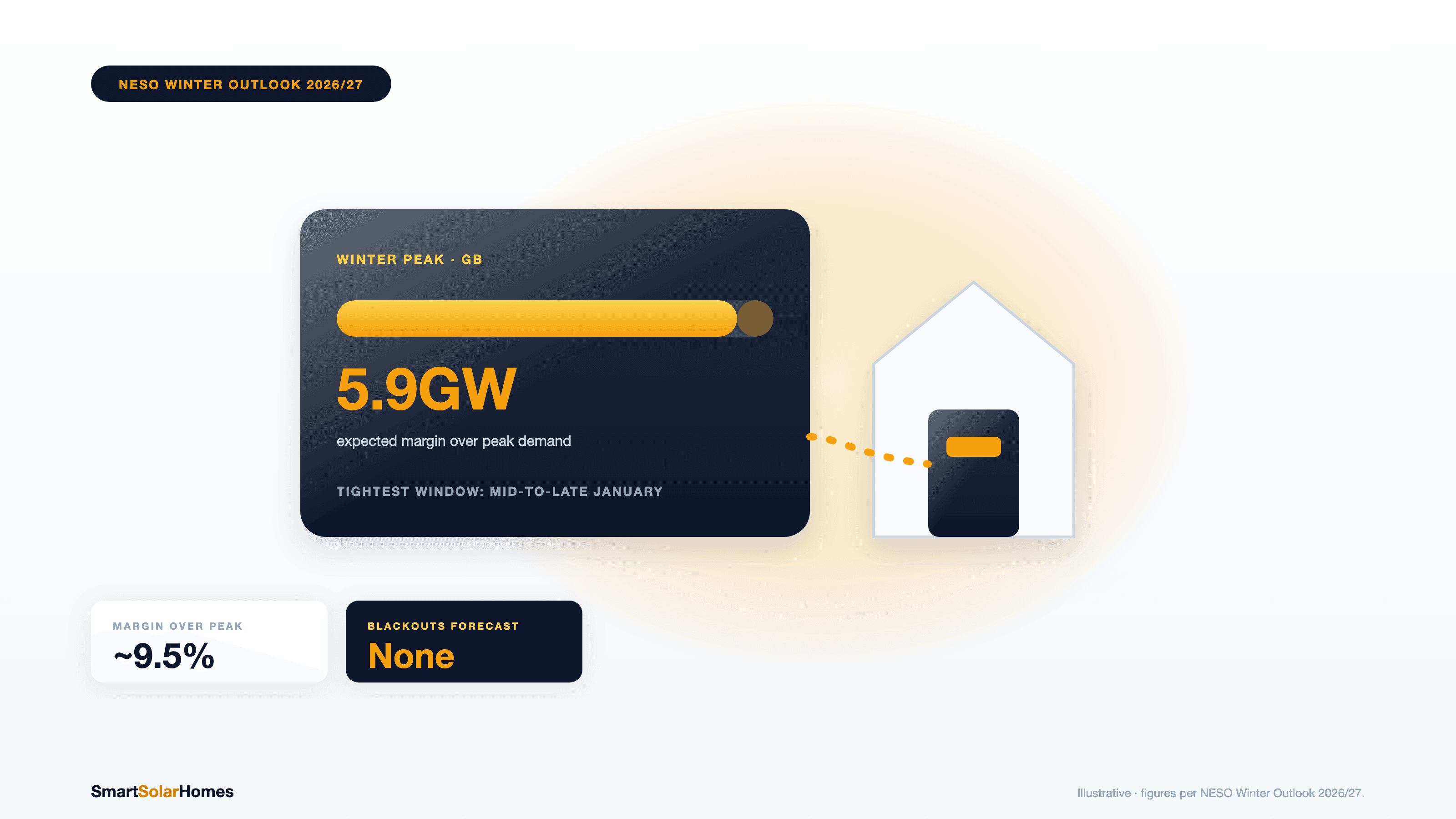
Britain's electricity system operator says the lights should stay on this winter. NESO's Winter Outlook 2026/27, published on 26 October 2026, puts the expected margin at 5.9GW, or around 9.5% above peak demand, and says it is not forecasting blackouts. For homeowners with solar panels or a home battery, the more useful question is what that margin means for your own set-up: whether a battery will protect you, and what changes on the tightest days.
What NESO's winter outlook says
The headline number. NESO describes the margin as the buffer between the electricity expected to be available and what Britain is expected to need at peak times. The final October figure of 5.9GW (around 9.5%) is up from the 5.5GW (8.8%) in the Early View published in June. NESO tested 30,000 winter scenarios and says the outlook is broadly comparable with recent winters.
What is helping. Peak demand is expected to rise, but NESO says that increase has been largely offset by new capacity, including battery storage, gas-fired generation and wind. In other words, the grid-scale batteries now being built are one reason the margin holds up.
Where the risk sits. NESO expects mid-to-late January to be the most likely window for tighter days. On those days it can use its usual operational tools, including issuing a notice asking the market to make more power available. Great Britain is also likely to be a net importer through interconnectors this winter.
Will there be power cuts this winter?
NESO's position is that supplies are expected to remain secure, with enough supply to meet demand through the winter. A tight day is not the same as a power cut: it means the system operator may ask generators, batteries and other providers to do more, not that households lose supply. If a rare shortfall ever did happen, it would be a national supply problem, which is different from the local faults that cause most outages.
That distinction matters for what you buy. A home battery with a backup gateway helps when your local network goes down, for example after storm damage. It is not something you need to buy because of the national outlook. Our guide to home battery backup power explains which systems keep the lights on during an outage and which do not, since many batteries switch off with the grid unless they were installed with backup wiring.
What it means if you have solar and a battery
Winter solar output is low. Short days mean panels contribute far less between November and February, so the grid still does most of the work for most households. Solar does not remove your exposure to winter prices, but it reduces it in the months when the sun is up. See how this plays out in our look at how the national grid and home solar interact.
Your battery is most valuable on a cheap-rate tariff. The practical winter play is to charge from the grid when power is cheap and use it in the evening peak, the same period NESO's margin is measured against. If you are not yet on a time-of-use plan, our guide to time-of-use tariffs for solar owners covers the options.
Flexibility may pay. Aggregators can pay households that shift or export power at peak times. If your battery is smart-enabled, see our explainer on virtual power plants in the UK to check whether your system qualifies before signing up.
What to do before January
- Check your battery's backup mode. If it supports backup, confirm the reserve setting so it is not drained to zero overnight.
- Review your tariff. The energy price cap still moves quarterly, so read our guide to the UK energy price cap and compare against a time-of-use plan.
- Keep expectations realistic. Grid margin and household bills are separate questions; a healthy margin does not by itself lower prices. For the policy backdrop, see the Clean Power 2030 shift towards bills.
The bottom line
NESO's Winter Outlook 2026/27 is reassuring rather than alarming: a 5.9GW margin, no blackout forecast, and January as the month to watch. For most solar and battery owners the sensible response is not to buy anything new, but to make sure the equipment you have is set up to use cheap power and, if it is meant to, to back up your home when the local network fails.
FAQs
Will there be blackouts in the UK this winter 2026/27?
When is the grid tightest this winter?
Do I need a home battery because of the NESO winter outlook?
Is the NESO winter margin higher than the last forecast?
Sources — verified 27 October 2026
- NESO, “Winter Outlook 2026/27” — www.neso.energy
- Electrical Review, “Storage growth helps offset demand rise in NESO winter margin forecast” — www.electricalreview.co.uk
- Drax, “NESO forecasts adequate but lower supply margins this winter” — energy.drax.com
- NESO, “Early View of Winter 2026/27” — www.neso.energy

About the author
Sepehr
Solar specialist & co-founder, Smart Solar Homes
Solar specialist and co-founder of Smart Solar Homes, which works with MCS-certified UK installer partners. I write all the guides and reviews here; the aim is straight-talking education the industry rarely provides.
Citing this page? Please use a dofollow link back to the original article — it helps us keep the data on this page accurate and up to date.
Browse Solar Panels on Smart Solar Homes


Want to compare these side by side? Use the compare tool →
Or browse all Solar Panels on Smart Solar Homes.
Related reading
More on solar panels from the editorial team.
Find installers near you
MCS-certified solar installers covering these areas.