What Size Home Battery Do You Need?

Written and reviewed by Sepehr. See our editorial policy.
Most people ask “what size battery do I need?” and reach for their annual electricity usage figure. That's the wrong starting point. A home battery can only store electricity your solar panels have generated but not yet used — your solar surplus — and it can only discharge what your household hasn't already consumed. Sizing to your total daily consumption leads to an oversized, underutilised battery that costs more than it returns. This guide explains the surplus-based sizing method, works through a practical example, and covers when it genuinely makes sense to size up. For the full context on how batteries work with solar, including coupling types and what to ask an installer, the complete home battery storage guide is the right companion read.
The core principle: size to your surplus, not your consumption
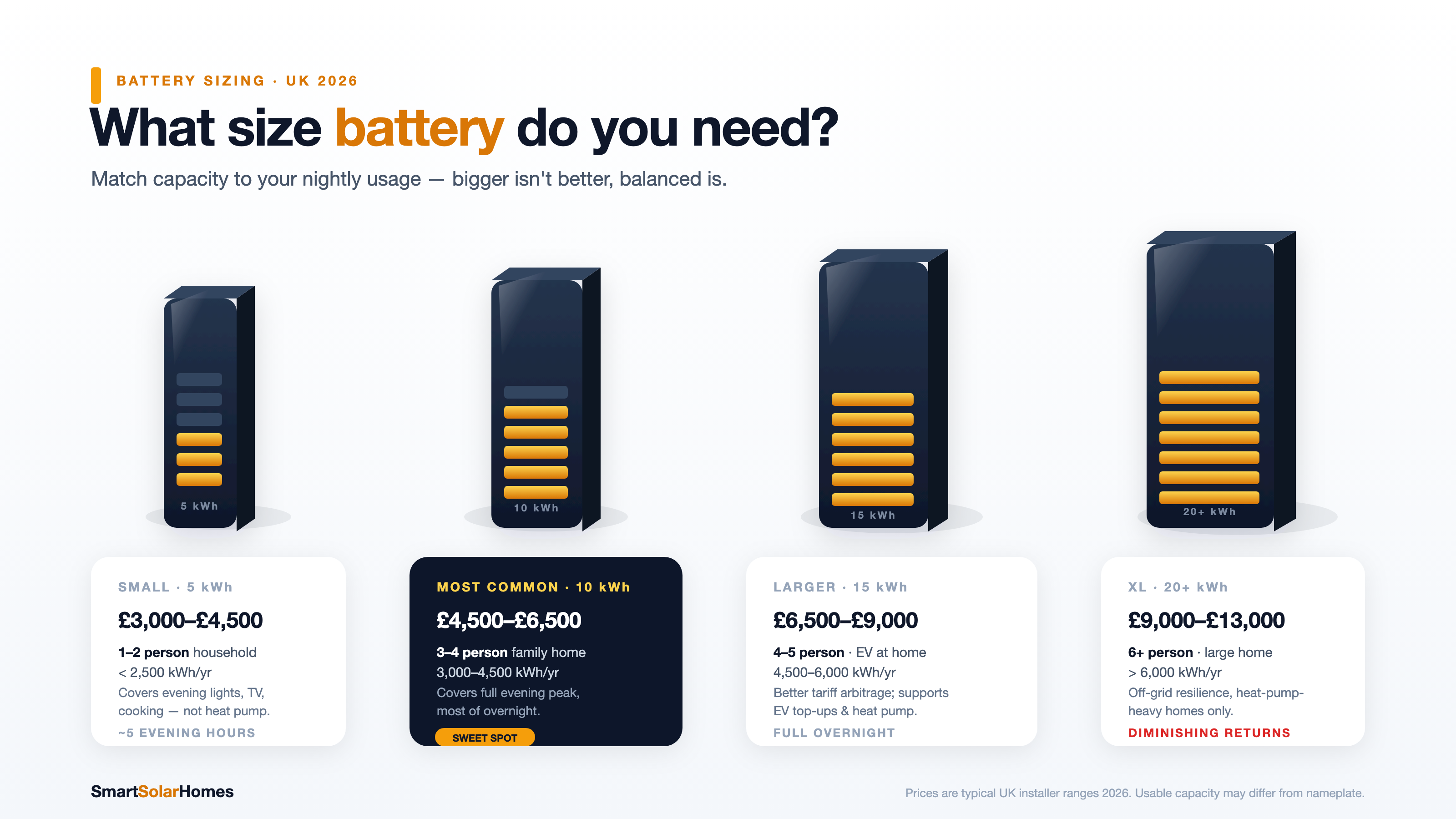
Consider a household that uses around 10kWh per day. Their 4kWp solar system generates around 12kWh on a good summer day. During the day, while appliances are running and the household is home, they self-consume around 6kWh directly from the panels. That leaves a surplus of roughly 6kWh — electricity generated but not used as it's produced.
That 6kWh is the maximum the battery can meaningfully store. A 13.5kWh battery would wake up every morning at 6–7kWh — less than half full — and discharge back to near-empty each evening. The upper half of its capacity is never used. A 6–8kWh battery captures the same surplus at lower cost and with fewer cycles per unit of capacity, which is gentler on long-term degradation.
The principle: useful battery size ≈ daily solar surplus. Your daily solar surplus is daily generation minus direct daytime self-consumption.
How to calculate your daily solar surplus
If you already have solar panels, your inverter's monitoring app is the best data source. Look for:
- Total daily generation — the kWh your panels produced on a given day.
- Grid export — what was sent to the grid because you didn't use it at the time.
Your daily surplus is approximately equal to your daily grid export. If you exported 5.5kWh yesterday, a 6kWh battery would have captured almost all of it. If you consistently export 8–9kWh in summer but only 2–3kWh in winter, your sizing decision involves a trade-off: you can optimise for summer or choose a mid-range capacity that delivers reasonable performance year-round.
If you don't have solar yet, you'll be estimating. A rule of thumb: a 4kWp south-facing system in the UK generates around 3,400–4,000kWh per year, averaging roughly 9–11kWh per day in summer and 2–4kWh in winter. Daytime self-consumption depends on your household's occupancy and appliance use. For guidance on system sizing, how many solar panels you need covers panel counts and generation estimates for different property types. The battery section of the solar installation guide works through whether a battery makes sense alongside a new installation versus as a later addition.
Worked example
Take a household with a 3.6kWp solar system. In June, they generate around 15kWh per day. They're out during the day; daytime self-consumption is low, around 3kWh. Their daily surplus is approximately 12kWh. An 8kWh battery would capture two-thirds of that — a meaningful improvement. A 13.5kWh battery would capture nearly all of it, but the incremental gain on the extra 5.5kWh of capacity costs roughly £2,500–£3,000 more. Whether that incremental capacity is worth paying for depends on how much they value full self-sufficiency in summer versus a faster return on the battery investment.
In December, the same system generates around 4kWh per day, and direct daytime use accounts for maybe 1.5kWh. Daily surplus: around 2.5kWh. At that point, any battery above 3kWh is more than adequate for winter conditions. The 8kWh battery they chose sits mostly idle in December — which is fine. Batteries are sized for the season when they deliver most value, which for solar is typically spring through early autumn.
When to size up
There are good reasons to buy more capacity than your current surplus strictly requires.
An EV in the near future. If you plan to charge an electric vehicle from solar, a larger battery bridges the gap between when your panels generate and when you plug in. An EV charger drawing 7.4kW will exhaust a 6kWh battery in under an hour. For households heading towards EV ownership, sizing for 10–13kWh now avoids replacing the battery in three years.
A heat pump or significant load increase. Similarly, if a heat pump installation is planned, your winter electricity demand will rise substantially, and a larger battery has more opportunity to contribute.
Time-of-use tariff arbitrage. On tariffs like Octopus Agile, a battery charges from the grid overnight at cheap rates and discharges during expensive peak periods. For this use case, the sizing logic is different: you want enough capacity to cover your evening peak demand, regardless of solar surplus. A household with a 4–5kWh evening peak needs at least 4–5kWh of usable capacity for full arbitrage benefit.
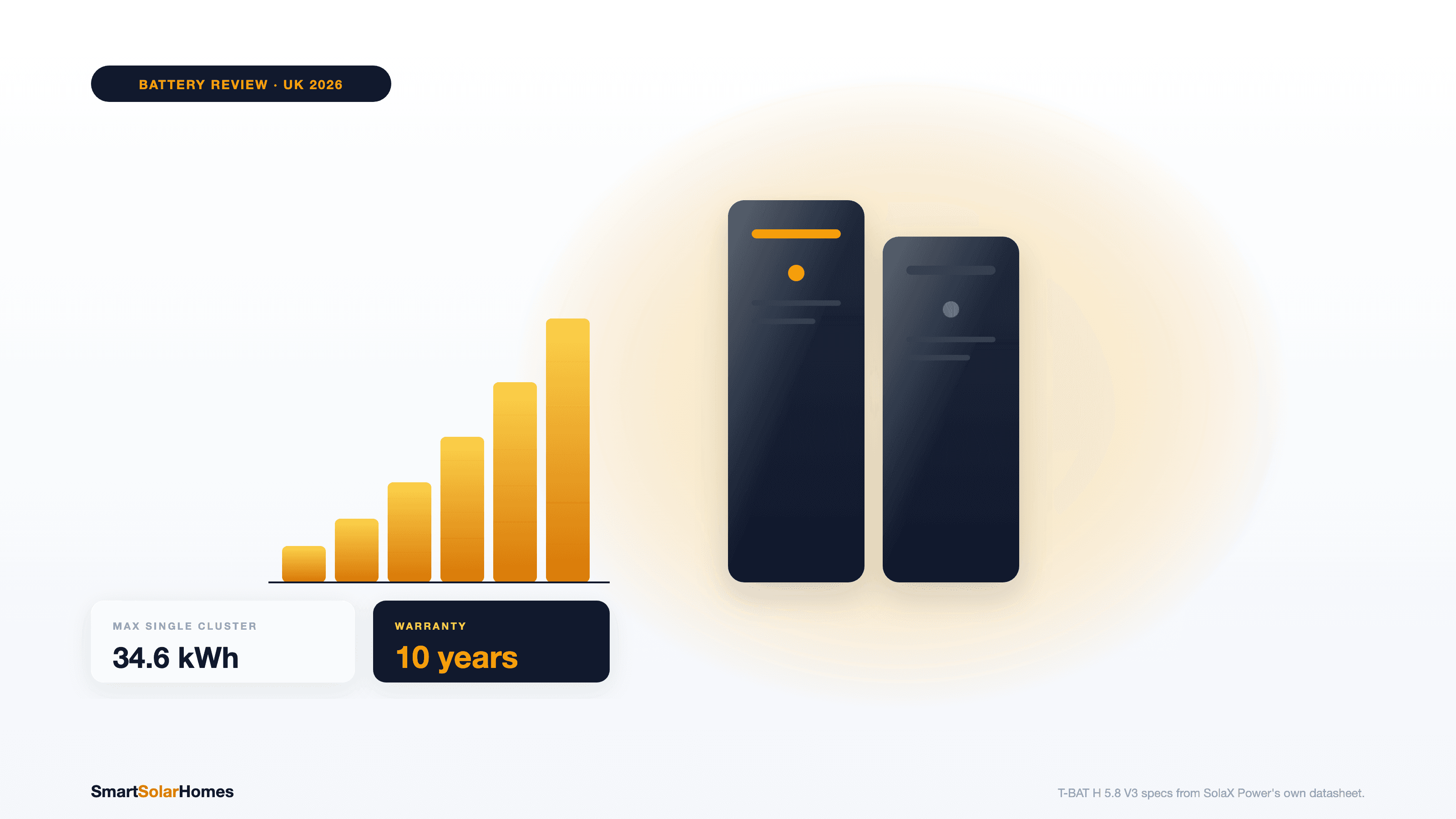
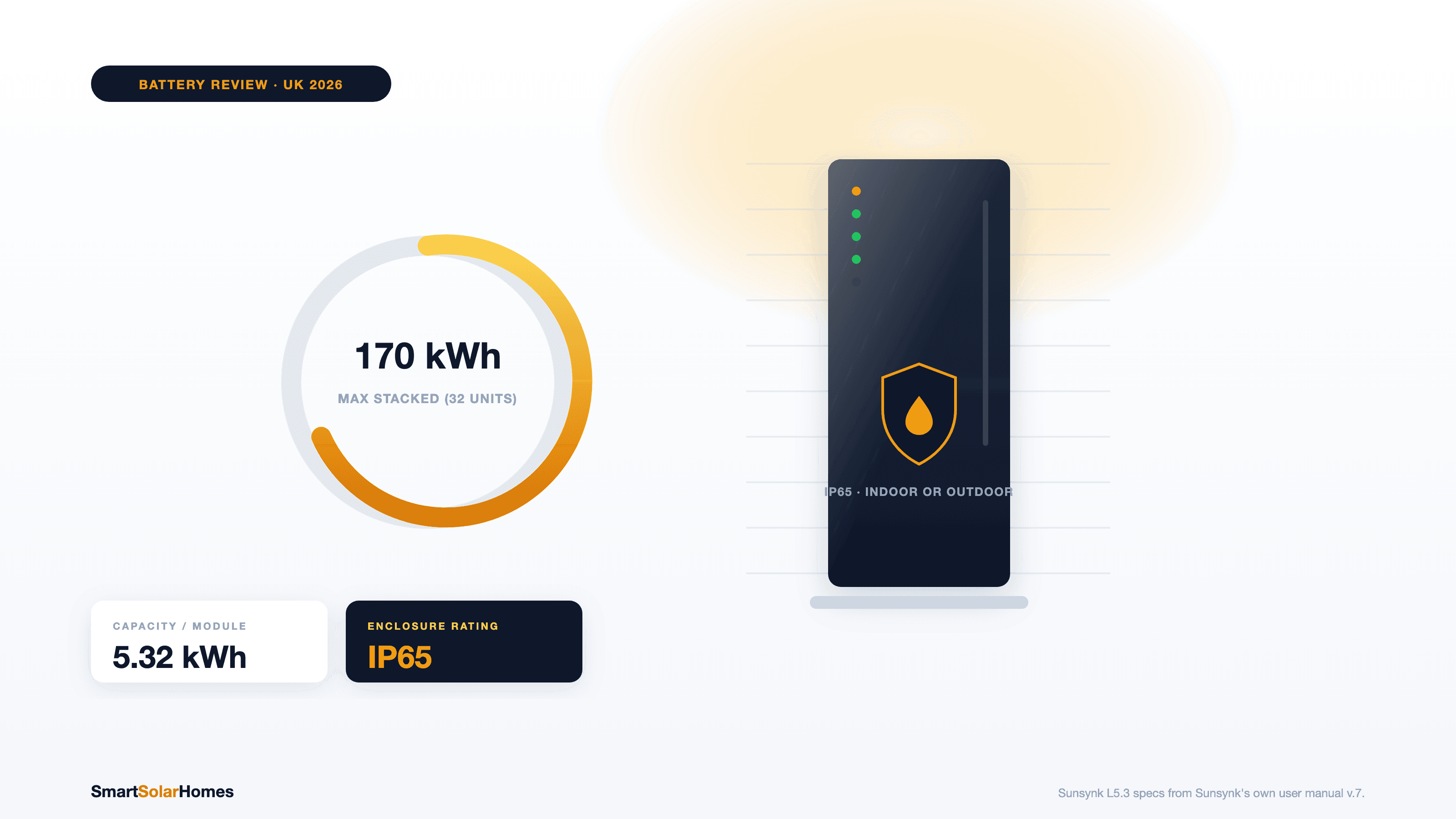
Modular systems. If you're unsure, modular systems let you start smaller and add capacity later. The Fox ESS H3 supports additional ECS2900 modules (2.88kWh each, up to seven per stack for roughly 20kWh), so you can start with a small stack now and expand later without replacing the inverter or control unit. The GivEnergy All-in-One also supports expansion batteries. Starting modular is more cost-efficient than over-specifying if you're uncertain about future demand. The Sunsynk L5.3 takes the same modular approach (up to 32 units in parallel on a single bus) but adds an IP65 enclosure rating, so it can be wall-mounted outdoors if you don't have indoor space for a growing stack.
When to size down
A smaller battery is the right call if your solar system is modestly sized, your daytime occupancy is high (meaning you self-consume most generation directly), or you're primarily interested in modest grid independence rather than maximum self-sufficiency. A 5–6kWh battery in these conditions will perform at close to its theoretical maximum daily — full charge, full discharge — which is exactly what you want from a battery. More cycles per unit of capacity means better return per pound spent.
A note on gross versus usable capacity
Battery manufacturers quote gross capacity (the physical cell size) in their marketing materials. Usable capacity — what you can actually store and retrieve — is typically 5–10% less, because manufacturers reserve a portion at each end to protect cell longevity. Always compare usable figures when sizing. A battery listed as 10kWh gross may deliver 9.5kWh in practice. The home battery cost guide explains how this affects cost-per-usable-kWh comparisons between products.
Summary: a simple sizing decision tree
- Check your daily solar export from your inverter app. If you don't have panels yet, estimate from your planned system size.
- Match usable capacity to that export figure as a baseline. Add 10–20% headroom to account for seasonal variation and mild future load growth.
- Size up if an EV, heat pump, or significant load increase is planned within three to five years, or if you want time-of-use arbitrage beyond solar self-consumption.
- Consider modular if you want to start lean and expand without replacing hardware.
- Always compare usable capacity, not gross, and round-trip efficiency — a 10kWh battery at 95% efficiency delivers meaningfully more usable energy per cycle than one rated 92%.
Once you have a capacity target, getting quotes from MCS-certified installers is the next step. Giving installers a specific usable capacity figure to quote against makes comparisons cleaner and reduces the risk of being steered towards a larger (and more profitable for the installer) system than you actually need.
FAQs
What size home battery do I need for solar panels?
Is a bigger battery like 13.5kWh worth it?
How do I work out my daily solar surplus?
Why is usable battery capacity different from the advertised size?
Can I add more battery capacity later?
Sources — verified 5 June 2026
- Energy Saving Trust, “Solar panels” — energysavingtrust.org.uk
- Ofgem, “Changes to energy price cap between 1 April and 30 June 2026” — www.ofgem.gov.uk
- Fox ESS, “Hybrid Inverter (H3) and ECS2900 battery system” — www.fox-ess.com
- GivEnergy, “All In One 2 Expansion Battery” — givenergy.com
- MCS, “Battery Storage” — mcscertified.com

About the author
Sepehr
Solar specialist & co-founder, Smart Solar Homes
Solar specialist and co-founder of Smart Solar Homes, which works with MCS-certified UK installer partners. I write all the guides and reviews here; the aim is straight-talking education the industry rarely provides.
Citing this page? Please use a dofollow link back to the original article — it helps us keep the data on this page accurate and up to date.
Browse Battery Storage on Smart Solar Homes


Want to compare these side by side? Use the compare tool →
Or browse all Battery Storage on Smart Solar Homes.
Related reading
More on battery storage from the editorial team.
Find installers near you
MCS-certified solar installers covering these areas.