Bifacial Solar Panels UK: Are Double-Sided Panels Worth the Premium?

Written and reviewed by Sepehr. See our editorial policy.
Most solar panels only harvest light from their front face. Bifacial panels collect sunlight from both sides — the front receives direct irradiance from the sky, while the rear captures reflected and diffuse light bouncing up from the ground or roof surface below. The result, in the right setting, is measurably more electricity from the same footprint. But the UK's cloudy skies and predominantly dark-tiled rooftops change the maths significantly compared with sunnier climates — so let's be precise about when bifacial technology actually pays.
How bifacial solar panels work
The physics is straightforward. A standard panel laminates silicon cells between an opaque white backsheet and a tempered glass front face. A bifacial panel replaces the backsheet with a second layer of tempered glass (or a clear composite), exposing the rear of the cells to any light that travels up from below. Both faces feed into the same electrical circuit, so the panel's total output equals front-face generation plus rear-side gain — a figure quoted in manufacturers' datasheets as the bifaciality factor, typically 70–85%.
Because the rear face sees less intense, more diffuse illumination, it never doubles output. Real-world rear-side contributions depend almost entirely on three variables: how much light reflects off the surface beneath (albedo), how high the panel is mounted above that surface, and the UK's particular mix of direct versus diffuse irradiance.
The albedo factor: what's under the panels matters most
Albedo is the single biggest driver of bifacial gain in the UK. Surfaces reflect different fractions of incoming light: fresh white gravel sits around 0.50–0.55, light concrete around 0.30–0.35, short grass around 0.20–0.25, and dark roof tiles as low as 0.08–0.12. Academic testing at a UK site (published via NCBI/PMC) found that an albedo of 0.13 (dark soil) produced an 8.2% rear-side gain, a medium albedo of 0.28–0.30 delivered 12–13%, and a high albedo of 0.50 (white stone) pushed gains to 22.4%. Those figures assume a well-elevated ground-mount array; rooftop installs over dark British slate commonly see only 3–7%.
The practical takeaway: if you can control what lies beneath the panels and choose a pale surface, bifacial technology is genuinely rewarding. If the substrate is fixed and dark, most of the premium evaporates.
UK irradiance profile: diffuse light as a hidden advantage
The UK receives roughly 50–60% of its annual solar irradiance as diffuse (scattered) light rather than the direct beam irradiance that dominates in southern Europe or the Middle East. This is often cited as a weakness for solar in general, but for bifacial panels it cuts both ways. Diffuse light is less directional, so it reaches the rear face of elevated panels from multiple angles — not just the narrow beam reflected off the substrate. Research published by ResearchGate on annual diffuse ratios for UK locations confirms the UK's high diffuse fraction, which slightly softens the advantage that direct-beam climates have over us, and keeps rear-side gains more consistent across cloudy days. Even so, total bifacial gain in a UK ground-mount installation (5–20%) is noticeably smaller than the 20–35% often cited for Spain or the US Southwest.
Where bifacial panels earn their premium in the UK
Ground-mounted systems over pale gravel or crushed limestone are the clear sweet spot. Elevation is easy to control — the EE Renewables guide recommends a minimum clearance of 30–50 cm for meaningful rear contribution, with 1.0–1.3 m being optimal for maximum bifacial gain. Pale gravel or light aggregate beneath the array can push rear-face irradiance gain to 15–25% in UK conditions, and the cooler microclimate at ground level reduces temperature-related efficiency losses.
Solar carports are increasingly popular for businesses and rural properties. The canopy structure inherently provides clearance, and the surface below — usually light concrete or tarmac — has a moderate albedo of 0.25–0.35. Installer Solspan UK reports typical bifacial gain of 10–18% on carport installations, alongside the dual-use benefit of covered parking.
Flat commercial roofs with a white TPO or PVC membrane offer albedo values of 0.60–0.80 and are already common in the UK commercial solar market. Ballasted arrays on white membranes routinely achieve 15–20% rear-side gain with only 15–20 cm of clearance, making bifacial modules a straightforward upsell on commercial flat-roof projects.
Elevated residential flat roofs with a pale coating or white stone ballast can also benefit, though the gain is more modest (8–14%) and depends on careful mounting design.
Where bifacial panels are NOT worth the extra cost
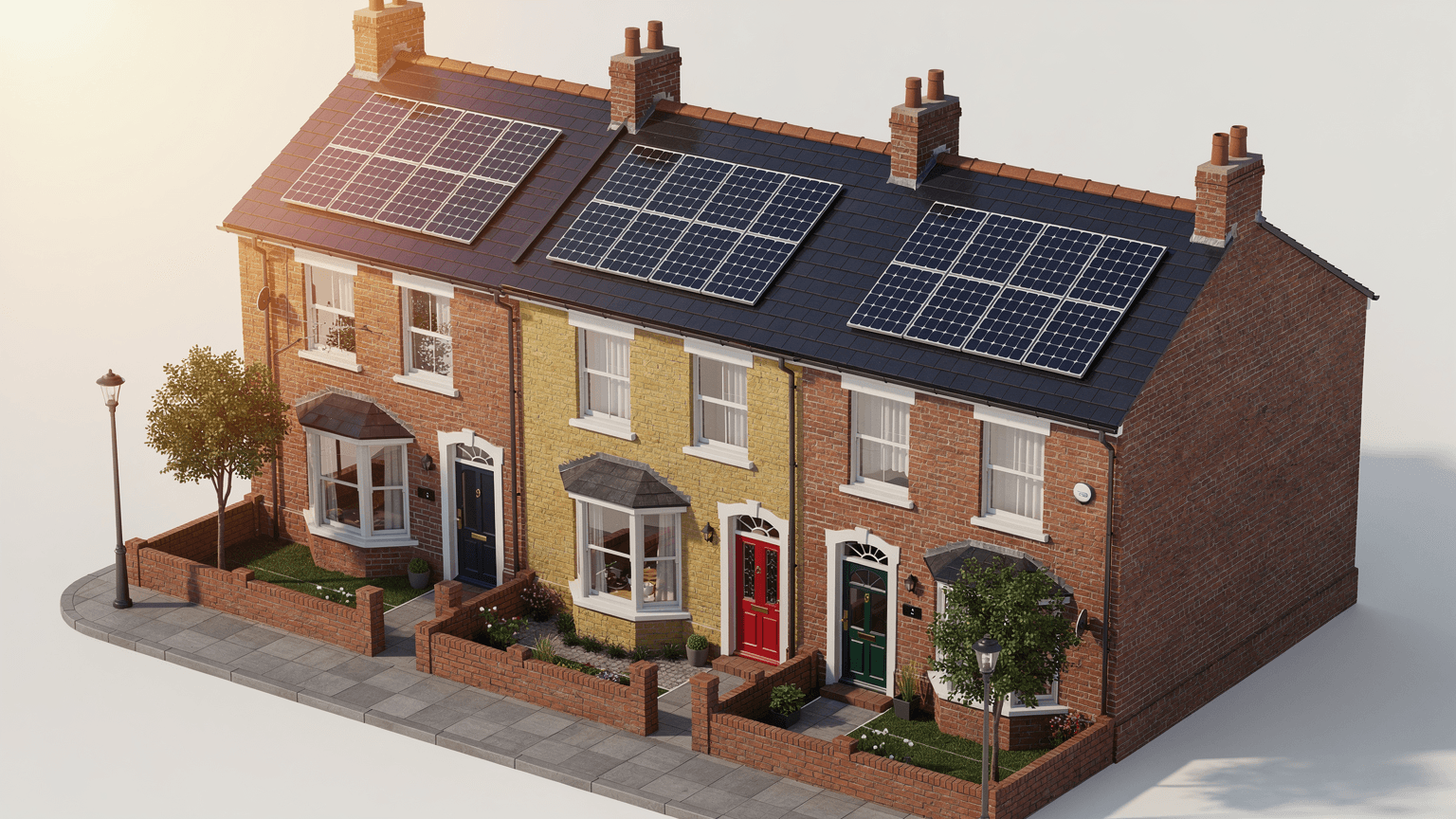
Standard pitched residential rooftops in the UK — dark slate, grey concrete tiles, or aged clay — deliver the worst-case scenario for bifacial technology. Low albedo combined with the close-mounted rafter brackets used in domestic installations (typically only 5–8 cm of standoff) means the rear face sees almost no usable irradiance. For these installations, the 10–20% price premium over a standard monofacial panel produces little to no energy return. A well-specified top-rated monofacial panel will almost always offer better value on a typical UK pitched roof.
Framed vs frameless bifacial panels
Most bifacial modules come in one of two formats. Framed bifacial panels use an aluminium frame around both glass layers — easier to handle and mount, and compatible with standard UK rail systems, but the frame casts a small shadow on the rear-face edges. Frameless (dual-glass, frame-free) panels eliminate that edge shading and allow slightly higher rear irradiance, at the cost of more complex clamping requirements and marginally higher installation labour. For ground-mounted and carport applications, frameless is worth considering; for rooftop installs, framed is more practical and the rear-shading difference is negligible.
Leading bifacial panels available in the UK
LONGi Hi-MO X6 — Uses N-type HPBC+ cells, achieving module efficiency above 22% and a bifaciality factor of around 75–80%. The dual-glass construction carries a linear power warranty of 30 years at 87.4% retained output, making it a popular choice for ground-mount commercial arrays in the UK.
JA Solar DeepBlue 4.0 — Features an N-type TOPCon cell design, 23% module efficiency, and an 80 ±5% bifaciality factor. The 2 mm double-glass construction is IEC 61215/61730 certified and widely stocked by UK distributors.
Both products carry MCS-compatible product certifications. Under the Microgeneration Certification Scheme (MCS), it is the installer that must hold MCS accreditation rather than any specific panel model — any module meeting IEC 61215 and IEC 61730 (the international safety and performance standards) can be used on an MCS-compliant installation. Bifacial panels from reputable tier-1 manufacturers are fully eligible.
Price premium and payback reality
Bifacial panels carry a 10–20% purchase-price premium over comparable monofacial modules. At current UK installer pricing, EE Renewables and Greenmatch both place bifacial panel costs at roughly £220–£350 per panel versus £180–£280 for monofacial equivalents. A 4 kWp ground-mount system using bifacial panels may cost £5,500–£6,600 compared with £4,500–£5,500 for a similar monofacial array.
Payback on that premium depends entirely on the rear-side gain achieved. At a modest 8% rear gain on a dark-substrate rooftop, the premium effectively never pays back within a typical 25-year panel life. At 15–20% rear gain on a pale-substrate ground mount, the additional energy yield at current electricity prices (around 24–25p/kWh in 2026 per Ofgem's standard unit rates) can recover the bifacial premium within 6–9 years, leaving over 15 years of surplus return.
For a detailed cost breakdown by system size, see our guide to solar panel cost by system size.
Should you choose bifacial panels?
The honest answer is: only in specific circumstances. Bifacial technology earns its premium when three conditions align — a pale, reflective substrate below the panels; sufficient mounting clearance to let rear irradiance reach the cells; and an installation type (ground-mount, carport, or white flat roof) that allows both conditions to be met. For the vast majority of UK domestic pitched-roof installations, those conditions don't exist, and a well-specified monofacial panel with the same budget will deliver better value. If you are planning a ground-mount or commercial flat-roof installation, bifacial is worth requesting a site-specific bifacial gain estimate from your MCS-accredited installer before specifying modules.
Most bifacial modules come from the same large makers that dominate the standard panel market — for a wider view of who builds the panels on British roofs, see our guide to solar panel manufacturers.
FAQs
Are bifacial solar panels worth it on a UK home roof?
How much extra electricity do bifacial panels generate in the UK?
What is the albedo factor for bifacial solar panels?
How much more do bifacial solar panels cost than monofacial ones?
How much mounting clearance do bifacial panels need?
Sources — verified 8 June 2026
- NCBI/PMC — Electrical and thermal performance of bifacial photovoltaics under varying albedo conditions at temperate climate (UK) — www.ncbi.nlm.nih.gov
- ResearchGate — Annual diffuse ratio for UK locations — www.researchgate.net
- Sandia National Laboratories / PVPMC, "Bifacial PV Project" — pvpmc.sandia.gov
- NREL, "Bifacial Solar Advances with the Times—and the Sun" — www.nrel.gov
- LONGi Solar — Hi-MO X6 product page — www.longi.com
- NREL, "Bifacial Solar Advances with the Times—and the Sun" — www.nrel.gov
- Ofgem — Energy price cap: unit rates 2026 — www.ofgem.gov.uk

About the author
Sepehr
Solar specialist & co-founder, Smart Solar Homes
Solar specialist and co-founder of Smart Solar Homes, which works with MCS-certified UK installer partners. I write all the guides and reviews here; the aim is straight-talking education the industry rarely provides.
Citing this page? Please use a dofollow link back to the original article — it helps us keep the data on this page accurate and up to date.
Browse Solar Panels on Smart Solar Homes


Want to compare these side by side? Use the compare tool →
Or browse all Solar Panels on Smart Solar Homes.
Related reading
More on solar panels from the editorial team.
Find installers near you
MCS-certified solar installers covering these areas.