Home Batteries Without Solar Are Now Outselling Solar-Only
Written and reviewed by Sepehr. See our editorial policy.
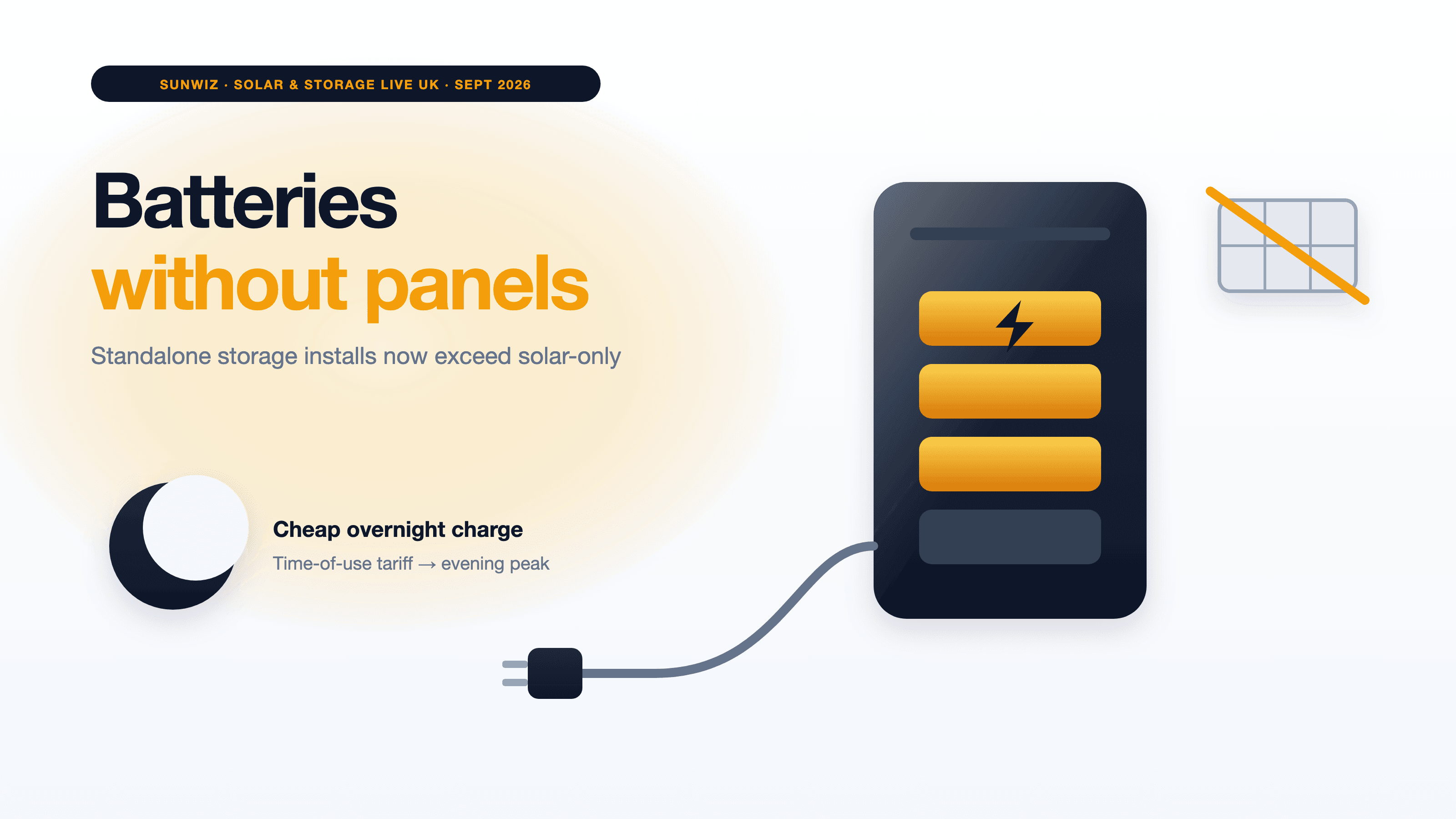
Home batteries are increasingly being installed on their own, without new solar panels. At Solar & Storage Live UK in Birmingham (22–24 September 2026), Australian consultancy SunWiz presented data showing that standalone energy storage installations now exceed standalone solar in the UK, according to pv magazine's report from the event. Here is what the finding does and doesn't tell us, why it is happening, and whether a home battery without solar makes sense for your house.
What SunWiz actually reported
The headline claim. Standalone storage installs — batteries fitted without a new solar system alongside them — are now running ahead of solar-only installs. pv magazine attributes the shift to households using batteries to profit from time-of-use tariffs offered by the major UK suppliers.
The caveat. The data did not distinguish between batteries retrofitted to homes that already have solar and batteries fitted to homes with no solar at all. So “standalone” here means a battery installed as its own job, not necessarily a battery on a house without panels. It also isn't a like-for-like comparison with official MCS statistics: Solar Power Portal reported in November 2025 that MCS data showed roughly 20 batteries per 100 solar systems, while SunWiz's analysis suggested the true attachment rate was much higher because many installers don't record batteries in the MCS database. The same report noted early signs of battery-only systems, often 25kWh or larger.
For scale, an Ember report puts UK monthly household installs at around 6,000 batteries and 15,000 rooftop solar systems. Those figures use a different measure from SunWiz's, so treat the two as pointing in the same direction (batteries growing fast) rather than as a contradiction.
Why people are buying batteries without solar
Cheap night-time electricity. A battery doesn't need panels to earn its keep. It can charge from the grid during a cheap overnight window and power the home through the expensive evening peak. Octopus, for example, advertises a fixed off-peak window of 11:30pm to 5:30am on Intelligent Octopus Go, and its tariff page quotes smart-charging rates from around 8p/kWh (check the live rate, as it changes). Our guide to time-of-use tariffs covers how the main options compare. Note that some EV-focused tariffs tie the cheapest rate to owning a compatible car, so confirm eligibility before you buy a battery on the strength of a headline rate.
Rising bills. Ofgem is raising the price cap by 4% from 1 October 2026, taking the typical dual-fuel bill to about £1,723 a year (Ofgem). Our price cap explainer covers what that means for solar owners. Households without a suitable roof, or in a flat or rented home, can't fit panels but may still be able to fit a battery if they own the property and have space.
0% VAT on standalone batteries. HMRC's VAT Notice 708/6 zero-rates “the installation of a standalone battery for storing electricity from the grid” from 1 February 2024 to 31 March 2027 in Great Britain, after which the 5% reduced rate returns. The relief applies to installed batteries, not ones you buy and fit yourself. That deadline is a genuine reason to decide in the next few months if you're weighing it up.
Does a battery without solar pay back?
It's harder to justify than a solar-plus-battery system. With solar, a battery stores free midday surplus. Without it, every kWh you store is bought from the grid, so your saving is only the gap between the cheap night rate and the rate you'd otherwise pay in the evening, minus losses when charging and discharging. The bigger that gap and the more evening electricity you use, the better the case. Households with an EV, electric heating or a heat pump, which use a lot of electricity, are the strongest candidates.
Before committing, check three things: the exact rate gap on the tariff you'd use, how much of your usage falls in the expensive hours (your smart meter data will show this), and the installed price for the size you need. Our are solar batteries worth it guide walks through the sums, and the home battery installation guide covers what installers will assess. If you may add panels later, ask whether the inverter is solar-ready (hybrid or AC-coupled), which avoids paying for a second inverter.
What about plug-in batteries?
Plug-in solar of up to 800W became legal for self-installation in the UK in August 2026, but plug-in battery storage is not yet permitted for consumers to install themselves. pv magazine reports that an ongoing safety consultation means rules could take more than a year to be finalised. See our piece on the plug-in battery safety study for the background. Until then, a battery is a job for a qualified installer.
The bottom line
The SunWiz finding shows batteries have become a product in their own right, not just an add-on to panels. That's good news if you have high evening usage and a cheap overnight tariff available, but the figures are industry estimates with definitional gaps, and a grid-charged battery needs a solid tariff spread to pay back. Get quotes from MCS-certified installers, compare the tariff maths on your actual usage, and factor in the 31 March 2027 VAT deadline.
FAQs
Can you install a home battery without solar panels?
Is a home battery worth it without solar panels?
Is there VAT on a home battery installed without solar?
Can I fit a plug-in battery myself in the UK?
Sources — verified 29 September 2026
- pv magazine, “Key takeaways from Solar & Storage Live UK, Birmingham” — www.pv-magazine.com
- Solar Power Portal, “UK battery attachment rate far greater than previously thought” — www.solarpowerportal.co.uk
- SolarQuarter, “Ember report highlights role of rooftop solar, EVs and batteries in protecting UK households from energy price shocks” — solarquarter.com
- HMRC / GOV.UK, “Energy-saving materials and heating equipment (VAT Notice 708/6)” — www.gov.uk
- Ofgem, “Energy price cap will rise by 4% from October 2026” — www.ofgem.gov.uk
- Octopus Energy, “Intelligent Octopus Go” — octopus.energy

About the author
Sepehr
Solar specialist & co-founder, Smart Solar Homes
Solar specialist and co-founder of Smart Solar Homes, which works with MCS-certified UK installer partners. I write all the guides and reviews here; the aim is straight-talking education the industry rarely provides.
Citing this page? Please use a dofollow link back to the original article — it helps us keep the data on this page accurate and up to date.
Browse Battery Storage on Smart Solar Homes


Want to compare these side by side? Use the compare tool →
Or browse all Battery Storage on Smart Solar Homes.
Related reading
More on battery storage from the editorial team.
Find installers near you
MCS-certified solar installers covering these areas.