Plug-In Home Batteries Won't Be UK-Legal Until at Least 2028
Written and reviewed by Sepehr. See our editorial policy.
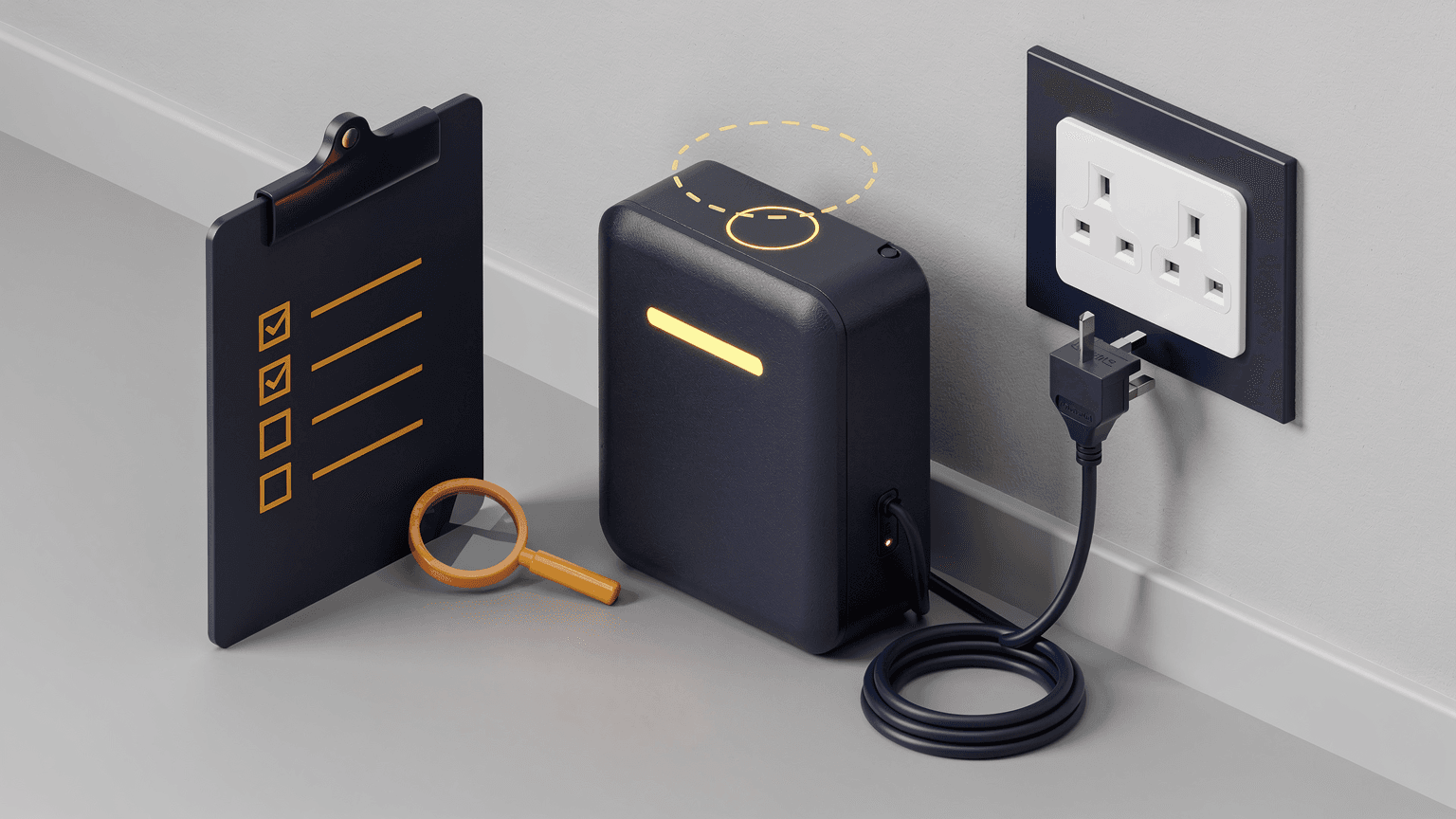
Plug-in solar panels have been legal to buy and self-install in Great Britain since 27 August 2026. Plug-in batteries have not — and a new tender from the Department for Energy Security and Net Zero (DESNZ) confirms that gap will last a lot longer than many buyers expected. DESNZ has opened a procurement for an 18-month safety and risk assessment of plug-in battery storage, with the resulting contract not due to finish until 31 March 2028. That is roughly a year and a half longer, and around three times the budget, of the equivalent study that cleared the way for plug-in solar.
What the DESNZ tender covers
The tender is for an evidence-based safety and risk assessment of self-installed, plug-in battery storage products rated up to 800W AC output — the same power ceiling used for plug-in solar. An expression of interest was published on 17 August 2026, with submissions due to close around 30 September 2026 and an award decision pencilled in for 5 October 2026. The study itself is expected to run for around 18 months from that start date, taking it through to March 2028.
The work is split into two phases. The first reviews plug-in battery products already sold in other markets — particularly Germany, where such devices are covered by VDE (Association for Electrical, Electronic and Information Technologies) standards — and puts a handful of real units through laboratory testing, including deliberately misusing them and exposing them to fire-risk scenarios. A second phase, budget permitting, would extend fire-safety testing to home battery storage more broadly, not just plug-in units.
Jason Howlett, chief executive of the Energy Storage Association (UK), has said the industry would "wholeheartedly support" a safe route to plug-in batteries, but pointed out that current UK electrical safety rules require wiring checks and often outdoor installation for stationary batteries — requirements that plug-in products, by design, bypass.
Why solar and batteries are being treated so differently
Plug-in solar and plug-in batteries went through the same regulatory front door, but at very different speeds. The equivalent study that led to plug-in solar's legalisation had a far smaller scope and budget, and moved from a finished study to an SI amending the Plugs and Sockets etc. (Safety) Regulations 1994 in around seven months. Read the detail of that process, and what it changed, in our guide to plug-in and balcony solar in the UK.
Batteries carry a materially different risk profile to a panel-and-microinverter kit. A plug-in solar panel converts sunlight to AC power and pushes it into your home's wiring — there is no significant stored energy on your wall if something goes wrong. A battery, by contrast, is a stored energy source in your home around the clock, and lithium-based cells that fail can produce a self-sustaining fire that is very difficult to extinguish. That is also why the domestic wiring regulations already treat the two differently: BS 7671 Amendment 4, which came into force in April 2026, added a dedicated chapter for stationary battery storage systems (Chapter 702) alongside its new chapter for plug-in generators (Chapter 708), with home batteries kept out of lofts, bedrooms and escape routes and given a one-metre outdoor clearance requirement. A plug-in kit that skips a proper installation process would sidestep those safeguards entirely, which is precisely what the DESNZ study now has to weigh up before regulators go anywhere near a plug-in battery product specification.
What this means if you already have plug-in solar
If you've bought or are considering an 800W plug-in solar kit, don't expect a UK-legal plug-in battery add-on any time soon. Some balcony solar and battery products sold on the continent, and several shown at IFA Berlin 2026 — including the Anker SOLIX Solarbank Max and BLUETTI Balco 500 — pair a balcony panel with a plug-in battery pack. None of that combined hardware can be legally sold as a plug-in, self-installed system in Great Britain while the DESNZ study is still under way; the plug-in solar Interim Product Specification explicitly covers grid-tied generation, not stationary storage. If a UK retailer is offering a bundled kit with a battery pack, check its compliance paperwork carefully — the battery element likely needs to go through the standard installation route, wiring checks and all, rather than a simple socket connection.
For most households, the practical route to solar-plus-storage in the UK today is still a professionally installed system, notified to your network operator in the normal way. If your home has grid-connected solar already and you're weighing up adding storage, our home battery storage guide covers sizing, cost and payback for that installed route. If you're relying on a wall socket and a plug-in panel and worried about your home's wiring more generally, see our guide to plug-in solar safety in older homes.
The DESNZ tender doesn't rule out plug-in batteries reaching the UK market eventually — the regen.co.uk industry view is squarely that "plug-in solar is coming, plug-in batteries should follow" once the safety case is made. But a contract that doesn't complete until March 2028, with any resulting standard or law still to follow after that, means anyone hoping for a legal plug-in battery this year or next is going to be disappointed.
FAQs
Are plug-in batteries legal in the UK?
When will plug-in home batteries be legal in the UK?
Can I add a battery to my plug-in solar kit in the UK?
Sources — verified 15 September 2026
- ESS News, “UK explores plug-in battery regulations following balcony solar launch” — www.ess-news.com
- Plug-In Solar, Explained, “We Probably Won't See Plug-In Solar Batteries Till 2028 — DESNZ plug-in battery safety study” — www.pluginsolarexplained.co.uk
- GOV.UK, “Plug-in solar: Regulatory amendment and interim product specification” — www.gov.uk
- legislation.gov.uk, “The Plugs and Sockets etc. (Safety) and Electricity Safety, Quality and Continuity (Amendment) Regulations 2026 (SI 2026/848)” — www.legislation.gov.uk
- regen.co.uk, “Plug-in solar is coming. Plug-in batteries should follow.” — www.regen.co.uk

About the author
Sepehr
Solar specialist & co-founder, Smart Solar Homes
Solar specialist and co-founder of Smart Solar Homes, which works with MCS-certified UK installer partners. I write all the guides and reviews here; the aim is straight-talking education the industry rarely provides.
Citing this page? Please use a dofollow link back to the original article — it helps us keep the data on this page accurate and up to date.
Related reading
More on plug-in solar batteries from the editorial team.

Find installers near you
MCS-certified solar installers covering these areas.