How Many Solar Panels Fit on a Small Roof? Space-Efficient Options

Written and reviewed by Sepehr. See our editorial policy.
A small roof does not rule out solar. Whether you live in a mid-terrace in Manchester or a two-bedroom end-of-terrace in Bristol, the right panel technology and system design can still generate meaningful electricity — enough to cut a significant slice off your energy bills. The key is understanding how much usable roof area you actually have, then choosing panels and inverter hardware that extract the most from every square metre.
How much roof area do solar panels need?
Standard residential panels measure approximately 1.76 m × 1.13 m — around 2 m² of roof surface per panel — and most 400 W models fall close to those dimensions. With installation spacing accounted for (around the edges and between rows for maintenance access), each panel typically requires 2.0–2.2 m² of usable roof space in practice.
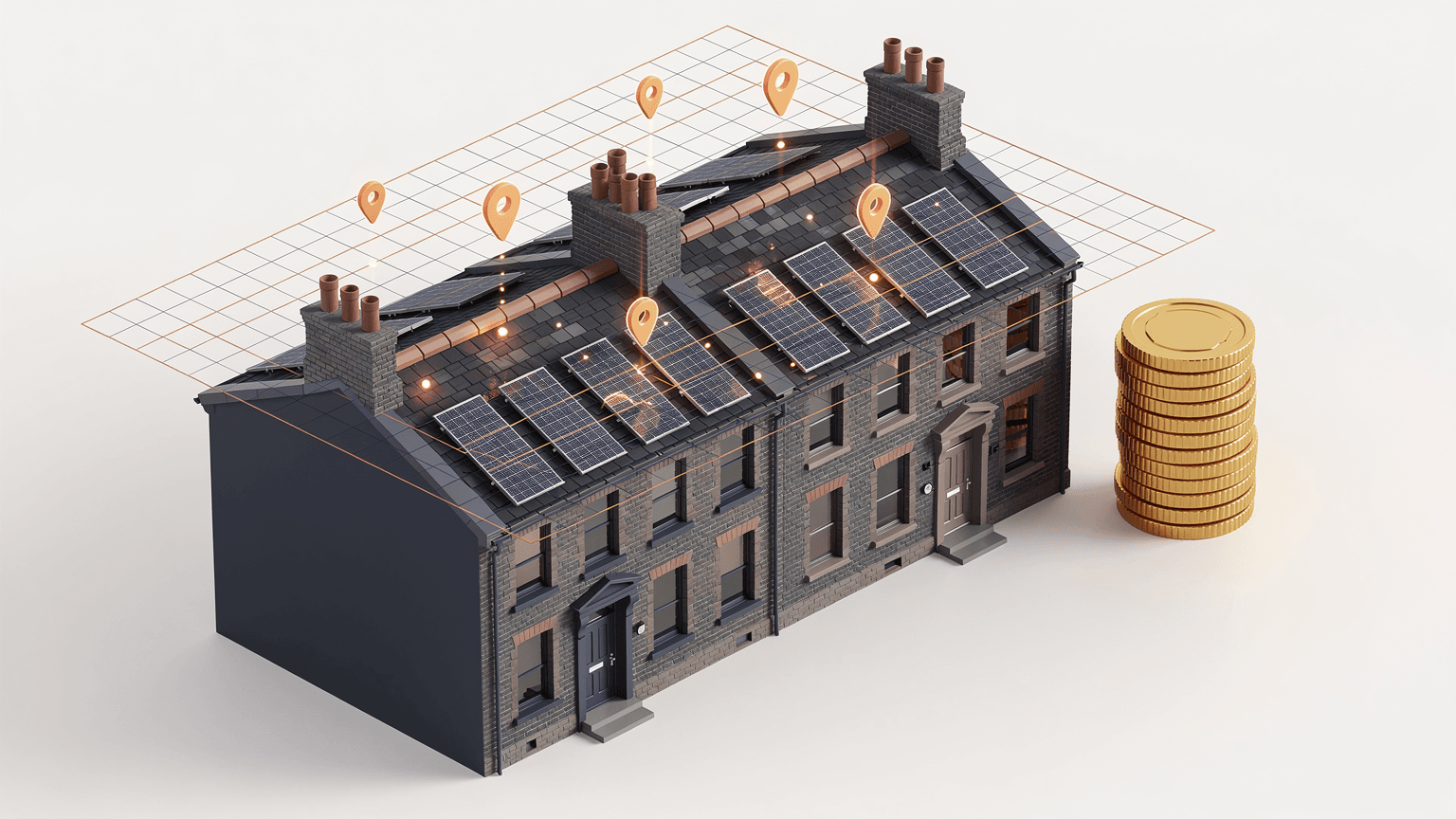
Not all roof area counts. Obstructions such as chimneys, skylights, flue pipes, and ridge lines can reduce the workable zone by 20–30% on a typical UK terraced or semi-detached house. A surveyor will map the exact usable area before sizing your system; as a rough planning guide, assume you lose roughly a quarter of the total roof area before fitting a single panel.
How many panels fit on a small UK roof?
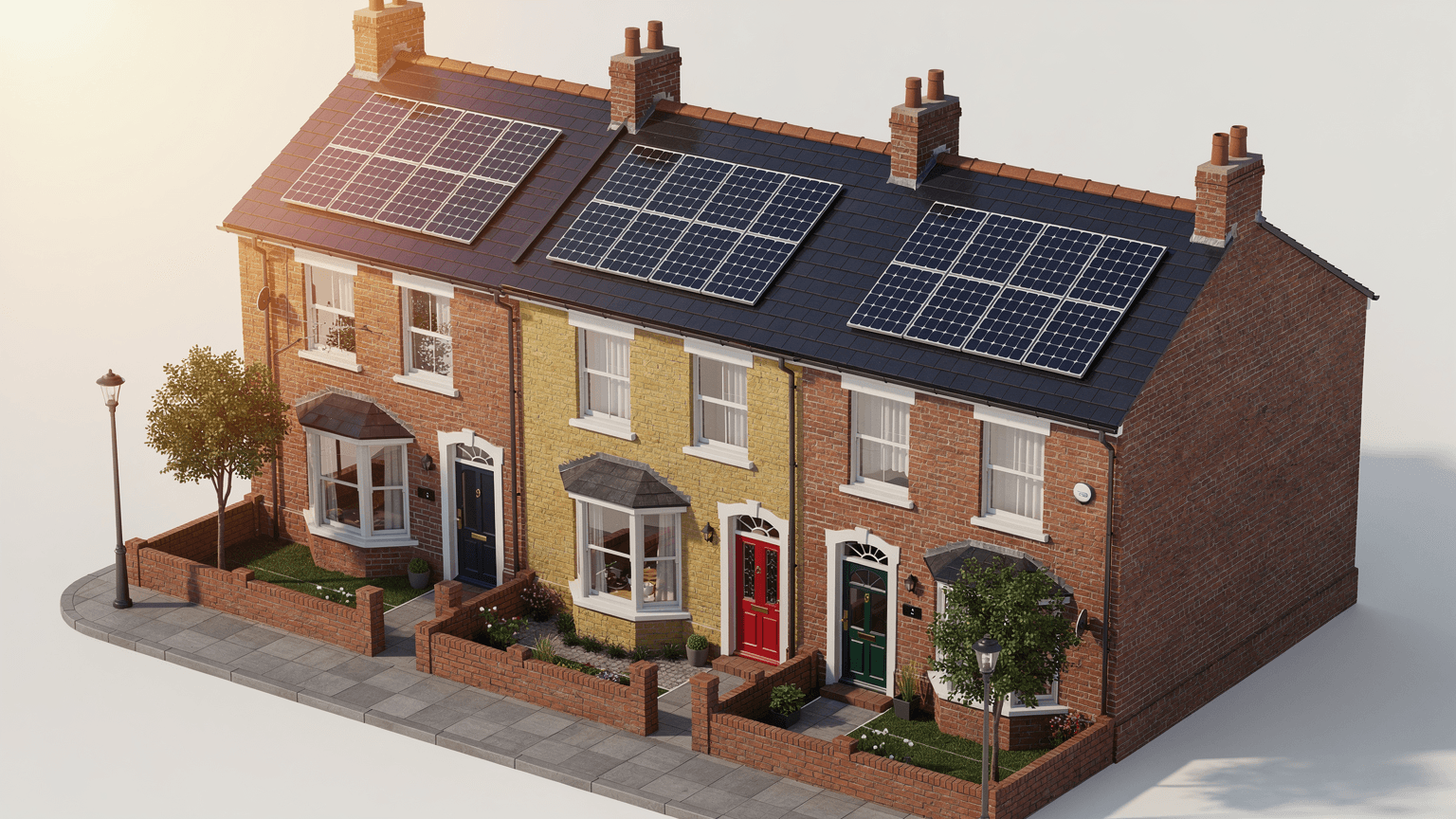
A typical two-bedroom terraced house with 15–20 m² of south-facing usable roof space can accommodate 6–10 panels. That translates to a system of approximately 2.4–4.0 kWp using standard 400 W panels, or 2.7–4.5 kWp with premium 450 W panels in the same footprint. Smaller one-bedroom or studio properties with 8–12 m² of usable space might fit just 4–6 panels (1.6–2.4 kWp) — but that is still a worthwhile system for daytime self-consumption.
Portrait orientation is generally preferred on narrow UK roofs: panels mounted portrait (tall) rather than landscape (wide) often allow more rows to fit within the usable area and reduce the wasted strip at eaves and ridge. For awkward L-shaped or stepped roofs, your installer may split the array across two sub-sections and use power optimisers to keep each panel working independently.
To get a more detailed view of how system size maps to household usage, see our guide to how many solar panels you need in the UK, which covers electricity consumption matching in depth.
High-efficiency panels: more output per m²
If roof space is your binding constraint, high-efficiency panel technology is the single most impactful upgrade you can make. Standard PERC monocrystalline panels typically achieve 19–20% module efficiency; newer TOPCon and HJT (heterojunction) panels reach 22–24% in real-world conditions. In practical terms, a 430 W TOPCon panel fits in almost the same footprint as a standard 380 W PERC panel — roughly 13% more power from identical roof space.
- TOPCon panels — Tunnel Oxide Passivated Contact cells achieve 22–24.5% module efficiency and are now widely available from mainstream brands at modest premium over PERC. Market share has grown sharply since 2023 and most new UK installations specify TOPCon or better.
- HJT panels — Heterojunction panels (including Panasonic EverVolt and REC Alpha Pure-R) reach 22–23% module efficiency and carry an excellent temperature coefficient of around −0.24%/°C, meaning they lose less performance on warm summer days than conventional panels.
- IBC/back-contact panels — Products such as SunPower Maxeon achieve up to 22.8% module efficiency with a 40-year product warranty, though at the highest price point. Worth considering where every watt counts and the budget allows it.
For a full breakdown of the best panel options on the UK market today, see our best solar panels UK 2026 guide, which compares leading TOPCon and HJT models with real-world efficiency figures.
Half-cut cell technology and small roofs
Almost every panel manufactured since 2023 uses half-cut cells — a design where standard silicon cells are laser-cut in half before being wired into the module. This produces two independent parallel strings within the panel, so if shading hits the bottom row (a common scenario on terraced roofs with a neighbour's chimney nearby), the top half continues at full output. Traditional full-cell panels could lose 30–80% of output from a single partial-shadow event; half-cut panels typically lose only 20–40% in equivalent conditions. The technology also reduces resistive losses within the cell, giving 2–3% more power from the same cell quality. For a small, shading-prone roof this is a meaningful real-world gain, not just a spec-sheet improvement.
Microinverters and power optimisers: why they matter more on small roofs
Small roofs are disproportionately affected by shading and mixed orientations. A standard string inverter chains all panels in series: one shaded panel throttles the entire string. Power optimisers (fitted to each panel, feeding a central string inverter) decouple panel outputs so a shaded panel no longer drags down the rest. UK installers report 5–15% more annual energy yield on complex rooftops with obstructions. Optimisers typically add around 15% to system cost, a reasonable premium on a small installation where every kWh of lost generation represents a larger percentage of total output.
Microinverters (one per panel, converting DC to AC at the roof) deliver similar shade resilience at higher upfront cost — roughly three times more expensive than optimisers per panel. They are best suited to roofs split across multiple orientations (for example, east- and west-facing sections on a hipped roof) where each panel's peak generation time differs significantly from its neighbours.
Is a small system still worth it?
A 2 kWp system on a well-oriented roof will generate roughly 1,600–1,800 kWh per year in most of England and Wales (slightly less in Scotland). Every kWh you self-consume saves you the retail import rate — around 24.5p/kWh on a typical variable tariff as of mid-2026. Generating and using 1,600 kWh yourself saves approximately £392 per year. Any surplus exported earns additional income under the Smart Export Guarantee, currently paying 3–15p/kWh depending on your supplier and tariff.
Payback periods on small systems (2–3 kWp) typically run 7–10 years, slightly longer than larger installations because fixed costs (scaffolding, DNO notification, inverter) are spread across fewer panels. However, upgrading to high-efficiency panels shortens payback by extracting more kWh from the same roof area.
Planning permission for small roof installations
Most domestic solar installations in England are permitted development — you do not need a planning application as long as panels protrude no more than 200 mm beyond the roof plane and do not exceed the highest point of the roof (excluding the chimney). Rear-facing panels on terraced houses are generally straightforward; panels visible from the street may require permission in conservation areas. Listed buildings always require listed building consent. The Planning Portal's guidance is the authoritative reference for your local authority area. Scotland's equivalent guidance was updated in 2024 under Circular 2/2024.
Practical steps for a small-roof assessment
- Measure usable area. Subtract chimneys, skylights, and a 30 cm perimeter margin from total roof area. Multiply the remaining area by 0.5 panels/m² as a conservative estimate of how many panels will fit.
- Request a shading analysis. Ask your installer for a software-based shade assessment (tools such as PVsyst or Solargis) to quantify losses at your specific address before specifying panel technology.
- Specify TOPCon or HJT panels. For roofs under 20 m² of usable space, the efficiency premium pays back meaningfully over 25 years compared with standard PERC panels.
- Add power optimisers if there is any shading. On a small system the energy recovery typically covers the added cost within the first few years of operation.
- Check DNO requirements. Systems up to 3.68 kWp on a single-phase supply require a G98 notification to your Distribution Network Operator — your MCS-certified installer handles this on your behalf.
For a fuller picture of what a system will cost before deciding on size, our solar panel cost UK guide covers pricing by system size, installation region, and panel technology tier.
FAQs
How many solar panels fit on a small UK roof?
How much roof space does one solar panel need?
Is a small 2 kWp solar system still worth it?
Do high-efficiency panels help on a small roof?
Do I need planning permission for solar panels on a small roof?
Sources — verified 8 June 2026
- Planning Portal — Solar Panels: Planning Permission — www.planningportal.co.uk
- Scottish Government — Circular 2/2024: Non-Domestic Permitted Development Rights, Annex C Solar Panels — www.gov.scot
- Renewable Energy Hub — How Much Roof Space Is Required for Solar Panels in the UK? (Feb 2026) — www.renewableenergyhub.co.uk
- NREL — Best Research-Cell Efficiency Chart (TOPCon, HJT, IBC efficiency records) — www.nrel.gov
- SolarLove — Half-Cut Solar Cells: UK Performance Guide 2026 — solarlove.org
- Energy Saving Trust — Solar panel installation guide (microinverters and optimisers for shaded roofs) — energysavingtrust.org.uk
- Energy Saving Trust — Solar panel installation: a step-by-step guide — energysavingtrust.org.uk

About the author
Sepehr
Solar specialist & co-founder, Smart Solar Homes
Solar specialist and co-founder of Smart Solar Homes, which works with MCS-certified UK installer partners. I write all the guides and reviews here; the aim is straight-talking education the industry rarely provides.
Citing this page? Please use a dofollow link back to the original article — it helps us keep the data on this page accurate and up to date.
Browse Solar Panels on Smart Solar Homes


Want to compare these side by side? Use the compare tool →
Or browse all Solar Panels on Smart Solar Homes.
Related reading
More on solar panels from the editorial team.
Find installers near you
MCS-certified solar installers covering these areas.