Solar Panels for Property Developers: Integrating Solar in New Developments

Written and reviewed by Sepehr. See our editorial policy.
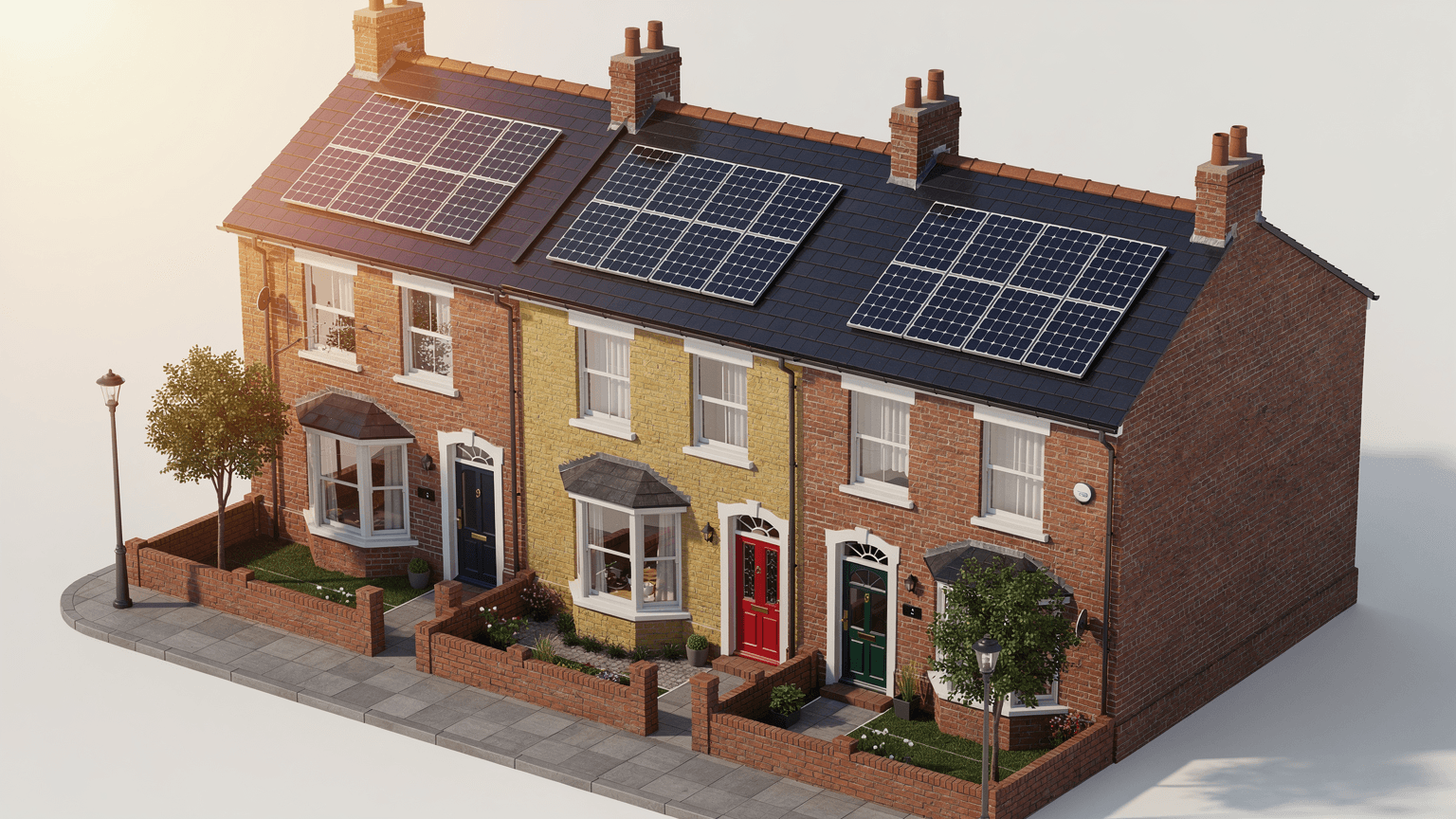
Solar panels are no longer a value-add option for UK property developers — from March 2027 they become a legal requirement on virtually every new home. The Future Homes Standard (FHS), published in final form on 24 March 2026, mandates on-site renewable electricity generation equivalent to 40% of each dwelling's ground-floor area, and in practice rooftop PV is the standard compliance route. Understanding the regulatory framework, the cost economics, and the market premium that follows is now a core development skill.
The Future Homes Standard and Part L compliance
The FHS introduces a new functional requirement — L3 — requiring on-site renewable generation on all new dwellings. The regulations come into force on 24 March 2027, with a transitional period running to 24 March 2028. New homes must achieve at least 75% lower carbon emissions than properties built to the 2013 Part L baseline. SAP 10.3 (or the successor Home Energy Model, HEM) is the compliance methodology: the Dwelling Emission Rate (DER) must not exceed the Target Emission Rate (TER), and solar PV is the most efficient way to push DER down.
The PV area requirement — equivalent to 40% of ground-floor area — translates to roughly 3–5 kWp on a typical two-bed terrace and 5–8 kWp on a four-bed detached. Exemptions exist for buildings over 18 metres, higher-risk buildings, and sites where shading or roof geometry means the system cannot achieve a minimum output of 720 kWh per year. The government's FHS impact assessment estimates the weighted average additional build cost per dwelling at approximately £4,350 (2025 prices, including heat pump and insulation uplift); solar PV accounts for a portion of that, and developer-scale procurement cuts the unit cost significantly.
Developer-scale costs versus individual installs
The cost differential between a single domestic install and a site-wide procurement is substantial. Retail domestic solar averages around £1,686 per kWp in early 2026 (based on MCS-registered installer data). Developer and commercial installs, bought in volume with a single crew mobilisation across a site, typically run £850–£1,100 per kWp ex-VAT — a saving of 35–50% per unit. On a 50-home development averaging 4 kWp per plot, that differential can represent £150,000–£200,000 in avoided cost versus homeowners retrofitting individually.
The efficiency gains come from: single scaffold mobilisation across multiple plots; bulk equipment purchasing (modules, inverters, mounting rails); one G98/G99 DNO application covering the site; and a single MCS installation certificate per system. For the MCS route, the installer's certification covers each individual dwelling system; the developer's role is to specify an MCS-certified contractor and ensure handover documentation accompanies each legal completion. Under MCS Installation Standard MIS 3002 (updated January 2025, transition deadline June 2026), where Building Regulations notification is handled by the developer, the MCS contractor may hand over immediately after commissioning — removing friction for plot-by-plot completions.
VAT treatment on new-build solar
New-build solar is zero-rated for VAT, which simplifies the developer's cost model considerably. The entire supply and installation of a new residential building is zero-rated under HMRC's longstanding new-build rules, and solar panels and batteries fitted as part of that supply take the same zero rating. This differs from the temporary 0% energy-saving materials relief that applies to retrofit installs (currently running until 31 March 2027, then reverting to 5%): for new builds, zero-rating derives from the construction supply itself, not the ESM relief. Developers should confirm their VAT position with their accountant, particularly if the development includes any commercial or mixed-use elements.
Capital allowances for developer businesses
Where a developer retains units to let — build-to-rent, student accommodation, or mixed-tenure — capital allowances become relevant. HMRC classifies solar panels as special-rate plant and machinery (CA22335), qualifying for the Annual Investment Allowance (AIA) up to £1,000,000 per year at 100%, or Writing Down Allowances at 6% per year on the special-rate pool. The critical restriction: capital allowances cannot be claimed on plant and machinery used in a dwelling-house for a residential property business. This means allowances are available on commercial elements, shared plant, communal systems on multi-occupancy buildings, and build-to-rent portfolios where the developer is the landlord — but not on equipment within a privately owned home sold to an owner-occupier. Developers with mixed portfolios should model the allowance position unit by unit.
EPC ratings and the buyer premium
The commercial case for solar goes beyond compliance. A properly specified PV system on a new build typically achieves an EPC A rating, and the evidence on price premiums is strong. Nationwide Building Society research found A and B-rated homes command approximately 2.8% more than comparable D-rated properties. RICS research on solar-specific premiums found a statistically significant uplift of 0.9–2% on homes with solar fitted, while a 2024 study published in Energy Economics, analysing over 1.5 million UK transactions using causal machine learning, found solar-equipped homes command a 6.1–7.1% premium over comparable non-solar properties. On a £350,000 new-build, that top-end premium is worth over £20,000 — well above the incremental build cost of the PV system.
For more on how solar affects ongoing running costs for buyers, see our guide to solar panel costs and savings in the UK. And if your specification includes battery storage alongside PV — which significantly improves EPC scores and buyer appeal — our home battery storage guide covers the key options and costs.
Solar on leasehold and flatted developments
Flatted developments introduce additional complexity around system ownership and ongoing costs. Where the freehold is retained by the developer or a management company, the solar installation on the roof is typically owned by the freeholder and the income or savings flow into the service charge account. MCS-certified communal systems on blocks of flats qualify for the Smart Export Guarantee (SEG), which can generate export income to offset building running costs — a genuine selling point for leasehold buyers and a factor in service charge modelling.
The Commonhold and Leasehold Reform Bill, progressing through Parliament in 2026, will eventually require new flatted developments to be sold as commonhold rather than leasehold (with limited exceptions). Under commonhold, the solar system would be a common part owned collectively by the unit owners — handled through the Commonhold Association. Developers planning flatted schemes now should factor both models into their conveyancing and management structures.
NHBC warranty and roof integration
NHBC Buildmark provides 10-year warranty and insurance cover on new homes, and solar installations must comply with NHBC Standards 2026 (which apply to foundations begun on or after 1 January 2026). NHBC Standards do not exclude solar PV, but roof penetrations and mounting systems must comply with NHBC chapter requirements on weathertightness and structural loading. In-roof (integrated) systems, where modules replace roof tiles rather than mounting over them, require additional attention to BS 5250 vapour control and NHBC chapter 7.2 on roof coverings. Manufacturers of compliant integrated systems — such as Viridian Solar's ClearLine Fusion — publish technical notes on NHBC compliance to support developers specifying these products. Developers should ensure their PV contractor provides installation documentation that NHBC inspectors can review at each stage.
FAQs
Do you need a battery with solar panels?
What happens to surplus solar if you don't have a battery?
How much does a home battery cost in the UK?
Is a solar battery worth it?
Can you add a battery to solar panels later?
Sources — verified 12 August 2026
- MHCLG — Approved Document L, Conservation of Fuel and Power (2026 edition) — www.gov.uk
- MHCLG — Future Homes Standard Final Stage Impact Assessment (2026) — assets.publishing.service.gov.uk
- HMRC Capital Allowances Manual CA22335 — Plant and Machinery: Solar Panels — www.gov.uk
- MCS — MIS 3002 Solar PV Installation Standard v1.0 (January 2025) — mcscertified.com
- RICS Property Journal — Affirming the Value of Solar Property — ww3.rics.org
- NHBC — Buildmark Warranty and Insurance Cover — www.nhbc.co.uk
- NHBC — Standards 2026 — www.nhbc.co.uk
- Home Energy Model — Future Homes Standard 2026 Full Guide — home-energy-model.co.uk

About the author
Sepehr
Solar specialist & co-founder, Smart Solar Homes
Solar specialist and co-founder of Smart Solar Homes, which works with MCS-certified UK installer partners. I write all the guides and reviews here; the aim is straight-talking education the industry rarely provides.
Citing this page? Please use a dofollow link back to the original article — it helps us keep the data on this page accurate and up to date.
Browse Solar Panels on Smart Solar Homes


Want to compare these side by side? Use the compare tool →
Or browse all Solar Panels on Smart Solar Homes.
Related reading
More on solar panels from the editorial team.

Find installers near you
MCS-certified solar installers covering these areas.