6mm² Solar DC Cable UK: H1Z2Z2-K Specs and Checks
Written and reviewed by Sepehr. See our editorial policy.
H1Z2Z2-K is the cable type used for 6mm² solar DC wiring, and the figures that matter are its voltage rating, current capacity and temperature limits. This guide to 6mm² solar DC cable works through Prysmian’s PRYSUN and TECSUN datasheets for the 1 × 6mm² version, explains the numbers, and corrects a mistake in our own product listing. For how panels are wired together, see our series vs parallel wiring guide.
What is H1Z2Z2-K cable?
Prysmian describes PRYSUN H1Z2Z2-K 1/1kV as rubber cable for photovoltaic plants, designed and tested to EN 50618 and IEC 62930. It is suitable for indoor and outdoor use, fixed or freely suspended installation, and in cable trays, conduits, and on or in walls. The conductor is class 5 (finely stranded) tinned copper, and both the insulation and outer sheath are halogen-free cross-linked elastomer. The sheath comes in black, red or black/red. Prysmian’s TECSUN (PV) range sells the same H1Z2Z2-K type in a 1 × 6mm² blue-sheath version, with TUV and VDE certificates listed.
Datasheet figures for 1 × 6mm²
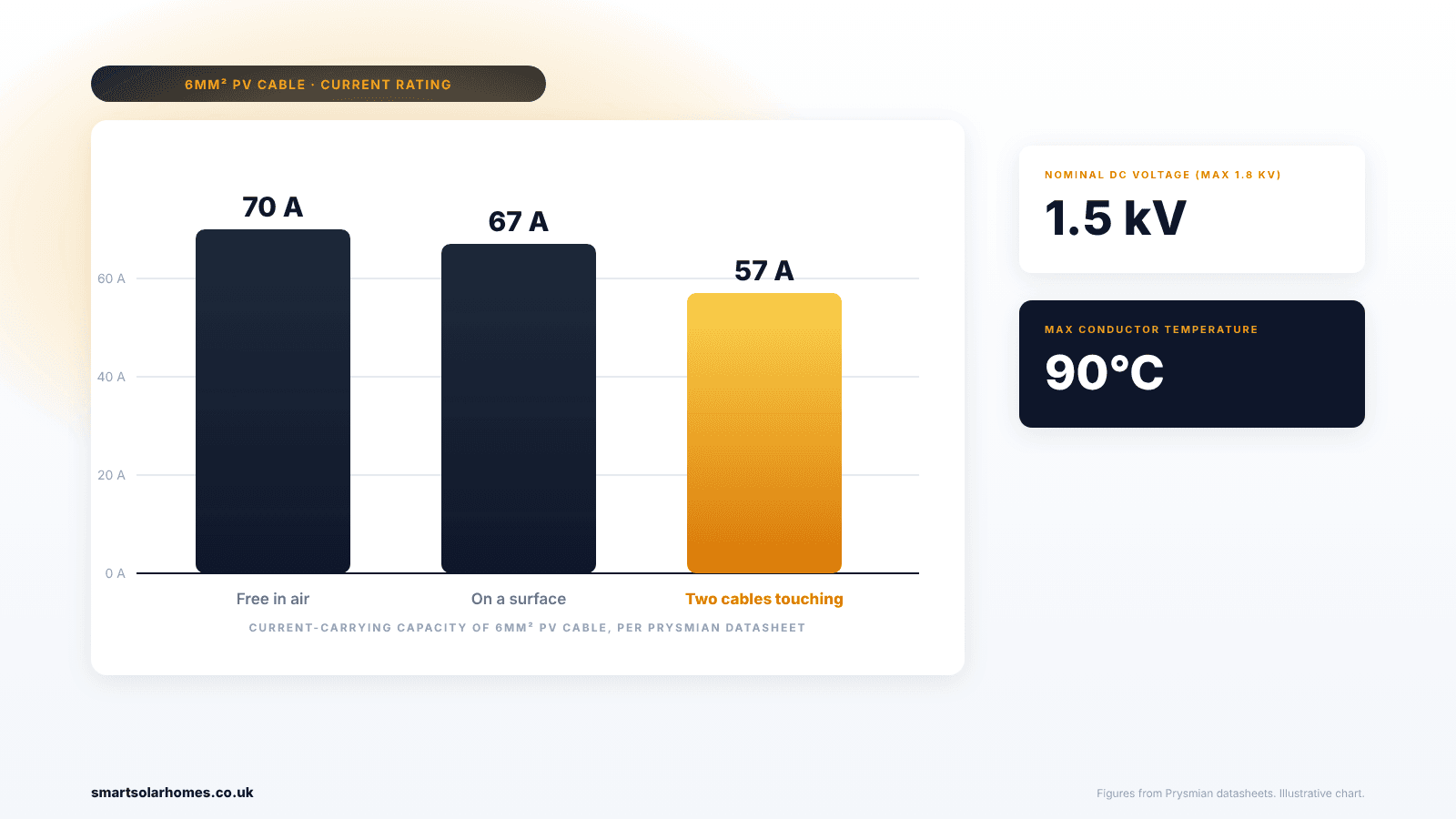
- Voltage: rated 0.6/1 (1.2) kV AC, with a nominal DC voltage of 1,500V and a maximum DC voltage of 1,800V. Test voltage is 6.5kV AC or 15kV DC for 5 minutes.
- Temperature: maximum conductor temperature of 90°C, 250°C at short circuit, and an operating ambient range of −40°C to +90°C. Installation is rated for −25°C to +60°C.
- Size: conductor diameter 2.95mm, insulation 0.7mm and sheath 0.8mm, giving an overall diameter of 5.9 to 6.4mm and a weight of about 81kg per km.
- Resistance: 3.39Ω per km at 20°C.
- Protection: suitable for Protection Class II equipment, halogen-free, low smoke, ozone resistant and UV resistant under EN 50618 Annex E.
Current capacity and derating
For 6mm² the datasheet lists 70A for a single cable in free air, 67A on a surface and 57A for two loaded cables touching on a surface. The TECSUN sheet lists the same 67A and 70A. These ratings assume a 60°C ambient; Prysmian’s conversion factors reduce them to 0.92 at 70°C, 0.84 at 80°C and 0.75 at 90°C. Panel strings carry far less current than these limits, but the tables show why bundling cables on a hot roof or in a loft needs thought. A qualified installer should size and route cable under the wiring regulations; see our BS 7671 Amendment 4 guide.
A quick voltage-drop illustration
At 3.39Ω per km, 20m of 6mm² conductor (10m out and 10m back) has a resistance of about 0.068Ω. With an assumed 10A string current, that drops roughly 0.7V, or about 0.17% of an assumed 400V string. These assumptions are ours, not the datasheet’s, but they show that 6mm² keeps cable losses small on typical domestic runs.
Where the two datasheets differ
The PRYSUN sheet gives a minimum bending radius of 6D, while the TECSUN sheet gives 3 × D for fixed installation and 40mm during installation. The colour, weight (81 vs 80kg per km) and diameter ranges also differ slightly. Both carry a 20 November 2026 file reference, but check which product and revision your supplier is selling before you rely on a figure. The TECSUN sheet says the cable has direct-bury properties provided the installer protects it against damage.
Our listing was wrong
Our product listing called this cable “twin-core” and “rated to 1.8kV DC”. Prysmian’s 1 × 6mm² H1Z2Z2-K is single-core (one conductor, usually bought as separate red and black cables), and 1.8kV is the maximum DC voltage, with 1.5kV the nominal rating. We list it at about £28 per 10m; prices vary by supplier and colour.
What to check when buying
- Standard: look for EN 50618 (H1Z2Z2-K) marking on the cable, not a generic “solar cable” label.
- Conductor: tinned copper, class 5, at the stated cross-section.
- Connectors: use connectors made for your cable diameter, following the panel manufacturer’s instructions.
- Installation: DC wiring is a fire-safety issue; see our solar panel fire risk guide, and think carefully before the DIY route.
- Surge protection and earthing: covered in our lightning and surge protection guide.
For most homes the cable is part of an MCS-certified installation (see our MCS certificate guide), so ask your installer which cable they use.
Our verdict
A 6mm² H1Z2Z2-K cable is the standard, well-specified choice for domestic solar DC wiring, with ample current capacity and a 1.5kV DC rating. The practical risks lie in installation, routing and connectors rather than the cable itself. Check the marking, the datasheet revision and who is doing the wiring.
FAQs
What is H1Z2Z2-K solar cable?
What voltage is 6mm solar cable rated for?
How much current can 6mm² solar cable carry?
What temperature can solar DC cable handle?
Is solar DC cable single-core or twin-core?
Sources — verified 20 November 2026
- Prysmian, “PRYSUN H1Z2Z2-K 1/1kV datasheet (GB00_PRYSUN_H1Z2Z2_K_1KV_20261120)” — datasheet.prysmian.com
- Prysmian, “TECSUN (PV) H1Z2Z2-K 1X6 datasheet” — datasheet.prysmiangroup.com

About the author
Sepehr
Solar specialist & co-founder, Smart Solar Homes
Solar specialist and co-founder of Smart Solar Homes, which works with MCS-certified UK installer partners. I write all the guides and reviews here; the aim is straight-talking education the industry rarely provides.
Citing this page? Please use a dofollow link back to the original article — it helps us keep the data on this page accurate and up to date.
Browse Solar Panels on Smart Solar Homes


Want to compare these side by side? Use the compare tool →
Or browse all Solar Panels on Smart Solar Homes.
Related reading
More on solar panels from the editorial team.
Find installers near you
MCS-certified solar installers covering these areas.