Pylontech US5000 Battery Review UK: Specs, Price & Verdict
Written and reviewed by Sepehr. See our editorial policy.
Pylontech doesn't sell an all-in-one battery-and-inverter box like GivEnergy or a single-vendor system like Tesla. Instead, the US5000 is a bare 48V lithium module designed to be paired with whichever hybrid inverter your installer already favours — Solis, Sunsynk, Growatt, GoodWe, Solax and dozens of others. It's one of the most-installed battery modules in the UK precisely because it isn't tied to one brand, yet it rarely gets reviewed on its own terms. This review works through the official specs, this site's own 2026 pricing, and how the US5000 compares to the all-in-one batteries already covered here — the GivEnergy AIO, Fox ESS EP5 and Powervault.
Pylontech US5000: specs and capacity
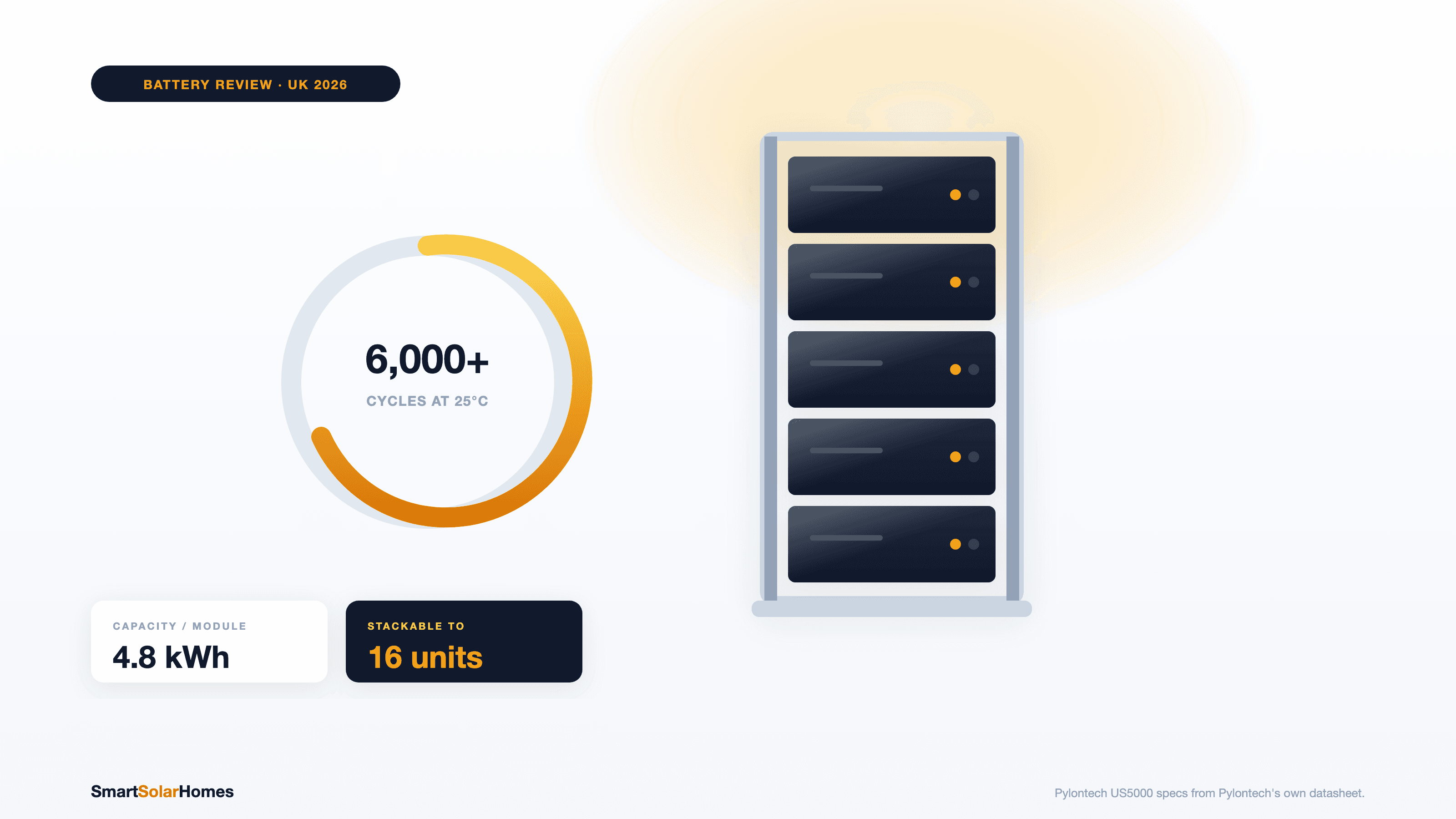
The US5000 is a 4.8kWh nominal LiFePO4 module built around a 48V nominal bus. Per Pylontech's own datasheet, each unit measures 442 x 420 x 161mm and weighs around 40kg, communicates over RS485 or CAN, and is rated for up to 16 units wired in a single string — roughly 76.8kWh nominal capacity for a large stacked installation, though most UK homes use two to four modules. Depth of discharge on this site's own listing for the US5000 is quoted at 95%, giving a usable figure of around 4.5–4.6kWh per module once the manufacturer's own 95%-DoD nominal-to-usable ratio is applied.
- Capacity: 4.8kWh nominal per module, stackable to 16 units in series on a single string
- Chemistry: LiFePO4 (LFP), passively cooled — no fan or active cooling
- Dimensions / weight: 442 x 420 x 161mm, approximately 40kg per module
- Charge/discharge current: 80A recommended, up to 100A max continuous (rated for a cell temperature of 10–40°C; current derates outside that band)
- Operating temperature: 0–50°C charging, -10–50°C discharging; -20–60°C shelf storage
- Protection rating: IP20 — indoor use only, not rated for outdoor or unheated exposed locations
- Communication: RS485 and CAN, for compatibility with third-party hybrid inverter BMS integration
- Cycle life / design life: rated above 6,000 cycles at 25°C, with a 15+ year design life quoted by the manufacturer
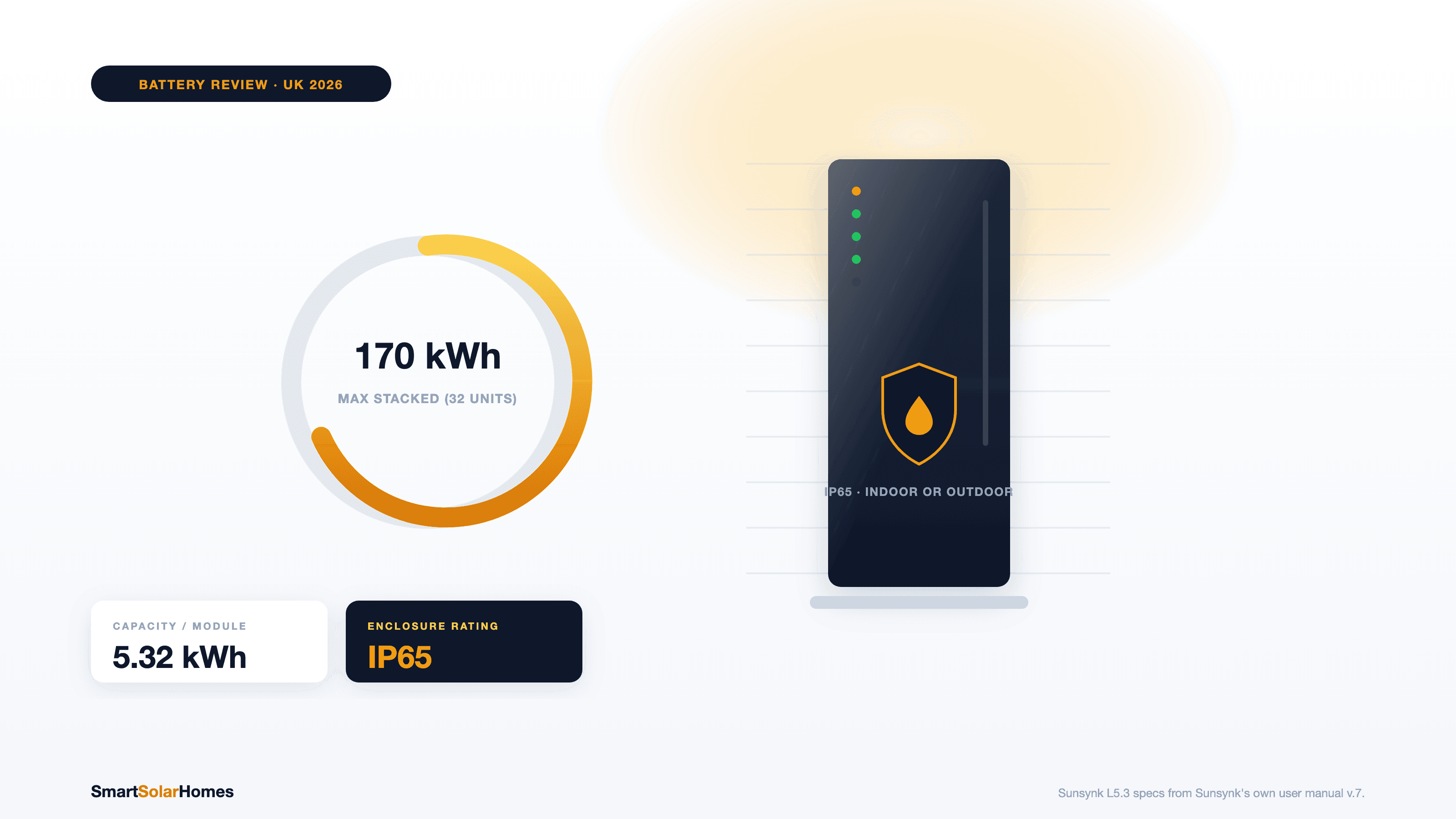
The IP20 rating and passive cooling are the two figures worth planning around: the US5000 needs a dry indoor space with reasonable airflow — a garage or utility room works, but a cold, damp outbuilding or an unventilated cupboard doesn't suit it as well as an IP65-rated module built for outdoor mounting. For how this stackable format compares with sealed all-in-one units when sizing a system, see our battery sizing guide.
Pylontech US5000 price and warranty in the UK
This site's own product catalogue lists the US5000 at £787.58 ex VAT for a single 4.8kWh module, with a 10-year warranty and a 6,000-cycle warranty allowance — both cross-checked directly against the listing rather than an external retailer quote. That price is for the battery cell alone: unlike an all-in-one system, there's no inverter, cabinet or installation included, so a real-world quote depends heavily on how many modules you stack and which hybrid inverter your installer pairs it with. Our home battery installation guide breaks down typical installed costs for third-party-battery-plus-hybrid-inverter setups, including a worked Solis-plus-Pylontech example.
Because the US5000 is a bare module rather than a packaged system, per-kWh cost usually comes out lower than an equivalent capacity from a sealed all-in-one battery — the trade-off is that you're also pricing in the inverter and installer labour separately, rather than as one bundled figure.
The catch: no inverter, and it's an indoor-only module
The US5000 needs a compatible 48V hybrid inverter already specified or installed — it isn't a standalone product. That's a deliberate design choice, not a flaw: it's what lets the same module work across dozens of inverter brands rather than locking you into one ecosystem. But it does mean the true cost of a US5000-based system only becomes clear once the inverter, cabling and installer labour are added on top of the module price above, and it means checking your chosen inverter's compatibility list before ordering rather than assuming any hybrid inverter will pair with it. The IP20 rating is the second constraint: unlike an outdoor-rated unit, the US5000 has to live somewhere dry and ventilated indoors, which can be a real limitation in smaller homes without a garage or utility room. Our hybrid inverter buyer guide covers how to check inverter-battery compatibility before committing to a third-party stack like this one.
Pylontech US5000 vs GivEnergy AIO
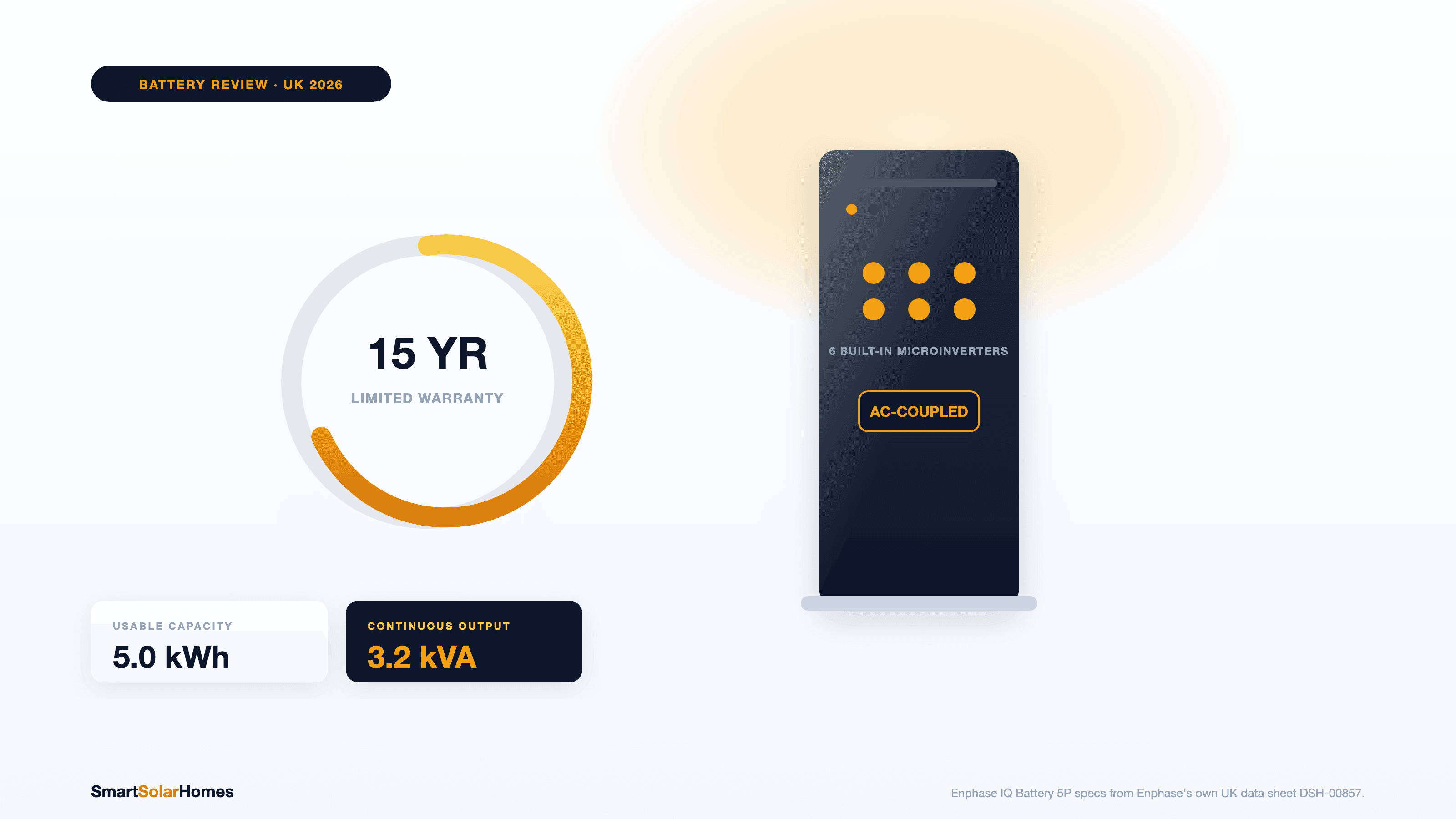
GivEnergy's All in One 13.5kWh bundles a 5kW hybrid inverter and battery into a single AC-coupled box with a 10-year warranty as standard — a simpler one-purchase, one-install decision than sourcing a Pylontech stack and a separate inverter. The US5000's advantage is flexibility and typically lower cost per kWh, particularly if you're already committed to a specific inverter brand that the AIO doesn't offer, or you want to scale capacity up gradually by adding modules later. If a single-vendor, single-warranty package matters more to you than modularity, the AIO is the simpler route; see our full GivEnergy AIO vs Tesla Powerwall 3 comparison for how it stacks up against the other major all-in-one option.
Pylontech US5000 vs Fox ESS EP5 and Powervault
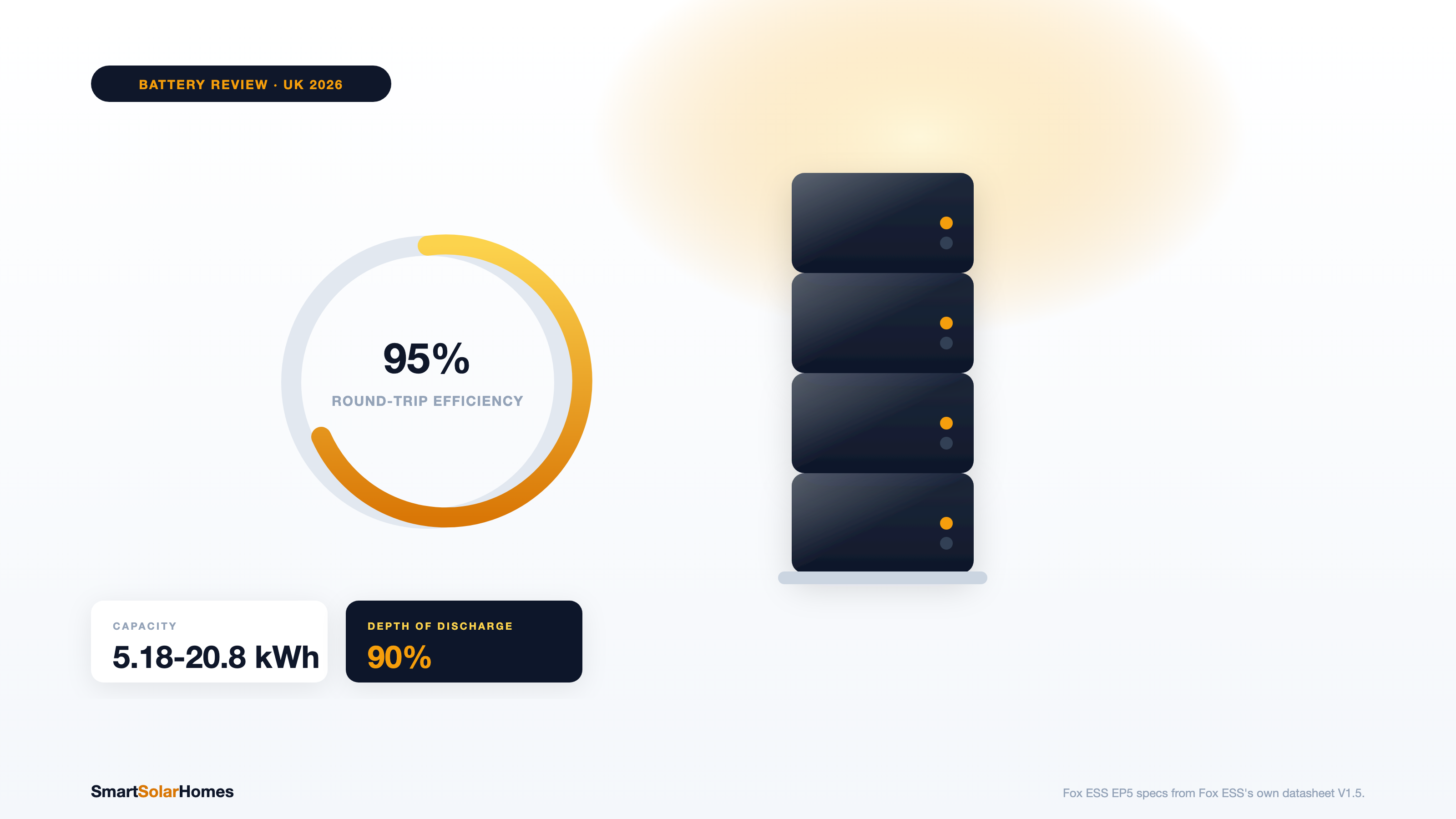
The Fox ESS EP5 is a closer relative — also a stackable, DC-coupled module — but it locks you into Fox ESS's own H1/KH/H3 inverter range, whereas the US5000's whole appeal is working across many inverter brands rather than one. See our full Fox ESS EP5 review for the comparison in more depth. Powervault's PVCompact takes a different approach again: it's AC-coupled and bolts onto an existing solar inverter of any brand without touching it, which suits a retrofit onto a system you don't want to disturb. The US5000 needs the inverter conversation up front, as part of a new install or a hybrid-inverter swap, rather than as an afterthought; our Powervault battery review covers the full PVCompact and P4 range for comparison.
Who the Pylontech US5000 suits
The US5000 is the right pick if your installer is already specifying (or you already own) a compatible third-party hybrid inverter, and you want the lowest cost per kWh without being tied to a single vendor's ecosystem. It's a weaker fit if you want a single-box, single-warranty purchase with nothing else to plan around, or if you don't have a dry, ventilated indoor space to site it. For a broader shortlist across brands and formats, our battery sizing guide and the home battery installation guide both cover where a modular third-party stack like this one fits against sealed all-in-one alternatives.
FAQs
What is the capacity of the Pylontech US5000 battery?
How much does the Pylontech US5000 cost in the UK?
Does the Pylontech US5000 work with any solar inverter?
Can the Pylontech US5000 be installed outdoors?
Is the Pylontech US5000 better than a GivEnergy AIO?
Sources — verified 16 September 2026
- Pylontech, “US2000C/US3000C/US5000/US5000B Residential BESS Datasheet (PY21SDRE01-12-3)” — midsummerenergy.co.uk
- Pylon Technologies Co., Ltd, “US5000 product page” — en.pylontech.com.cn

About the author
Sepehr
Solar specialist & co-founder, Smart Solar Homes
Solar specialist and co-founder of Smart Solar Homes, which works with MCS-certified UK installer partners. I write all the guides and reviews here; the aim is straight-talking education the industry rarely provides.
Citing this page? Please use a dofollow link back to the original article — it helps us keep the data on this page accurate and up to date.
Browse Battery Storage on Smart Solar Homes


Want to compare these side by side? Use the compare tool →
Or browse all Battery Storage on Smart Solar Homes.
Related reading
More on battery storage from the editorial team.
Find installers near you
MCS-certified solar installers covering these areas.