Powervault Battery Review UK: Cost, Specs and Verdict
Written and reviewed by Sepehr. See our editorial policy.
Powervault has been building home batteries in London since 2014, longer than most of the brands that now dominate UK solar-battery conversations. It rarely shows up in the same sentence as Tesla Powerwall or GivEnergy, but it has a genuine track record, a nationwide MCS-accredited installer network, and two current product lines that cover most UK homes. This review works through the PVCompact and P4 ranges — specs, 2026 pricing, warranty terms, and where Powervault fits if you are shortlisting home battery storage.
The Powervault range for UK homes
Powervault currently sells two product families for domestic and small-commercial use: PVCompact and P4. Both share the same lithium iron phosphate (LFP) chemistry and SMARTSTOR smart-tariff software, but they target different property sizes.
PVCompact — the smaller-home option
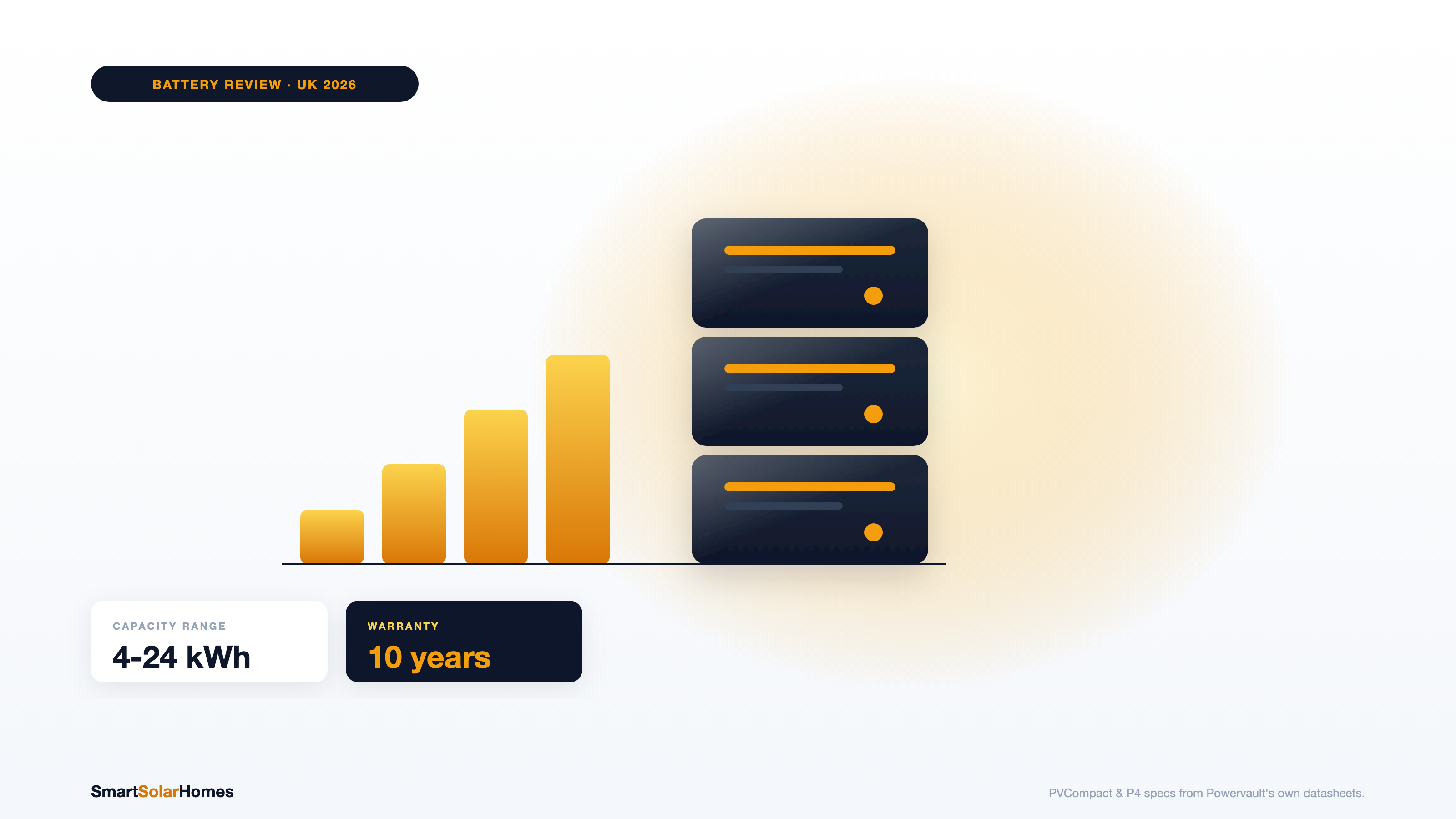
PVCompact is Powervault's most compact unit, launched in 2022 as the first to carry SMARTSTOR technology. It ships in three usable capacities — 4 kWh, 6 kWh and 8 kWh (nominal 4.8, 7.2 and 9.6 kWh) — with a built-in hybrid inverter rated at 3.68 kW AC. It can be specified as AC-coupled (bolts onto an existing solar inverter without touching it) or DC-coupled for a new-build solar-plus-battery install, and it's built to the G98 inverter-compliance standard used for smaller single-phase connections. Weight ranges from 101 kg to 158 kg depending on capacity, and it can be floor-standing or wall-mounted on a load-bearing wall.
P4 — the larger-home and modular option
The P4, launched in 2023, is aimed at bigger households or higher energy demand. It scales across five usable capacities — 8, 12, 16, 20 and 24 kWh (nominal up to 28.8 kWh) — with a larger 6.0 kW AC hybrid inverter and G99 compliance for the higher-capacity connections that threshold requires. Weight climbs with capacity, from 180 kg at the 8 kWh end to 380 kg at 24 kWh, and the larger cases must be both floor and wall mounted. Multiple P4 units can be combined per phase, subject to a site survey, for three-phase or larger installations.
Powervault's product menu also lists a newer P5, described as its first fully-integrated all-in-one solar-and-battery system, upgradeable to 20 kWh. Powervault has not published a full public spec sheet for the P5 at the time of writing, so treat capacity and pricing for that specific model as provisional until you get a written quote.
Key specifications
Both PVCompact and P4 use lithium iron phosphate (LFP) cells, the same chemistry GivEnergy, Alpha ESS and most current-generation batteries use for its stability and long cycle life. Per Powervault's own technical datasheets:
- Chemistry: Lithium-ion, LFP
- Depth of discharge: 100% (usable capacity equals discharge capacity)
- Battery nominal voltage: 48V on both ranges
- Warranty: 10 years or 4,500 discharge cycles, whichever comes first, with the battery guaranteed to retain at least 60% state of health at the end of the warranty period
- Smart control: SMARTSTOR software as standard, scheduling charge/discharge manually or automatically around your tariff
- Connectivity: built-in Ethernet plus Wi-Fi and Powerline options, with a web-based customer portal
A 4,500-cycle, 60%-end-of-warranty guarantee is a fairly typical spec for LFP home batteries in 2026 — see our guide to solar battery lifespan and degradation for how that compares across brands and what it means for real-world daily cycling.
What Powervault costs in 2026
Powervault sells exclusively through its installer network rather than listing fixed retail prices, so costs vary by installer and region. Based on typical 2025–26 UK installer quotes reported by comparison sites, a single-module PVCompact around 4 kWh installed runs approximately £5,700–£6,500, while a stacked P4 system around 12 kWh comes in around £10,500–£11,500 fully installed. Treat these as indicative ranges, not fixed prices — always get a written, itemised quote.
Whatever the final figure, professionally installed battery storage in Great Britain currently qualifies for 0% VAT under HMRC's energy-saving materials relief, which applies until 31 March 2027 before reverting to the standard reduced rate. That applies whether the battery is installed alongside solar panels or retrofitted as a standalone unit, a rule change HMRC confirmed from 1 February 2024.
MCS certification and installation
Powervault batteries are fitted through a nationwide network of MCS-accredited installers rather than being sold direct to homeowners for self-install. MCS accreditation matters for two practical reasons: it's generally a requirement for 0% VAT relief and for Smart Export Guarantee eligibility if you're exporting solar, and since 2025 MCS has published a dedicated battery installation standard (MIS 3012) that sets design and installation requirements specifically for battery energy storage systems, separate from the older solar PV standard. Ask any installer quoting you for a Powervault system to confirm they hold current MCS battery-storage certification, not just an older PV-only certificate.
How Powervault compares
Against Tesla Powerwall 3, Powervault's P4 is the more directly comparable size-for-size rival in the 8–24 kWh range, and its AC-coupled option is a genuine advantage for anyone retrofitting storage onto an existing solar inverter without replacing it — Powerwall 3 effectively wants to be the inverter. Against GivEnergy, which our GivEnergy AIO vs Powerwall 3 comparison covers in more depth, Powervault sits in a similar modular, UK-installer-network category, with Powervault's edge being a longer UK trading history and PVCompact's smaller 4 kWh entry point for flats and smaller homes that GivEnergy's AIO doesn't really address.
Who Powervault actually suits
PVCompact fits smaller homes or flats wanting a modest amount of overnight storage without a large upfront outlay, and its AC-coupled option makes it a straightforward bolt-on for an existing solar array. P4 suits larger households, homes with higher evening demand, or anyone wanting the option to expand capacity over time without swapping out the inverter. If you're comparing brands rather than models, our best home battery storage UK ranking sets Powervault alongside Tesla, GivEnergy, Fox ESS and others on the same criteria.
FAQs
How much does a Powervault battery cost installed in the UK?
What is the difference between Powervault PVCompact and P4?
Is Powervault MCS certified?
What warranty does a Powervault battery come with?
Can I add a Powervault battery to my existing solar panels?
Sources — verified 12 September 2026
- Powervault Ltd, “PVCompact Technical Specs (Edition 04/2024)” — www.powervault.co.uk
- Powervault Ltd, “Powervault P4 Technical Specs (Edition 04/2024)” — www.powervault.co.uk
- Powervault, “Our Story — product generation history” — powervault.co.uk
- HMRC, “VAT relief on energy-saving materials — VAT Notice 708/6” — www.gov.uk
- MCS, “Battery Storage — the MCS Battery Installation Standard (MIS 3012)” — mcscertified.com
- Heatable, “Powervault 3 Solar Battery UK: Cost, Specs & Is It Worth It?” — heatable.co.uk

About the author
Sepehr
Solar specialist & co-founder, Smart Solar Homes
Solar specialist and co-founder of Smart Solar Homes, which works with MCS-certified UK installer partners. I write all the guides and reviews here; the aim is straight-talking education the industry rarely provides.
Citing this page? Please use a dofollow link back to the original article — it helps us keep the data on this page accurate and up to date.
Browse Battery Storage on Smart Solar Homes


Want to compare these side by side? Use the compare tool →
Or browse all Battery Storage on Smart Solar Homes.
Related reading
More on battery storage from the editorial team.
Find installers near you
MCS-certified solar installers covering these areas.