Solar Homes Could Save £201m With Batteries, Says E.ON
Written and reviewed by Sepehr. See our editorial policy.
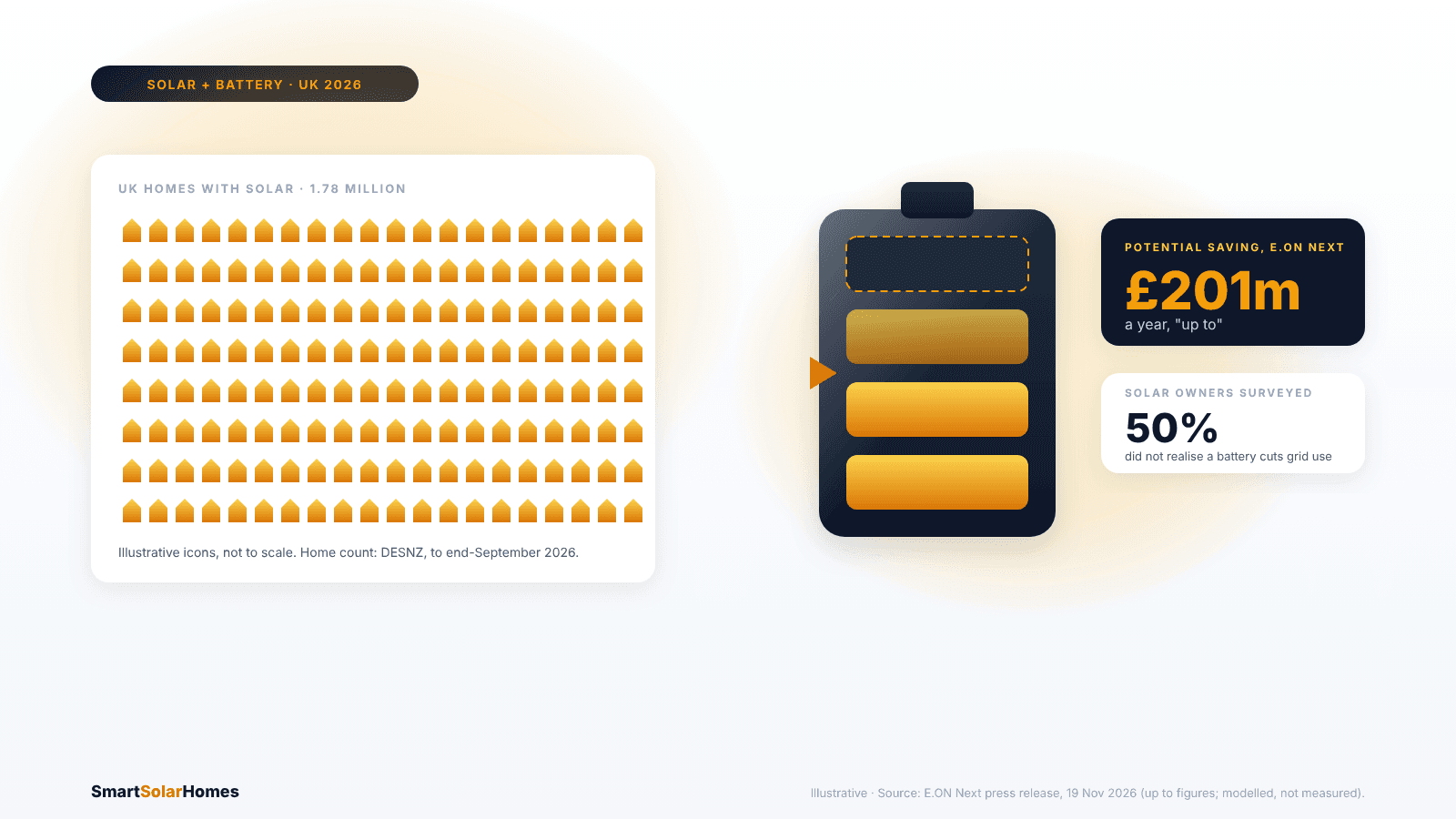
E.ON Next says the 1.78 million UK homes with solar panels could collectively save up to £201 million a year on electricity bills by adding a home battery. The claim comes from a press release published on 19 November 2026 and a survey suggesting many solar owners do not understand what a battery does. Here is what the solar homes battery savings analysis actually assumes, what the survey found, and how to read an “up to” figure from a supplier that sells the product.
What E.ON Next announced
The headline is an estimate, not a measurement. In its “Missing Millions” release, E.ON Next puts the combined potential saving at up to £201 million a year. It also says that pairing a battery with its Next Optimise tariff could add up to £452 a year for a typical solar and battery customer. The home count of 1.78 million comes from DESNZ’s solar photovoltaics deployment statistics, published on 29 October 2026 and covering installations up to the end of September 2026.
Dividing £201 million by 1.78 million homes gives roughly £113 per home per year. That is our arithmetic, not a figure E.ON states, and it is a useful reality check: the £452 tariff example is a different, much more optimistic scenario.
How E.ON calculated the £201 million
The footnotes matter more than the headline. E.ON’s own notes say the £201 million assumes:
- annual household consumption of 4,000 kWh;
- the UK-average 4.0 kWp solar array generating 3,400 kWh a year;
- where applicable, a 5.1 kWh battery (4.6 kWh usable), run either for solar self-consumption or in an optimised mode;
- an import rate of 26.32p/kWh, the Ofgem price cap from 1 October 2026 with 0% VAT on electricity;
- export payments of 13.0p/kWh under the Smart Export Guarantee, or Next Optimise pricing for 2025.
E.ON adds that geographical and eligibility restrictions apply. A typical home that does not match these assumptions will land above or below the average. Our solar panel cost and savings guide explains why self-consumption varies so much between households.
The £452 Next Optimise example
This is one specific house, not a typical one. E.ON’s second footnote describes a 2025 East Midlands property using 4,000 kWh a year and occupied all day. It has a 12-panel array generating 4,950 kWh a year and a Sunsynk Elite battery with 10.2 kWh of capacity, running on Next Optimise at all times. The pricing includes a 3p early-bird booster and 0% VAT, and the comparison is against a standard tariff with a 25.36p/kWh import rate, a 51.45p/day standing charge and 13p/kWh export payments under E.ON Next Export Exclusive v3.
That is a bigger-than-average array, a bigger-than-average battery and a home that is always in. E.ON itself says results vary with energy prices, solar output, system set-up, other technologies such as EVs or heat pumps, consumption and how the tariff is used. For how the tariff works, see our E.ON Next Optimise explainer.
What the survey found
Half of solar owners may not understand what a battery does. E.ON commissioned 3GEM to survey 500 solar panel owners between 6 and 11 November 2026. The results, as reported in the release:
- 50% did not realise a battery could reduce how much electricity they buy from the grid;
- 40% did not know a battery could store excess energy for later use;
- 19% did not realise a battery could help reduce their bills;
- 36% said knowing how much they could save would encourage them to install one;
- 20% did not know how solar panels, batteries and dynamic tariffs work together;
- 31% did not realise smart tariffs can let a battery import and export automatically based on market prices.
It is a small sample commissioned by a supplier that sells batteries and tariffs, so treat it as a pointer rather than a national statistic. Julian Lennertz, E.ON Next’s Chief Commercial Officer, compares a battery to a household freezer that stores spare solar power until it is needed.
Should you add a battery?
The saving depends on what your solar currently does. A battery earns its keep by moving solar generated at midday into the evening, so it matters most if you are out during the day and your export rate is well below what you pay to import. In E.ON’s own assumptions the gap is 13.0p to export against 26.32p to import. If you are home all day and already use most of your solar, the gain is smaller.
Before relying on any “up to” figure, check three things: your annual consumption, your solar generation, and whether your installer quotes a payback on your own numbers. Our home battery storage guide covers sizing and costs, and SEG best rates will show whether a better export tariff closes part of the gap without a battery. Demand is rising regardless: see how MCS battery installs nearly doubled in 2026, and E.ON’s own Battery Boost free battery scheme for homes without solar.
Our take
Useful direction, thin evidence. The release is right that a battery lets you use more of your own solar, and the published assumptions are more transparent than many supplier claims. But the £201 million is a modelled ceiling built on one average house, and the £452 is a best-case example. Use them to decide whether to get a quote, not to predict your own bill. The release also quotes a £650 million figure for additional savings across the UK without a clear breakdown, so we have not relied on it.
FAQs
How much could UK solar homes save with a battery?
What is the E.ON Next Optimise £452 saving?
Is a home battery worth it with solar panels?
Sources — verified 26 November 2026
- E.ON Next, “Missing Millions: UK solar households could be missing out on £201m in savings every year (19 November 2026)” — news.eonenergy.com
- GOV.UK (DESNZ), “Solar photovoltaics deployment statistics” — www.gov.uk
- Ofgem, “Energy price cap” — www.ofgem.gov.uk
- Ofgem, “Smart Export Guarantee (SEG)” — www.ofgem.gov.uk

About the author
Sepehr
Solar specialist & co-founder, Smart Solar Homes
Solar specialist and co-founder of Smart Solar Homes, which works with MCS-certified UK installer partners. I write all the guides and reviews here; the aim is straight-talking education the industry rarely provides.
Citing this page? Please use a dofollow link back to the original article — it helps us keep the data on this page accurate and up to date.
Browse Battery Storage on Smart Solar Homes


Want to compare these side by side? Use the compare tool →
Or browse all Battery Storage on Smart Solar Homes.
Related reading
More on battery storage from the editorial team.
Find installers near you
MCS-certified solar installers covering these areas.