Tariff Interoperability: Suppliers' Tariff API in 2027
Written and reviewed by Sepehr. See our editorial policy.
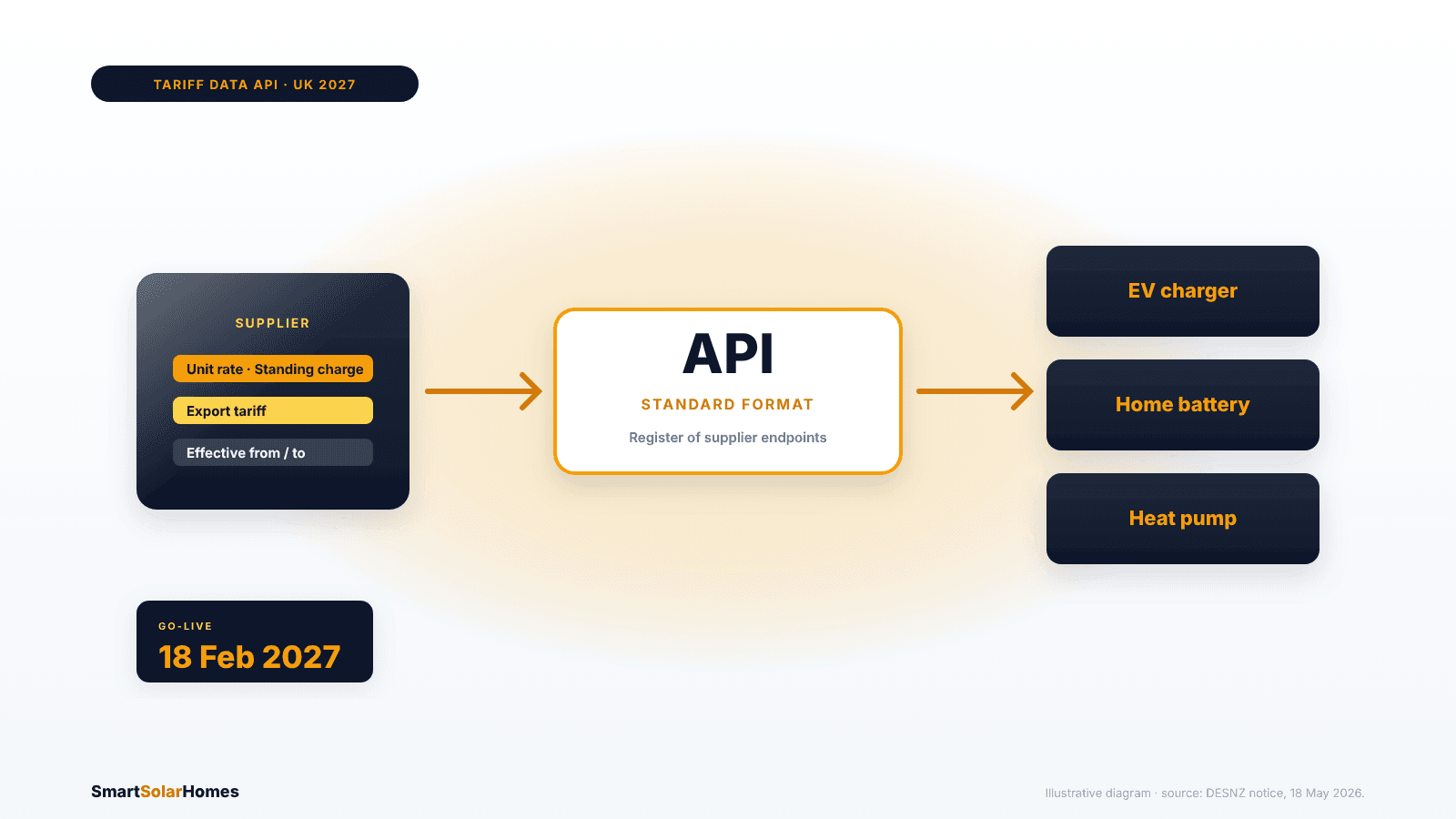
From 18 February 2027, UK electricity suppliers must make their tariff prices and export rates available to approved third parties through a standard API, under “tariff interoperability” rules the government made in May 2026. In plain terms, an EV charger, home battery or heat pump app should be able to look up your supplier’s current rates automatically instead of relying on you typing them in. This explainer sets out what the rules say, what they do not say, and what solar and battery owners should expect. It is based on the Department for Energy Security and Net Zero (DESNZ) notice of modification published on 18 May 2026.
What is tariff interoperability?
Tariff interoperability is the first phase of the government’s Smart Secure Electricity Systems programme work on tariff data. DESNZ says it aims to help energy smart appliances respond automatically to price signals, with domestic EV charge points and heat pumps given as examples. The Secretary of State used powers under section 245 of the Energy Act 2023 to change two documents: the Electricity Supply Standard Licence Conditions and the Retail Energy Code (REC). The notice is dated 13 May 2026, follows a consultation response published on 11 May 2026, and the changes took effect on 18 May 2026.
What must suppliers publish?
A new licence condition (11C) requires electricity suppliers to make information about their charges for the supply of electricity – excluding charges for the electricity meter – and their export tariffs available in line with the REC requirements. The notice defines an export tariff broadly: payments or charges relating to generation or export at a customer’s premises, including the unit price paid for exported electricity. That matters for anyone paid under the Smart Export Guarantee.
The data is shared in a standard format and must be complete, accurate and up to date. Prices can carry “effective from” and “effective to” dates, and when prices change the new data must be available at least 60 minutes before the change takes effect. A free-text “tariff comments” field is meant to flag extras that affect the overall cost, such as pass-through costs or incentives.
When does it start?
- 18 May 2026: the licence and REC changes took effect, with suppliers developing and testing their APIs.
- 31 December 2026: each supplier must give the Retail Energy Code Company (RECCo) the web address of its API, or a later date if the Secretary of State designates one.
- 18 February 2027: the go-live date for the core duties, or a later date the Secretary of State designates.
Because the go-live date can be pushed back, treat 18 February 2027 as the planned date rather than a guarantee.
How will the data be accessed?
RECCo will keep a public register of each supplier’s endpoint, with contact details. Anyone wanting the data – the notice calls them a “tariff interoperability user” – looks up the supplier in the register, requests a list of that supplier’s tariff identifiers, then requests the pricing data for a specific tariff. The REC also sets performance standards: suppliers must make the data available 99.9% of the time in each calendar month, cope with at least 1,000 requests a second (5,000 at peak) and answer 95% of requests within one second at normal volumes. Access can be suspended for security reasons or if request limits are hit.
The notice also says the arrangements cover consumer consent, data protection and security, but the details sit in separate REC requirements and the technical specification, which we have not reviewed.
What it means for solar, battery and EV owners
Nothing changes on your bill. The rules sit between suppliers and the companies building apps and devices. If manufacturers and app developers use the data, you could see smarter setups: a home battery that charges when a time-of-use tariff is cheapest, or a charger that adapts when your rates change. Whether any particular product does so is up to its maker.
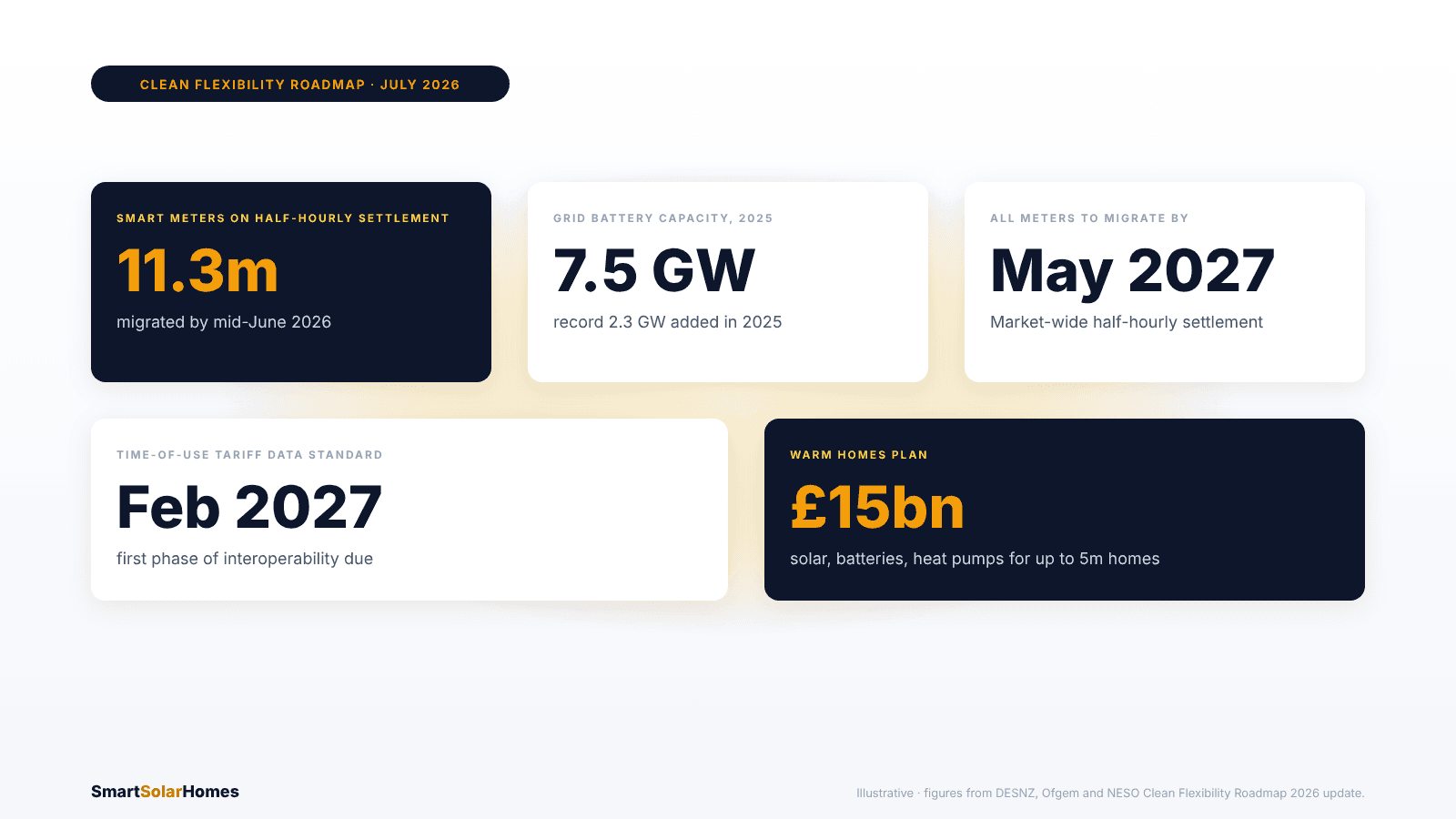
It also fits a wider push towards flexibility. Our explainer on the Clean Flexibility Roadmap 2026 update covers the surrounding policy, and our guide to Octopus tariffs for solar owners shows the kind of time-varying tariffs the data could describe.
What the rules do not do
- No accuracy check: RECCo monitoring covers compliance with the technical and performance rules, and the notice says it does not measure the accuracy of the data shared.
- Not every tariff: tariffs whose unit rate or standing charge varies with how much electricity you use, and unmetered supplies, are not required to be shared.
- Gas is optional: gas suppliers can opt in but are not required to.
- No guarantee your device uses it: the duty is on suppliers, not on device makers.
FAQs
What is tariff interoperability in the UK?
When does tariff interoperability start?
Will tariff interoperability change my energy bill?
Does tariff interoperability include export tariffs like the SEG?
Sources — verified 25 November 2026
- DESNZ, “Notice of modification of the Electricity Supply Standard Licence Conditions and the Retail Energy Code (tariff interoperability), May 2026” — assets.publishing.service.gov.uk
- GOV.UK (DESNZ), “Smart secure electricity systems (SSES): tariff interoperability code and licence modifications” — www.gov.uk

About the author
Sepehr
Solar specialist & co-founder, Smart Solar Homes
Solar specialist and co-founder of Smart Solar Homes, which works with MCS-certified UK installer partners. I write all the guides and reviews here; the aim is straight-talking education the industry rarely provides.
Citing this page? Please use a dofollow link back to the original article — it helps us keep the data on this page accurate and up to date.
Browse Battery Storage on Smart Solar Homes


Want to compare these side by side? Use the compare tool →
Or browse all Battery Storage on Smart Solar Homes.
Related reading
More on battery storage from the editorial team.
Find installers near you
MCS-certified solar installers covering these areas.